
Middle of its segment, modest efficiency
The AURORA ME-132BD series consists of double-glass, bifacial photovoltaic modules built for installations expected to perform reliably for decades without significant power loss. The use of half-cut cells reduces resistive losses and improves module behavior under partial shading, which translates into meaningfully higher energy yield in demanding site conditions. The defining feature of this series, however, is its bifacial double-glass construction - glass instead of a rear backsheet allows the module to capture light reflected off the ground, boosting total energy output without increasing the installation footprint. The panels also stand out for their high environmental resistance, including resistance to salt mist corrosion, ammonia, sand and dust, and potential induced degradation (PID), making them a strong fit for industrial, agricultural, and coastal installations. The glass-glass structure additionally gives the modules greater mechanical rigidity and better resistance to physical damage compared to conventional backsheet panels. The manufacturer backs the series with a long-term warranty extending up to 30 years, supporting a lower LCOE over the system's full lifecycle. This makes the series a strong fit primarily for commercial and industrial investors who prioritize yield stability and low failure rates over the lowest upfront price.
Ranking
Signals from the data
Commercial, utility-scale and shaded-installations.
Tight roof space and roofs where every square metre has to count.
Bottom 5% of the PERC 600-650 W segment, against a median of 21.38%. Ranked 11,136th in the whole database.
Bottom 5% of the PERC 600-650 W segment, against a median of 213.8. Ranked 11,137th in the whole database.
Glass instead of a rear backsheet allows the module to capture light reflected off the ground, increasing total energy yield without expanding the installation footprint, while also improving mechanical stiffness and resistance to microcracks compared to standard glass-backsheet panels.
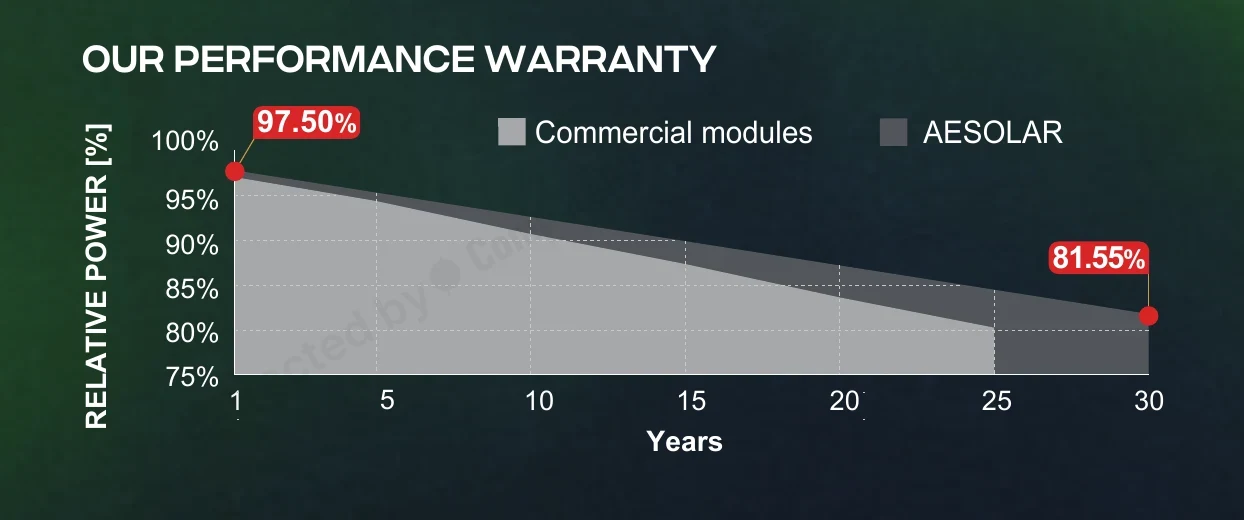
The manufacturer guarantees power retention above 87% of nominal output after 30 years, exceeding the segment's typical standard (25 years / ~84.8%) and materially lowering LCOE across the installation's lifecycle.
Half-cut cell technology reduces resistive losses and improves module behavior under partial shading, translating into higher energy yield in challenging locations, such as sites with nearby structures or vegetation casting shade.
AE Solar (Germany, founded 2003) has achieved 16 consecutive quarters on the BNEF Tier 1 list, confirming the series' bankability and access to project financing for commercial and industrial installations.
The modules are certified against salt-mist corrosion, ammonia, sand, and PID, and the glass-glass construction achieves a Class A fire rating and Class 4 hail resistance, making the series well suited for coastal and agrivoltaic installations.
At 20.63-21.27%, efficiency is notably lower than comparable peer modules (LONGi Hi-MO 9: 24.4%, Canadian Solar TOPBiHiKu6: 24.4%, PolyCrown Monocrystalline120: 23.32%), reflecting the use of older PERC cell technology rather than the N-type TOPCon/HJT cells now dominant in the 640-660 Wp segment.
The 15-year product (material/workmanship) warranty is half the length of the stated 30-year power warranty, meaning that after 15 years any material or build-quality defects are no longer covered, even though the performance guarantee remains in effect.
- Efficiency of 20.6% is 0.8pp below the PERC 600-650W median (21.4%)
- 206.3 W/m² power density is 7.5 W/m² below PERC 600-650W median (213.8 W/m²) - requires larger installation area
- At -0.34%/°C, hot weather performance is typical for PERC 600-650W panels
- At 37.0 kg (3.0 kg above PERC 600-650W median of 34.0 kg), requires checking roof load capacity
- Bifacial design (70% factor) captures reflected light - adds 4-10% yield on ground-mount or white roof
Specifications
Datasheet charts
Measured curves published by AE Solar in this model's datasheet. A chart carrying a wattage was measured on that variant alone - only the ones that describe 640 Wp appear here. The rest cover the whole series.
Simulations
Degradation from this panel's own datasheet figures. No inverter, soiling or shading losses.
Model: bifaciality × albedo × 0.6 view factor. A first-order estimate, not a yield simulation.






Found 1393 panels of the same or similar size to this one, within ±10 mm. See them here Found 1403 panels of the same or similar size to this one, within ±25 mm. See them here Found 1403 panels of the same or similar size to this one, within ±50 mm. See them here Found 1435 panels of the same or similar size to this one, within ±100 mm. See them here
About the AURORA ME-132BD series
These answers cover the whole series. Where a figure differs, the specification above is this module's own.