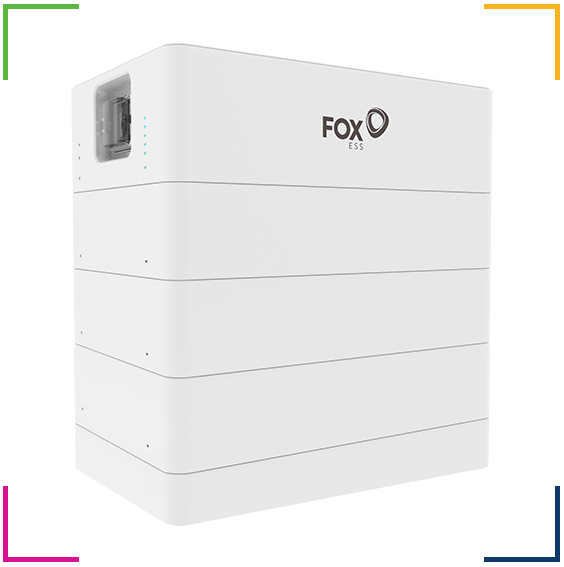

FoxESS ECS2900-H6
The FoxESS ECS series (ECS2900-H2/H3/H4/H5/H6/H7) is a high-voltage, modular energy storage system where capacity increases by adding subsequent segments in a single tower. This architecture simplifies the design of installations - from a single-family home to a larger facility - and allows for system expansion when energy consumption genuinely increases or you plan to add PV.
The applied chemistry, LFP (LiFePO4), prioritizes safety and operational stability, along with excellent resistance to intensive cyclic charging and discharging. In practice, this translates to a long service life. The declared number of cycles and 10-year warranty ensure predictable costs and a lower risk of the storage unit's utility declining over time.
The system is scalable up to 7 modules in series. The plug-and-play installation type speeds up both installation and service. The ECS works with hybrid FoxESS inverters and is a good option for prosumers, companies, and systems with backup power and semi-off-grid operation.
Ranking
Specifications
Pros and cons
LiFePO4 cells are reported to have a lifespan of ≥6,000 full cycles under 90% DoD and 0.5C conditions at 25°C (V3.7 datasheet, 2024). In comparison, NMC/NCA batteries used by some competitors typically achieve 3,000-4,500 cycles under similar conditions, which translates to a significantly longer and more reliable lifespan for the battery.
The 1-module master (CM2900) system, combined with up to 6 slave modules (CS2900), allows for the creation of a system with a capacity ranging from 5.76 kWh (H2) to 20.16 kWh (H7) without the need to replace the BMS controller. This enables cost-effective expansion over time, and the six pre-configured H2-H7 options cover both typical prosumer installations (~10 kWh) and larger facilities.
FoxESS guarantees a minimum of 70% of its nominal capacity is maintained for 10 years from installation (or 12 years in certain regions, according to warranty policy v2.6, December 2025). The clearly defined retention threshold and the long warranty period reduce investment risk and simplify the calculation of TCO (Total Cost of Ownership).
The modules are mechanically and electrically connected in a plug-and-play manner, which reduces installation and maintenance time. The high-voltage system (~52 V per module in series) allows for lower operating currents (up to 50 A continuous, peak of 65 A for 30 seconds) while maintaining the same power, thereby reducing resistive losses in the wiring.
FoxESS is listed as a bankable manufacturer by Bloomberg NEF, which makes it easier for banks and funds to finance projects and confirms the stability and continuity of service support provided by the company. Despite its relatively short period of operation (founded in 2019), the company has quickly obtained certifications and achieved a production scale comparable to established suppliers.
The ECS2900-H is designed to work exclusively with FoxESS hybrid inverters (e.g., H3, AIO series). The lack of a standard communication protocol prevents integration with popular inverters from SMA, Fronius, Huawei SUN2000, SolarEdge, or Victron. In the event of inverter failure or a desire to switch inverter brands, the entire system becomes unusable without replacing it with FoxESS equipment.
Modules in versions V1 and V2 cannot be mixed in a single system, and modules with different capacities (e.g., ECS2900 and ECS4100) also cannot function simultaneously. This means that expanding the system with newer-generation modules requires replacing the entire tower, rather than simply purchasing individual modules.
Alternatives






About the ECS Series (ECS2900-H2/H3/H4/H5/H6/H7) series
These answers cover the whole series. Where a figure differs, the specification above is this model's own.