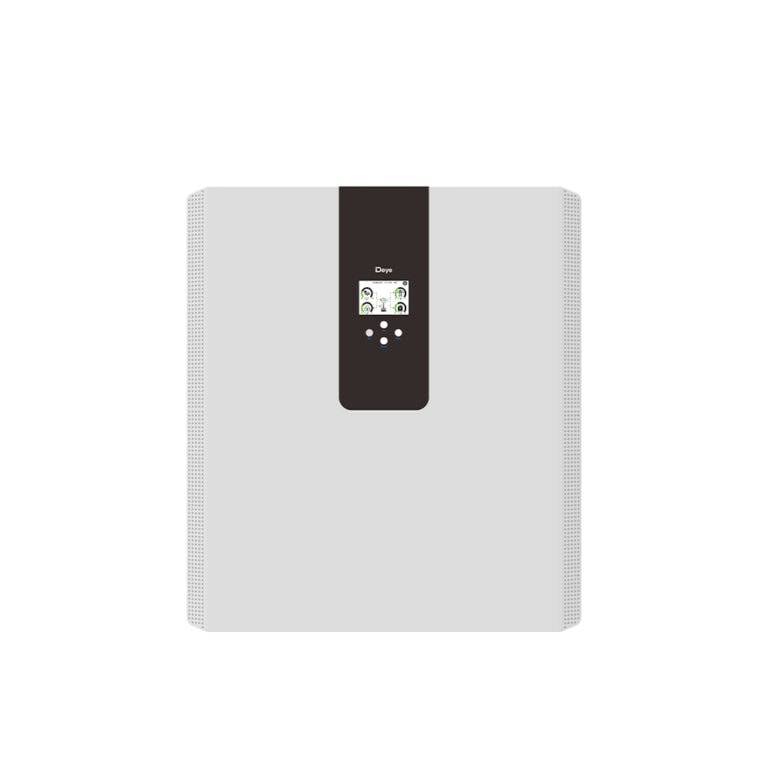

Deye RW-F5.3-2H3
The Deye RW-F5.3 series is a low-voltage all-in-one energy storage system, where a hybrid inverter and battery are integrated into a single unit. This simplifies the installation design, shortens the mounting process, and facilitates future maintenance. The key advantage is the LiFePO4 (LFP) chemistry - compared to NMC, it offers superior thermal safety, more stable operation, and longer lifespan. This translates to practical benefits with daily charging and discharging from PV sources.
The system utilizes an intelligent BMS, and rapid switching to backup power supply allows better protection for sensitive devices in homes or small businesses. In practice, the high cycle count and warranty guarantee years of trouble-free operation - with no noticeable loss of utility in typical self-consumption scenarios.
The RW-F5.3 is also scalable - you can expand the installation with additional units, adjusting the capacity to match growing needs. This solution is suitable for hybrid systems, working with PV and providing backup or support for off-grid installations.
Ranking
Specifications
Pros and cons
The hybrid inverter (3.6 kW or 5 kW, depending on the model) and the 5.32 kWh battery are housed in a single, wall-mounted enclosure with an IP65 rating, which allows for outdoor installation. Compared to modular solutions (e.g., BYD B-Box + external inverter), it eliminates the need for additional DC wiring between components and reduces installation time.
LiFePO4 cells guarantee at least 6,000 full charge/discharge cycles - corresponding to over 16 years of operation under daily solar power generation. For comparison, older generation NMC batteries (e.g., LG Chem RESU 6.5) typically offer 3,000-4,000 cycles, while LFP chemistry eliminates the risk of exothermic runaway reactions that are characteristic of NMC.
The switchover time to backup power is 4 ms, which meets the requirements for protecting sensitive equipment with pulse inverters (UPS tolerance: <20 ms). This value is better than typical ATS switches (20-100 ms) and comparable to SMA Sunny Boy Storage 3.7 (approximately 6 ms, according to product specifications).
Independent tests conducted by Basenpower (2024) showed that the Deye inverter achieved a charging efficiency of 97.5% and a discharging efficiency of 96.8%, resulting in an overall round-trip efficiency of approximately 94.3% - a value comparable to that of the SolarEdge Home Hub (94.5% DC-coupled) and significantly higher than typical AC-coupled ESS (~89-91%).
Simultaneous connection to 16 RW-F5.3 units provides a total of 80 kW of inverter capacity and 84.8 kWh of storage capacity without replacing the inverter. This is a key option for installations planning to add 7.4 kW EV chargers or air conditioning, and it allows starting with a single 5.32 kWh unit.
The RW-F5.3-2H3 model has a maximum AC output of 3.6 kW, which is insufficient for households with heat pumps (peak power consumption of 5-8 kW) or 7.4 kW EV chargers. The 1H3 variant (5 kW) partially addresses this issue, but it still falls below the required threshold for installations with a combined load exceeding 5 kW, which would necessitate connecting two units in parallel.
Alternatives


About the RW-F5.3 (Low Voltage All-in-one Energy Storage System) series
These answers cover the whole series. Where a figure differs, the specification above is this model's own.