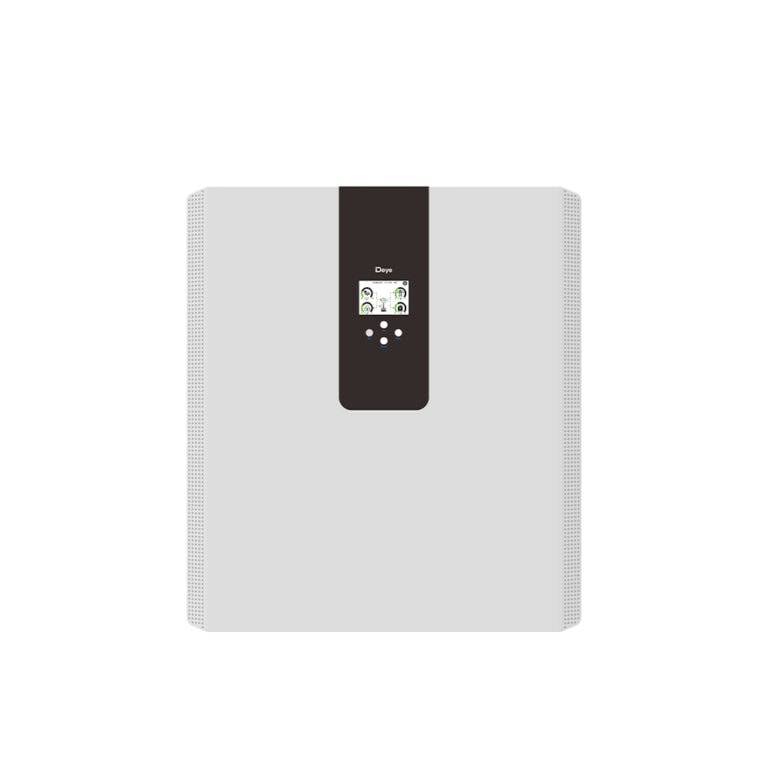

Deye RW-F5.3-1H3

Deye RW-F5.3-1H3

5.32 kWh usable LFP Low voltage Built-in inverter Outdoor-rated
Compare with closest alternative Datasheet PDF
Usable (kWh)
5.32
Strong · top 11%
Round-trip (%)
-
Not published
Power (kW)
-
Not published
Cycles
6000
Typical · median 6000
Weight (kg)
71.0
Weak · 19.8 kg above median
Warranty (yrs)
10
Typical · median 10 yrs

The Deye RW-F5.3 series is a low-voltage all-in-one energy storage system, where a hybrid inverter and battery are integrated into a single unit. This simplifies the installation design, shortens the mounting process, and facilitates future maintenance. The key advantage is the LiFePO4 (LFP) chemistry - compared to NMC, it offers superior thermal safety, more stable operation, and longer lifespan. This translates to practical benefits with daily charging and discharging from PV sources.

The system utilizes an intelligent BMS, and rapid switching to backup power supply allows better protection for sensitive devices in homes or small businesses. In practice, the high cycle count and warranty guarantee years of trouble-free operation - with no noticeable loss of utility in typical self-consumption scenarios.

The RW-F5.3 is also scalable - you can expand the installation with additional units, adjusting the capacity to match growing needs. This solution is suitable for hybrid systems, working with PV and providing backup or support for off-grid installations.

Ranking

27 batteries up to 6 kWh
Metric This battery Median Position in class Rank in class
Round-trip efficiency - 95.0% Not published -
Power per kWh - 0.98 Not published -
Cycle life 6000 6000 Typical 2
Weight per kWh 13.3 11.1 Weak · bottom 12% 23
Warranty 10 yrs 10 yrs Typical 1
Colour key Strong - top 25% Typical - middle 50% Weak - bottom 25%

See 44 Deye offers

Specifications

Open datasheet PDF
Usable energy 5.32 kWh What the battery delivers, full to empty
Nominal energy 5.32 kWh What the cells hold
Module energy 5.32 kWh
Max system capacity 85.1 kWh
Units in parallel 16
Peak discharge power 10.00 kW For 10 s
Max discharge current 100 A
Max charge current 100 A
Cycle life 6000 cycles
Capacity at end of life 70 %
Voltage class Low voltage
Nominal voltage 51.2 V
Operating voltage 45 to 58 V
Cell technology LFP LiFePO4
Cell management Cobalt-freeThermal management
Phases Single-phase
MPPT trackers 2
Dimensions 690 × 616 × 191 mm Height × width × depth
Weight 71.0 kg 13.3 kg per kWh
Enclosure IP65
Mounting wall
Outdoor installation Yes
Cooling passive
Noise 30 dB
Operating temperature -40 to 60 °C
Protocols WiFiGPRS (cloud/app monitoring)
Warranty 10 years
Certifications IEC/EN 61000-6-1IEC/EN 61000-6-2IEC/EN 61000-6-3IEC/EN 61000-6-4IEC/EN 62109-1IEC/EN 62109-2IEC 61727IEC 62116CEI 0-21EN 50549NRS 097RD 140UNE 217002OVE-Richtlinie R25G99VDE-AR-N 4105

Pros and cons

5 positive · 1 caution
What owners get
All-in-one IP65 architecture

The hybrid inverter (3.6 kW or 5 kW, depending on the model) and the 5.32 kWh battery are housed in a single, wall-mounted enclosure with an IP65 rating, which allows for outdoor installation. Compared to modular solutions (e.g., BYD B-Box + external inverter), it eliminates the need for additional DC wiring between components and reduces installation time.

LFP: minimum 6,000 cycles

LiFePO4 cells guarantee at least 6,000 full charge/discharge cycles - corresponding to over 16 years of operation under daily solar power generation. For comparison, older generation NMC batteries (e.g., LG Chem RESU 6.5) typically offer 3,000-4,000 cycles, while LFP chemistry eliminates the risk of exothermic runaway reactions that are characteristic of NMC.

Emergency switchover time: 4 ms

The switchover time to backup power is 4 ms, which meets the requirements for protecting sensitive equipment with pulse inverters (UPS tolerance: <20 ms). This value is better than typical ATS switches (20-100 ms) and comparable to SMA Sunny Boy Storage 3.7 (approximately 6 ms, according to product specifications).

Round-trip efficiency ~94.3%

Independent tests conducted by Basenpower (2024) showed that the Deye inverter achieved a charging efficiency of 97.5% and a discharging efficiency of 96.8%, resulting in an overall round-trip efficiency of approximately 94.3% - a value comparable to that of the SolarEdge Home Hub (94.5% DC-coupled) and significantly higher than typical AC-coupled ESS (~89-91%).

Scalable up to 84.8 kWh

Simultaneous connection to 16 RW-F5.3 units provides a total of 80 kW of inverter capacity and 84.8 kWh of storage capacity without replacing the inverter. This is a key option for installations planning to add 7.4 kW EV chargers or air conditioning, and it allows starting with a single 5.32 kWh unit.

Trade-offs
3.6 kW inverter in the 2H3 variant

The RW-F5.3-2H3 model has a maximum AC output of 3.6 kW, which is insufficient for households with heat pumps (peak power consumption of 5-8 kW) or 7.4 kW EV chargers. The 1H3 variant (5 kW) partially addresses this issue, but it still falls below the required threshold for installations with a combined load exceeding 5 kW, which would necessitate connecting two units in parallel.

Alternatives

All Deye batteries
Battery Usable Round-trip Power Voltage Difference
Deye RW-F5.3-1H3 5.32 kWh - - Low voltage You are here
RW-F5.3-2H3 5.32 kWh - - LV Similar on paper
SE-G5.1 Pro-B (EU, NA, AU) 5.12 kWh - 5.1 kW LV -0.2 kWh
RW-L5.1 5.12 kWh - 5.0 kW LV -0.2 kWh
SE-G 5.1 5.12 kWh - 2.5 kW LV -0.2 kWh
RW-M6.1-B 5.53 kWh - 5.1 kW LV +0.2 kWh
RW-M6.1 5.53 kWh - 5.1 kW LV +0.2 kWh
LUX-E-48100LG03 4.86 kWh - - LV -0.5 kWh
DL5.0C 4.61 kWh 90.0% 2.6 kW LV -0.7 kWh

About the RW-F5.3 (Low Voltage All-in-one Energy Storage System) series

6 answered

These answers cover the whole series. Where a figure differs, the specification above is this model's own.

What is the warranty on the Deye RW-F5.3 energy storage system, and how many charge/discharge cycles can the battery withstand?
The Deye RW-F5.3 comes with a 10-year manufacturer's warranty. The LiFePO4 battery can withstand at least 6,000 charge and discharge cycles while maintaining a minimum of 70% of its original capacity. This means that with a single daily cycle, the battery's lifespan exceeds 16 years, which is a significant advantage over NMC chemistry used in more affordable solutions.
How quickly does the Deye RW-F5.3 switch to backup power in the event of a power outage?
The RW-F5.3 system switches to backup power in just 4 milliseconds. This is sufficient to protect sensitive electronic devices, such as computers, NAS devices, and medical equipment, which cannot tolerate even brief interruptions in power. The switchover is automatic, requiring no manual intervention.
How many Deye RW-F5.3 units can be connected to increase the storage capacity?
The RW-F5.3 series can be expanded by connecting up to 16 units in parallel, providing a total storage capacity exceeding 84 kWh and inverter power up to 80 kW. Furthermore, it can be expanded with external Deye low-voltage batteries, reaching even over 160 kWh. Scalability is a key advantage when the energy needs of a household or small business are growing.
What differentiates the Deye RW-F5.3 from a standard hybrid inverter plus separate battery system?
RW-F5.3 combines a hybrid inverter and a LiFePO4 battery in a single, all-in-one wall-mounted enclosure. This eliminates the need for separate wiring between the inverter and the battery, reduces installation time, and simplifies future maintenance. A single manufacturer is responsible for the entire system, which makes troubleshooting and obtaining warranty support easier.
Is the Deye RW-F5.3 suitable for off-grid operation or as a backup power source when a grid connection is not available?
Yes, the RW-F5.3 supports off-grid operation and can function as a backup power source disconnected from the grid. The integrated hybrid inverter, combined with a 5.3 kWh LiFePO4 battery, enables self-sufficiency for a home or small business by utilizing energy generated from PV panels. This solution is suitable for both hybrid and off-grid installations.
Can the Deye RW-F5.3 be monitored remotely using an app?
Yes, the system includes Wi-Fi and Bluetooth modules, which enable remote monitoring of the warehouse's operation via a mobile app or web browser. The manufacturer also offers the option of remote software updates. This allows you to track battery status, energy flows, and alarms without needing to visit an installer.
Compare with alternative
