
Buying
What certifications should a solar panel have?
Which certificates a solar panel datasheet should list, what IEC 61215, 61730, salt mist, ammonia and PID tests prove, and how often our catalogue has each.
In short: Every module you consider should list two standards: IEC 61215, which tests whether the design survives years outdoors, and IEC 61730, which tests whether it stays electrically safe. Of the 13,523 modules in our catalogue whose datasheet lists any certificate, 72 % name both. Salt mist, ammonia and PID tests are extras that matter only for some sites, and none of these certificates tells you how long a module will last.
A datasheet's certificate line is the densest part of the sheet: a row of standard numbers, a few logos, sometimes a factory quality badge, all set in small print. Most of it is real, but it isn't equally useful. Some lines are third-party tests of the module design, some are the manufacturer's own declaration, and one is about the factory's paperwork rather than the module. This article sorts them, and counts how often each appears on the datasheets we hold.
The back of a small module shows the shape of it in one photograph: the rating label names the two base standards, the logos at the bottom include CE, and the junction box carries its own markings.
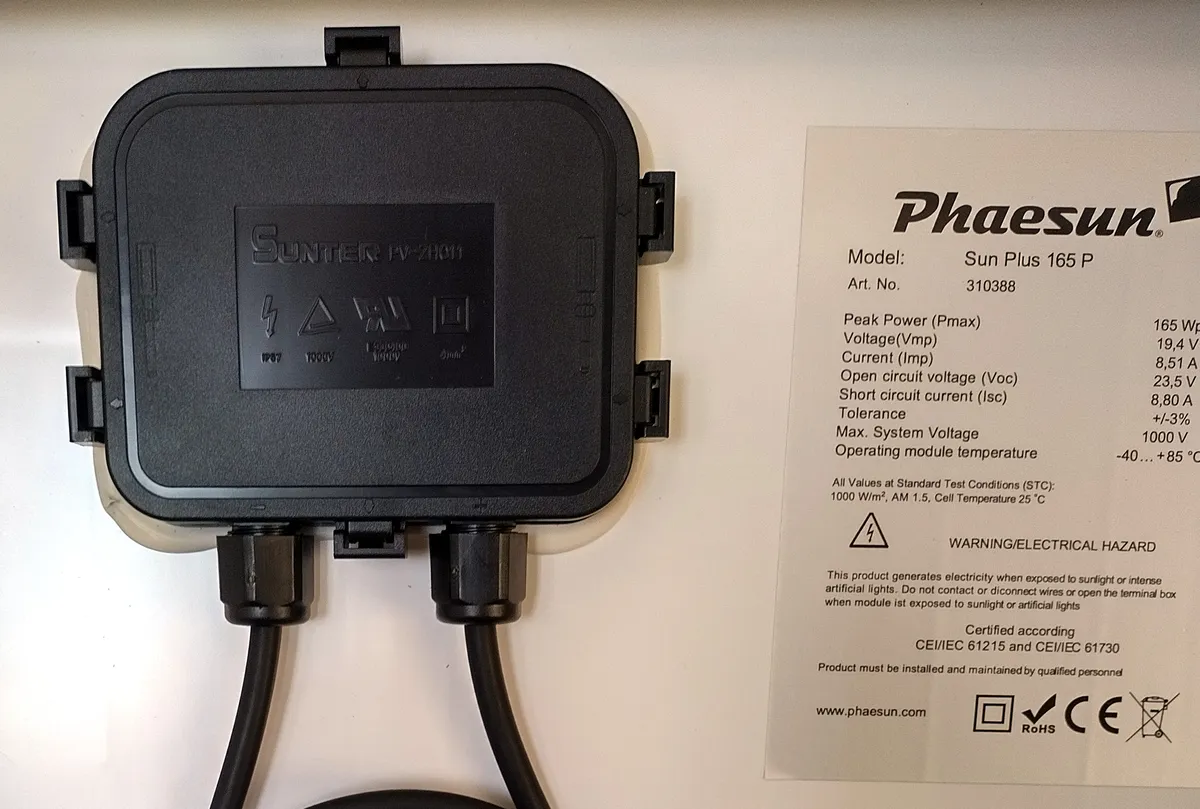

The two standards every module should name
IEC 61215 is the design qualification standard. Part 1 sets the requirements and Part 2 the test procedures. Samples of a module design go through a sequence of stress tests in a laboratory, among them thermal cycling, damp heat, humidity freeze, UV exposure, static mechanical load and a hail test, and the module's loss of maximum power after each test and after the whole sequence must stay within set limits. The IEC describes the goal of the procedures as showing, "as far as possible within reasonable constraints of cost and time, that the module is capable of withstanding prolonged exposure outdoors."
The current edition is from 2021, and it changed more than the year. Its list of technical changes adds a cyclic (dynamic) mechanical load test, a test for detecting potential-induced degradation and methods for bifacial and flexible modules. A datasheet that says "IEC 61215:2016" was certified before those were part of the sequence. If the year is printed, it's worth reading.
IEC 61730 is the safety qualification standard. Part 1 covers construction, Part 2 the tests. In the IEC's words it sets out construction requirements "in order to provide safe electrical and mechanical operation", and the topics are electric shock, fire and injury from mechanical and environmental stresses. Where 61215 asks whether the module keeps working, 61730 asks whether it can hurt anyone while it does.
The two belong together. A design that survives the outdoors but isn't shown to be safe, or the other way round, is half certified. That's why the first thing I look for is both numbers on the same sheet.
In North America the safety standard is published as UL 61730. UL says its older module standard, UL 1703, was harmonised to the international one in December 2017, and that products already certified to UL 1703 may keep the UL mark until it is withdrawn. So either number on a datasheet points to the North American safety listing; for a buyer in Europe it is a sign the module was also prepared for the US market, nothing more.
Extra tests for the coast, the farm and the desert
Three further standards test one specific hazard each. They sit outside the base pair, so a module has them only if the manufacturer paid for them.
- Salt mist, IEC 61701. The IEC abstract describes test sequences for modules "operating under wet atmospheres having high concentration of dissolved salt". It is the line to look for within reach of sea spray and near roads salted in winter. The standard offers several methods, taken from IEC 60068-2-52, and an annex on which applies to which application, so "salt mist tested" without the method leaves out how hard the test was.
- Ammonia, IEC 62716. The same idea for ammonia: tests for modules in "wet atmospheres having high concentration of dissolved ammonia". Ammonia comes from livestock, so this is the line for a barn or stable roof.
- Potential-induced degradation, IEC TS 62804-1. PID is power loss driven by the voltage between the cells and earth (the grounded frame), and that voltage is largest in the modules at the ends of a long string. The 2025 edition of the technical specification gives test methods for crystalline silicon modules and is careful about what they show: they "assess PV module sensitivity to PID irrespective of actual stresses under operation in different climates and systems." It's a screening test, not a promise about your string. The 2021 edition of IEC 61215 added a PID detection test to its own sequence, but the separate specification is the number datasheets name.
A fourth, IEC 60068, is a general family of environmental tests rather than a module standard. On module datasheets that name the part, it is usually Part 2-68, Test L, dust and sand, the line that matters for desert sites where wind carries sand at the glass. The number alone doesn't say which part of the family was used.
Heat on its own has no extra certificate in this list. IEC 61730-1 applies to modules in climates where the module's 98th percentile operating temperature is 70 °C or less, and points to a separate guideline, IEC TS 63126, above that. I didn't count TS 63126 in the catalogue. For hot roofs the useful figure is the temperature coefficient; the hot climate article works through it.
How often datasheets list each
Of 14,005 modules in our catalogue, 13,523 list at least one certificate. The table counts each standard twice: as modules out of the whole catalogue, and as a share of the modules that list anything. Read the share first, then check the count next to it: the smaller the count under a share, the more it can move when one manufacturer adds a datasheet ladder.
| Certificate | What it covers | Modules | Share of modules listing any certificate |
|---|---|---|---|
| IEC 61215 | design qualification | 9,714 | 72 % |
| IEC 61730 | safety qualification | 10,040 | 74 % |
| Both of the above | the base pair | 9,707 | 72 % |
| IEC 61701 | salt mist | 4,464 | 33 % |
| IEC 62716 | ammonia | 4,230 | 31 % |
| IEC TS 62804 | potential-induced degradation | 1,892 | 14 % |
| IEC 60068 | environmental tests, e.g. sand | 2,862 | 21 % |
| UL 61730 or UL 1703 | North American safety listing | 2,941 | 22 % |
| CE | manufacturer's EU declaration | 7,415 | 55 % |
| ISO 9001 | factory quality management | 9,393 | 69 % |
Compare the "both" row with the two rows above it. Where it sits close to each of them, a datasheet that names one base standard almost always names the other too, and the gap between the "both" share and 100 % is the part of the catalogue to look at twice. A module missing from that row hasn't necessarily failed anything; its datasheet may list the certificates in a separate document, or our record of its sheet may have missed the line. But it's the one where you ask.
Read the three hazard rows against the base pair rather than against each other. They cost money and only matter for some sites, so a manufacturer certifies the series it sells to coastal or farm buyers. If you need one, filter for it; if you don't, its absence says nothing bad about a module.
How I read the certificate line
The certifications field on a datasheet is free text, written differently by every manufacturer: "IEC 61215:2021", "IEC/EN 61215", "IEC61215". I strip the punctuation and match the standard number, so all of those count, and I don't check the edition year. A word such as "PID free" or "PID resistant" doesn't count as the PID test: that's a claim about the module, not the name of a test it went through. The exact rules are under the article.
Junction box IP and system voltage
Two more ratings on the same sheet are about safety in the system rather than certificates, and they're easier to check.
The junction box is the sealed housing on the back where the cell strings end and the cables leave. Its IP rating states how well it keeps out dust and water. The first digit 6 means "totally protected against dust"; the second digit 5 or 6 means water jets, 7 "temporary immersion" and 8 "continuous immersion" under defined conditions. One trap: Palazzoli, an enclosure maker with its own test laboratory, notes that "IPX7 and IPX8 protection degrees do not include IPX5 and IPX6 protection degrees", so a box rated IP68 alone hasn't been shown to resist water jets.
| Junction box rating named | Modules |
|---|---|
| Any IP rating stated | 13,721 |
| IP68 | 12,750 |
| IP67 at most | 842 |
| IP65 or IP66 at most | 129 |
The maximum system voltage is the highest DC voltage the module's insulation is rated for inside a string. Our catalogue has 12,612 modules rated for 1500 V and 988 rated for 1000 V. A home string rarely comes near either, but the rating decides how many modules you may put in series, and on a cold morning the string's voltage is higher than on the datasheet. The Voc and inverter article has the sum.
What a certificate does not prove
It doesn't predict lifetime. IEC 61215-1 says so in its own abstract: "Test results are not construed as a quantitative prediction of module lifetime." The useful service life, it adds, depends on the design, the environment and how the module is operated. Passing the sequence means a sample of the design survived a fixed set of stresses. How long your module lasts is what the performance warranty is for, and even that is a promise to pay, not a forecast.
It's a test of samples, not of your module. Qualification tests a few modules of a design. Whether the module on your pallet is built the same way is a question of the factory, which is where ISO 9001 comes in, and ISO 9001 is a certificate of the factory's quality management system, not of the product.
CE is not a test at all. Under the EU Low Voltage Directive, which covers equipment rated between 75 and 1,500 V DC, the manufacturer draws up the declaration of conformity and affixes the CE marking itself. The procedure in Annex III, internal production control, involves no outside body. CE tells you the manufacturer takes legal responsibility for conformity in the EU. It doesn't tell you anyone else looked. A missing CE in our count can simply mean the datasheet left it off the list; it doesn't by itself mean the module can't be sold in Europe.
A logo isn't a certificate number. A datasheet can print a test lab's logo and a standard number without saying which model, which edition or which certificate. If it matters, for a large array or a subsidy that requires it, ask the seller for the certificate itself, with the model names on it.
A checklist before you buy
- Both IEC 61215 and IEC 61730 on the datasheet. If only one is there, ask why.
- The edition year, if printed. IEC 61215:2021 includes tests the 2016 edition doesn't.
- The site-specific test you need, and only that. Salt mist near the sea or salted roads, ammonia on a farm building, sand in the desert. Don't pay extra for the others.
- PID: a named test, not a word. Look for IEC TS 62804, and remember it's a screening test, not a guarantee.
- Junction box IP67 or IP68, and IP65 or IP66 as well if the modules will be cleaned with water jets.
- Maximum system voltage that fits your string, checked with the cold-morning voltage.
- For a large purchase, the certificate itself, naming the model you're buying.
Then compare what's left on the things certificates don't cover: efficiency, the temperature coefficient, the warranty terms and price per watt. The panel comparison calculator puts two modules side by side, and the datasheet guide shows where each figure sits on the sheet.
Figures and denominators
How the figures above were computed. Every figure is recomputed from the catalogue and the live shop offers when the page is served, and each one counts only the modules or offers that publish the value.
Catalogue figures are computed from the modules listed in our catalogue (the rankings view, which keeps only modules with a power rating and a page): 14,005 modules. Each is a row read from its manufacturer's datasheet, and one datasheet usually covers a ladder of power ratings, so a datasheet with eight ratings is eight modules here.
The certificate figures read the certifications field of each module. Before matching, the field is uppercased and stripped of everything that is not a letter or a digit, so "IEC 61215:2021", "IEC61215" and "IEC/EN 61215" all count as IEC 61215; the edition year is not checked. A standard counts when its number appears anywhere in the field: 61215, 61730, 61701 (salt mist), 62716 (ammonia), 62804 (potential-induced degradation), 60068 (environmental tests such as blowing sand) and ISO 9001. UL counts when the field names UL 61730 or the older UL 1703. CE counts only when it is a separate entry in the list, so the letters inside another word do not. The word "PID" on its own does not count as IEC TS 62804: "PID resistant" is a claimed feature, not a named test.
The modules columns are out of the whole catalogue. The shares are out of the 13,523 modules whose datasheet lists any certificate at all, so a module with an empty field neither helps nor hurts a share. Junction box IP ratings are read from free text and counted under the highest rating each names: IP68, then IP67, then IP65 or IP66. Maximum system voltage counts modules stating exactly 1000 V or 1500 V.
All 28 figures on this page and what each counts
| Figure | Value | Computed over |
|---|---|---|
| Modules listing any certificate | 13,523 | 14,005 modules |
| Share of modules listing any certificate that list both IEC 61215 and IEC 61730 | 72 % | 13,523 modules |
| Modules in the catalogue | 14,005 | 14,005 modules |
| Modules listing IEC 61215 (design qualification) | 9,714 | 14,005 modules |
| Share of modules listing any certificate that list IEC 61215 (design qualification) | 72 % | 13,523 modules |
| Modules listing IEC 61730 (safety qualification) | 10,040 | 14,005 modules |
| Share of modules listing any certificate that list IEC 61730 (safety qualification) | 74 % | 13,523 modules |
| Modules listing both IEC 61215 and IEC 61730 | 9,707 | 14,005 modules |
| Modules listing IEC 61701 (salt mist) | 4,464 | 14,005 modules |
| Share of modules listing any certificate that list IEC 61701 (salt mist) | 33 % | 13,523 modules |
| Modules listing IEC 62716 (ammonia) | 4,230 | 14,005 modules |
| Share of modules listing any certificate that list IEC 62716 (ammonia) | 31 % | 13,523 modules |
| Modules listing IEC TS 62804 (potential-induced degradation) | 1,892 | 14,005 modules |
| Share of modules listing any certificate that list IEC TS 62804 (potential-induced degradation) | 14 % | 13,523 modules |
| Modules listing IEC 60068 (environmental tests, e.g. blowing sand) | 2,862 | 14,005 modules |
| Share of modules listing any certificate that list IEC 60068 (environmental tests, e.g. blowing sand) | 21 % | 13,523 modules |
| Modules listing UL 61730 or UL 1703 | 2,941 | 14,005 modules |
| Share of modules listing any certificate that list UL 61730 or UL 1703 | 22 % | 13,523 modules |
| Modules listing the CE marking | 7,415 | 14,005 modules |
| Share of modules listing any certificate that list the CE marking | 55 % | 13,523 modules |
| Modules listing ISO 9001 (factory quality management) | 9,393 | 14,005 modules |
| Share of modules listing any certificate that list ISO 9001 (factory quality management) | 69 % | 13,523 modules |
| Modules stating a junction box IP rating | 13,721 | 14,005 modules |
| Modules naming IP68 for the junction box | 12,750 | 14,005 modules |
| Modules naming IP67 at most for the junction box | 842 | 14,005 modules |
| Modules naming IP65 or IP66 at most for the junction box | 129 | 14,005 modules |
| Modules rated for 1500 V system voltage | 12,612 | 14,005 modules |
| Modules rated for 1000 V system voltage | 988 | 14,005 modules |
Related tools
Reference list
- IEC 61215-1:2021, Terrestrial photovoltaic (PV) modules, Design qualification and type approval, Part 1, Test requirements (IEC webstore abstract)
- IEC 61215-2:2021, Part 2, Test procedures (IEC webstore abstract, list of technical changes)
- IS 14286:2010, identical to IEC 61215:2005, clause 6 Pass criteria and clause 10 Test procedures (Bureau of Indian Standards, via Internet Archive)
- IEC 61730-1:2023, Photovoltaic (PV) module safety qualification, Part 1, Requirements for construction (IEC webstore abstract)
- IEC 61701:2020, Photovoltaic (PV) modules, Salt mist corrosion testing (IEC webstore abstract)
- IEC 62716:2013, Photovoltaic (PV) modules, Ammonia corrosion testing (IEC webstore abstract)
- IEC TS 62804-1:2025, Test methods for the detection of potential-induced degradation, Part 1, Crystalline silicon (IEC webstore abstract)
- IEC 60068-2-68:1994, Environmental testing, Test L, Dust and sand (IEC webstore abstract)
- Directive 2014/35/EU (Low Voltage Directive), Article 1, Articles 15 and 17, Annex III
- UL, UL 1703 to UL 61730, PV module safety standards updates
- Palazzoli, Test of the degree of protection against solid objects and liquids (IEC 60529 digits)