
Buying
Product warranty versus performance warranty
How long solar module product and performance warranties run across our catalogue, how they differ by cell technology and maker, and what each one covers.
In short: A solar module carries two warranties with different jobs. The product warranty covers defects in materials and workmanship; the performance warranty promises how much rated power the module keeps, year by year, measured in a lab. Across our catalogue the median product warranty is 15 years against 30 years for performance, and on 89 % of modules stating both, the product warranty is the shorter one.
The datasheet prints the two lengths side by side, as if they were two versions of one promise. They aren't. They cover different failures, and they can end in different years.
Two promises with different jobs
The product warranty pays out when something breaks. A junction box that fails, a connector that corrodes, a cell that was faulty from the factory: these are defects, and only the product warranty names them.
The performance warranty doesn't care why power is missing. It's a schedule: so much of the rated power after year one, a little less each year after that. If a module measured in a lab falls below its line, the manufacturer owes you a remedy.
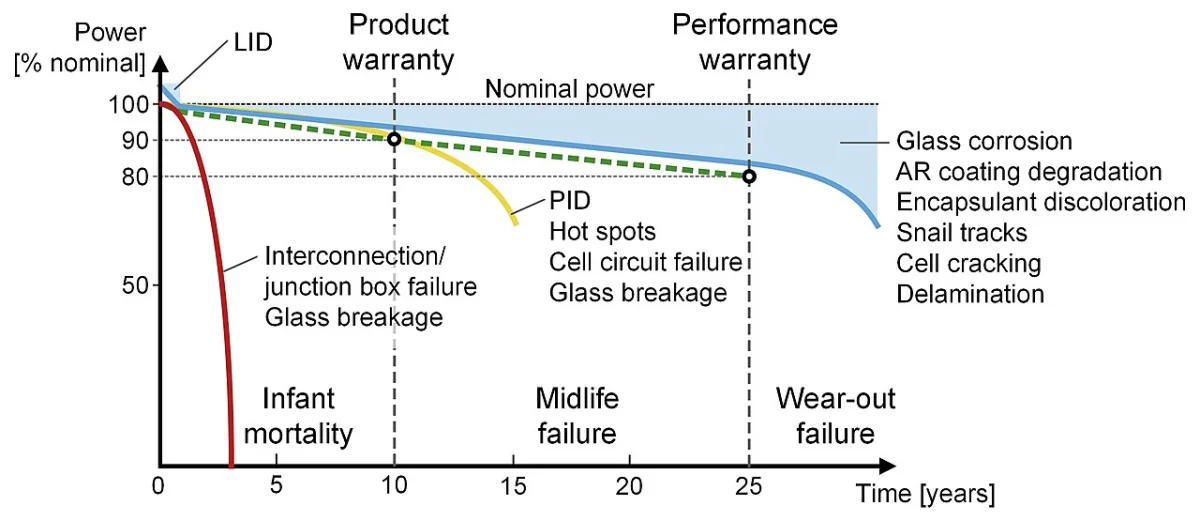
The drawing below shows the split. Its 10 and 25 years are an older pairing, so take today's lengths from the tables further down; the logic is the same. Early and mid-life faults fall inside the product warranty, slow wear is tracked against the performance line.

What I counted and what I read
Of the 14,005 modules in the catalogue, 13,615 state a product warranty, 13,877 a performance warranty and 12,330 the power the performance warranty promises at its end. One datasheet usually covers a ladder of power ratings, the same module sold at several wattages, and each rating is its own row here. The sanity ranges and the count behind every figure are under "Figures and denominators" below the article.
I group by cell technology and by manufacturer, two things the datasheets state themselves. I left out manufacturer tier: our "Tier 1" flag was filled in by a language model, not taken from a published list, so nobody could check a finding resting on it.
What each warranty covers is in the manufacturer's warranty document, not the datasheet. I read two from LONGi: its March 2024 limited warranty for Hi-MO X6 modules in the distributed generation (rooftop) market, and an older one for its single glass modules, both from copies on Australian solar websites. Other manufacturers write their own terms, so read the clauses below as one worked example.
Two modules run through the article, picked by rule when it was written; nobody paid for either place. The first had the most shop offers in our live offers list among modules whose warranty figures agree with each other (the end figure follows from the degradation figures; the datasheet article explains that check). It's a LONGi module.
Scorecard for this module: open its page on ComparePV.
The second had the most shop offers among modules with a product warranty of 25 years or more. It's a Jolywood module.
Scorecard for this module: open its page on ComparePV.
How long each warranty runs
Product warranty lengths
Look for three lengths in the chart: 12 years, stated by 44 % of modules, 15 years by 30 %, and 25 years or more by 21 %.
The numbers behind the chart
| Product warranty (years) | Modules |
|---|---|
| <11 | 511 |
| 11-14 | 5,970 |
| 14-17 | 4,100 |
| 17-20 | 0 |
| 20-23 | 238 |
| 23-26 | 1,692 |
| 26-29 | 0 |
| 29-32 | 1,084 |
| 32+ | 20 |
Performance warranty and how the two pair up
Of the modules stating a performance warranty, 70 % promise 30 years or more. The table counts modules for eight common pairs. Compare the rows where the two lengths match with those where they don't, to see how much one length tells you about the other.
| Product warranty | Performance warranty | Modules |
|---|---|---|
| 12 years | 30 years | 3,549 |
| 15 years | 30 years | 3,375 |
| 12 years | 25 years | 2,290 |
| 25 years | 30 years | 1,321 |
| 30 years | 30 years | 1,084 |
| 15 years | 25 years | 721 |
| 10 years | 25 years | 387 |
| 25 years | 25 years | 371 |
The length and the power promised at the end are separate terms, so read both. The median module with a 25-year performance warranty is promised 84.8 % of its rated power when it ends. The median module with a 30-year warranty is promised 87.4 %, five years later.
The modules with the longest stated performance warranty, picked by the rule in the caption:
Top 3 by the longest performance warranty, one module per datasheet, among 13,877 modules with a stated performance warranty, as of the last catalogue sync.
Scorecard for this module: open its page on ComparePV.
Scorecard for this module: open its page on ComparePV.
Scorecard for this module: open its page on ComparePV.
Warranties by cell technology
The product side first. "N-type only" means the datasheet says N-type without naming the cell structure; back contact cells have all their contacts on the rear face.
| Technology | Median product warranty | Product 25 years or more |
|---|---|---|
| TOPCon | 15 years | 28 % |
| PERC | 12 years | 12 % |
| N-type only | 15 years | 12 % |
| HJT | 15 years | 38 % |
| Back contact | 15 years | 31 % |
On the performance side, the end power is the median promised when the warranty ends, whatever its length.
| Technology | Performance 30 years or more | Median end power |
|---|---|---|
| TOPCon | 91 % | 87.4 % |
| PERC | 42 % | 84.8 % |
| N-type only | 83 % | 87.4 % |
| HJT | 89 % | 90.3 % |
| Back contact | 87 % | 88.8 % |
Read the two columns together. A 25-year schedule stops five years before a 30-year one, so where two groups differ a lot in the first column, their end figures aren't taken at the same year. Within one length, the end figure follows from the degradation allowances: a smaller first-year loss and a lower annual rate leave more power.
Warranties by manufacturer
Counting companies rather than modules, 66 manufacturers have a median product warranty of 12 years, 52 of 15 years and 37 of 25 years or more.
108 manufacturers state more than one product warranty length across their own modules, so for them the brand doesn't settle the term. LONGi's 2024 rooftop warranty shows how that happens: one document gives 25 years of product warranty to some module types and 15 years to others, listed by model number. The older single glass warranty gave 10.
Among manufacturers that list both TOPCon and PERC modules, 26 give TOPCon the longer median product warranty, 50 give both the same and 12 give TOPCon the shorter one. Which manufacturers state the longest terms, with a minimum number of datasheets behind each, is in warranty terms across manufacturers.
What each warranty covers
Product warranty: defects in materials and workmanship
LONGi's 2024 document draws the line plainly. It says the modules, "including the DC connectors and cables", will be free of defects in material or workmanship which affect the performance of the modules, provided they're installed and maintained as the installation manual says. It excludes changes in appearance and normal wear and tear, and says outright that power output isn't covered here.
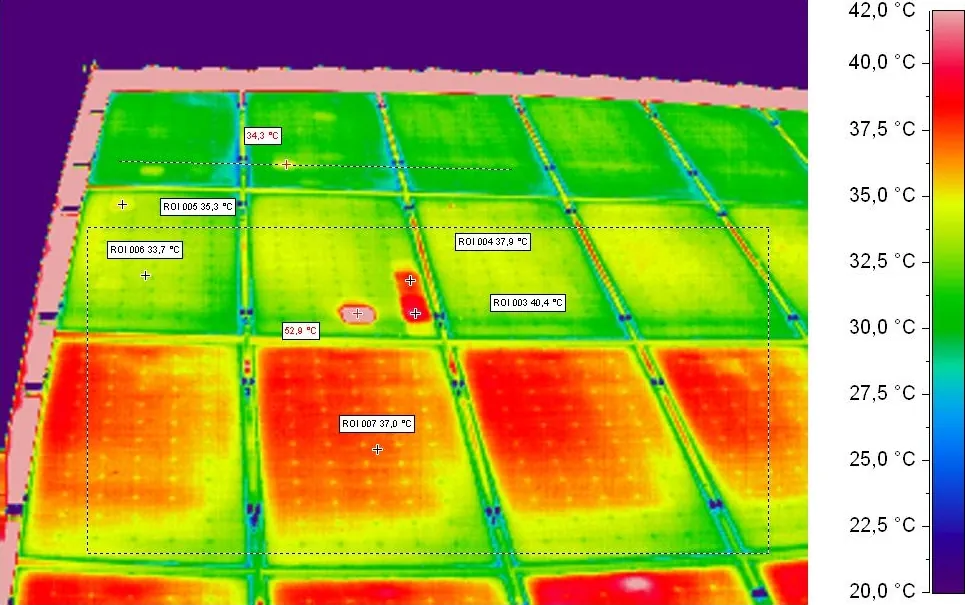
A defective cell is the kind of fault this warranty exists for. It often shows up as a hot spot, a cell running hotter than its neighbours, which an infrared camera picks up even when the module looks fine. Whether a fault qualifies is decided under the document, so a clear record helps.

Performance warranty: a power schedule measured in a lab
For one group of modules, LONGi promises at least 99 % of rated power in the first year and a decline of no more than 0.35 % a year after that: 99 - 0.35 × 29 = 88.85 % in year 30.
Power is measured at standard test conditions (1000 W/m², 25 °C cell temperature) in an independent lab the supplier accepts, with the equipment's measurement tolerance taken into account. That isn't what a module makes on your roof on a hot afternoon, and the warranty never says it is.
Three clauses that matter more than the length
The remedy is the supplier's choice. It can repair the modules, replace them, add modules to make up the shortfall, or refund either the module's residual value or the value of the missing power. Residual value is the current price per watt times the rated power times the share of the performance warranty period that's left.
Labour is yours. Dismantling, repacking and reinstalling the modules fall on the customer.
The clock doesn't restart. A repaired or replaced module carries the remainder of the old warranty.
The two examples, worked through
The LONGi module states 15 years of product warranty and 30 years of performance: 1 % allowed in the first year and 0.35 % a year after, so 100 - 1 - 0.35 × 29 = 88.85 % at year 30. The Jolywood module states 25 years of product warranty and the same 30 years of performance, at 1 % and 0.4 % a year: 100 - 1 - 0.4 × 29 = 87.4 %.
So the two trade in opposite directions. Year 20 sits inside both performance warranties; look at the last column.
| Module | Guaranteed power at year 20 | Product warranty at year 20 |
|---|---|---|
| LONGi | 100 - 1 - 0.35 × 19 = 92.35 % (498.7 W of 540 W) | Ended after year 15 |
| Jolywood | 100 - 1 - 0.4 × 19 = 91.4 % | Running until year 25 |
The LONGi module promises slightly more power. Only the Jolywood module is still covered if a junction box fails that year. Which matters more depends on what you fear: slow fade, or a part that breaks.
The figure below runs both schedules year by year, with bars for the warranty still running. The second module starts on the Jolywood terms; you can change either.
Two warranties on one timeline
Scrub through 35 years and watch two modules age against the floors their performance warranties guarantee, while the bars above show which warranty is still running.
How this is computed
Expected output follows the two loss figures exactly: 100 % at installation, down by the first-year loss over year one, then down by the annual loss every year after: output = 100 - first-year loss - annual loss × (years - 1). The guarantee floor starts at 100 - first-year loss for year one and runs in a straight line to the guaranteed share at the end of the performance warranty; after that there is no floor.
Headroom is expected output minus the floor. A datasheet whose end figure follows from its own loss figures, as most do, sits exactly on its floor: the warranty promises no more than the schedule. Type a lower annual loss, a measured field rate for example, and the headroom is what the module keeps above its guarantee.
Energy lost to ageing is the area between 100 % and the output line up to the chosen year, as a share of what a module that never aged would have made over the same years. It ignores weather, heat and shade, which cost energy in every year alike.
The figure shows terms, not outcomes. What a claim needs, how power is measured and what the remedy is are set by each warranty document, which the article reads clause by clause; a warranty is also only as good as the company behind it. Real modules do not age in straight lines: early losses such as light-induced degradation are what the first-year allowance absorbs.
Illustrative model, not a measurement.
Checklist before you buy
- Read the product warranty first. It's the one that names defects: a failed connector, a cable, a fault in the module's materials.
- Compare the schedule, not the headline. "30 years" on two datasheets can mean different end figures, so work out the guaranteed power in the year you care about from the first-year allowance and the annual rate, for both modules.
- Ask for the warranty document. The remedy, the claim procedure and who pays for labour are only there. Under the LONGi terms, a residual value refund in year 20 of a 30-year warranty is 10 / 30 = a third of what the module's watts cost that day, and the labour is yours.
- Check the model number. A warranty you read for one series doesn't carry over to another line from the same manufacturer.
The panel comparison calculator shows the warranty fields of any two catalogue modules side by side. The payback calculator shows how many years a system needs to pay for itself, and that's the stretch I'd read any warranty against.
What these figures can't tell you
Every length here is our reading of a datasheet, a claim on paper. The datasheet can differ from the current warranty document, and the document is what binds. The clauses are one manufacturer's terms, in one market, at one date. And a warranty is only as good as the company that has to honour it, which no datasheet field measures.
Module shares count rows, so a manufacturer with long power ladders weighs more in them than one with short ladders. That's why the manufacturer figures count each company once.
The performance warranty doesn't cover output lost to heat, shade, soiling or a poorly matched inverter, and its first-year allowance absorbs early losses such as light-induced degradation. None of these figures measures how cells actually age.
Figures and denominators
How the figures above were computed. Every figure is recomputed from the catalogue and the live shop offers when the page is served, and each one counts only the modules or offers that publish the value.
Every catalogue figure on this page is computed from the modules listed in our catalogue (the rankings view, which keeps only modules with a power rating and a page): 14,005 modules. Each one is a row read from its manufacturer's datasheet, and one datasheet usually covers a ladder of power ratings, so a datasheet with eight ratings is eight modules here.
A warranty counts only when it sits inside a sanity range: product warranty 5 to 50 years, performance warranty 10 to 50 years, power at the end of the performance warranty 50 to 100 %. Outside those ranges a value is a misread column, not a term anyone sells. Shares are the percentage of modules inside the range; medians are continuous medians over the same modules.
Manufacturer figures count companies, not modules. A manufacturer counts once if at least one of its modules states a product warranty, and its figure is the median over its own modules. The TOPCon and PERC comparison takes the manufacturers that list modules of both technologies and compares their two medians. Cell technology is the label on the datasheet; modules labelled only "N-type" are a group of their own.
All 48 figures on this page and what each counts
| Figure | Value | Computed over |
|---|---|---|
| Product warranty, median | 15 years | 13,615 modules |
| Performance warranty, median | 30 years | 13,877 modules |
| Share of modules whose product warranty is shorter than the performance warranty | 89 % | 13,611 modules |
| Modules in the catalogue | 14,005 | 14,005 modules |
| Modules stating a product warranty | 13,615 | 14,005 modules |
| Modules stating a performance warranty | 13,877 | 14,005 modules |
| Modules stating the power promised at the end of the performance warranty | 12,330 | 14,005 modules |
| Share of modules with a 12-year product warranty | 44 % | 13,615 modules |
| Share of modules with a 15-year product warranty | 30 % | 13,615 modules |
| Share of modules with a product warranty of 25 years or more | 21 % | 13,615 modules |
| Share of modules with a performance warranty of 30 years or more | 70 % | 13,877 modules |
| Modules with a 12-year product and 30-year performance warranty | 3,549 | 14,005 modules |
| Modules with a 15-year product and 30-year performance warranty | 3,375 | 14,005 modules |
| Modules with a 12-year product and 25-year performance warranty | 2,290 | 14,005 modules |
| Modules with a 25-year product and 30-year performance warranty | 1,321 | 14,005 modules |
| Modules with a 30-year product and 30-year performance warranty | 1,084 | 14,005 modules |
| Modules with a 15-year product and 25-year performance warranty | 721 | 14,005 modules |
| Modules with a 10-year product and 25-year performance warranty | 387 | 14,005 modules |
| Modules with a 25-year product and 25-year performance warranty | 371 | 14,005 modules |
| Power promised after a 25-year performance warranty, median | 84.8 % | 3,423 modules |
| Power promised after a 30-year performance warranty, median | 87.4 % | 8,749 modules |
| TOPCon: product warranty, median | 15 years | 5,682 modules |
| TOPCon: share with a product warranty of 25 years or more | 28 % | 5,682 modules |
| PERC: product warranty, median | 12 years | 4,172 modules |
| PERC: share with a product warranty of 25 years or more | 12 % | 4,172 modules |
| N-type: product warranty, median | 15 years | 1,638 modules |
| N-type: share with a product warranty of 25 years or more | 12 % | 1,638 modules |
| HJT: product warranty, median | 15 years | 689 modules |
| HJT: share with a product warranty of 25 years or more | 38 % | 689 modules |
| Back Contact: product warranty, median | 15 years | 439 modules |
| Back Contact: share with a product warranty of 25 years or more | 31 % | 439 modules |
| TOPCon: share with a performance warranty of 30 years or more | 91 % | 5,727 modules |
| TOPCon: power at the end of the performance warranty, median | 87.4 % | 5,213 modules |
| PERC: share with a performance warranty of 30 years or more | 42 % | 4,263 modules |
| PERC: power at the end of the performance warranty, median | 84.8 % | 3,706 modules |
| N-type: share with a performance warranty of 30 years or more | 83 % | 1,651 modules |
| N-type: power at the end of the performance warranty, median | 87.4 % | 1,565 modules |
| HJT: share with a performance warranty of 30 years or more | 89 % | 695 modules |
| HJT: power at the end of the performance warranty, median | 90.3 % | 629 modules |
| Back Contact: share with a performance warranty of 30 years or more | 87 % | 439 modules |
| Back Contact: power at the end of the performance warranty, median | 88.8 % | 407 modules |
| Manufacturers whose median product warranty is 12 years | 66 | 174 manufacturers |
| Manufacturers whose median product warranty is 15 years | 52 | 174 manufacturers |
| Manufacturers whose median product warranty is 25 years or more | 37 | 174 manufacturers |
| Manufacturers stating more than one product warranty length | 108 | 174 manufacturers |
| Manufacturers of both whose TOPCon median product warranty is longer than PERC | 26 | 88 manufacturers |
| Manufacturers of both whose TOPCon and PERC median product warranties are equal | 50 | 88 manufacturers |
| Manufacturers of both whose TOPCon median product warranty is shorter than PERC | 12 | 88 manufacturers |