
Prices
Gross or net: why two shop prices are not comparable
Which solar panel shops print prices with VAT and which without, market by market, and how to turn any shop price into a figure you can compare.
In short: a price including VAT and a price before it differ by the VAT rate, so two shop prices only compare once both sit on the same side of VAT. In our live offers, 68 % of the 2,685 rooftop module offers are quoted including VAT. Divide a price including VAT by one plus the rate to get the net price, then divide by the watts.
A solar shop prints one price per module. It's either what a household pays, VAT included, or what a business pays before VAT, which the business reclaims later. In a search result the two look like two offers for the same thing. They differ by the VAT rate, and that rate changes between markets and sometimes between shops in one market.
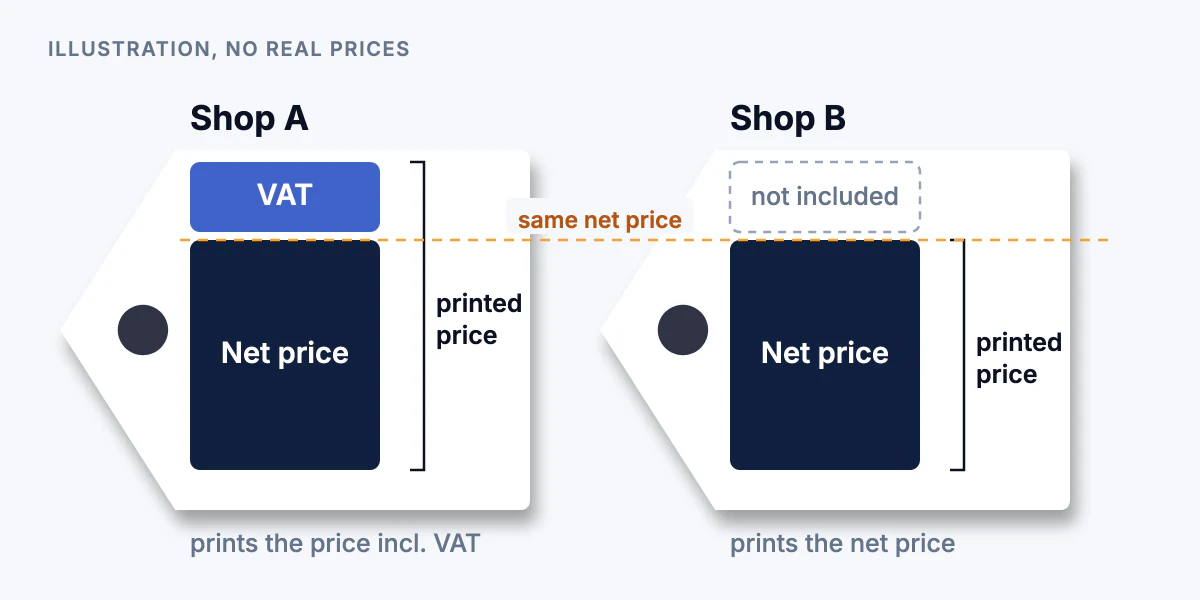
How the offers were read
The pool is 2,685 offers for single rooftop modules rated 400 to 800 W, from 117 shops. Each carries the shop's own label for its side of VAT and the rate the shop applies. Gross means including VAT, net means before it.
Price per watt is the price in euro divided by the rated power the shop printed, which is the module's power at standard test conditions. I work it out twice: on the printed price, as you see it in the shop, and with VAT taken off, the basis the other price articles on this site use. Everything is recomputed from the live offers when the page is served, so the figures move as shops change prices and labels. The exact counting rules are under Figures and denominators.
How the pool splits between gross and net
The table counts both kinds across the pool, by offers and by the shops behind them.
| Quoted | Offers | Shops |
|---|---|---|
| Including VAT | 1,824 | 84 |
| Before VAT | 861 | 33 |
A shop could quote some modules one way and the rest the other. The count of shops that do is 0, out of 117. Where that count is zero, the side of VAT is a property of the shop: one labelled product page tells you how it quotes everything it sells.
Including or before VAT, market by market
The table covers six markets. Read the share of offers including VAT next to the shop counts: a share that rests on a handful of shops can swing when one of them changes its display. The last column is the median VAT rate across the market's offers.
| Market | Offers | Incl. VAT (%) | Shops incl. VAT / net | Rate (%) |
|---|---|---|---|---|
| Poland | 1,171 | 69 | 34 / 4 | 23 |
| Germany | 233 | 90 | 8 / 1 | 0 |
| Italy | 269 | 72 | 10 / 5 | 10 |
| Netherlands | 68 | 26 | 2 / 6 | 21 |
| Slovakia | 105 | 100 | 7 / 0 | 23 |
| India | 51 | 100 | 6 / 0 | 12 |
The VAT rate is not one number per country
Germany shows why. Its VAT Act sets a zero rate for modules supplied to the operator of a system on or near a home, and treats any system up to 30 kWp as meeting that condition. A German shop selling to households can print a price including VAT at zero, which is the same number as its price before VAT. Across the pool, 243 offers are quoted including VAT at a zero rate, and they come from 3 markets.
A zero rate covers only the supplies the law names. A purchase outside them carries the rate that does apply, so don't budget on zero until you know your purchase qualifies.
Italy has a reduced 10 % rate for some supplies. The number of Italian shops applying it is 7, over 173 offers. India charges GST rather than VAT; the crawler records the rate the shop applies in the same way, so Indian offers sit in the same tables. India cut GST on solar cells and modules from 12 % to 5 % on 22 September 2025, so a recorded Indian rate that differs from 5 % is what the shop or the crawler holds, not what the law now says.
Printed prices give a different comparison
The next two tables set both kinds of shop side by side in three markets where shops quote both ways. All price columns are medians per watt. Printed is what the shops including VAT print. Before VAT is the same offers with VAT taken off. Net shops are the shops that quote before VAT in the first place. In the last column, "a / b" means a offers including VAT and b offers before it; check it before you lean on a median.
| Market | Printed (EUR/W) | Before VAT (EUR/W) | Net shops (EUR/W) | Offers (incl. VAT / net) |
|---|---|---|---|---|
| Poland | 0.181 | 0.147 | 0.142 | 812 / 359 |
| Italy | 0.207 | 0.185 | 0.210 | 194 / 75 |
| Netherlands | 0.166 | 0.137 | 0.178 | 18 / 50 |
The second table turns those medians into one gap per market: how much dearer per watt the shops including VAT came out than the net shops. The first column compares printed prices as they stand, the second takes VAT off both sides first. A negative figure means the shops including VAT were the cheaper group.
| Market | Gap on printed prices (%) | Gap before VAT (%) |
|---|---|---|
| Poland | 28 | 4 |
| Italy | -1 | -12 |
| Netherlands | -7 | -23 |
Only the second column compares shops on the same side of VAT. The distance between the two columns is what the tax alone did to the comparison.
Read the signs as well as the sizes. Where the sign differs between markets, neither kind of shop is cheaper as a rule. And different shops sell different modules, so each gap compares two baskets; it says what reading printed prices does to a comparison and nothing about which kind of shop to buy from.
One module, several shops
The offer tables on our panel pages sort on the price before VAT. I picked the module below by a rule, applied when this article was written: among catalogue modules with offers on both sides of VAT, the one with the most offers quoted before VAT, ties broken by the most offers in total. Nobody paid for the spot.
Cheapest current offers for Longi Solar LR7-54HVH-480M, prices read 9 Oct 2026.
| Shop | Market | Price | Availability |
|---|---|---|---|
| Megawat Elektrohurt | Poland | 346.86 zł incl. VAT | In stock |
| PV Zenit | Poland | 363.00 zł incl. VAT | In stock |
| Eco System Projekt | Poland | 390.00 zł incl. VAT | In stock |
| PVhurt | Poland | 396.58 zł incl. VAT | In stock |
| pvsklep.pl | Poland | 396.58 zł incl. VAT | In stock |
Each price is the figure the shop printed, on its own side of VAT.
Each row prints the shop's own price, in its own currency, labelled as including VAT or net. The order follows the price before VAT, converted to a common currency, so a net row can sit lower in the table than a row including VAT that prints a bigger number. That isn't a sorting bug.
How to compare two shop prices
Three steps, in this order.
- Check the label before the number. Look for "incl. VAT", "brutto", "net" or the shop's equivalent near the price or in the footer.
- Put both prices on your side of VAT. To go from a price including VAT to one before it, divide by one plus the rate: at a 23 % rate, a price of 123 is 100 before VAT. To go the other way, multiply.
- Divide by the watts. A module of higher rated power can cost more and still be cheaper per watt.
Your side depends on whether you reclaim VAT. A business that does compares net prices. A household that can't pays the net price plus whatever VAT applies to its purchase, however the shop printed the price, so it compares prices including VAT at the rate it will be charged. That's also the figure to type into the solar payback calculator.
A worked example
Say shop A prints 123 zł including 23 % VAT for a 500 W module, and shop B prints 110 zł net for a 450 W module. On the screen, B looks cheaper.
Take VAT off A: 123 / 1.23 = 100 zł net, and 100 / 500 = 0.20 zł per watt. B is already net: 110 / 450 = 0.24 zł per watt. A is cheaper per watt. A household buying from B would also pay VAT on top, 110 × 1.23 = 135.30 zł, which the printed 110 zł never showed.
Try it with your own two prices. The figure starts on the example above.
Two shop prices on one side of VAT
Type two shop prices, say which side of VAT each is quoted on, and see both prices per watt before VAT and including it, next to what the printed numbers suggest.
How this is computed
Price before VAT = price including VAT / (1 + rate / 100); price including VAT = price before VAT × (1 + rate / 100). Per watt is the price on one side divided by the rated power the shop printed, the power at standard test conditions. The gap is the dearer price per watt over the cheaper one, minus one, in percent.
One rate serves both shops, because the comparison is for one buyer: the rate you will be charged, or the one you reclaim. With one rate, the gap before VAT and the gap including VAT are the same number, and only the printed gap differs. "Cheaper as printed" divides each shop's number as it stands, on whatever side of VAT the shop chose.
The model takes the shop's label as true and ignores shipping, payment fees, pallet minimums and currency conversion: both prices are in the currency you type. It does not know which rate you qualify for; a reduced or zero rate depends on who buys and where the system goes.
The other price articles here work on the price before VAT for this reason: price per watt by market, which power class is cheapest per watt, pallet or single module and the same module, different shop. For what a cost per watt means over a system's life, see levelized cost of electricity.
What these figures cannot tell you
The side of VAT is the shop's own label, as the crawler read it. A shop that labels its prices wrongly, or switches its display on a setting the crawler doesn't set, is recorded as it showed itself. I have no way to catch that from the page.
Some offers have no recorded rate: 153 in the pool, of which 0 are quoted including VAT. Where that second count is zero, every offer including VAT can be taken back to its net price.
The rate is the one the shop applies, not the one a given buyer owes. Reduced and zero rates depend on who buys and where the system goes, and a shop page can't say either, so I don't judge who qualifies.
Prices are converted at the ECB reference rate of the day each offer was read, and the ECB publishes those rates for information purposes only. Where both kinds of shop in a market quote in the same currency, the gaps depend on the exchange rate only through its movement between the days the offers were read.
Figures and denominators
How the figures above were computed. Every figure is recomputed from the catalogue and the live shop offers when the page is served, and each one counts only the modules or offers that publish the value.
The offers come from our crawler, which reads the public product pages of shops in several countries and keeps one current row per product page. A product page the crawler stops seeing drops out after a week, so the pool is the offers live when the page is served, not a price history.
For every offer the crawler records the price the shop printed, the side of VAT it is on (including VAT or before it, as the shop labels it) and the VAT rate the shop applies. Where the rate is known, the price on the other side of VAT is derived from it. The rate is the one the shop states or the one the crawler sets for that shop; it is not checked against the law of the country.
The pool is the price per watt pool from our article on price per watt by market: single rooftop modules rated 400 to 800 W, priced between 0.05 and 2 EUR/W before tax. That is 2,685 offers from 117 shops. Prices are converted to euro at the ECB reference rate of the day the offer was read.
The printed price per watt is the shop's own figure, on its own side of VAT, in euro, divided by the rated power the shop printed. The price per watt before VAT is the same offer with VAT taken off at the recorded rate. The gap between two groups of shops is the median of one group over the median of the other, minus one, in percent. Offers in the United States are left out of the market table: the United States has no VAT, sales tax is added at checkout, and the crawler records a zero rate for every US offer, so both sides print the same number.
All 14 figures on this page and what each counts
| Figure | Value | Computed over |
|---|---|---|
| Offers in the price per watt pool quoted including VAT, share | 68 % | 2,685 offers |
| Rooftop module offers in the price per watt pool | 2,685 | 2,685 offers |
| Shops in the price per watt pool | 117 | 117 shops |
| Offers quoted including VAT | 1,824 | 2,685 offers |
| Shops quoting including VAT | 84 | 1,824 offers |
| Offers quoted before VAT | 861 | 2,685 offers |
| Shops quoting before VAT | 33 | 861 offers |
| Of those, shops quoting some offers including VAT and some before it | 0 | 117 shops |
| Offers outside the United States quoted including VAT at a zero rate | 243 | 1,815 offers |
| Markets with an offer quoted including VAT at a zero rate | 3 | 243 offers |
| Italy: shops applying a 10 percent rate | 7 | 173 offers |
| Italy: offers at a 10 percent rate | 173 | 269 offers |
| Offers with no VAT rate recorded | 153 | 2,685 offers |
| Offers quoted including VAT with no rate recorded | 0 | 1,824 offers |
Related tools
Reference list
- German VAT Act (UStG), section 12, paragraph 3, zero rate for solar modules
- European Commission, Clean energy for EU islands, Italy: reduced VAT rate for renewable electricity installations
- pv magazine, India cuts GST on solar cells and modules to lower costs
- European Central Bank, euro foreign exchange reference rates