
Prices
Pallet or single module: which is cheaper per watt?
How much cheaper per watt is a pallet or multipack of solar panels than a single module? Live shop offers, same shop and same module, with counts.
In short: compare inside one shop, not across a market. For the same make and rated power in the same shop, 101 of 113 pack offers are cheaper per watt than the single module, at a median difference of -3.8 %, and 15 of 16 shops price their packs lower. Before you divide anything, check whether the listed price is for one module or for the whole pallet.
Some shops list the same module twice: once by the piece, and once by the pallet or in a set. This article measures whether the second listing is cheaper per watt, using the offers shops list today, and shows where the listings alone can mislead you.
One price, two possible meanings
A pack listing prints one price, and nothing on the page says whether it covers one module or all of them. Get it wrong and your price per watt is off by a factor of the pack size.
Some cases are easy. A pallet of 31 modules listed at roughly what one module costs is a price per piece, with the pallet as the minimum order. The same pallet listed in the thousands is the price of the whole pallet. The hard cases are small sets of two to five modules, where both readings can look like a plausible module price.
Which pack listings we could read
So the first job was deciding which listings can be read at all. The table follows the rules step by step; compare each row with the one above to see where listings drop out.
| Step | Pack offers |
|---|---|
| Rooftop modules, 400 to 800 W, with a price | 317 |
| State one pack size in the title | 223 |
| Price reads only one way | 201 |
| Price reads both ways, left out | 22 |
At the second step, kits sold by total kilowatts, listings that name only a minimum order and titles that say "pallet" and nothing more fall out. At the third, a price reads one way when it is sensible for one module and absurd for the pack, or the other way round.
Of the readable offers, 158 price the whole pack and 43 price one module of it. 165 are packs of 25 modules or more. They come from 30 shops.
Price per watt is the price before tax, converted to euro, divided by the rated power the shop printed. That rating is the module's power at standard test conditions, the lab reference of 1000 W/m² and 25 °C. The exact pack size patterns and the price band are under Figures and denominators below the article.
Pack and single prices per watt by market
Putting every pack offer next to every single offer in a market mostly tells you which shops sell pallets. A pack median resting on three or four shops is close to those shops' price lists, so read the shop counts before the medians.
| Market | Pack median (EUR/W) | Single median (EUR/W) | Pack offers (shops) | Single offers (shops) |
|---|---|---|---|---|
| United States | 0.320 | 0.383 | 69 (7) | 229 (11) |
| Germany | 0.161 | 0.177 | 46 (3) | 233 (9) |
| Italy | 0.200 | 0.190 | 41 (8) | 269 (15) |
| Poland | 0.142 | 0.146 | 19 (4) | 1,171 (38) |
A pack median above the single median doesn't mean pallets are dearer in that market. The two columns cover different shops and different modules: a shop that sells one expensive module line by the pallet can lift the pack median on its own. A market median compares two different baskets.
Same shop, same module
Pairing fixes the basket problem. Each readable pack offer is matched with the single modules the same shop sells from the same manufacturer at the same rated power. The table shows which way those pairs went and by how much.
| Same-shop pairs | Value |
|---|---|
| Pairs compared | 113 |
| Shops behind the pairs | 16 |
| Pack cheaper per watt | 101 |
| Pack dearer per watt | 12 |
| Median difference | -3.8 % |
| Middle half of pairs | -5.7 % to -2.3 % |
A shop with many pallet listings weighs more in the pair count. The shop with the most pairs supplies 26 of them, so I'd read the shop-level figure first. Counting each shop once, by its own median pair, 15 of 16 shops priced their packs lower, with a median shop difference of -4.0 %.
Below is the single-module side of one such comparison. When I wrote this, the rule that picked the module was: among catalogue modules that two or more shops in our data sell by the pallet, the one with the most single-module shop offers. Nobody paid for a place here.
Cheapest current offers for JA Solar JAM54D40-460/LB, prices read 9 Oct 2026.
| Shop | Market | Price | Availability |
|---|---|---|---|
| Megawat Elektrohurt | Poland | 321.03 zł incl. VAT | In stock |
| PV Zenit | Poland | 333.00 zł incl. VAT | In stock |
| Eco System Projekt | Poland | 350.00 zł incl. VAT | In stock |
| pvsklep.pl | Poland | 363.76 zł incl. VAT | In stock |
| PVhurt | Poland | 363.76 zł incl. VAT | In stock |
Each price is the figure the shop printed, on its own side of VAT.
Each row is the shop's own price, in its own currency and on its own side of VAT. To set it against a pallet listing, put both prices on the same side of VAT and divide both by the rated watts. If the pallet price covers the whole pallet, divide it by the number of modules too.
What this means when you buy
Weigh the discount against shopping around
Take the pair median and the middle half of the pairs above, then look at how far the same single module's price varies between shops, which our same module, different shop article measures. If the spread between shops is wider than the pallet discount, shopping around for the single module saves you more than the pallet does.
Buy a pallet only if your array needs one
At the 25-module cutoff, 25 modules of 400 W each already make a 10 kWp array. Spare modules on a garage floor are paid for at the pallet price and earn nothing.
The discount also applies only to the modules, which are one part of the system cost, so it moves payback by less than its percentage. The solar payback calculator shows by how much for your own figures.
Read the listing before you divide
A price near one module's cost is per piece; a price in the thousands is the whole pallet. On sets of two to five modules both can look right, and only the product page settles it.
Check it's the same module
The pairs match on maker and rated power as the shop names them. A black-frame pallet and a single glass-glass module of the same wattage are different products, and the rated power carries a power tolerance either way. Compare the model number on both listings. For how price per watt shifts with module size, see which power class is cheapest per watt.
Price the delivery separately
Modules ship standing edge-on in cartons with corner protectors, as in the photo below.
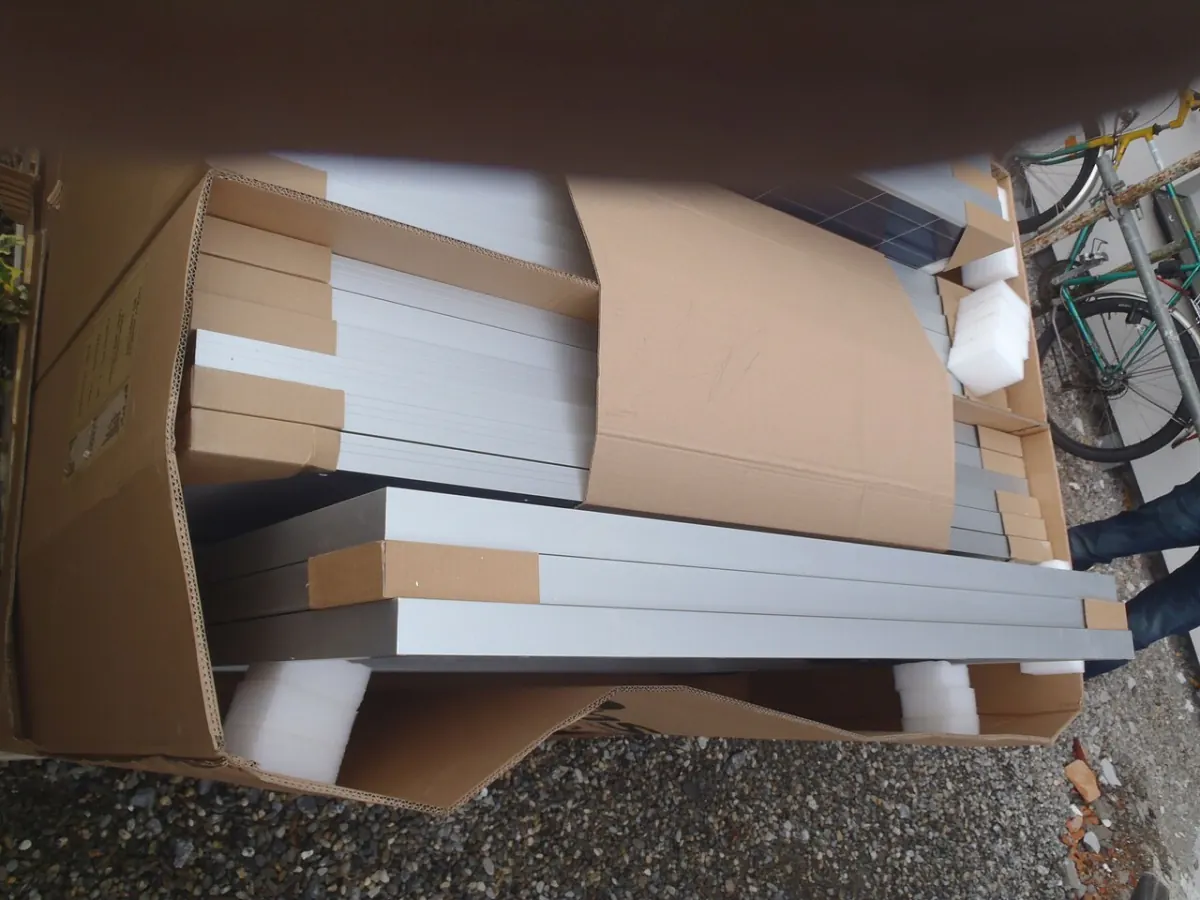

A single module goes as a parcel or you collect it. A pallet usually comes on a truck with a tail lift, or needs a forklift at your end. Neither cost is in the prices above, and on a small order the delivery can outweigh the discount.
Put the two listings you're weighing into the figure below, delivery included, and move your order to see where the pallet starts to pay.
Where a pallet starts to pay off
Type a single price, a pallet price per module, the pallet size and both deliveries, then move your order and see what each way of buying costs, delivery and leftover modules included.
How this is computed
Singles total = modules × single price + the singles delivery, paid once per order. Pallets = modules / modules per pallet, rounded up; pallet total = pallets × modules per pallet × pallet price per module + pallets × delivery per pallet. Leftover = modules bought on pallets - modules needed. Per watt = total / (modules needed × rated power), the watts you need, so leftovers count as cost and not as power.
Break-even is the smallest order where the pallet total is no higher than the singles total. It always falls within the first pallet: every further pallet adds the same difference against singles, and the singles delivery is paid only once, so a pallet that loses when full loses at every size. Past a full pallet the next one starts empty, which is why the pallet can win at 36 and lose at 37.
The model takes one delivery price for any number of singles, which is rarely true for a large order; type a higher one for a large order if your shop charges by the parcel. Both prices must be on the same side of VAT and in the same currency. It ignores what leftover modules could be resold for, payment fees, a forklift or tail lift at your end, and storage.
Illustrative model, not a measurement.
Limits of these figures
These are asking prices before shipping. A shop may sell below its listed price to installers or on larger orders.
The reading rule shapes the pack pool. It keeps titles that state a clear count, which may favour shops that write tidy titles, and it drops small sets whose two price readings overlap. The figures describe packs that state their size.
The pairing trusts the shop's manufacturer name and rated power. Two product lines from one manufacturer at the same wattage would pair as if they were one module, and a shop that names the manufacturer differently on its two listings wouldn't pair at all.
Currency conversion uses the ECB reference rate of the day the offer was read, which the ECB publishes for information only. A rate move shifts a non-euro market's figures without any shop changing a price. It doesn't touch a same-shop comparison, where both prices are in one currency.
Figures and denominators
How the figures above were computed. Every figure is recomputed from the catalogue and the live shop offers when the page is served, and each one counts only the modules or offers that publish the value.
The offers come from our crawler, which reads the public product pages of shops in several countries and keeps one current row per product page. A product page the crawler stops seeing drops out after a week, so the pool is the offers live when the page is served, not a price history. The crawler flags a listing as a pack when it sells more than one module.
The pack pool is every pack listing for a rooftop module, rated 400 to 800 W, with a price: 317 offers. A pack size counts only when the title states exactly one number of modules in a form we read mechanically: a number followed by a word for pieces or panels in one of the fleet's languages ("36 pcs", "36 szt", "36 Stk."), "pallet of 31" and its translations, or "36x" before the module name. A title with no such number, or with two different ones, gets no pack size. Kits sold by total kilowatts and listings with only a minimum order fall out here.
A pack price can mean the price of one module (a pallet price quoted per piece) or the price of the whole pack. We compute both readings, the price divided by the rated power and that again divided by the pack size, and keep the one that lands between 0.05 and 2 EUR/W, the band of the single-module pool. When both land in the band, the listing is ambiguous and left out; that happens with small packs, where the two readings sit close together.
Prices are the shop's price before VAT (before sales tax in the United States), converted to euro at the ECB reference rate of the day the offer was read, divided by the rated power the shop printed. The single-module pool is the one from our article on price per watt by market: 2,685 single rooftop module offers.
The same-shop comparison pairs each readable pack offer with the median price per watt of the single modules the same shop sells from the same manufacturer at the same rated power, as the shop names them. A pack offer whose shop sells no such single module is not paired. The difference is the pack's price per watt over the single module's, minus one, in percent. The shop-level figures take each shop's median difference, so one shop with many pallets counts once.
All 20 figures on this page and what each counts
| Figure | Value | Computed over |
|---|---|---|
| Pack offers cheaper per watt than the same shop's single module | 101 | 113 offers |
| Readable pack offers whose shop also sells a single module of the same make and rated power | 113 | 201 offers |
| Pack against the same shop's single module, price per watt difference, median | -3.8 % | 113 offers |
| Of those, shops whose median pack offer is cheaper per watt | 15 | 16 shops |
| Shops with a pack offer and a single module of the same make and rated power | 16 | 16 shops |
| Pallet and multipack offers for rooftop modules (400 to 800 W) with a price | 317 | 317 offers |
| Of those, offers whose title states one pack size | 223 | 317 offers |
| Of those, offers whose price reads one way only (per module or per pack) | 201 | 223 offers |
| Offers with a stated pack size whose price reads both ways | 22 | 223 offers |
| Readable pack offers priced for the whole pack | 158 | 201 offers |
| Readable pack offers priced per module | 43 | 201 offers |
| Readable pack offers of 25 modules or more | 165 | 201 offers |
| Shops with a readable pack offer | 30 | 201 offers |
| Shops in the same-shop comparison | 16 | 113 offers |
| Pack offers dearer per watt than the same shop's single module | 12 | 113 offers |
| Pack against the same shop's single module, price per watt difference, 25th percentile | -5.7 % | 113 offers |
| Pack against the same shop's single module, price per watt difference, 75th percentile | -2.3 % | 113 offers |
| Pack offers compared at the shop with the most of them | 26 | 16 shops |
| Pack against single module, the median shop's median difference | -4.0 % | 16 shops |
| Rooftop module offers in the price per watt pool | 2,685 | 2,685 offers |