
VSUN590N-144BMH-DG

590 Wp TOPCon Bifacial 80%
ComparePV verdict

Efficiency leader, no clear weak spot

Rank 3,779 of 14,005
Compare panels Datasheet PDF
Power (Wp)
590
Strong · top 18%
Efficiency (%)
22.84
Strong · top 15%
Density (Wp/m²)
228.4
Strong · top 17%
Temp (%/°C)
-0.300
Typical · median -0.290
Weight (kg)
32.7
Typical · median 31.2 kg
Warranty (yrs)
30
Typical · median 30 yrs

VSUN N-144BMH-DG photovoltaic modules utilize advanced N-type cell technology, which forms the foundation of their exceptional efficiency in variable weather conditions. Thanks to the bifacial double glass design, these panels can absorb solar radiation from both sides, which drastically increases energy production on surfaces with high reflectivity. The innovative half-cut and multi-busbar architecture effectively eliminates resistive losses and increases the module's resistance to mechanical damage, ensuring trouble-free operation for many years. This series was designed for investors planning utility-scale solar farms and modern commercial installations, where the priority is the highest yield per square meter. It addresses key industry challenges, such as LID-type degradation, offering significantly more stable power parameters in the long term than standard modules. What sets this series apart from the competition is its excellent temperature characteristics, allowing it to maintain high efficiency even during summer heatwaves. By choosing VSUN N-144BMH-DG, you choose technological reliability, which realistically translates into higher investment profitability and a faster return on capital in the Polish climate.

Ranking

1,018 panels in the segment TOPCon 550-600 W
Metric This panel Median Position in segment Overall rank
Module efficiency 22.84% 22.44% Strong · top 15% 2,617
Power density 228.4 224.4 Strong · top 17% 2,598
Temperature coefficient -0.300 -0.290 Typical 6,093
Weight per kWp 55.4 53.8 Typical 9,852
Performance warranty 30 yrs 30 yrs Typical 21
Colour key Strong - top 25% Typical - middle 50% Weak - bottom 25%

Signals from the data

2 positive · 0 caution
Best for

Utility-scale, commercial, shaded-installations and hot-climate.

Strengths
22.84% module efficiency

Top 15% of the TOPCon 550-600 W segment, against a median of 22.44%.

228.4 watts per square metre

Top 17% of the TOPCon 550-600 W segment, against a median of 224.4.

Notes from the database
  • At 22.8% efficiency, this panel is on par with typical TOPCon 550-600W modules
  • Power density of 228.4 W/m² packs 4.0 W/m² more into the same footprint vs TOPCon 550-600W median (224.4 W/m²)
  • Temperature coefficient of -0.30%/°C matches the TOPCon 550-600W median
  • At 32.7 kg, this panel is 1.5 kg heavier than the TOPCon 550-600W median (31.2 kg) - more demanding for installation crews
  • Bifaciality factor of 80% can add 4-12% extra yield with reflective mounting surface

Specifications

Open datasheet PDF
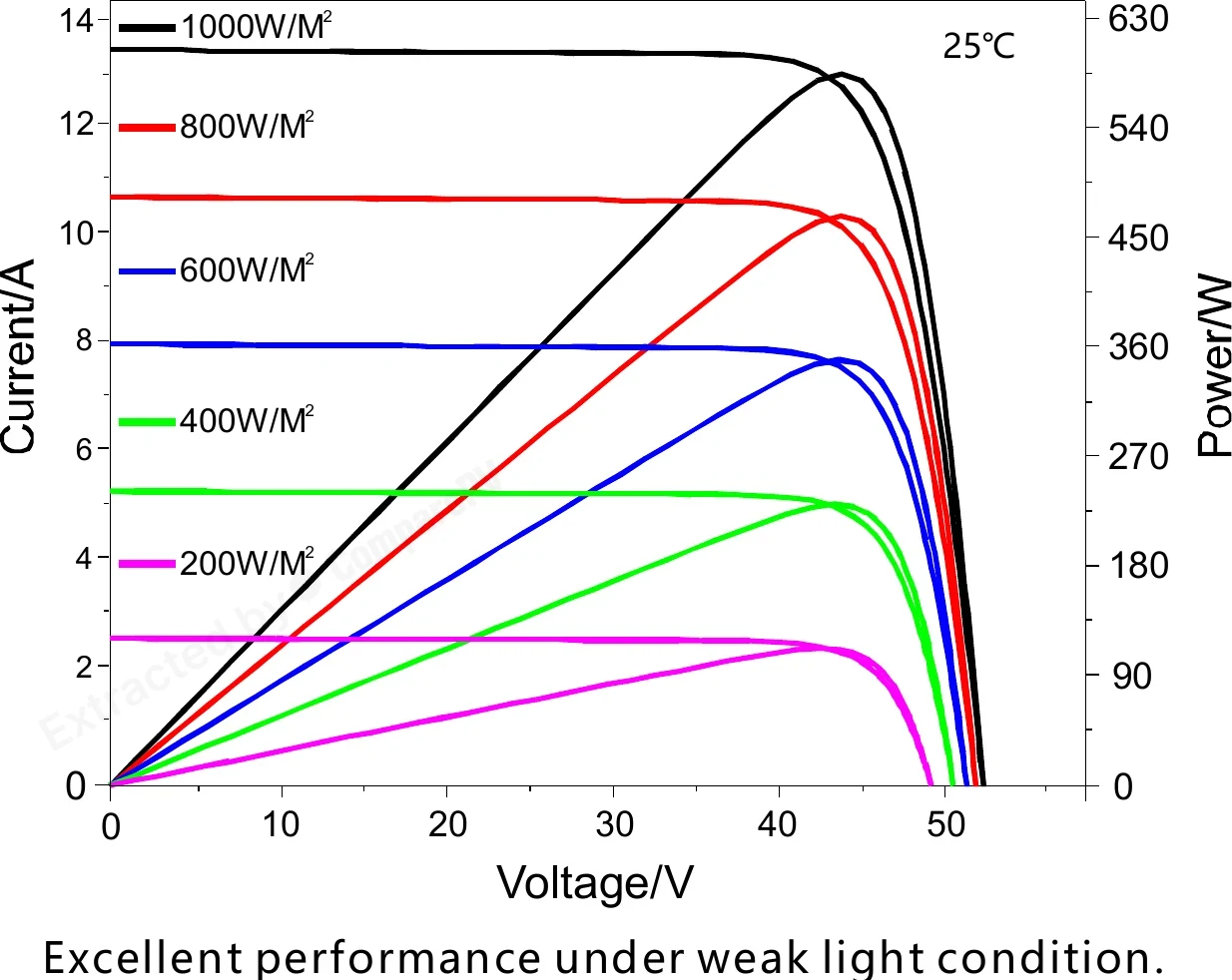
Nominal power (Pmax) 590 Wp Nameplate at 1000 W/m², 25 °C
Module efficiency 22.84 % Strong Segment median 22.44%
Vmpp · Impp 43.11 V · 13.69 A Operating point at max power
Voc · Isc 51.79 V · 14.49 A Sizes the string length
Max system voltage 1500 V Longer strings than 1000 V modules
Dimensions 2278×1134×35 mm · 2.58 m² of roof
Weight 32.7 kg Typical Typical · median 31.2 kg
Cells 144 · TOPCon Monocrystalline
Bifaciality 80 % Rear output as a share of front
Coefficient Pmax -0.300 %/°C Typical median -0.290 of its segment
Coefficient Voc · Isc -0.260 · 0.046 %/°C
NOCT 45 °C At 800 W/m², 20 °C ambient
Product warranty 12 years Hardware defects only
Performance warranty 30 years Typical median 30 yrs · median 30 yrs
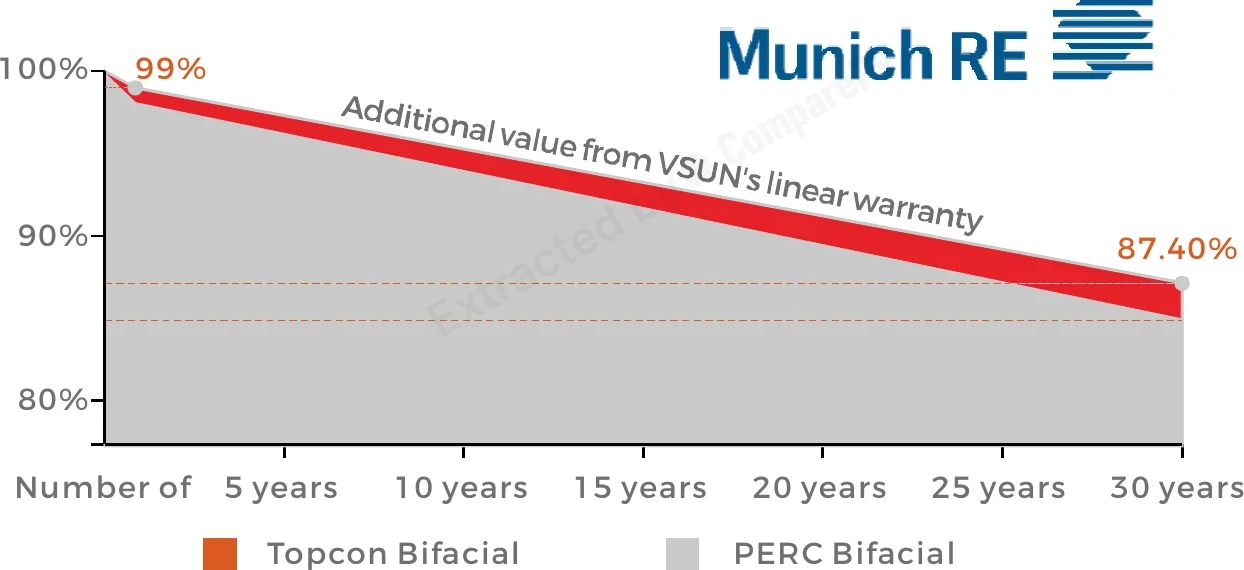
End-of-warranty output 87.4 % Equals 516 W guaranteed
Degradation 1.00 → 0.40 % First year, then annual

Datasheet charts

Open datasheet PDF

Measured curves published by VSUN in this model's datasheet. A chart carrying a wattage was measured on that variant alone - only the ones that describe 590 Wp appear here. The rest cover the whole series.
Simulations

Live - change any input
Lifetime output & value
30 years at 1200 kWh/kWp/year and €0.50 per kWh
Power in year 30
-
Lifetime energy
-
Energy value
-
With bifacial gain
-

Degradation from this panel's own datasheet figures. No inverter, soiling or shading losses.

Heat losses
-0.300 %/°C against a segment median of -0.290
-
Bifacial gain
Rear gain over light concrete: -
-

Model: bifaciality × albedo × 0.6 view factor. A first-order estimate, not a yield simulation.

Filter these
Size
Panel Power Eff. Temp. Weight Difference
VSUN VSUN590N-144BMH-DG 590 W 22.84% -0.300 32.7 kg You are here
LR7-60HVH-560M 560 W 24.80% -0.260 25.0 kg Cooler, lighter, +2.0 pp
AIKO-A640-MAE72Mw 640 W 24.80% -0.260 27.0 kg +50 W, lighter, +2.0 pp
LR7-60HVH-555M 555 W 24.60% -0.260 25.0 kg Cooler, lighter, +1.8 pp
AIKO-A635-MAE72Mw 635 W 24.60% -0.260 27.0 kg +45 W, lighter, +1.8 pp
AIKO-A630-MAH72Dw 630 W 24.40% -0.260 32.5 kg +40 W, cooler, +1.6 pp
LR7-60HVHL-550M 550 W 24.40% -0.260 16.3 kg -40 W, 16 kg lighter, +1.6 pp
VSUN535-144MH 535 W 20.71% -0.320 28.8 kg -55 W, -2.1 pp, -5 yr warranty
VSUN540-144MH 540 W 20.90% -0.320 28.8 kg -50 W, -1.9 pp, -5 yr warranty
VSUN545-144MH 545 W 21.10% -0.320 28.8 kg -45 W, -1.7 pp, -5 yr warranty
VSUN550-144BMH 550 W 21.29% -0.320 28.8 kg -40 W, lighter, -1.6 pp
AIKO-A650-MAE72Mw 650 W 25.20% -0.260 27.0 kg +60 W, lighter, +2.4 pp
AIKO-A645-MAE72Mw 645 W 25.00% -0.260 27.0 kg +55 W, lighter, +2.2 pp

Found 2326 panels of the same or similar size to this one, within ±10 mm. See them here Found 2368 panels of the same or similar size to this one, within ±25 mm. See them here Found 2382 panels of the same or similar size to this one, within ±50 mm. See them here Found 2547 panels of the same or similar size to this one, within ±100 mm. See them here

Common questions

6 answered
How much extra energy does the bifacial design of the VSUN N-144BMH-DG generate?
The bifacial double-glass design allows the module to capture reflected radiation on its rear side as well. With a high-albedo surface (white gravel, reflective sheeting, or snow) and proper mounting height, the additional annual energy yield can range from a few percent up to double digits compared to a standard monofacial module. The biggest gains occur on ground-mounted solar farms rather than typical sloped residential roofs where the rear side is blocked.
How does the TOPCon technology in the VSUN N-144BMH-DG differ from standard PERC cells?
N-type TOPCon cells have higher base efficiency and are significantly less prone to LID (Light Induced Degradation) than common P-type PERC cells. This means the module loses less power in its early years and maintains higher performance over the long term, translating into genuinely higher energy output throughout the 30-year linear power warranty period.
What warranty comes with the VSUN N-144BMH-DG solar panels?
The manufacturer provides a 12-year product warranty covering material and workmanship defects, plus a 30-year linear power output warranty. This means that even after 30 years of operation, the module is guaranteed to retain a high percentage of its original power rating — an important factor when calculating long-term investment returns.
What type of installations is the VSUN N-144BMH-DG, rated up to 590 Wp, best suited for?
Given its high unit power output of up to 590 Wp and double-glass construction, this series is primarily designed for utility-scale solar farms and large commercial installations, where maximizing energy yield per square meter is the priority. The large dimensions and weight make it a less typical choice for small residential rooftop installations on sloped roofs.
Does the VSUN N-144BMH-DG perform well in high summer temperatures?
Yes, modules built on N-type TOPCon cells have a more favorable power temperature coefficient than standard PERC panels, resulting in a smaller performance drop during hot weather. This means the panel maintains more stable energy production on hot, sunny days, which is relevant for installations in Poland's increasingly warm summers.
Does the half-cut and multi-busbar design of the VSUN N-144BMH-DG improve resistance to damage?
Yes, splitting cells into halves (half-cut) combined with multi-busbar technology reduces resistive losses and distributes mechanical stress across more connection points. This makes the module less susceptible to micro-cracks and hot-spot effects — for example from partial shading, snow loads, or strong wind — resulting in longer, more reliable operation.
Add to compare