SKT430M10-108D5

430 Wp N-type Bifacial
ComparePV verdict

Solid all-round for its segment

Rank 9,660 of 14,005
Compare panels Datasheet PDF
Power (Wp)
430
Typical for its class
Efficiency (%)
22.00
Typical · median 21.91%
Density (Wp/m²)
220.2
Typical · median 218.3
Temp (%/°C)
-0.290
Typical · median -0.290
Weight (kg)
23.4
Typical · median 22.0 kg
Warranty (yrs)
30
Typical · median 30 yrs

The SunKean Mono Half Cell PV Module (Double Glass Bifacial) combines a double glass structure with bifacial energy harvesting, thereby realistically improving energy yield in locations where light reflects off the ground - on bright roofs, membranes, gravel, or in ground-mounted installations. The use of monocrystalline half-cell technology stabilizes module performance under partial shading and reduces losses due to heating, resulting in more predictable daily energy production. Furthermore, the multi-busbar architecture supports more efficient current collection and better resistance to micro-cracks in everyday operation. This series is available in technologies such as TOPCon or HJT, allowing for easy selection of a module based on priority - maximum energy yield or stability at higher temperatures. This solution is ideal for demanding commercial, industrial, and PV farm installations, where the durability of the laminate, safety, and additional yield from the back of the module are crucial.

Ranking

321 panels in the segment N-type 400-450 W
Metric This panel Median Position in segment Overall rank
Module efficiency 22.00% 21.91% Typical 6,517
Power density 220.2 218.3 Typical 6,481
Temperature coefficient -0.290 -0.290 Typical 2,165
Weight per kWp 54.4 51.2 Typical 8,720
Performance warranty 30 yrs 30 yrs Typical 21
Colour key Strong - top 25% Typical - middle 50% Weak - bottom 25%

Signals from the data

0 positive · 0 caution
Best for

Commercial, shaded-installations and hot-climate.

Notes from the database
  • Efficiency of 22.0% matches the N-type 400-450W median
  • Power density of 220.2 W/m² matches the N-type 400-450W median
  • At -0.29%/°C, hot weather performance is typical for N-type 400-450W panels
  • At 23.4 kg (1.4 kg above N-type 400-450W median of 22.0 kg), requires checking roof load capacity
  • Ranked #6517 out of 14005 panels for efficiency in the database

Specifications

Open datasheet PDF
Nominal power (Pmax) 430 Wp Nameplate at 1000 W/m², 25 °C
Module efficiency 22.00 % Typical Segment median 21.91%
Vmpp · Impp 32.34 V · 13.30 A Operating point at max power
Voc · Isc 38.72 V · 13.91 A Sizes the string length
Max system voltage 1500 V Longer strings than 1000 V modules
Dimensions 1722×1134×30 mm · 1.95 m² of roof
Weight 23.4 kg Typical Typical · median 22.0 kg
Cells 108 · N-type Monocrystalline
Coefficient Pmax -0.290 %/°C Typical median -0.290 of its segment
Coefficient Voc · Isc -0.250 · 0.045 %/°C
NOCT 45 °C At 800 W/m², 20 °C ambient
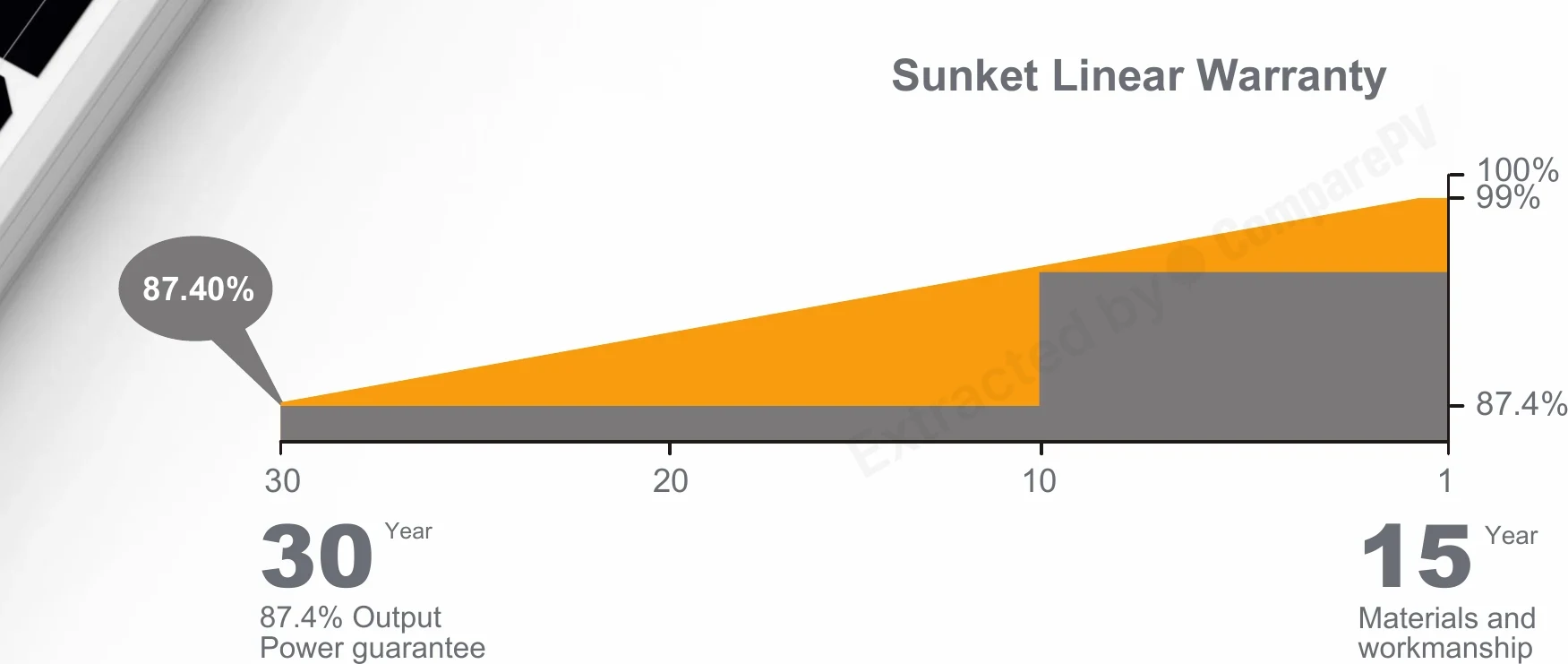
Product warranty 15 years Hardware defects only
Performance warranty 30 years Typical median 30 yrs · median 30 yrs
End-of-warranty output 87.4 % Equals 376 W guaranteed
Degradation 1.00 % First year

Datasheet charts

Open datasheet PDF

Measured curves published by SunKean in this model's datasheet. A chart carrying a wattage was measured on that variant alone - only the ones that describe 430 Wp appear here. The rest cover the whole series.
Simulations

Live - change any input
Lifetime output & value
30 years at 1200 kWh/kWp/year and €0.50 per kWh
Power in year 30
-
Lifetime energy
-
Energy value
-

Degradation from this panel's own datasheet figures. No inverter, soiling or shading losses.

Heat losses
-0.290 %/°C against a segment median of -0.290
-

Alternatives

All SunKean panels
Filter these
Size
Panel Power Eff. Temp. Weight Difference
SunKean SKT430M10-108D5 430 W 22.00% -0.290 23.4 kg You are here
AIKO-A480-MAH54Mw 480 W 24.10% -0.260 21.5 kg +50 W, cooler, +2.1 pp
GK-5-54HG-480M 480 W 24.10% -0.260 21.0 kg +50 W, cooler, +2.1 pp
JKM480N-48QL6-DB-F2-EU 480 W 24.02% -0.260 24.4 kg +50 W, cooler, +2.0 pp
GKA96N-PRO-480W 480 W 24.02% -0.300 21.0 kg +50 W, lighter, +2.0 pp
SKT345M10 345 W 17.70% -0.290 20.5 kg -85 W, -4.3 pp, -5 yr warranty
SKT350M10 350 W 17.90% -0.290 20.5 kg -80 W, -4.1 pp, -5 yr warranty
SKT355M10 355 W 18.20% -0.290 20.5 kg -75 W, -3.8 pp, -5 yr warranty
SKT360M10 360 W 18.40% -0.290 20.5 kg -70 W, -3.6 pp, -5 yr warranty
SKT365M10 365 W 18.70% -0.290 20.5 kg -65 W, -3.3 pp, -5 yr warranty
SKT385M10 385 W 19.80% -0.350 23.4 kg -45 W, hotter, -2.2 pp
SKT390M10 390 W 20.00% -0.350 23.4 kg -40 W, hotter, -2.0 pp
SKT395M10 395 W 20.20% -0.350 23.4 kg -35 W, hotter, -1.8 pp
SKT400M10 400 W 20.50% -0.350 23.4 kg -30 W, hotter, -1.5 pp
SKT405M10 405 W 20.80% -0.350 23.4 kg -25 W, hotter, -1.2 pp
LR7-54HJD-510M 510 W 25.00% -0.240 23.5 kg +80 W, cooler, +3.0 pp
AIKO-A495-MCE54Mw 495 W 24.80% -0.260 21.0 kg +65 W, cooler, +2.8 pp

Found 1783 panels of the same or similar size to this one, within ±10 mm. See them here Found 1914 panels of the same or similar size to this one, within ±25 mm. See them here Found 3392 panels of the same or similar size to this one, within ±50 mm. See them here Found 3970 panels of the same or similar size to this one, within ±100 mm. See them here

Common questions

6 answered
How much extra energy can I get from the bifacial feature in the SunKean Mono Half Cell Double Glass Bifacial series?
Bifacial modules can boost total energy yield by 5–20% compared to standard monofacial panels, depending on the ground albedo. The best results occur on high-reflectance surfaces such as white TPO membranes, light-colored gravel, or concrete, as well as ground-mount systems over grass. On a typical dark rooftop the gain is smaller but still measurable thanks to diffuse and side-reflected light reaching the rear cell surface.
What warranty comes with SunKean Mono Half Cell Double Glass Bifacial modules?
The series carries a 15-year product warranty covering material defects and workmanship, plus a 30-year linear power output warranty. Over those 30 years the manufacturer guarantees that output will not fall below defined degradation thresholds — a standard commitment for this class of N-type modules. Always confirm the full warranty terms and local service coverage with an authorized distributor before purchasing.
Why does the SunKean Double Glass Bifacial series use a glass-glass construction instead of a polymer backsheet, and does it matter for durability?
The double glass design replaces the conventional polymer backsheet with a second tempered glass sheet. Glass is significantly more resistant to moisture ingress, UV degradation, and mechanical stress than polymer films, which meaningfully extends module service life and reduces PID degradation risk. This matters most in humid climates, high-wind sites, or hail-prone regions. The trade-off is added weight, which requires a properly rated mounting structure.
What is the difference between the TOPCon and HJT variants in the SunKean Bifacial series, and which one should I choose?
TOPCon cells deliver high efficiency and excellent temperature stability, making them a strong choice for large commercial installations in warm climates. HJT (Heterojunction) cells feature an even lower temperature coefficient and virtually no LID initial degradation, but typically come at a higher cost per watt. If maximizing annual yield on a space-constrained rooftop is the priority, HJT is worth considering; for large-scale PV farms where LCOE optimization drives decisions, TOPCon will generally be more cost-effective.
Are SunKean 430 Wp Mono Half Cell Double Glass Bifacial modules suitable for a utility-scale PV farm?
Yes, the series is designed for demanding commercial, industrial, and utility-scale PV applications. The 430 Wp rating, N-type cell technology, half-cut multi-busbar architecture, and bifacial energy capture combine to deliver higher yield per square meter and a lower LCOE in ground-mount systems. The durable glass-glass laminate reduces long-term O&M costs. Before finalizing the project design, verify that the modules carry IEC 61215 and IEC 61730 certifications.
How do half-cut cells and multi-busbar design in the SunKean Bifacial series affect performance under partial shading?
Splitting each cell in half means both halves operate semi-independently — shading one portion of the module no longer blocks the full string as severely as in a conventional full-cell design. The multi-busbar architecture shortens the current path and reduces internal resistance, cutting resistive losses under low-irradiance conditions. Together, these features stabilize daily energy production and lower the risk of hot-spots when partial shading is unavoidable.
Add to compare