Resun Solar RS9V-M-DG-550

RS9V-M-DG-550

550 Wp TOPCon Bifacial 1000%
ComparePV verdict

Middle of its segment, modest efficiency

Rank 5,993 of 14,005
Compare panels Datasheet PDF
Power (Wp)
550
Weak · bottom 2%
Efficiency (%)
21.51
Weak · bottom 8%
Density (Wp/m²)
215.1
Weak · bottom 8%
Temp (%/°C)
-0.300
Typical · median -0.290
Weight (kg)
31.2
Weak · bottom 12%
Warranty (yrs)
30
Typical · median 30 yrs

The RS9V-M-DG series consists of bifacial photovoltaic modules built around N-type TOPCon cells, combining high conversion efficiency with a lower temperature coefficient than conventional P-type designs. The use of MBB (multi-busbar) technology reduces resistive losses and improves current collection uniformity across the cell surface, resulting in more stable energy yield under partial shading conditions. The panel features a dual glass construction, boosting mechanical strength and module lifespan, and thanks to its high bifaciality it captures additional energy reflected from the ground, making it especially well suited for ground-mount installations and light-colored roof surfaces. Strong resistance to PID (potential-induced degradation) together with compatibility with 1500V systems helps lower BoS costs and simplifies design for large commercial installations and utility-scale PV farms. This is a solution for investors seeking modules with long service life, predictable power degradation over time, and rugged construction able to withstand demanding operating conditions, setting it apart from standard monofacial P-type panels.

Ranking

1,018 panels in the segment TOPCon 550-600 W
Metric This panel Median Position in segment Overall rank
Module efficiency 21.51% 22.44% Weak · bottom 8% 7,894
Power density 215.1 224.4 Weak · bottom 8% 7,874
Temperature coefficient -0.300 -0.290 Typical 6,093
Weight per kWp 56.7 53.8 Weak · bottom 12% 10,830
Performance warranty 30 yrs 30 yrs Typical 21
Colour key Strong - top 25% Typical - middle 50% Weak - bottom 25%

Signals from the data

0 positive · 3 caution
Best for

Commercial and utility-scale.

Not ideal for

Tight roof space, roofs where every square metre has to count and weight-limited structures.

Watch-outs
21.51% module efficiency

Bottom 8% of the TOPCon 550-600 W segment, against a median of 22.44%. Ranked 7,894th in the whole database.

215.1 watts per square metre

Bottom 8% of the TOPCon 550-600 W segment, against a median of 224.4. Ranked 7,874th in the whole database.

56.7 kg per kWp

Bottom 12% of the TOPCon 550-600 W segment, against a median of 53.8.

Notes from the database
  • At 21.5% efficiency, this panel is 0.9pp below the TOPCon 550-600W median of 22.4%
  • Power density of 215.1 W/m² is 9.3 W/m² below TOPCon 550-600W median (224.4 W/m²) - needs more roof space
  • At -0.30%/°C, hot weather performance is typical for TOPCon 550-600W panels
  • In the top 56% for efficiency among all TOPCon panels

Specifications

Open datasheet PDF
Nominal power (Pmax) 550 Wp Nameplate at 1000 W/m², 25 °C
Module efficiency 21.51 % Weak Segment median 22.44%
Vmpp · Impp 32.21 V · 17.08 A Operating point at max power
Voc · Isc 38.65 V · 18.13 A Sizes the string length
Max system voltage 1500 V Longer strings than 1000 V modules
Dimensions 1962×1303×35 mm · 2.56 m² of roof
Weight 31.2 kg Weak Weak · bottom 12%
Cells 108 · TOPCon Monocrystalline
Bifaciality 1000 % Rear output as a share of front
Coefficient Pmax -0.300 %/°C Typical median -0.290 of its segment
Coefficient Voc · Isc -0.250 · 0.045 %/°C
NOCT 45 °C At 800 W/m², 20 °C ambient
Product warranty 15 years Hardware defects only
Performance warranty 30 years Typical median 30 yrs · median 30 yrs
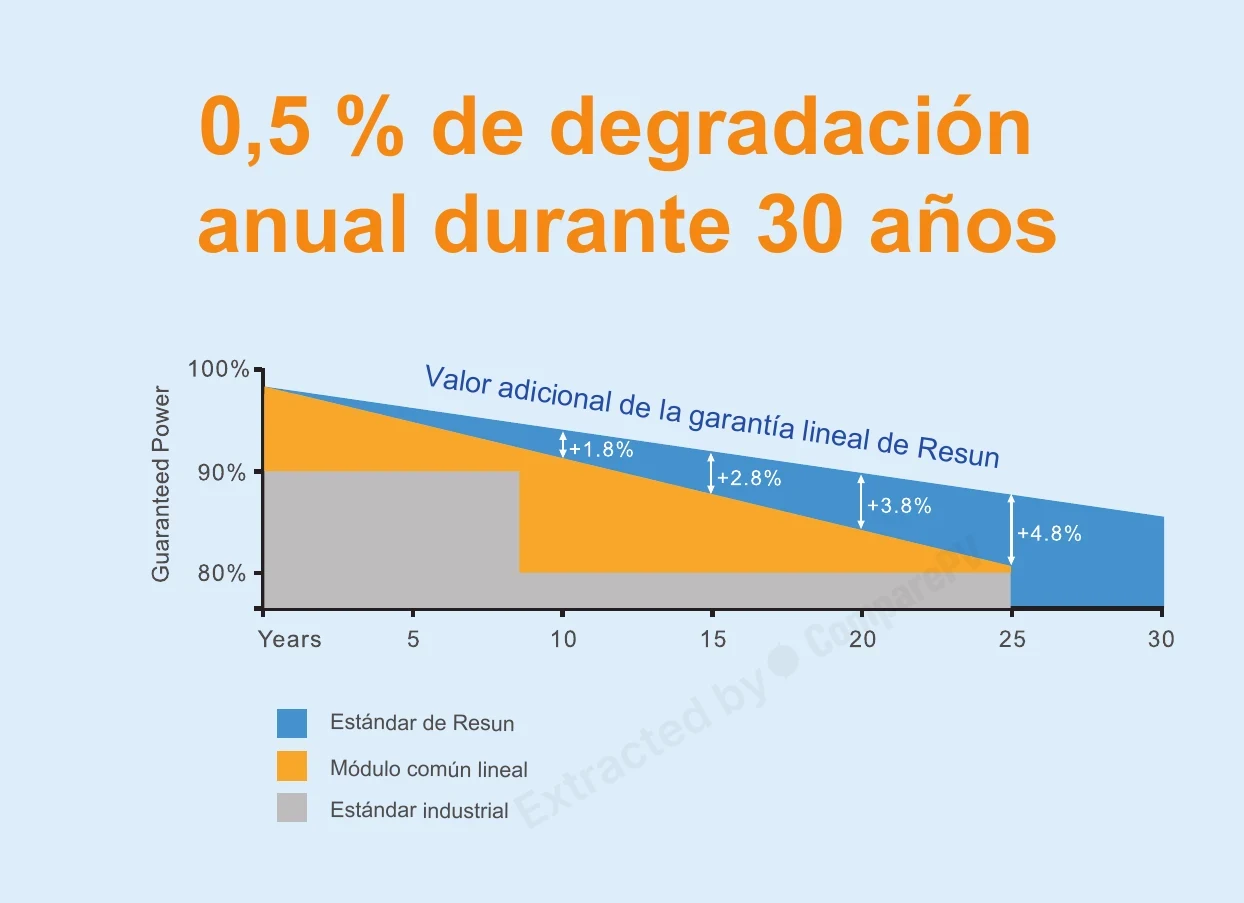
Degradation 0.50 % Per year after the first

Datasheet charts

Open datasheet PDF

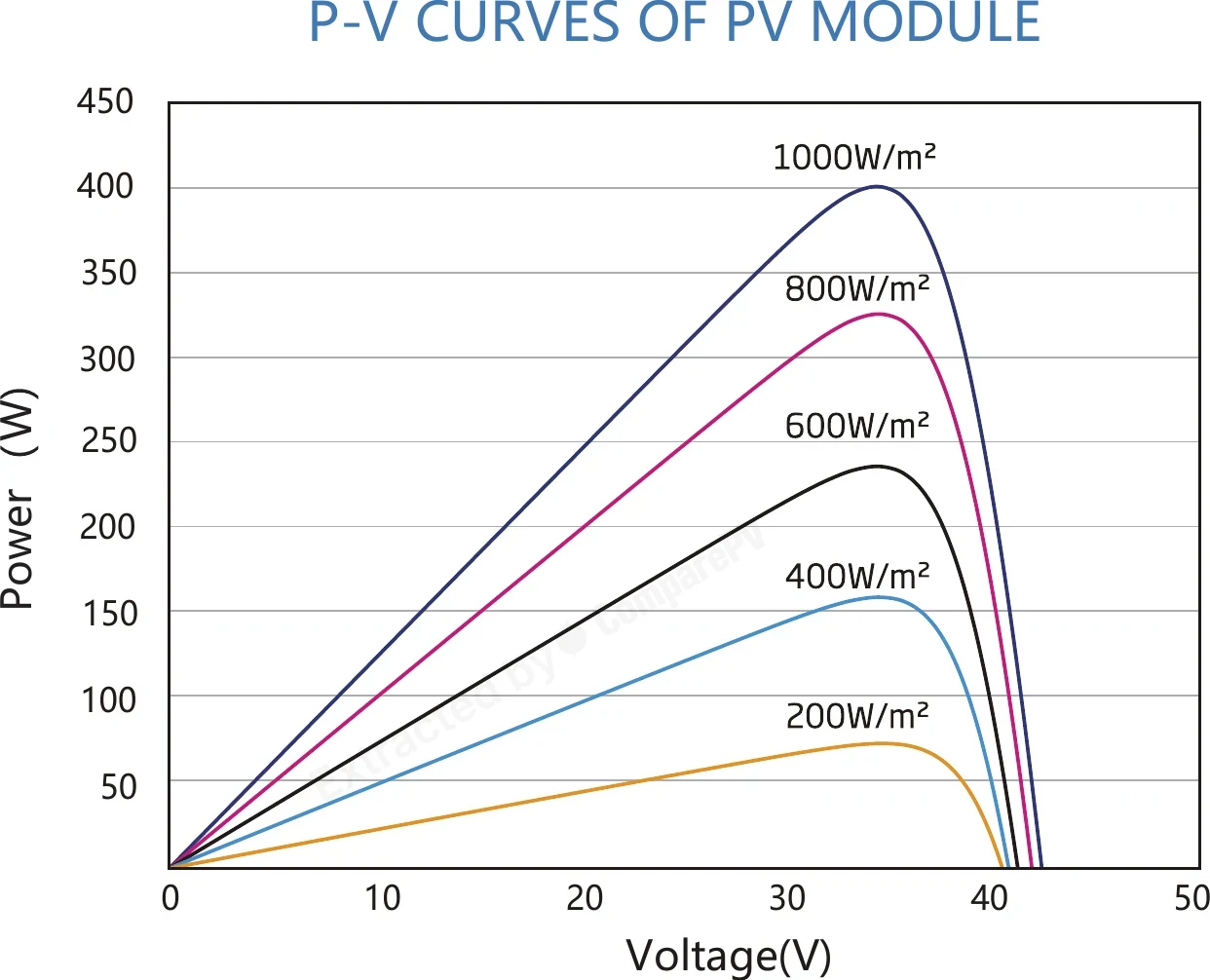
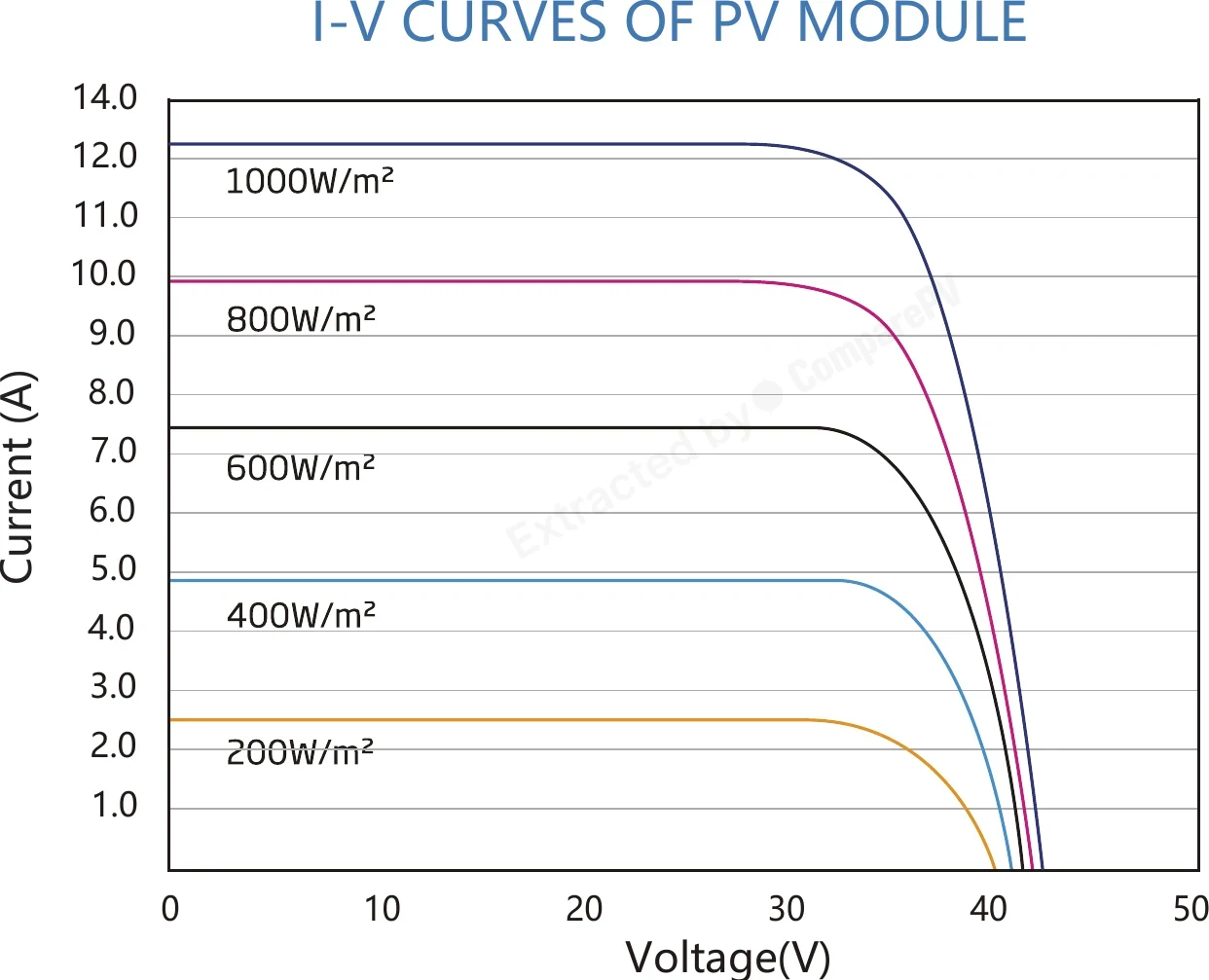
Measured curves published by Resun Solar in this model's datasheet. A chart carrying a wattage was measured on that variant alone - only the ones that describe 550 Wp appear here. The rest cover the whole series.
Simulations

Live - change any input
Lifetime output & value
30 years at 1200 kWh/kWp/year and €0.50 per kWh
Power in year 30
-
Lifetime energy
-
Energy value
-
With bifacial gain
-

Degradation from this panel's own datasheet figures. No inverter, soiling or shading losses.

Heat losses
-0.300 %/°C against a segment median of -0.290
-
Bifacial gain
Rear gain over light concrete: -
-

Model: bifaciality × albedo × 0.6 view factor. A first-order estimate, not a yield simulation.

Alternatives

All Resun Solar panels
Filter these
Size
Panel Power Eff. Temp. Weight Difference
Resun Solar RS9V-M-DG-550 550 W 21.51% -0.300 31.2 kg You are here
LR7-54HJD-510M 510 W 25.00% -0.240 23.5 kg Cooler, lighter, +3.5 pp
LR7-60HVH-560M 560 W 24.80% -0.260 25.0 kg Cooler, lighter, +3.3 pp
LR7-54HJD-505M 505 W 24.70% -0.240 23.5 kg Cooler, lighter, +3.2 pp
LR7-60HVH-555M 555 W 24.60% -0.260 25.0 kg Cooler, lighter, +3.1 pp
LR7-54HJD-500M 500 W 24.50% -0.240 23.5 kg Cooler, lighter, +3.0 pp
RS9V-M-DG-555 555 W 21.71% -0.300 31.2 kg Very close match
RS9V-M-DG-560 560 W 21.91% -0.300 31.2 kg +10 W, +0.4 pp
RS9V-M-DG-565 565 W 22.10% -0.300 31.2 kg +15 W, +0.6 pp
RS9V-M-DG-570 570 W 22.30% -0.300 31.2 kg +20 W, +0.8 pp
RS9V-M-DG-575 575 W 22.49% -0.300 31.2 kg +25 W, +1.0 pp
RS9V-M-DG-580 580 W 22.69% -0.300 31.2 kg +30 W, +1.2 pp
RS9V-M-DG-585 585 W 22.88% -0.300 31.2 kg +35 W, +1.4 pp
RS9V-M-DG-590 590 W 23.08% -0.300 31.2 kg +40 W, +1.6 pp
JT590SJk(B) 590 W 23.10% -0.240 30.7 kg +40 W, cooler, +1.6 pp
JT585SJk(B) 585 W 22.90% -0.240 30.7 kg +35 W, cooler, +1.4 pp
GKA210N108-580W 580 W 22.71% -0.340 25.5 kg Hotter, lighter, +1.2 pp

Found 31 panels of the same or similar size to this one, within ±10 mm. See them here Found 41 panels of the same or similar size to this one, within ±25 mm. See them here Found 41 panels of the same or similar size to this one, within ±50 mm. See them here Found 85 panels of the same or similar size to this one, within ±100 mm. See them here

Common questions

6 answered
How do the N-type TOPCon cells in the RS9V-M-DG differ from classic P-type cells?
The N-type TOPCon cells used in the RS9V-M-DG series deliver higher conversion efficiency and a lower temperature coefficient than P-type PERC cells, meaning less power loss on hot days. They also degrade more slowly over time and resist LID better, resulting in higher annual energy yield, especially in warmer climates.
Do bifacial RS9V-M-DG panels actually generate more energy?
Yes, thanks to the dual glass design and transparent rear side, the module captures additional light reflected off the ground, which over a bright surface, gravel, or white roof membrane can boost yield by several to over a dozen percent compared to a standard monofacial panel. The effect is strongest in ground-mount installations and elevated racking systems where light can freely reach the panel's underside.
What warranty comes with Resun Solar RS9V-M-DG panels?
Resun Solar provides a 15-year product warranty and a 30-year linear power output warranty for the RS9V-M-DG series. This warranty length is typical for modern TOPCon modules and reflects a predictable, gradual power decline over the years, making return-on-investment planning easier.
Are RS9V-M-DG panels compatible with 1500V systems and large-scale PV farms?
Yes, RS9V-M-DG modules are designed for systems up to 1500V, allowing longer string configurations and fewer cables and inverters in large installations. Combined with strong resistance to potential-induced degradation (PID), this reduces balance-of-system (BoS) costs on commercial projects and utility-scale solar farms.
What is the maximum power output of the RS9V-M-DG, and how many panels are needed for a typical home installation?
The highest-power version in the RS9V-M-DG series reaches 590 Wp. A typical 10 kWp residential system requires roughly 17 such panels, though the exact number depends on available roof area and inverter configuration. The high per-module power output helps fit more kilowatts onto a limited roof surface.
Does the multi-busbar (MBB) technology in the RS9V-M-DG affect performance under partial shading?
Yes, MBB technology spreads more narrow conductive paths across the cell surface, reducing resistive losses and improving current collection uniformity. In practice, this means a smaller performance drop when part of the panel is shaded, such as by a chimney, antenna, or passing cloud, compared to older designs with fewer busbars.
Add to compare