Resun Solar RS9K-M-DG-630

RS9K-M-DG-630

630 Wp TOPCon Bifacial
ComparePV verdict

Middle of its segment, needs the roof space

Rank 2,446 of 14,005
Compare panels Datasheet PDF
Power (Wp)
630
Typical for its class
Efficiency (%)
22.26
Weak · bottom 16%
Density (Wp/m²)
222.6
Weak · bottom 16%
Temp (%/°C)
-0.300
Weak · bottom 19%
Weight (kg)
34.5
Weak · 1.8 kg above median
Warranty (yrs)
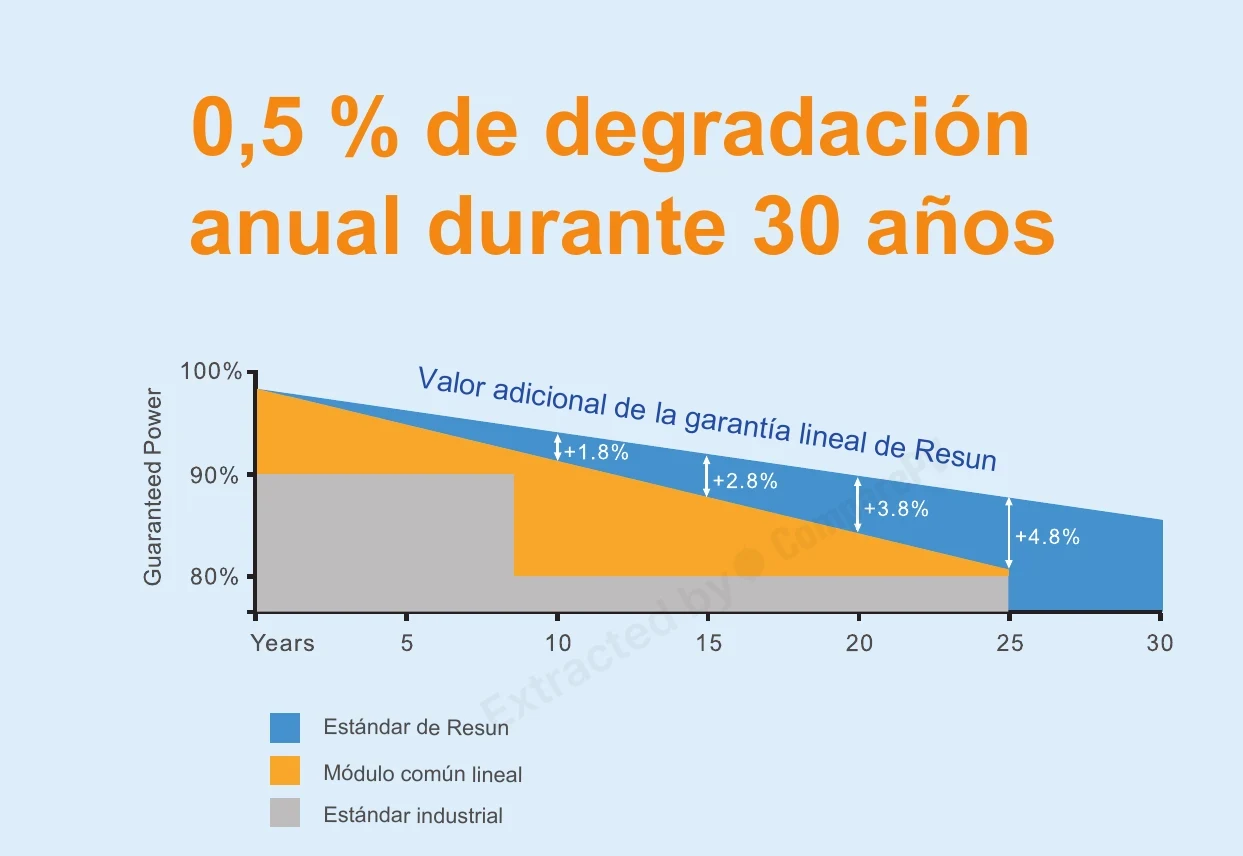
30
Typical · median 30 yrs

The RS9K-M-DG series consists of bifacial, dual-glass photovoltaic modules designed for investors who expect maximum durability and stable energy yield over decades of operation. At the core of the design are monocrystalline N-type TOPCon cells with multi-busbar (MBB) technology, which reduce internal power losses and boost conversion efficiency while lowering the risk of microcracks and busbar breakage. Combining this solution with half-cell technology significantly improves the module's resistance to the hot-spot effect caused by partial shading, meaningfully extending system lifespan in demanding installation conditions. The panels also stand out for their high resistance to potential-induced degradation (anti-PID), allowing them to maintain stable energy output and lower the levelized cost of energy (LCOE) throughout their lifetime. Tempered front glass measuring 2.0+2.0 mm with an anti-reflective coating improves performance in low-light conditions, while certified resistance to wind and snow loads as well as salt mist and ammonia makes this series suitable for both rooftop installations and ground-mounted farms in harsh climates. The manufacturer backs the modules with a 30-year linear power warranty, confirming confidence in the product's quality and long-term stability. RS9K-M-DG is the choice for installers and investors who prioritize reliability, strong return on investment, and reduced operational risk.

Ranking

1,086 panels in the segment TOPCon 600-650 W
Metric This panel Median Position in segment Overall rank
Module efficiency 22.26% 22.80% Weak · bottom 16% 5,593
Power density 222.6 227.7 Weak · bottom 16% 5,501
Temperature coefficient -0.300 -0.290 Weak · bottom 19% 6,093
Weight per kWp 54.8 53.1 Weak · bottom 20% 9,157
Performance warranty 30 yrs 30 yrs Typical 21
Colour key Strong - top 25% Typical - middle 50% Weak - bottom 25%

Signals from the data

0 positive · 3 caution
Not ideal for

Roofs where every square metre has to count, tight roof space and hot climates.

Watch-outs
222.6 watts per square metre

Bottom 16% of the TOPCon 600-650 W segment, against a median of 227.7.

22.26% module efficiency

Bottom 16% of the TOPCon 600-650 W segment, against a median of 22.80%.

-0.300 %/°C temperature coefficient

Bottom 19% of the TOPCon 600-650 W segment, against a median of -0.290.

Notes from the database
  • Efficiency of 22.3% is 0.5pp below the TOPCon 600-650W median (22.8%)
  • At 222.6 W/m², this panel generates 5.1 W/m² less per unit area than TOPCon 600-650W median (227.7 W/m²)
  • At -0.30%/°C, hot weather performance is typical for TOPCon 600-650W panels
  • At 34.5 kg, this panel is 1.8 kg heavier than the TOPCon 600-650W median (32.7 kg) - more demanding for installation crews
  • In the top 40% for efficiency among all TOPCon panels

Specifications

Open datasheet PDF
Nominal power (Pmax) 630 Wp Nameplate at 1000 W/m², 25 °C
Module efficiency 22.26 % Weak Segment median 22.80%
Vmpp · Impp 36.53 V · 17.25 A Operating point at max power
Voc · Isc 43.75 V · 18.27 A Sizes the string length
Max system voltage 1500 V Longer strings than 1000 V modules
Dimensions 2172×1303×35 mm · 2.83 m² of roof
Weight 34.5 kg Weak Weak · 1.8 kg above median
Cells 120 · TOPCon Monocrystalline
Coefficient Pmax -0.300 %/°C Weak bottom 19% of its segment
Coefficient Voc · Isc -0.250 · 0.045 %/°C
NOCT 45 °C At 800 W/m², 20 °C ambient
Product warranty 15 years Hardware defects only
Performance warranty 30 years Typical median 30 yrs · median 30 yrs
Degradation 0.50 % Per year after the first

Datasheet charts

Open datasheet PDF

Measured curves published by Resun Solar in this model's datasheet. A chart carrying a wattage was measured on that variant alone - only the ones that describe 630 Wp appear here. The rest cover the whole series.
Simulations

Live - change any input
Lifetime output & value
30 years at 1200 kWh/kWp/year and €0.50 per kWh
Power in year 30
-
Lifetime energy
-
Energy value
-

Degradation from this panel's own datasheet figures. No inverter, soiling or shading losses.

Heat losses
-0.300 %/°C against a segment median of -0.290
-

Alternatives

All Resun Solar panels
Filter these
Size
Panel Power Eff. Temp. Weight Difference
Resun Solar RS9K-M-DG-630 630 W 22.26% -0.300 34.5 kg You are here
AIKO-A650-MAE72Mw 650 W 25.20% -0.260 27.0 kg Cooler, lighter, +2.9 pp
AIKO-A680-MDE72Mw 680 W 25.20% -0.260 29.0 kg +50 W, lighter, +2.9 pp
AIKO-A675-MDE72Mw 675 W 25.00% -0.260 29.0 kg +45 W, lighter, +2.7 pp
AIKO-A645-MAE72Mw 645 W 25.00% -0.260 27.0 kg Cooler, lighter, +2.7 pp
AIKO-G670-MCH72Mw 670 W 24.80% -0.260 28.2 kg +40 W, lighter, +2.5 pp
LR7-72HVHF-670M 670 W 24.80% -0.260 28.5 kg +40 W, lighter, +2.5 pp
AIKO-A640-MAE72Mw 640 W 24.80% -0.260 27.0 kg Cooler, lighter, +2.5 pp
RS9K-M-DG-610 610 W 21.55% -0.300 34.5 kg -20 W, -0.7 pp
RS9K-M-DG-615 615 W 21.73% -0.300 34.5 kg -15 W, -0.5 pp
RS9K-M-DG-620 620 W 21.91% -0.300 34.5 kg -10 W, -0.4 pp
RS9K-M-DG-625 625 W 22.08% -0.300 34.5 kg Very close match
RS9K-M-DG-635 635 W 22.44% -0.300 34.5 kg Very close match
GKA210N120 680 W 24.03% -0.340 28.0 kg +50 W, lighter, +1.8 pp
GKA210N120-675 675 W 23.85% -0.340 28.0 kg +45 W, lighter, +1.6 pp
QN-670HJT-01 670 W 23.70% -0.240 35.5 kg +40 W, cooler, +1.4 pp
GKA210N120-670 670 W 23.67% -0.340 28.0 kg Hotter, lighter, +1.4 pp

Found 497 panels of the same or similar size to this one, within ±10 mm. See them here Found 502 panels of the same or similar size to this one, within ±25 mm. See them here Found 502 panels of the same or similar size to this one, within ±50 mm. See them here Found 506 panels of the same or similar size to this one, within ±100 mm. See them here

Common questions

6 answered
Are RS9K-M-DG panels suitable for solar farms in harsh environments (coastal, industrial)?
Yes, the RS9K-M-DG series is certified for resistance to salt mist and ammonia, making it suitable for coastal installations and agricultural sites with livestock, where ammonia concentrations can be high. The panels also withstand heavy wind and snow loads, making them a good fit for both ground-mount farms and rooftops in demanding weather conditions.
What is TOPCon technology in the RS9K-M-DG and does it translate into real energy gains?
TOPCon is an N-type monocrystalline cell technology with an additional passivation layer that reduces current losses and increases conversion efficiency compared to older PERC cells. In the RS9K-M-DG it's combined with multi-busbar (MBB), further reducing resistive losses and microcrack risk. In practice, this means higher energy yield from the same roof or ground area and lower power degradation over time.
What's the difference between the product warranty and the power warranty for the RS9K-M-DG series?
The product warranty covers 15 years and includes material and workmanship defects, such as frame or connector damage. The power warranty extends to 30 years, guaranteeing a minimum energy output level over the system's lifetime with linear degradation. This is longer than the market-standard 25 years, resulting in a lower real levelized cost of energy (LCOE) over the installation's full life cycle.
Do bifacial RS9K-M-DG panels generate more energy than standard monofacial modules?
Yes, thanks to the dual-glass bifacial construction, the module also captures light reflected off the ground onto the rear side of the cells. Depending on the albedo of the surface beneath the panels (e.g., light gravel, snow, white roofing), the additional energy gain can range from a few percent up to more than ten percent compared to a traditional monofacial module of the same nominal power.
Does the half-cell technology in the RS9K-M-DG actually protect against hot-spot effects under partial shading?
Yes, splitting cells into half-cut segments reduces power losses when part of the panel is shaded by leaves, a chimney, or a neighboring building. Smaller cells generate lower currents, which reduces heating in the shaded section and the risk of permanent damage to the module structure. This is a significant advantage for rooftop installations with uneven sun exposure throughout the day.
What is the maximum power output of the RS9K-M-DG module, and how many panels are needed for a typical 10 kWp installation?
The highest-power variants in the RS9K-M-DG series reach up to 650 Wp. At this power level, a roughly 10 kWp installation requires approximately 15-16 modules, reducing the number of panels, cable runs, and the roof or ground area needed compared to lower-wattage modules.
Add to compare