NS-330MH-60

330 Wp N-type
ComparePV verdict

Strong in heat, short guarantee

Rank 12,653 of 14,005
Compare panels Datasheet PDF
Power (Wp)
330
Weak · bottom 6%
Efficiency (%)
20.28
Typical · median 21.02%
Density (Wp/m²)
202.8
Typical · median 210.1
Temp (%/°C)
-0.290
Strong · top 19%
Weight (kg)
17.0
Typical · median 22.0 kg
Warranty (yrs)
25
Weak · bottom 19%

The Phono Solar Monocrystalline 60 series is designed for installations where high energy production on a limited roof area and stable performance in variable weather conditions are key. The use of PERC-type monocrystalline cells allows for better utilization of diffuse light, which, in the Polish context, translates to more predictable annual energy yields. Thanks to half-cut construction, the modules are less sensitive to losses caused by partial shading and have lower current loads, which supports long-term reliability.

In practice, this is a good solution for single-family homes, small businesses, and multi-family buildings, where aesthetics and easy adaptation to the roof layout are important. The series also features multi-busbar technology, which improves current collection from the cells and reduces the impact of microcracks. The entire system is complemented by robust mechanical resistance to wind and snow loads - which is essential for installation on roofs in different parts of Poland.

Ranking

186 panels in the segment N-type 230-430 W
Metric This panel Median Position in segment Overall rank
Module efficiency 20.28% 21.02% Typical 11,853
Power density 202.8 210.1 Typical 11,796
Temperature coefficient -0.290 -0.300 Strong · top 19% 2,165
Weight per kWp 51.5 53.0 Typical 4,883
Performance warranty 25 yrs 30 yrs Weak · bottom 19% 9,798
Colour key Strong - top 25% Typical - middle 50% Weak - bottom 25%

Signals from the data

6 positive · 4 caution
Best for

Residential, commercial and shaded-installations.

Not ideal for

Owners who want a long output guarantee.

Strengths
-0.290 %/°C temperature coefficient

Top 19% of the N-type 230-430 W segment, against a median of -0.300.

Watch-outs
25 year performance warranty

Bottom 19% of the N-type 230-430 W segment, against a median of 30 yrs.

What owners get
Up to 22.12% efficiency - segment leader

The upper efficiency bound of 22.12% outperforms all listed peer comparables: Corab Encor EC360M-6-120FB (19.27%), Bisol Spectrum (18%), and Just Solar IBC Mono Module (21.3%). This represents a real advantage at the same 360 Wp maximum power, meaning less roof area is needed to reach the same system capacity.

Tier-1 BNEF manufacturer since 2014

Phono Solar has been continuously listed on the Bloomberg New Energy Finance Tier-1 list since 2014, confirming strong bankability required by banks and leasing companies financing PV installations. The manufacturer is backed by the Sumec/Sinomach Group, a Fortune 500-listed company.

Half-cut design with multi-busbar technology

Half-cut cells reduce power losses under partial shading and lower internal current loads, while multi-busbar interconnection improves current collection and minimizes the impact of microcracks on energy yield.

N-type cell technology

The use of N-type cells provides a lower LID (Light Induced Degradation) coefficient and a more favorable power temperature coefficient compared to the P-type cells used in many competing series from this era.

Established manufacturer track record

Phono Solar has been operating since 2004, giving it over 20 years of production history in a PV industry known for high brand turnover - a real indicator of the manufacturer's ability to honor long-term power warranties reaching 25 years.

Trade-offs
Production discontinued in 2021

The Monocrystalline 60 series was discontinued (end of production: 2021), meaning limited availability of identical replacement modules for expanding existing installations and potentially longer turnaround for warranty service claims.

Warranty below current N-type standard

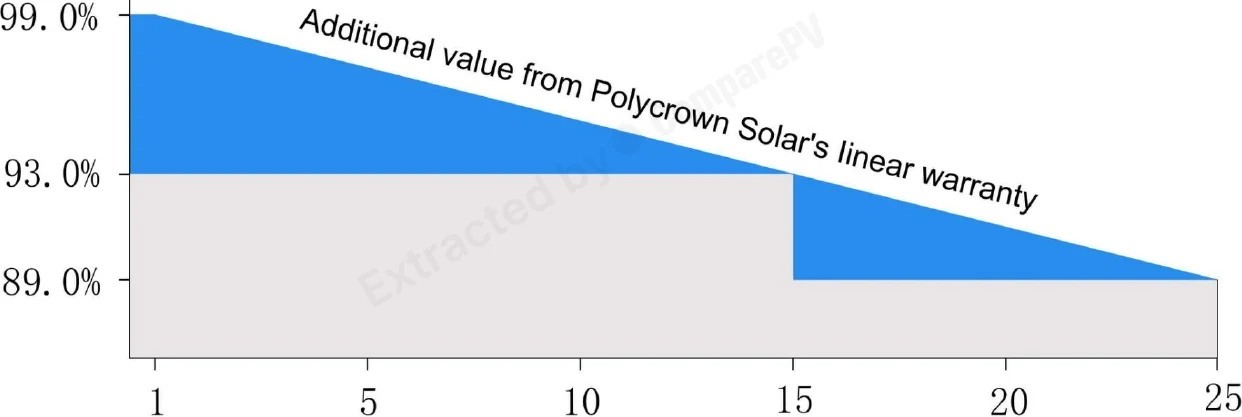
The 15-year product warranty and 25-year linear power warranty reflect a market standard from several years ago, while current N-type/TOPCon series from Tier-1 manufacturers typically offer up to 25 years of product warranty and 30 years of power warranty.

No bifacial variant

The series lacks a bifacial option, ruling out additional energy gain from light reflected off the ground (particularly relevant for ground-mount installations or bright roofing surfaces) that is available in newer competing solutions.

Notes from the database
  • Efficiency of 20.3% is 0.8pp above the N-type 0-400W median (19.5%)
  • 202.8 W/m² power density - 7.9 W/m² more than N-type 0-400W median (194.9 W/m²), more power per roof area
  • Temperature coefficient of -0.29%/°C vs median -0.32%/°C means ~1% less power loss at 65°C
  • Weight of 17.0 kg (5.0 kg below N-type 0-400W median of 22.0 kg) allows easier transport and roof mounting
  • Ranked #11853 out of 14005 panels for efficiency in the database

Specifications

Open datasheet PDF
Nominal power (Pmax) 330 Wp Nameplate at 1000 W/m², 25 °C
Module efficiency 20.28 % Typical Segment median 21.02%
Vmpp · Impp 32.62 V · 10.12 A Operating point at max power
Voc · Isc 38.23 V · 10.78 A Sizes the string length
Max system voltage 1500 V Longer strings than 1000 V modules
Dimensions 1640×992×30 mm · 1.63 m² of roof
Weight 17.0 kg Typical Typical · median 22.0 kg
Cells 60 · N-type Monocrystalline
Coefficient Pmax -0.290 %/°C Strong top 19% of its segment
Coefficient Voc · Isc -0.250 · 0.045 %/°C
NOCT 45 °C At 800 W/m², 20 °C ambient
Product warranty 15 years Hardware defects only
Performance warranty 25 years Weak bottom 19% · median 30 yrs

Datasheet charts

Open datasheet PDF

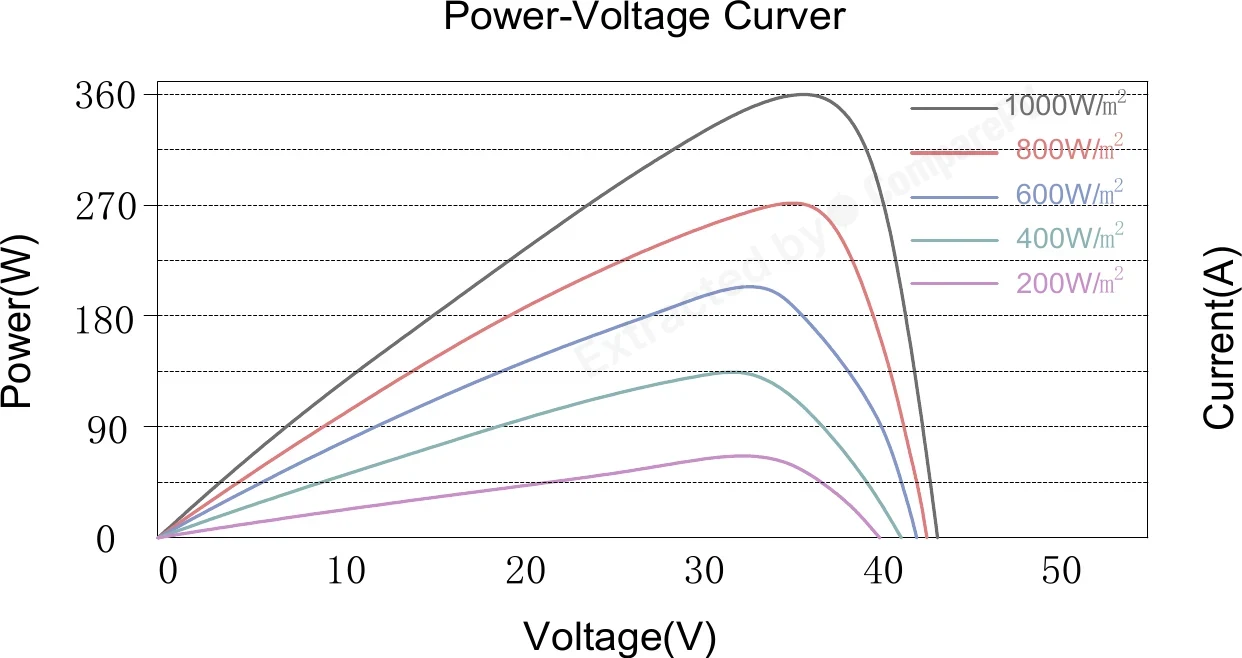
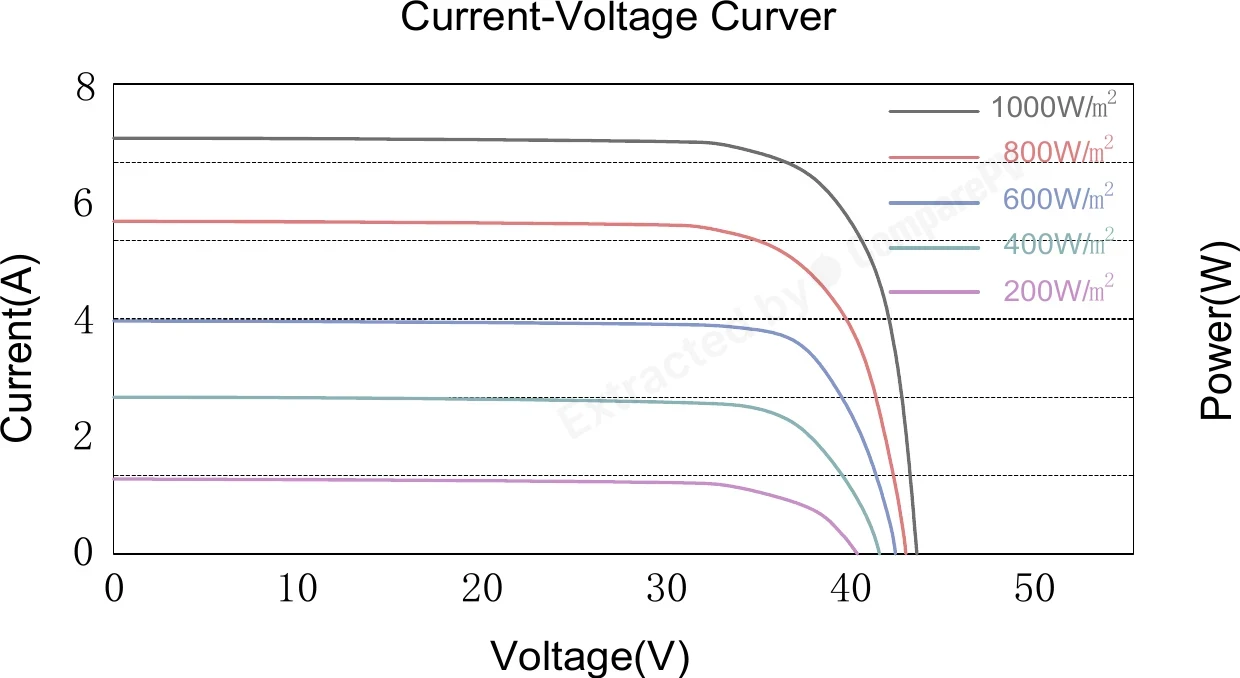
Measured curves published by Phono Solar in this model's datasheet. A chart carrying a wattage was measured on that variant alone - only the ones that describe 330 Wp appear here. The rest cover the whole series.
Simulations

Live - change any input
Lifetime output & value
30 years at 1200 kWh/kWp/year and €0.50 per kWh
Power in year 30
-
Lifetime energy
-
Energy value
-

Degradation from this panel's own datasheet figures. No inverter, soiling or shading losses.

Heat losses
-0.290 %/°C against a segment median of -0.300
-
Filter these
Size
Panel Power Eff. Temp. Weight Difference
Phono Solar NS-330MH-60 330 W 20.28% -0.290 17.0 kg You are here
NS-300MH-72 300 W 23.32% -0.290 12.5 kg -30 W, lighter, +3.0 pp
ZEUS 1.2 FullBlack 280W 280 W 23.31% -0.260 14.3 kg -50 W, +3.0 pp, +5 yr warranty
NS-330MH-80 330 W 23.15% -0.290 15.0 kg Lighter, +2.9 pp
GKA182M285W 285 W 23.00% - 10.8 kg Lighter, +2.7 pp, +5 yr warranty
GKA182M300W 300 W 23.00% - 16.2 kg -30 W, +2.7 pp, +5 yr warranty
GKA210M320W 320 W 23.00% - 16.2 kg -10 W, +2.7 pp, +5 yr warranty
GKA210M340W 340 W 23.00% - 16.2 kg +10 W, +2.7 pp, +5 yr warranty
NS-320MH-60 320 W 19.66% -0.290 17.0 kg -10 W, -0.6 pp
NS-340MH-60 340 W 20.89% -0.290 17.0 kg +10 W, +0.6 pp
NS-350MH-60 350 W 21.51% -0.290 17.0 kg +20 W, +1.2 pp
NS-360MH-60 360 W 22.12% -0.290 17.0 kg +30 W, +1.8 pp
SPR-MAX3-400-COM 400 W 22.60% -0.270 19.0 kg +70 W, +2.3 pp, +15 yr warranty
LEPV 400 400 W 22.31% -0.290 20.0 kg +70 W, +2.0 pp, +5 yr warranty
NS-360MH-60 360 W 22.12% -0.290 17.0 kg +30 W, +1.8 pp

Found 182 panels of the same or similar size to this one, within ±10 mm. See them here Found 218 panels of the same or similar size to this one, within ±25 mm. See them here Found 379 panels of the same or similar size to this one, within ±50 mm. See them here Found 472 panels of the same or similar size to this one, within ±100 mm. See them here

Common questions

6 answered
Is the Phono Solar Monocrystalline 60 series still available for purchase?
The Phono Solar Monocrystalline 60 series has been discontinued and is no longer offered as a new product. If you need a similar specification, consider newer Phono Solar lines or other Tier 1 manufacturers featuring N-type technology and half-cut cell construction. Limited stock may still be available through some distributors — check current inventory with your local reseller.
What warranty does the Phono Solar Monocrystalline 60 carry?
The module comes with a 15-year product warranty covering material and workmanship defects, and a 25-year linear power output warranty guaranteeing that the panel retains a specified percentage of its rated output after 25 years of operation. Both warranty periods are standard for Tier 1 manufacturers and reflect the producer's confidence in long-term module reliability.
What does N-type cell technology in the Phono Solar Monocrystalline 60 mean for a homeowner?
N-type cells exhibit lower light-induced degradation (LID) and slower long-term aging compared to conventional P-type PERC cells. In practical terms, this means more stable energy production over the module's lifetime and better efficiency retention at higher operating temperatures — an advantage during summer months when roof temperatures can noticeably reduce output from older-generation panels.
Does the half-cut cell design in the Phono Solar Monocrystalline 60 actually help with partial shading?
Yes. Splitting each cell into two halves means that shading on one part of the module — from a chimney or dormer, for example — does not fully block the other half. With standard full cells, a single shaded row can disable an entire series string. The half-cut design significantly reduces power losses, which translates to measurable gains in annual yield on roofs with complex layouts.
What is the peak power of the Phono Solar Monocrystalline 60 and how many panels do I need for a 10 kWp system?
The module is rated at 360 Wp. To build a system with a combined capacity of approximately 10 kWp, you would need around 28 panels. During system planning, keep in mind that 28 modules typically require between 50 and 55 m² of usable roof area, depending on the specific mounting configuration.
How do the Phono Solar Monocrystalline 60 panels perform under the overcast conditions typical in Poland?
Monocrystalline N-type cells in this series respond better to diffuse light than older polycrystalline modules and maintain higher efficiency at low irradiance levels — important in Poland where autumn and winter bring predominantly cloudy days. The multi-busbar interconnection also reduces the impact of microcracks that can develop after repeated freeze-thaw cycles, supporting consistent output over multiple seasons.
Add to compare