LEPV 400

400 Wp Back Contact
ComparePV verdict

Middle of its segment, heavy for its output

Rank 9,244 of 14,005
Compare panels Datasheet PDF
Power (Wp)
400
Weak · bottom 4%
Efficiency (%)
22.31
Typical · median 22.30%
Density (Wp/m²)
222.9
Typical · median 222.7
Temp (%/°C)
-0.290
Typical · median -0.290
Weight (kg)
20.0
Weak · bottom 16%
Warranty (yrs)
30
Typical · median 25 yrs

The Lina Energy LEPV 120 ULTRA PREMIUM series is designed for maximum aesthetics and stable operation in real-world conditions - these are total black modules that complement modern architecture and do not detract from the appearance of the roof. The use of N-type cells and IBC (back contact) technology allows for minimizing losses due to shading and better utilization of the active surface, which translates into improved system performance. Additionally, the Half-Cut design enhances resistance to micro-cracks and reduces the risk of yield losses over time, particularly in systems exposed to temperature and load fluctuations.

This is a good choice for investors who expect long-term predictable energy production - whether in single-family homes, small businesses, or premium projects where appearance, durability, and parameter certainty are important. The series is also distinguished by extended linear warranty, making it easier to plan returns on investment and limit long-term risk costs.

Ranking

52 panels in the segment Back Contact 400-450 W
Metric This panel Median Position in segment Overall rank
Module efficiency 22.31% 22.30% Typical 5,082
Power density 222.9 222.7 Typical 5,097
Temperature coefficient -0.290 -0.290 Typical 2,165
Weight per kWp 50.0 48.2 Weak · bottom 16% 3,317
Performance warranty 30 yrs 25 yrs Typical 21
Colour key Strong - top 25% Typical - middle 50% Weak - bottom 25%

Signals from the data

5 positive · 3 caution
Best for

Residential, commercial and shaded-installations.

Not ideal for

Weight-limited structures.

Watch-outs
50.0 kg per kWp

Bottom 16% of the Back Contact 400-450 W segment, against a median of 48.2.

What owners get
22.31% efficiency – segment leader

At 22.31%, this module clearly outperforms comparable 400 Wp panels: Heliene 108HC (20.5%), MWG Mono (19.32%), and DMEGC GH400M10T-B48HST (15.48%). This means less roof area is needed to reach the same installed capacity.

N-type IBC (Back Contact) cells

The absence of front-side metallization grid and busbars eliminates shading losses from contacts and delivers a uniform total-black look without compromising electrical performance.

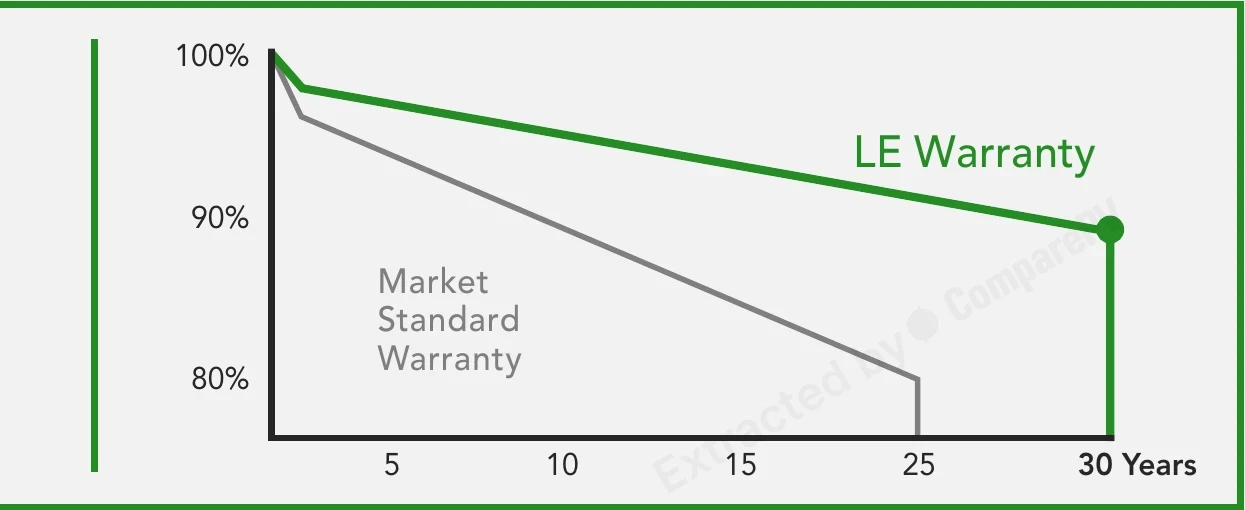
30-year linear power warranty

A 30-year power warranty and 20-year product warranty exceed the typical market standard (10-15 years product, 25 years linear for many competitors), simplifying long-term ROI planning.

Half-Cut design reduces microcracking

Splitting cells into halves lowers mechanical stress and the risk of microcrack propagation, and under partial shading (leaves, chimneys) power losses are lower than with full-size cells.

Low temperature coefficient of -0.29%/°C

According to ENF Solar datasheet data, the Pmax temperature coefficient is -0.29%/°C, better than the typical -0.35 to -0.40%/°C for PERC cells — the module loses less power at high roof temperatures in summer.

Trade-offs
No bifacial variant available

The series does not offer bifacial modules, so in ground-mount installations or on high-albedo surfaces it forfeits the several-to-teens-percent additional yield achievable with competing bifacial modules of the same power class.

Manufacturer not on the BNEF Tier 1 list

Lina Energy (United Kingdom, founded 2017) does not appear on BloombergNEF's Tier 1 bankability list, and its relatively short track record (~9 years) may complicate financing for larger commercial projects and raise questions about honoring the 30-year linear power warranty.

Notes from the database
  • Efficiency of 22.3% matches the Back Contact 400-450W median
  • At 222.9 W/m² power density, roof space requirements are typical for Back Contact 400-450W panels
  • At -0.29%/°C, hot weather performance is typical for Back Contact 400-450W panels
  • #5082 for efficiency, #2165 for temperature performance out of 14005 panels

Specifications

Open datasheet PDF
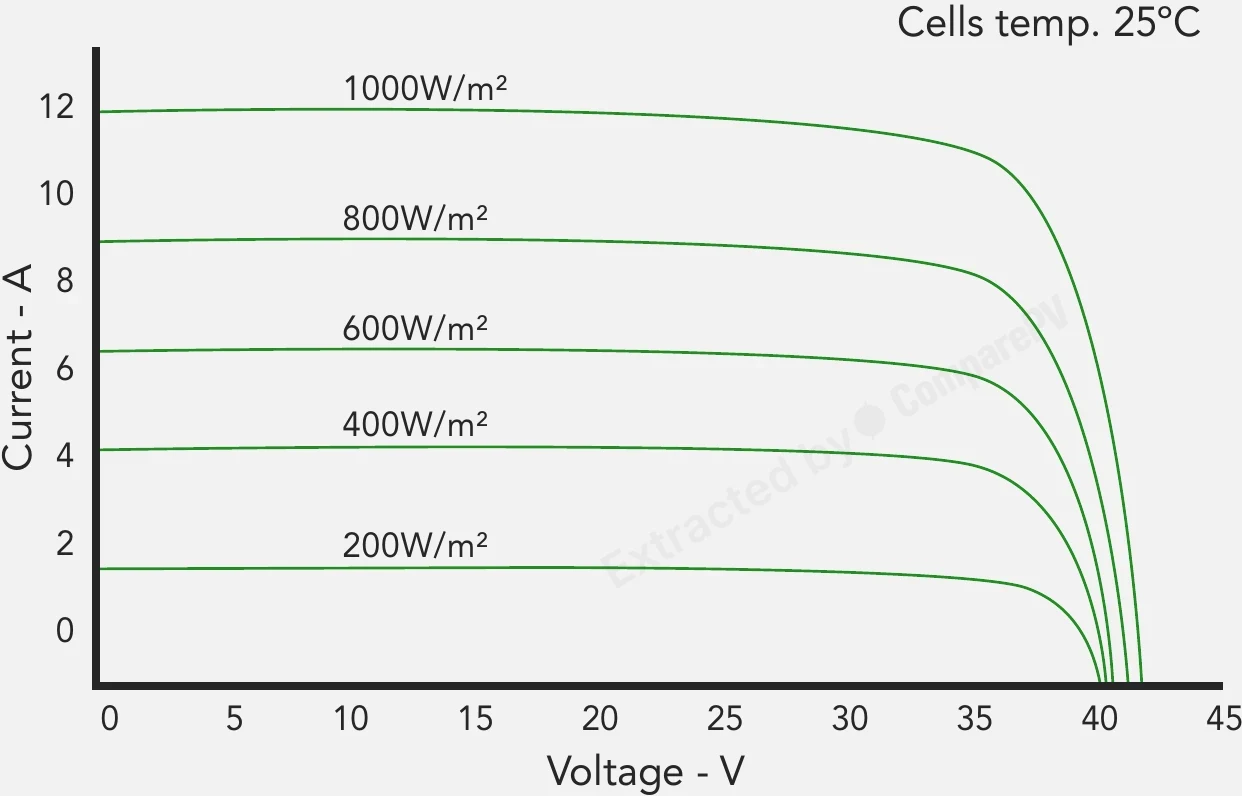
Nominal power (Pmax) 400 Wp Nameplate at 1000 W/m², 25 °C
Module efficiency 22.31 % Typical Segment median 22.30%
Vmpp · Impp 36.10 V · 11.09 A Operating point at max power
Voc · Isc 42.10 V · 12.05 A Sizes the string length
Max system voltage 1500 V Longer strings than 1000 V modules
Dimensions 1727×1039×30 mm · 1.79 m² of roof
Weight 20.0 kg Weak Weak · bottom 16%
Cells 120 · Back Contact Monocrystalline
Coefficient Pmax -0.290 %/°C Typical median -0.290 of its segment
Coefficient Voc · Isc -0.247 · 0.045 %/°C
NOCT 43 °C At 800 W/m², 20 °C ambient
Product warranty 20 years Hardware defects only
Performance warranty 30 years Typical median 25 yrs · median 25 yrs
End-of-warranty output 90.0 % Equals 360 W guaranteed

Datasheet charts

Open datasheet PDF

Measured curves published by Lina Energy in this model's datasheet. A chart carrying a wattage was measured on that variant alone - only the ones that describe 400 Wp appear here. The rest cover the whole series.
Simulations

Live - change any input
Lifetime output & value
30 years at 1200 kWh/kWp/year and €0.50 per kWh
Power in year 30
-
Lifetime energy
-
Energy value
-

Degradation from this panel's own datasheet figures. No inverter, soiling or shading losses.

Heat losses
-0.290 %/°C against a segment median of -0.290
-

Alternatives

All Lina Energy panels
Filter these
Size
Panel Power Eff. Temp. Weight Difference
Lina Energy LEPV 400 400 W 22.31% -0.290 20.0 kg You are here
LX-440M/182-108+GG 440 W 23.07% -0.240 23.6 kg +40 W, cooler, +0.8 pp
JST-EDMH-(445-465)W-TD (450W class) 450 W 23.05% -0.300 20.5 kg +50 W, hotter, +0.7 pp
QNN182-HG450-54 450 W 23.04% -0.290 24.0 kg +50 W, heavier, +0.7 pp
HY440-N108BDD 450 W 23.04% -0.300 23.5 kg +50 W, heavier, +0.7 pp
NLBK-27-450 450 W 23.04% -0.300 22.9 kg +50 W, heavier, +0.7 pp
RS41-450NBG-E3 450 W 23.04% -0.290 24.5 kg +50 W, heavier, +0.7 pp
LR7-54HJD-510M 510 W 25.00% -0.240 23.5 kg +110 W, cooler, +2.7 pp
AIKO-A495-MCE54Mw 495 W 24.80% -0.260 21.0 kg +95 W, cooler, +2.5 pp
LR7-54HJD-505M 505 W 24.70% -0.240 23.5 kg +105 W, cooler, +2.4 pp
AIKO-A490-MCE54Mw 490 W 24.50% -0.260 21.0 kg +90 W, cooler, +2.2 pp
LR7-54HJD-500M 500 W 24.50% -0.240 23.5 kg +100 W, cooler, +2.2 pp
CIPRO-TN9C54M-500W 500 W 24.50% -0.260 21.4 kg +100 W, cooler, +2.2 pp

Found 12 panels of the same or similar size to this one, within ±10 mm. See them here Found 22 panels of the same or similar size to this one, within ±25 mm. See them here Found 412 panels of the same or similar size to this one, within ±50 mm. See them here Found 4313 panels of the same or similar size to this one, within ±100 mm. See them here

Common questions

6 answered
What warranty comes with the Lina Energy LEPV 120 ULTRA PREMIUM panels?
The LEPV 120 ULTRA PREMIUM series carries a 20-year product warranty covering manufacturing defects and material faults, along with a 30-year linear power output warranty. The linear guarantee ensures a predictable, gradual power degradation curve over three decades, making it easier to model return on investment and reduce financial risk over the system's lifetime.
What is IBC (Back Contact) technology in the LEPV 120 ULTRA PREMIUM series and what does it mean for real-world performance?
IBC (Interdigitated Back Contact) moves all electrical contacts to the rear side of the cell, leaving the front surface entirely unobstructed for light absorption. This eliminates shading losses from front-side busbars, increases cell efficiency, and improves low-light and partial-shading performance. Combined with N-type cell architecture, IBC delivers higher energy yield per square meter compared to standard PERC or TOPCon modules.
Do the LEPV 120 ULTRA PREMIUM all-black panels work well on a modern house with a dark roof?
Yes, the LEPV 120 ULTRA PREMIUM is a total black module — cells, frame, and backsheet share a uniform black finish. This aesthetic integrates seamlessly with anthracite or black ceramic roof tiles and standing-seam metal roofing. It is a popular choice for premium residential projects where the visual impact of the solar installation is a key consideration for the homeowner.
How many Lina Energy LEPV 120 ULTRA PREMIUM panels do I need for a 5 kWp system?
At a rated output of 400 Wp per module, you need 13 panels to reach approximately 5.2 kWp. The exact number depends on roof area, orientation, shading, and inverter configuration, so it is worth consulting a certified installer for a site-specific design. A 13-panel array at this power class typically requires around 20–22 m² of unobstructed roof surface.
How does the half-cut cell layout in the LEPV 120 ULTRA PREMIUM reduce losses when a chimney or antenna partially shades the array?
Half-cut cells split each cell into two independent halves, lowering resistive losses and allowing each half of the panel to operate separately under partial shading. When a chimney or satellite dish shades one section, only that portion loses output while the rest of the module continues producing at full capacity. Paired with the IBC back-contact architecture and N-type cells, this significantly limits energy yield losses in real-world rooftop installations.
Is the Lina Energy LEPV 120 ULTRA PREMIUM a good fit for a small business or warehouse with high daytime energy consumption?
Yes, the LEPV 120 ULTRA PREMIUM suits both residential and small commercial applications with significant daytime loads. The 400 Wp rated output delivers high installed capacity on a limited roof footprint, while the 30-year linear power warranty and N-type cell technology ensure low LCOE and stable generation across the full system lifetime — key factors when sizing a system to offset commercial electricity bills.
Add to compare