EVPV390HK

390 Wp HJT
ComparePV verdict

Light for its output, weak in heat

Rank 10,480 of 14,005
Compare panels Datasheet PDF
Power (Wp)
390
Strong · top 19%
Efficiency (%)
21.10
Typical · median 20.90%
Density (Wp/m²)
210.8
Typical · median 209.3
Temp (%/°C)
-0.260
Weak · bottom 9%
Weight (kg)
20.5
Strong · 2.3 kg below median
Warranty (yrs)
25
Weak · bottom 19%

The Panasonic EVERVOLT Solar Module Black Series is designed to maximize energy yield even when roof conditions are not ideal. A key advantage is the heterojunction (HJT) technology combined with half-cut cells - this configuration improves module performance under partial shading and, in practice, stabilizes daily production. Furthermore, excellent performance at high temperatures means smaller power drops in summer, which, in Polish prosumer installations, translates directly into higher yields during the peak solar season.

The Black Series variants also feature a complete, black aesthetic that complements modern roofs and facades - without compromising performance. The series is primarily aimed at single-family homes and buildings where every square meter of roof space is valuable. The entire package is complemented by a 25-year warranty, which is important for those who want to minimize risk and plan a long-term return on investment.

Ranking

45 panels in the segment HJT 350-400 W
Metric This panel Median Position in segment Overall rank
Module efficiency 21.10% 20.90% Typical 9,297
Power density 210.8 209.3 Typical 9,551
Temperature coefficient -0.260 -0.259 Weak · bottom 9% 511
Weight per kWp 52.6 59.2 Strong · top 24% 6,190
Performance warranty 25 yrs 30 yrs Weak · bottom 19% 9,798
Colour key Strong - top 25% Typical - middle 50% Weak - bottom 25%

Signals from the data

6 positive · 6 caution
Best for

Residential, shaded-installations and hot-climate.

Not ideal for

Hot climates and owners who want a long output guarantee.

Strengths
52.6 kg per kWp

Top 24% of the HJT 350-400 W segment, against a median of 59.2.

Watch-outs
-0.260 %/°C temperature coefficient

Bottom 9% of the HJT 350-400 W segment, against a median of -0.259. Ranked 511th in the whole database.

25 year performance warranty

Bottom 19% of the HJT 350-400 W segment, against a median of 30 yrs.

What owners get
HJT technology with half-cut cells

The combination of heterojunction (HJT) cells and half-cut cell layout improves shading tolerance and lowers the power temperature coefficient (typically around -0.26%/°C versus roughly -0.35 to -0.40%/°C for standard PERC), reducing power losses on hot days.

25-year AllGuard/TripleGuard warranty

Panasonic covers the series with a combined 25-year product, power, parts, and labor warranty when installed by an authorized installer and registered within 60 days - broader than the common 12-15 year product / 25-year power split offered by many competitors.

Competitive 21.1% efficiency

At 21.1% efficiency, the module ranks in the upper tier of comparable 390 Wp panels - higher than JA Solar's JAM60S21 (21.0%) and close to Meyer Burger Glass (21.2%) and Phono Solar Twinplus (21.3%).

Full black aesthetics

The Black Series pairs black cells, frame, and backsheet, easing visual integration on dark pitched roofs of single-family homes without sacrificing the electrical parameters of the standard version.

Panasonic's technology legacy

Founded in 1918 in Japan, Panasonic has developed heterojunction technology since acquiring Sanyo's HIT patents, giving the EVERVOLT series a long R&D heritage in HJT cells, even though manufacturing was later shifted to subcontractors.

Trade-offs
Production discontinued - global exit

On April 28, 2025, Panasonic announced a full withdrawal from the solar panel and battery storage business worldwide, after already closing its in-house HJT manufacturing lines in Malaysia and Shimane Prefecture by March 2022. Panasonic states it will honor existing warranties, but service, spare parts, and after-sales support availability for new installations is now significantly limited.

Manufacturing shifted to a subcontractor

After closing its own factories in 2021-2022, Panasonic-branded EVERVOLT modules were produced by a subcontracted manufacturer, which may raise questions about production consistency compared to the earlier fully in-house HIT/HJT lines.

Efficiency trails part of the competition

At 21.1%, the module falls behind Phono Solar Twinplus (21.3%) and Meyer Burger Glass (21.2%) within the same 390 Wp power class - a small gap, but one that could tip the decision toward these alternatives at comparable pricing.

Single power variant only

The Black Series is offered exclusively in a 390 Wp variant, limiting flexibility for unusual roof layouts compared to manufacturers offering multiple power ratings within the same product line.

Notes from the database
  • Efficiency of 21.1% matches the HJT 0-400W median
  • At 210.8 W/m² power density, this panel generates 4.4 W/m² more per unit area than HJT 0-400W median (206.4 W/m²)
  • At -0.26%/°C, hot weather performance is typical for HJT 0-400W panels
  • At 20.5 kg, weight matches the HJT 0-400W median
  • #9297 for efficiency, #511 for temperature performance out of 14005 panels

Specifications

Open datasheet PDF
Nominal power (Pmax) 390 Wp Nameplate at 1000 W/m², 25 °C
Module efficiency 21.10 % Typical Segment median 20.90%
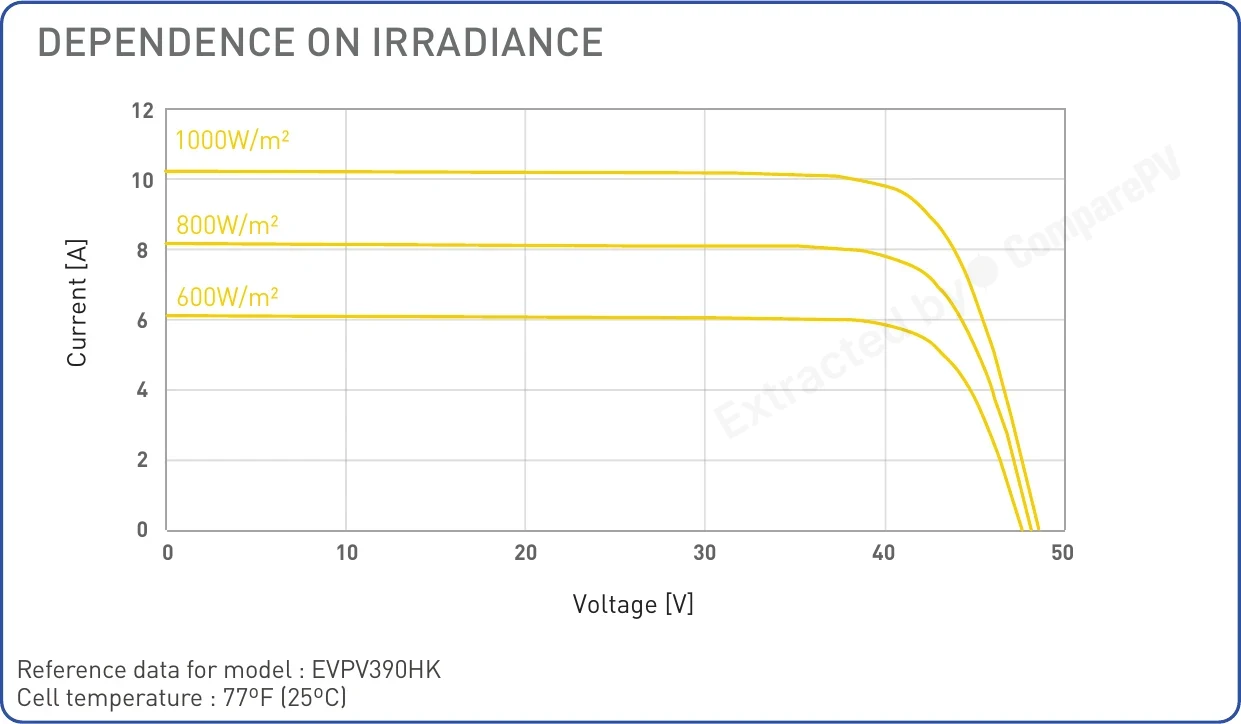
Vmpp · Impp 40.60 V · 9.61 A Operating point at max power
Voc · Isc 48.40 V · 10.38 A Sizes the string length
Max system voltage 1000 V Longer strings than 1000 V modules
Dimensions 1821×1016×30 mm · 1.85 m² of roof
Weight 20.5 kg Strong Strong · 2.3 kg below median
Coefficient Pmax -0.260 %/°C Weak bottom 9% of its segment
Coefficient Voc · Isc -0.240 · 0.040 %/°C
NOCT 44 °C At 800 W/m², 20 °C ambient
Product warranty 25 years Hardware defects only
Performance warranty 25 years Weak bottom 19% · median 30 yrs
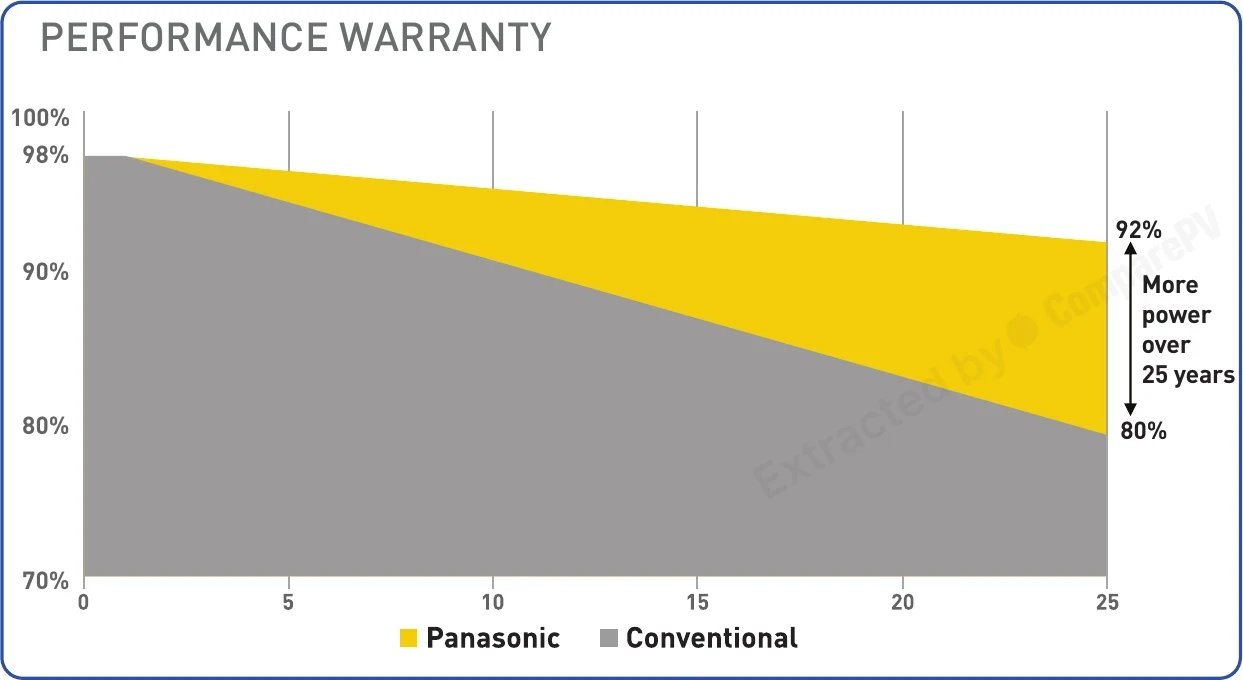
End-of-warranty output 92.0 % Equals 354 W guaranteed
Degradation 2.00 → 0.25 % First year, then annual

Datasheet charts

Open datasheet PDF

Measured curves published by Panasonic in this model's datasheet. A chart carrying a wattage was measured on that variant alone - only the ones that describe 390 Wp appear here. The rest cover the whole series.
Simulations

Live - change any input
Lifetime output & value
30 years at 1200 kWh/kWp/year and €0.50 per kWh
Power in year 30
-
Lifetime energy
-
Energy value
-

Degradation from this panel's own datasheet figures. No inverter, soiling or shading losses.

Heat losses
-0.260 %/°C against a segment median of -0.259
-
Filter these
Size
Panel Power Eff. Temp. Weight Difference
Panasonic EVPV390HK 390 W 21.10% -0.260 20.5 kg You are here
LX-440M/182-108+GG 440 W 23.07% -0.240 23.6 kg +50 W, +2.0 pp, +5 yr warranty
GKA210M340W 340 W 23.00% - 16.2 kg -50 W, +1.9 pp, +5 yr warranty
GKA210M360W 360 W 23.00% - 16.2 kg Lighter, +1.9 pp, +5 yr warranty
GKA210M380W (1/4*4*38) 380 W 23.00% - 17.1 kg Lighter, +1.9 pp, +5 yr warranty
GKA210M400W (1/2*4*20) 400 W 23.00% - 18.0 kg Lighter, +1.9 pp, +5 yr warranty
GKA210M400W (1/4*4*40) 400 W 23.00% - 18.0 kg Lighter, +1.9 pp, +5 yr warranty
GKA210M380W (1/2*4*19) 380 W 23.00% - 17.1 kg Lighter, +1.9 pp, +5 yr warranty
JT440SYK(B) 440 W 22.90% -0.240 23.0 kg +50 W, +1.8 pp, +5 yr warranty
EVPV400H 400 W 21.60% -0.260 20.5 kg +10 W, +0.5 pp
EVPV410H 410 W 22.20% -0.260 20.5 kg +20 W, +1.1 pp
SPR-MAX7-475 475 W 24.00% -0.270 21.1 kg +85 W, +2.9 pp, +15 yr warranty
SPR-MAX7-470 470 W 23.70% -0.270 21.1 kg +80 W, +2.6 pp, +15 yr warranty
SPR-MAX7-465 465 W 23.50% -0.270 21.1 kg +75 W, +2.4 pp, +15 yr warranty
SPR-MAX6-440 440 W 22.80% -0.290 20.9 kg +50 W, +1.7 pp, +15 yr warranty
JT435SYk(B) 435 W 22.70% -0.240 23.0 kg +45 W, +1.6 pp, +5 yr warranty
SPR-MAX3-430-R 430 W 22.70% -0.270 21.2 kg +40 W, +1.6 pp, +15 yr warranty

Found 6 panels of the same or similar size to this one, within ±10 mm. See them here Found 10 panels of the same or similar size to this one, within ±25 mm. See them here Found 86 panels of the same or similar size to this one, within ±50 mm. See them here Found 532 panels of the same or similar size to this one, within ±100 mm. See them here

Common questions

6 answered
Is the Panasonic EVERVOLT Solar Module Black Series still available for purchase?
No. Panasonic officially discontinued the entire EVERVOLT line — including the Black Series — in April 2025, fully exiting the residential solar panel and energy storage market. Some installers may still have remaining stock, but availability is extremely limited. Panasonic has confirmed it will continue to honor all warranties for panels already installed or purchased before the product line was retired.
What warranty does the Panasonic EVERVOLT Black Series carry?
The series comes with a 25-year product warranty and a 25-year linear power warranty. Panasonic guarantees at least 92% of rated output after 25 years. Despite exiting the solar market, Panasonic has publicly committed to honoring these warranties for all panels installed or purchased prior to the line's discontinuation.
What is HJT technology used in the Panasonic EVERVOLT Black Series, and is the premium worth it?
HJT (heterojunction technology) combines a monocrystalline silicon wafer with amorphous silicon layers on both sides. The practical result is a temperature coefficient of only -0.26%/°C, compared to roughly -0.35 to -0.37%/°C for standard PERC modules. During hot summers this translates to a few percent more annual energy yield. For prosumer installations focused on maximizing return over a 25-year horizon, the HJT premium was well justified.
How does the EVERVOLT Black Series 390W handle partial shading from a chimney or dormer window?
Better than most conventional full-cell modules. The half-cut cell design splits the module's electrical circuit into two independent strings, so shading the upper half of the panel does not shut down the entire module's output. On roofs with dormers or chimneys that intermittently shade part of a module, power losses are noticeably lower compared to older full-cell designs.
What is the maximum power output of the Panasonic EVERVOLT Black Series, and is it compatible with standard inverters?
Maximum power is 390 Wp. The electrical parameters fit within the typical MPPT input range of most single-phase and three-phase string inverters operating at 600–1000 V. Before purchasing remaining stock, verify your inverter's MPPT voltage window against the module's Voc and Vmp, since Panasonic no longer updates technical documentation following the line's discontinuation.
Why is it called the Black Series, and does the all-black design affect panel performance?
The Black Series name refers to the fully black aesthetic: black cells, black frame, and black backsheet. This look integrates seamlessly with dark roof tiles and modern facades without sacrificing efficiency. The black surface does absorb marginally more heat under direct sun, but the HJT temperature coefficient of -0.26%/°C effectively offsets this, keeping real-world performance competitive.
Add to compare