Meyer Burger MB_W120AyB_400

MB_W120AyB_400

400 Wp HJT
ComparePV verdict

Light for its output, short guarantee

Rank 9,796 of 14,005
Compare panels Datasheet PDF
Power (Wp)
400
Weak · bottom 4%
Efficiency (%)
21.70
Weak · bottom 21%
Density (Wp/m²)
217.5
Typical · median 221.6
Temp (%/°C)
-0.259
Typical · median -0.240
Weight (kg)
19.7
Strong · 3.3 kg below median
Warranty (yrs)
25
Weak · bottom 8%

The Meyer Burger White series consists of modules designed for high energy production on typical roofs, without compromising durability. A key advantage is the combination of HJT (heterojunction) solar cells with the company's proprietary SmartWire technology, which minimizes losses at connections and helps reduce the risk of microcracks, which are often responsible for decreased performance over time. The characteristic white backsheet is not just for aesthetics - it reflects light, supporting the performance of the cells under real sunlight conditions, which translates to more stable output in variable weather.

In practice, these panels solve the problem of "leaking" performance in hot weather and long-term degradation, offering low power degradation and predictable production over many years. An additional advantage is enhanced mechanical strength thanks to a reinforced front structure, which is important in hail and wind conditions.

This is a good choice for prosumers and small to medium-sized businesses that want to maximize their energy yield from a limited area and rely on a technology that clearly differentiates itself from standard PERC modules.

Ranking

113 panels in the segment HJT 400-450 W
Metric This panel Median Position in segment Overall rank
Module efficiency 21.70% 22.20% Weak · bottom 21% 7,421
Power density 217.5 221.6 Typical 7,316
Temperature coefficient -0.259 -0.240 Typical 480
Weight per kWp 49.2 52.4 Strong · top 18% 2,821
Performance warranty 25 yrs 30 yrs Weak · bottom 8% 9,798
Colour key Strong - top 25% Typical - middle 50% Weak - bottom 25%

Signals from the data

6 positive · 4 caution
Best for

Residential, commercial and hot-climate.

Not ideal for

Owners who want a long output guarantee and tight roof space.

Strengths
49.2 kg per kWp

Top 18% of the HJT 400-450 W segment, against a median of 52.4.

Watch-outs
25 year performance warranty

Bottom 8% of the HJT 400-450 W segment, against a median of 30 yrs. Ranked 9,798th in the whole database.

21.70% module efficiency

Bottom 21% of the HJT 400-450 W segment, against a median of 22.20%.

What owners get
HJT cells with SmartWire technology

The combination of heterojunction (HJT) cells with the proprietary SmartWire (SWCT) busbar-free grid reduces resistive interconnection losses and lowers the risk of microcracks, supporting more stable long-term module performance.

Efficiency among the highest in its class

Efficiency of 20.7-21.7% clearly outperforms comparable 400 Wp modules such as the Heliene 108HC (20.5%) or MWG Mono (19.32%), delivering more energy per unit of roof area.

Very low annual power degradation

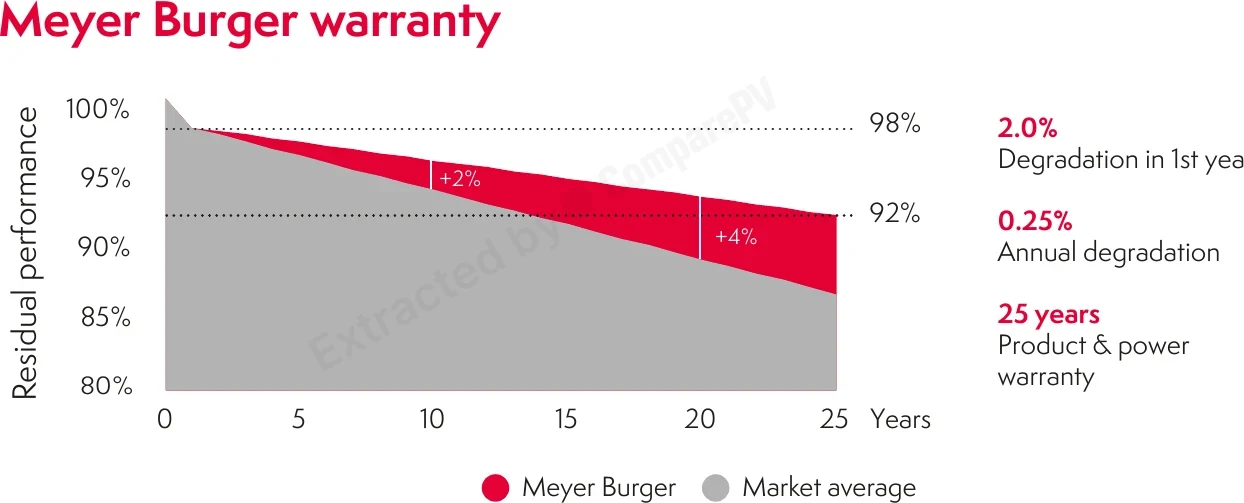
Manufacturer data indicates HJT-based degradation of around 0.25% per year after year two, well below the 0.5-0.7% typical of conventional PERC modules, supporting predictable yield over the warranty period.

Full 25/25-year warranty

The manufacturer provides a 25-year product warranty alongside a 25-year linear power warranty, unlike many tier-1 competitors that split coverage into a shorter product warranty (often 12-15 years) and a longer power warranty.

White backsheet supports yield

The distinctive white backsheet reflects part of the incoming light back onto the cells, improving performance under variable and diffuse irradiance conditions, with a practical impact on real-world rooftop yield.

Trade-offs
Discontinued production, limited service

The Meyer Burger White series has been discontinued (released 2021, ended 2024), and Meyer Burger closed its German plant (March 2024) and Arizona facility (2024), limiting availability of replacement parts and after-sales support for existing installations.

Manufacturer insolvency risk

In 2025 Meyer Burger filed for insolvency and sold its manufacturing assets (including to Waaree), raising concerns about the practical enforceability of the 25-year product and power warranties for end users.

Notes from the database
  • At 21.7% efficiency, this panel is on par with typical HJT 400-450W modules
  • 217.5 W/m² power density is 4.1 W/m² below HJT 400-450W median (221.6 W/m²) - requires larger installation area
  • At -0.26%/°C, hot weather performance is typical for HJT 400-450W panels
  • Weight of 19.7 kg (3.3 kg below HJT 400-450W median of 23.0 kg) allows easier transport and roof mounting
  • Ranked #7421 out of 14005 panels for efficiency in the database

Specifications

Open datasheet PDF
Nominal power (Pmax) 400 Wp Nameplate at 1000 W/m², 25 °C
Module efficiency 21.70 % Weak Segment median 22.20%
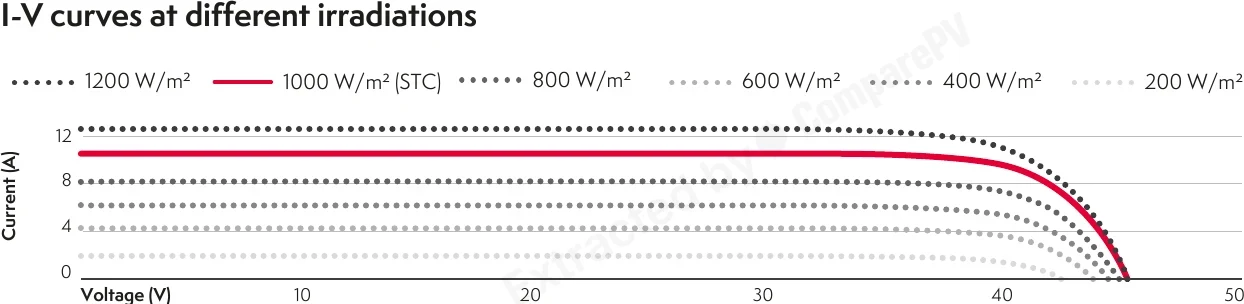
Vmpp · Impp 38.60 V · 10.40 A Operating point at max power
Voc · Isc 42.30 V · 10.90 A Sizes the string length
Max system voltage 1000 V Longer strings than 1000 V modules
Dimensions 1767×1041×35 mm · 1.84 m² of roof
Weight 19.7 kg Strong Strong · 3.3 kg below median
Cells 120 · HJT Monocrystalline
Coefficient Pmax -0.259 %/°C Typical median -0.240 of its segment
Coefficient Voc · Isc -0.234 · 0.033 %/°C
NOCT 44 °C At 800 W/m², 20 °C ambient
Product warranty 25 years Hardware defects only
Performance warranty 25 years Weak bottom 8% · median 30 yrs
End-of-warranty output 92.0 % Equals 363 W guaranteed
Degradation 2.00 → 0.25 % First year, then annual

Datasheet charts

Open datasheet PDF

Measured curves published by Meyer Burger in this model's datasheet. A chart carrying a wattage was measured on that variant alone - only the ones that describe 400 Wp appear here. The rest cover the whole series.
Simulations

Live - change any input
Lifetime output & value
30 years at 1200 kWh/kWp/year and €0.50 per kWh
Power in year 30
-
Lifetime energy
-
Energy value
-

Degradation from this panel's own datasheet figures. No inverter, soiling or shading losses.

Heat losses
-0.259 %/°C against a segment median of -0.240
-
Filter these
Size
Panel Power Eff. Temp. Weight Difference
Meyer Burger MB_W120AyB_400 400 W 21.70% -0.259 19.7 kg You are here
LX-440M/182-108+GG 440 W 23.07% -0.240 23.6 kg +40 W, +1.4 pp, +5 yr warranty
JST-EDMH-(445-465)W-TD (450W class) 450 W 23.05% -0.300 20.5 kg +50 W, +1.4 pp, +5 yr warranty
QNN182-HG450-54 450 W 23.04% -0.290 24.0 kg +50 W, +1.3 pp, +5 yr warranty
HY440-N108BDD 450 W 23.04% -0.300 23.5 kg +50 W, +1.3 pp, +5 yr warranty
NLBK-27-450 450 W 23.04% -0.300 22.9 kg +50 W, +1.3 pp, +5 yr warranty
RS41-450NBG-E3 450 W 23.04% -0.290 24.5 kg +50 W, +1.3 pp, +5 yr warranty
MB_B120AyB_375 375 W 20.40% -0.259 19.7 kg -25 W, -1.3 pp
MB_W120AyB_380 380 W 20.70% -0.259 19.7 kg -20 W, -1.0 pp
MB_W120AyB_385 385 W 20.90% -0.259 19.7 kg -15 W, -0.8 pp
MB_W120AyB_390 390 W 21.20% -0.259 19.7 kg -10 W, -0.5 pp
LR7-54HJD-510M 510 W 25.00% -0.240 23.5 kg +110 W, +3.3 pp, +5 yr warranty
AIKO-A495-MCE54Mw 495 W 24.80% -0.260 21.0 kg +95 W, +3.1 pp, +5 yr warranty
LR7-54HJD-505M 505 W 24.70% -0.240 23.5 kg +105 W, +3.0 pp, +5 yr warranty
AIKO-A490-MCE54Mw 490 W 24.50% -0.260 21.0 kg +90 W, +2.8 pp, +5 yr warranty
LR7-54HJD-500M 500 W 24.50% -0.240 23.5 kg +100 W, +2.8 pp, +5 yr warranty
CIPRO-TN9C54M-500W 500 W 24.50% -0.260 21.4 kg +100 W, +2.8 pp, +5 yr warranty

Found 78 panels of the same or similar size to this one, within ±10 mm. See them here Found 283 panels of the same or similar size to this one, within ±25 mm. See them here Found 317 panels of the same or similar size to this one, within ±50 mm. See them here Found 4139 panels of the same or similar size to this one, within ±100 mm. See them here

Common questions

6 answered
Are Meyer Burger White panels still available for purchase?
The Meyer Burger White series has been officially discontinued. Meyer Burger filed for bankruptcy in 2025 following the closure of its German facility and the end of U.S. production in May 2025. Availability is limited to residual distributor stock. Before purchasing, confirm the seller has physical inventory and can provide the original product warranty or a third-party warranty insurance covering the remaining guarantee period.
What is SmartWire technology in Meyer Burger White panels and why does it matter?
SmartWire replaces conventional busbars with a grid of 18 to 32 micro-wires creating up to 1,760 contact points per cell. Current is collected uniformly across the cell surface, reducing mechanical stress and lowering the risk of micro-cracks that commonly cause long-term output losses. Compared to soldered busbar connections, SmartWire results in more stable power delivery and slower degradation over the panel's lifetime.
What warranty does the Meyer Burger White series carry and is it still enforceable after the company's bankruptcy?
Meyer Burger originally offered 25-year product and power warranties, guaranteeing at least 92% of rated output after 25 years and a degradation rate of just 0.25% per year. Following the company's insolvency, enforcing warranty claims directly with the manufacturer is uncertain. Buyers purchasing residual stock should verify whether the distributor or a third-party insurer provides replacement warranty coverage, a common practice with reputable sellers.
How does the HJT cell technology in Meyer Burger White panels perform in hot weather?
HJT cells have a low temperature coefficient, typically around -0.26% per °C, compared to roughly -0.35% per °C for standard PERC modules. At a module temperature of 70°C, an HJT panel produces measurably more power than a comparable PERC module. For rooftops that heat up significantly in summer, this translates into a higher annual energy yield and better return on investment over the system lifetime.
Is the Meyer Burger White 400 Wp panel suitable for a typical pitched residential roof?
Yes, the White series up to 400 Wp is designed for residential prosumer installations on pitched roofs. The reinforced front frame provides enhanced mechanical resistance against snow loads and wind pressure common in Central European climates. The white backsheet reflects diffuse light, supporting cell performance under overcast conditions that dominate outside summer months. Module dimensions and weight are standard for conventional mounting systems.
How do Meyer Burger White panels compare to standard PERC modules on the market?
The key differences lie in cell and interconnection technology. Standard PERC modules use passivated-emitter rear-contact cells with conventional busbar soldering and typically show annual degradation of 0.45 to 0.55%. The White series uses HJT cells with amorphous silicon layers and SmartWire interconnection instead of busbars. The result is higher efficiency, better performance at elevated temperatures and low irradiance, and a lower annual degradation rate of 0.25%, yielding more lifetime energy output per watt installed.
Add to compare