
Light for its output, modest efficiency
The Meyer Burger Black series is designed for maximum aesthetic appeal on the roof, without compromising module performance. The panels have a uniformly dark appearance, achieved through SWCT technology - instead of traditional wide current rails, dense, thin conductors are used, which reduce shading of the cells and improve energy yield even in less sunny conditions. The core is a hetero-junction HJT cell based on n-type material, valued for its stable performance and good operation at higher temperatures, which helps maintain summer energy yields.
In practice, Meyer Burger Black solves common problems with roof-mounted installations: power losses due to microcracks and degradation over time - SWCT reduces sensitivity to microcracks, and the black backsheet with a moisture barrier enhances resistance to environmental conditions. It's a good choice for homes and small businesses where appearance, limited surface area, and long-term energy production are important. It stands out for its combination of consistent black color with engineering focused on stable performance, rather than just catalog specifications.
Ranking
Signals from the data
Residential, commercial, shaded-installations and hot-climate.
Tight roof space, roofs where every square metre has to count and owners who want a long output guarantee.
Top 21% of the HJT 350-400 W segment, against a median of 59.2.
Bottom 16% of the HJT 350-400 W segment, against a median of 20.90%.
Bottom 16% of the HJT 350-400 W segment, against a median of 209.3.
Bottom 19% of the HJT 350-400 W segment, against a median of 30 yrs.
HJT technology delivers a lower temperature coefficient (approx. -0.26%/°C) than conventional PERC or TOPCon cells, translating into higher summer yield and reduced LID/LeTID degradation over the 25-year service life.
Peak efficiency of 21.5% clearly outperforms comparable-power modules: Waaree EDO PRO (19.83%), HT-SAAE TOPCon (15.4%), and AE Solar Terra E (15.3%) - a real-world gap of up to 6 percentage points.
A dense grid of thin conductors replaces conventional busbars, reducing cell shading and improving resistance to microcracks, which realistically lowers the risk of localized power drops over time.
The all-black design, with no visible busbars or contrasting frames, is highly attractive for residential roof installations where facade aesthetics are a key selection criterion.
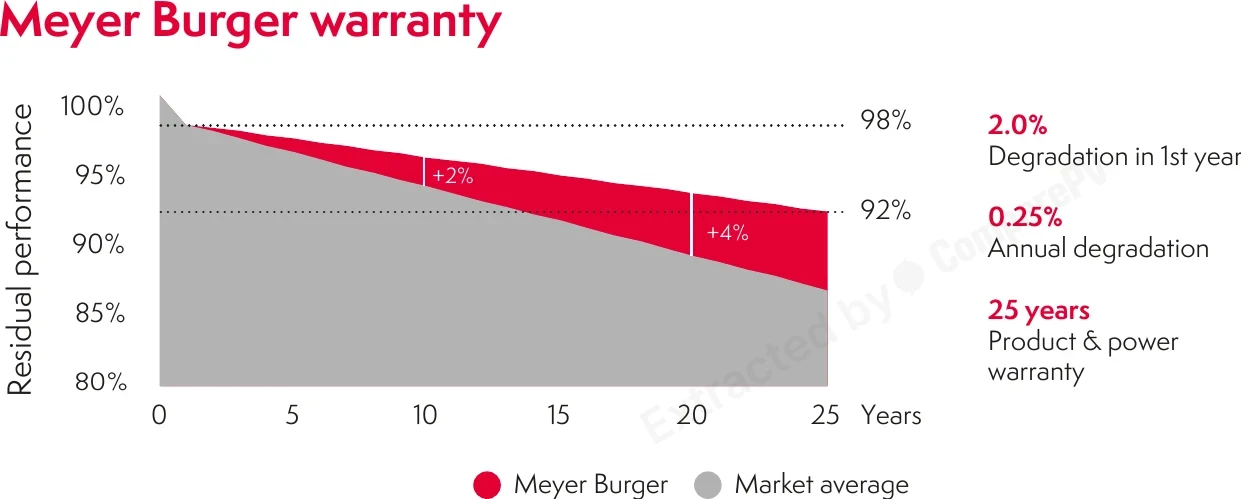
The manufacturer offers 25 years of coverage on both product and power output - a standard aligned with best practices in the premium segment, backed by the company's Swiss engineering heritage dating to 1953.
Meyer Burger Technology AG is under a Swiss debt-restructuring moratorium approved by the Oberland Regional Court (December 1, 2025 - June 1, 2026), and its German subsidiaries (Thalheim, Hohenstein-Ernstthal) filed for insolvency in May 2025 following the closure of the Freiberg module plant and halted production at the Goodyear, Arizona site. This materially undermines the claimed tier-1 bankable status and raises concerns about future 25-year warranty servicing.
The Black series is monofacial only (is_bifacial: false), forgoing the additional rear-side energy gain (up to several percent) offered by a growing number of bifacial TOPCon competitors, particularly for ground-mount installations or light-colored surfaces.
HJT modules are typically priced tens of percent higher than comparable-power TOPCon or PERC panels (e.g., Waaree, HT-SAAE, AE Solar from the peer comparison), which at a similar 375-395 Wp nominal power can extend the investment payback period.
- Efficiency of 20.4% matches the HJT 0-400W median
- At 203.9 W/m² power density, roof space requirements are typical for HJT 0-400W panels
- Temperature coefficient of -0.26%/°C matches the HJT 0-400W median
- 19.7 kg weight - 1.8 kg lighter than HJT 0-400W median (21.5 kg), reducing installation effort
- Ranked #11598 out of 14005 panels for efficiency in the database
Specifications
Datasheet charts
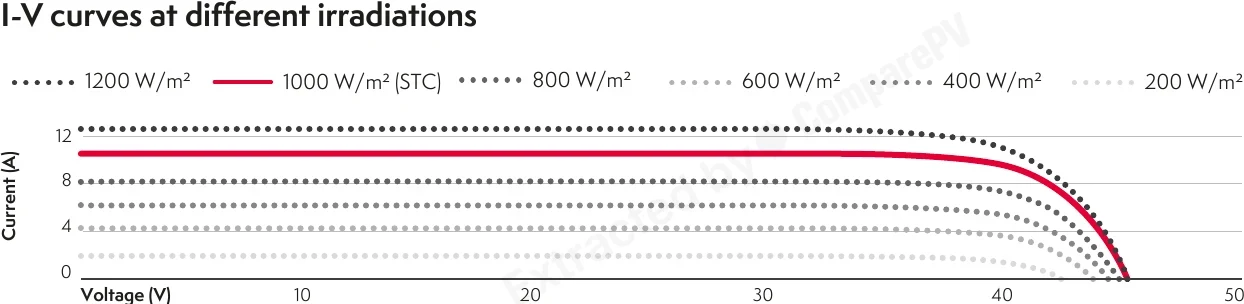
Measured curves published by Meyer Burger in this model's datasheet. A chart carrying a wattage was measured on that variant alone - only the ones that describe 375 Wp appear here. The rest cover the whole series.
Simulations
Degradation from this panel's own datasheet figures. No inverter, soiling or shading losses.






Found 78 panels of the same or similar size to this one, within ±10 mm. See them here Found 283 panels of the same or similar size to this one, within ±25 mm. See them here Found 317 panels of the same or similar size to this one, within ±50 mm. See them here Found 4139 panels of the same or similar size to this one, within ±100 mm. See them here