Solid all-round for its segment
The L/lab FORTIS N5 series from Luxen Solar was engineered to answer the growing demands of installations exposed to extreme weather - heavy wind loads, snow accumulation, and hail. The modules feature bifacial N-type TOPCon half-cut cells with SMBB LECO technology, delivering stable energy generation even under low irradiance and diffuse light conditions. A defining trait of the series is its ultra-high mechanical load resistance - the module withstands up to 8000 Pa on the front side and 4000 Pa on the rear, making it well suited for harsh climates, steeply pitched roofs carrying heavy snow, and ground-mount installations exposed to strong winds. The bifacial double-glass construction captures additional energy yield from reflected light on the rear side, boosting total output without expanding the installation footprint. The panels also stand out for their excellent anti-PID performance and low LID, ensuring stable output over the long service life of the system. These characteristics allow investors and installers using the FORTIS N5 series to reduce BoS and LCOE costs, making it an attractive choice for large-scale solar farms as well as demanding commercial and industrial installations where reliability and long-term durability are essential.
Ranking
Signals from the data
Utility-scale, commercial, cold-climate and shaded-installations.
Efficiency up to 22.84% places the FORTIS N5 series among the leading 590 Wp bifacial N-type modules - on par with the Horay Solar HS 182-144 Ocean (22.8%) and Talesun TM7G72M (22.8%), just behind the segment leader AE Solar HORIZON (22.86%).
A front load rating of up to 8000 Pa and rear load of up to 4000 Pa significantly exceeds the typical industry standard (around 5400 Pa / 2400 Pa), making the series a strong choice for ground-mount installations and roofs exposed to high wind, snow, or hail.
The manufacturer guarantees over 87.4% of rated power after 30 years, and Luxen Solar has held continuous BloombergNEF Tier-1 bankable status since 2022, reducing counterparty risk for long-term commercial and utility-scale PV projects.
Half-cut N-type bifacial cells with SMBB LECO and a dual-glass construction deliver low LID degradation and strong PID resistance, while the additional rear-side energy gain increases total output without expanding the installation footprint.
The dual-glass bifacial construction results in a module weight of around 27.5 kg, which increases mounting structure requirements and installation costs on large rooftop arrays compared to lighter glass-backsheet modules.
The FORTIS N5 series launched in 2024, so it lacks multi-year field performance data compared to competing lines that have been on the market longer - a factor worth weighing for bank-financed projects.
- Efficiency of 22.6% matches the N-type 550-600W median
- At 226.5 W/m² power density, roof space requirements are typical for N-type 550-600W panels
- Temperature coefficient of -0.29%/°C matches the N-type 550-600W median
- At 32.0 kg, this panel is 2.5 kg heavier than the N-type 550-600W median (29.5 kg) - more demanding for installation crews
- Bifaciality factor of 80% can add 4-12% extra yield with reflective mounting surface
Specifications
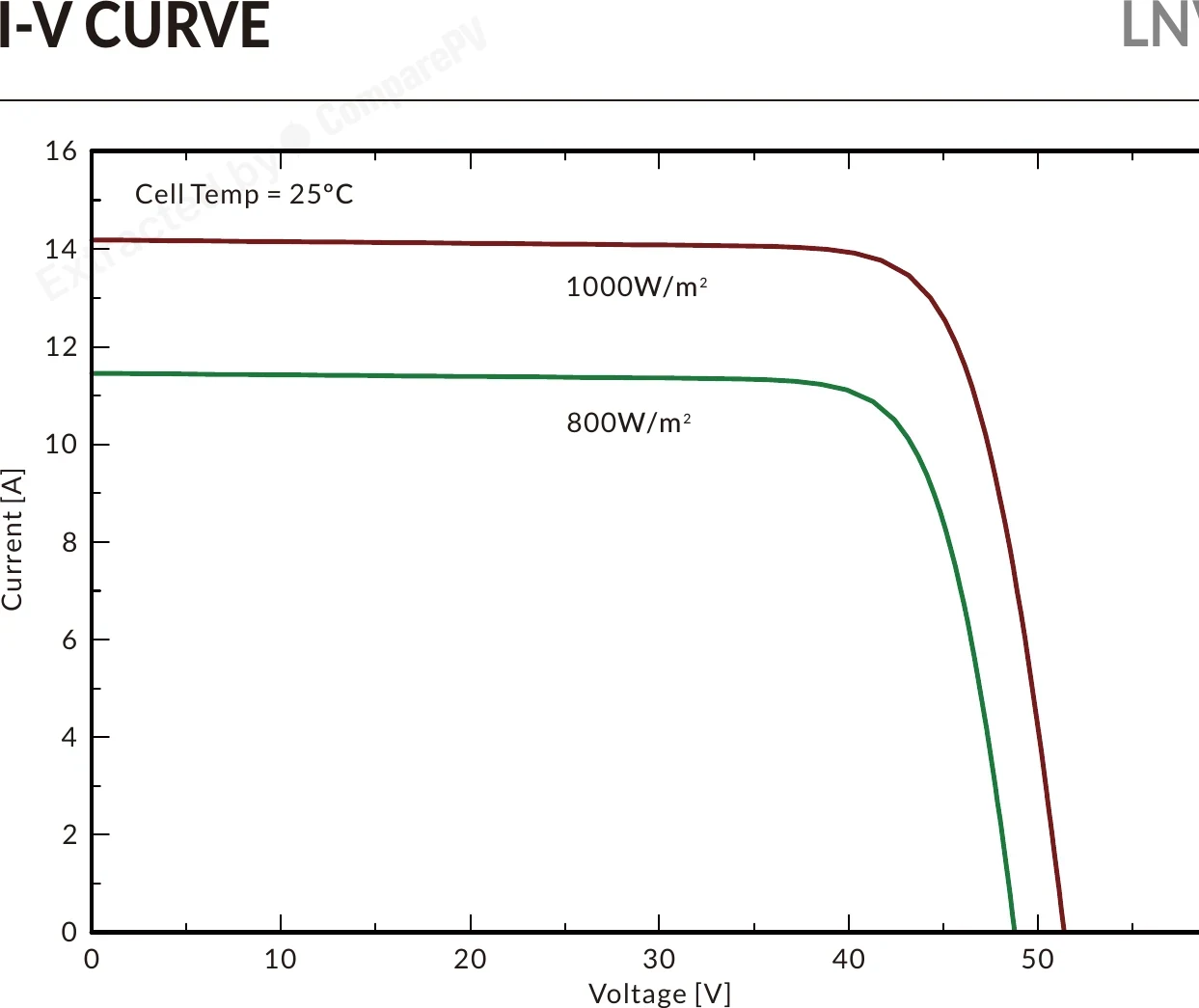
Datasheet charts
Measured curves published by Luxen Solar Energy in this model's datasheet. A chart carrying a wattage was measured on that variant alone - only the ones that describe 585 Wp appear here. The rest cover the whole series.
Simulations
Degradation from this panel's own datasheet figures. No inverter, soiling or shading losses.
Model: bifaciality × albedo × 0.6 view factor. A first-order estimate, not a yield simulation.



Found 2326 panels of the same or similar size to this one, within ±10 mm. See them here Found 2368 panels of the same or similar size to this one, within ±25 mm. See them here Found 2382 panels of the same or similar size to this one, within ±50 mm. See them here Found 2547 panels of the same or similar size to this one, within ±100 mm. See them here