Leapton LP210*210-M-66-NH-715W

LP210*210-M-66-NH-715W

715 Wp TOPCon
ComparePV verdict

Light for its output, weak in heat

Rank 92 of 14,005
Compare panels Datasheet PDF
Power (Wp)
715
Typical for its class
Efficiency (%)
23.12
Typical · median 23.00%
Density (Wp/m²)
230.2
Typical · median 230.2
Temp (%/°C)
-0.300
Weak · bottom 22%
Weight (kg)
34.0
Strong · 4.0 kg below median
Warranty (yrs)
30
Typical · median 30 yrs

The Leapton LP210*210-M-66-NH series is designed for maximum power generation from large mounting areas, where high power density and predictable performance over many years are crucial. The use of N-type cells helps to minimize typical performance losses seen in older technologies, resulting in more stable energy production throughout the lifespan of the installation. The modules in this series also feature large 210mm cell format, making it easier to complete the project to the desired power output without adding additional rows of panels.

In practice, LP210*210-M-66-NH solves a common problem for investors - how to increase power generation from a limited roof or ground-mounted area, without complicating the project. It is a good choice for PV farms, warehouses, and manufacturing plants, where lower degradation and consistent parameters in large deliveries are important. The series also supports operation in higher voltage systems, which simplifies the optimization of strings and BOS balance, distinguishing it from many standard modules in the commercial segment.

Ranking

420 panels in the segment TOPCon 700-750 W
Metric This panel Median Position in segment Overall rank
Module efficiency 23.12% 23.00% Typical 1,567
Power density 230.2 230.2 Typical 2,018
Temperature coefficient -0.300 -0.290 Weak · bottom 22% 6,093
Weight per kWp 47.6 52.9 Strong · top 13% 1,753
Performance warranty 30 yrs 30 yrs Typical 21
Colour key Strong - top 25% Typical - middle 50% Weak - bottom 25%

Signals from the data

6 positive · 3 caution
Best for

Commercial and utility-scale.

Not ideal for

Hot climates.

Strengths
47.6 kg per kWp

Top 13% of the TOPCon 700-750 W segment, against a median of 52.9.

Watch-outs
-0.300 %/°C temperature coefficient

Bottom 22% of the TOPCon 700-750 W segment, against a median of -0.290.

What owners get
N-type TOPCon cells with low degradation

N-type TOPCon technology delivers an annual degradation rate of 0.4%, clearly lower than older P-type PERC modules (typically 0.55-0.7%/year). This translates into higher cumulative energy yield over the full 30-year service life.

High module efficiency up to 23.18%

Module efficiency reaching 23.18% places the series among the leaders of the commercial segment, on par with competing TOPCon series such as DMEGC DMxxxG12T-B66HSW and GCL-NH12/66GDF (both up to 23.2%).

Tier-1 bankability per BloombergNEF

Leapton is listed on the BloombergNEF Tier-1 list, confirming manufacturer financial stability and easing project financing through banking institutions - important for large PV farm and commercial installations.

Extended product and power warranty

A 25-year product warranty and 30-year linear power warranty exceed the market standard (typically 12-15 years product and 25 years power for many competitors), reducing long-term risk for investors.

Large 210mm cell format and high unit power

Modules reaching up to 720Wp with 132 cells in the 210mm format allow fewer panels and shorter strings per required system power, easing BoS optimization and enabling higher system voltage operation.

Trade-offs
No bifacial variant available

The series is offered only in a monofacial version, while the 700+Wp TOPCon segment increasingly offers bifacial variants delivering an additional 5-10% yield in ground-mount installations and on bright roofing surfaces.

Efficiency marginally trails segment leaders

Maximum efficiency of 23.18% is slightly below comparable competitor series (DMEGC, GCL, Hanersun - up to 23.2%), meaning at identical 720Wp max power there is no real technological edge over rivals.

Notes from the database
  • At 23.1% efficiency, this panel is on par with typical TOPCon 700-750W modules
  • At 230.2 W/m² power density, roof space requirements are typical for TOPCon 700-750W panels
  • At -0.30%/°C, hot weather performance is typical for TOPCon 700-750W panels
  • 34.0 kg weight - 4.0 kg lighter than TOPCon 700-750W median (38.0 kg), reducing installation effort
  • #1567 for efficiency, #6093 for temperature performance out of 14005 panels

Specifications

Open datasheet PDF
Nominal power (Pmax) 715 Wp Nameplate at 1000 W/m², 25 °C
Module efficiency 23.12 % Typical Segment median 23.00%
Vmpp · Impp 40.80 V · 17.52 A Operating point at max power
Voc · Isc 48.80 V · 18.61 A Sizes the string length
Max system voltage 1500 V Longer strings than 1000 V modules
Dimensions 2384×1303×33 mm · 3.11 m² of roof
Weight 34.0 kg Strong Strong · 4.0 kg below median
Cells 132 · TOPCon Monocrystalline
Coefficient Pmax -0.300 %/°C Weak bottom 22% of its segment
Coefficient Voc · Isc -0.250 · 0.046 %/°C
NOCT 41 °C At 800 W/m², 20 °C ambient
Product warranty 25 years Hardware defects only
Performance warranty 30 years Typical median 30 yrs · median 30 yrs
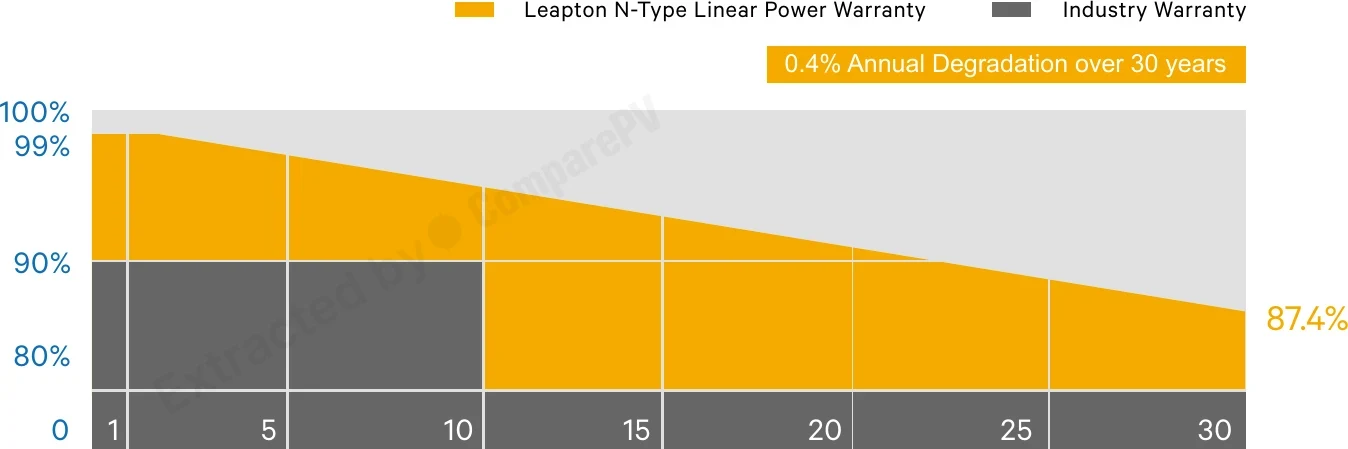
End-of-warranty output 87.4 % Equals 625 W guaranteed
Degradation 1.00 → 0.40 % First year, then annual

Datasheet charts

Open datasheet PDF

Measured curves published by Leapton in this model's datasheet. A chart carrying a wattage was measured on that variant alone - only the ones that describe 715 Wp appear here. The rest cover the whole series.
Simulations

Live - change any input
Lifetime output & value
30 years at 1200 kWh/kWp/year and €0.50 per kWh
Power in year 30
-
Lifetime energy
-
Energy value
-

Degradation from this panel's own datasheet figures. No inverter, soiling or shading losses.

Heat losses
-0.300 %/°C against a segment median of -0.290
-
Filter these
Size
Panel Power Eff. Temp. Weight Difference
Leapton LP210*210-M-66-NH-715W 715 W 23.12% -0.300 34.0 kg You are here
AIKO-A680-MDE72Mw 680 W 25.20% -0.260 29.0 kg Cooler, lighter, +2.1 pp
AIKO-A675-MDE72Mw 675 W 25.00% -0.260 29.0 kg -40 W, lighter, +1.9 pp
AIKO-A700-MAE78Dw 700 W 25.00% -0.260 34.5 kg -15 W, cooler, +1.9 pp
AIKO-A695-MAE78Dw 695 W 24.90% -0.260 34.5 kg -20 W, cooler, +1.8 pp
AIKO-G670-MCH72Mw 670 W 24.80% -0.260 28.2 kg -45 W, lighter, +1.7 pp
LR7-72HVHF-670M 670 W 24.80% -0.260 28.5 kg -45 W, lighter, +1.7 pp
JKM650-670N-66QL6-BDV (670W class) 670 W 24.80% -0.260 32.5 kg -45 W, cooler, +1.7 pp
LP210*210-M-66-NB-690W 690 W 22.21% -0.300 37.5 kg -25 W, heavier, -0.9 pp
LP210*210-M-66-NH-695W 695 W 22.37% -0.300 34.0 kg -20 W, -0.8 pp
LP210*210-M-66-NH-700W 700 W 22.53% -0.300 34.0 kg -15 W, -0.6 pp
LP210*210-M-66-NH-705W 705 W 22.70% -0.300 34.0 kg -10 W, -0.4 pp
LP210*210-M-66-NH-710W 710 W 22.86% -0.300 34.0 kg -0.3 pp
AIKO-A805-GRH78Dw 805 W 25.10% -0.260 39.8 kg +90 W, heavier, +2.0 pp
AIKO-A800-GRH78Dw 800 W 24.90% -0.260 39.8 kg +85 W, heavier, +1.8 pp
AIKO-A795-GRH78Dw 795 W 24.80% -0.260 39.8 kg +80 W, heavier, +1.7 pp
AIKO-A790-GRH78Dw 790 W 24.60% -0.260 39.8 kg +75 W, heavier, +1.5 pp

Found 1390 panels of the same or similar size to this one, within ±10 mm. See them here Found 1400 panels of the same or similar size to this one, within ±25 mm. See them here Found 1400 panels of the same or similar size to this one, within ±50 mm. See them here Found 1432 panels of the same or similar size to this one, within ±100 mm. See them here

Common questions

6 answered
What warranty does the Leapton LP210*210-M-66-NH series come with?
Leapton backs the LP210*210-M-66-NH series with a 25-year product warranty and a 30-year linear power output warranty. Annual degradation is capped at 0.4%, meaning the module retains significantly more of its rated output after three decades than older PERC-based panels. This places it among the most competitive warranty packages available in the commercial large-format segment.
What is the difference between the LP210*210-M-66-NH and the LP210*210-M-66-NB variant?
The key distinction is module construction: the NH variant is monofacial, while the NB is bifacial and harvests reflected light from the rear surface as well. LP210*210-M-66-NH is the right choice when the back of the panel has no useful albedo contribution — for instance, on rooftops with dark membranes or ground mounts over dark soil. The decision between the two variants depends on the albedo of the mounting surface.
Are LP210*210-M-66-NH panels compatible with 1500V DC inverters?
Yes, the LP210*210-M-66-NH series supports a maximum system voltage of 1500V DC. This enables longer strings with fewer inverters or combiner boxes, reducing overall BoS costs and simplifying system design. It is a meaningful advantage when engineering utility-scale PV farms or large commercial installations where infrastructure cost optimization is a priority.
How large and heavy are LP210*210-M-66-NH modules — can they be installed on a standard warehouse roof?
Each LP210*210-M-66-NH module measures 2384×1303×35 mm and weighs approximately 34 kg. This large format requires a structurally sound roof and at least a two-person installation crew. Warehouses and industrial facilities with flat or low-slope roofs are a typical application for this series, though a structural load assessment should always be completed prior to installation.
Does the TOPCon technology in the LP210*210-M-66-NH improve energy yield on cloudy days?
Yes. N-type TOPCon cells deliver higher output under low-irradiance conditions compared to PERC technology, and they also carry a lower temperature coefficient, which reduces power loss during hot summer days. In climates with frequent overcast conditions — typical of Central Europe — these characteristics translate into measurably higher annual energy yield per installed kilowatt-peak.
How many cells does the LP210*210-M-66-NH have, and how does this affect shading tolerance?
The LP210*210-M-66-NH uses 132 half-cut cells measuring 210×210 mm in a 66×2 layout. Splitting cells in half reduces resistive losses and improves partial-shading behavior — a shadow covering one section of the panel limits output only on that half-string, not the entire module. This is particularly relevant in commercial and industrial installations where chimneys, HVAC units, or adjacent structures may cast intermittent shadows.
Add to compare