JKM570N-72HL4-BDV

570 Wp N-type Bifacial 80%
ComparePV verdict

Middle of its segment, heavy for its output

Rank 5,309 of 14,005
Compare panels Datasheet PDF
Power (Wp)
570
Typical for its class
Efficiency (%)
22.07
Weak · bottom 24%
Density (Wp/m²)
220.7
Typical · median 224.5
Temp (%/°C)
-0.300
Weak · bottom 17%
Weight (kg)
32.0
Weak · 2.5 kg above median
Warranty (yrs)
30
Typical · median 30 yrs

The Tiger Neo N-type 72HL4-BDV series is a bifacial photovoltaic module built in a glass-glass configuration, engineered to maximize energy yield from every available square meter of an installation. The use of N-type TOPCon cells significantly reduces light- and temperature-induced degradation, allowing the panel to maintain high performance throughout its entire service life, even under demanding irradiance conditions. A key advantage of this series is its bifacial technology, which captures light reflected off the ground surface to generate additional energy gain without increasing the installation footprint - a solution particularly valued in ground-mount systems and flat roofs with light-colored surfaces. The dual glass construction provides substantially greater mechanical resistance and durability compared to traditional backsheet modules, translating into lower risk of microcracks and a longer operational lifespan under variable weather conditions. The panel is built on a half-cut cell layout, which reduces resistive losses and improves resilience against partial shading. The 72HL4-BDV series is well suited for both commercial installations and larger prosumer systems, where a low levelized cost of energy (LCOE) and predictable, stable long-term power output are essential.

Ranking

260 panels in the segment N-type 550-600 W
Metric This panel Median Position in segment Overall rank
Module efficiency 22.07% 22.45% Weak · bottom 24% 6,136
Power density 220.7 224.5 Typical 6,058
Temperature coefficient -0.300 -0.290 Weak · bottom 17% 6,093
Weight per kWp 56.1 52.3 Weak · bottom 11% 10,413
Performance warranty 30 yrs 30 yrs Typical 21
Colour key Strong - top 25% Typical - middle 50% Weak - bottom 25%

Signals from the data

5 positive · 5 caution
Best for

Commercial and utility-scale.

Not ideal for

Weight-limited structures, hot climates and tight roof space.

Watch-outs
56.1 kg per kWp

Bottom 11% of the N-type 550-600 W segment, against a median of 52.3.

-0.300 %/°C temperature coefficient

Bottom 17% of the N-type 550-600 W segment, against a median of -0.290.

22.07% module efficiency

Bottom 24% of the N-type 550-600 W segment, against a median of 22.45%.

What owners get
N-type TOPCon cells

N-type TOPCon technology delivers lower light-induced degradation (LID) and better high-temperature performance than legacy PERC cells, resulting in more stable annual energy yield, especially during summer months.

Bifacial glass-glass design

The glass-glass bifacial construction captures light reflected from the ground, generating additional energy yield (typically a few to over ten percent depending on albedo) without increasing installation footprint - a key advantage for ground-mount and flat, light-colored rooftop installations.

30-year linear power warranty

The manufacturer guarantees at least 87.4% of rated power after 30 years, matching the current premium standard for N-type TOPCon modules (LONGi, JA Solar, Trina Vertex S+) and clearly outperforming older PERC modules with 25-year power warranties.

Tier-1 manufacturer per BNEF

JinkoSolar is listed on BloombergNEF's Tier 1 list as of Q1 2026, confirming bankability and easing non-recourse project financing through commercial banks.

High mechanical durability

The dual-glass construction with half-cut cells reduces microcrack risk and improves load resistance, rated up to 5400 Pa snow load and 2400 Pa wind load, enhancing durability in demanding climates.

Trade-offs
Shorter product warranty than some peers

The 12-year product warranty is lower than the 15-year terms offered in this segment by e.g. Astronergy or LONGi Hi-MO6, while some N-type TOPCon leaders (Trina Vertex S+, JA Deep Blue) now offer 25-year product warranties as standard.

Efficiency in line with peers, no clear edge

The 22.45% peak efficiency matches Emmvee's Titanium Duo/Clear and is nearly identical to ZNShine's ZXM7-UHLD144 (22.44%) - the series does not stand out electrically among direct competitors at the comparable 580 Wp power class.

Notes from the database
  • Efficiency of 22.1% matches the N-type 550-600W median
  • At 220.7 W/m², this panel generates 3.8 W/m² less per unit area than N-type 550-600W median (224.5 W/m²)
  • At -0.30%/°C, hot weather performance is typical for N-type 550-600W panels
  • At 32.0 kg, this panel is 2.5 kg heavier than the N-type 550-600W median (29.5 kg) - more demanding for installation crews
  • Bifacial design (80% factor) captures reflected light - adds 4-12% yield on ground-mount or white roof

Specifications

Open datasheet PDF
Nominal power (Pmax) 570 Wp Nameplate at 1000 W/m², 25 °C
Module efficiency 22.07 % Weak Segment median 22.45%
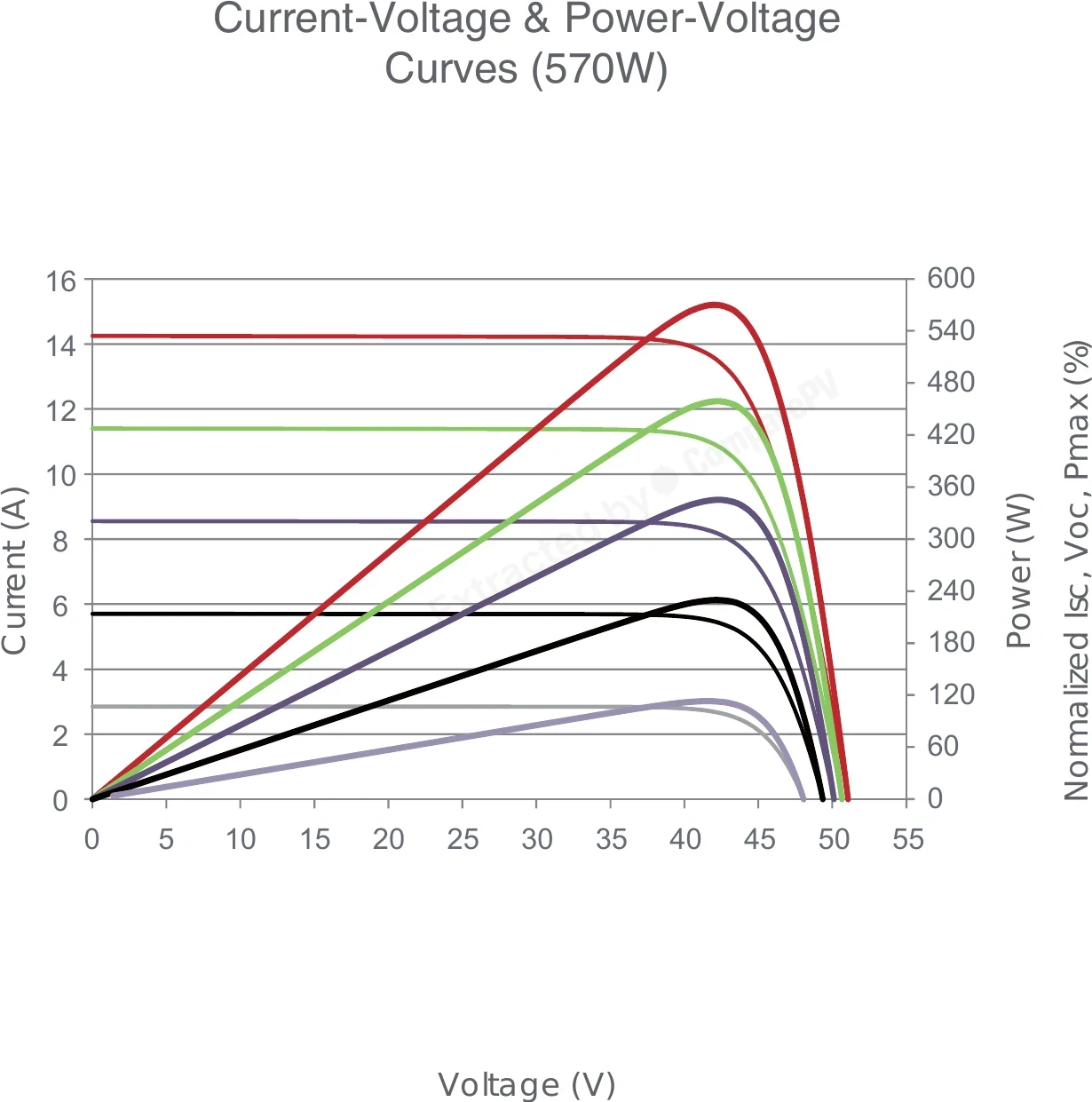
Vmpp · Impp 42.29 V · 13.48 A Operating point at max power
Voc · Isc 51.07 V · 14.25 A Sizes the string length
Max system voltage 1500 V Longer strings than 1000 V modules
Dimensions 2278×1134×30 mm · 2.58 m² of roof
Weight 32.0 kg Weak Weak · 2.5 kg above median
Cells 144 · N-type Monocrystalline
Bifaciality 80 % Rear output as a share of front
Coefficient Pmax -0.300 %/°C Weak bottom 17% of its segment
Coefficient Voc · Isc -0.250 · 0.046 %/°C
NOCT 45 °C At 800 W/m², 20 °C ambient
Product warranty 12 years Hardware defects only
Performance warranty 30 years Typical median 30 yrs · median 30 yrs
End-of-warranty output 87.4 % Equals 498 W guaranteed
Degradation 1.00 → 0.40 % First year, then annual

Datasheet charts

Open datasheet PDF

Measured curves published by Jinko Solar in this model's datasheet. A chart carrying a wattage was measured on that variant alone - only the ones that describe 570 Wp appear here. The rest cover the whole series.
Simulations

Live - change any input
Lifetime output & value
30 years at 1200 kWh/kWp/year and €0.50 per kWh
Power in year 30
-
Lifetime energy
-
Energy value
-
With bifacial gain
-

Degradation from this panel's own datasheet figures. No inverter, soiling or shading losses.

Heat losses
-0.300 %/°C against a segment median of -0.290
-
Bifacial gain
Rear gain over light concrete: -
-

Model: bifaciality × albedo × 0.6 view factor. A first-order estimate, not a yield simulation.

Filter these
Size
Panel Power Eff. Temp. Weight Difference
Jinko Solar JKM570N-72HL4-BDV 570 W 22.07% -0.300 32.0 kg You are here
LR7-60HVH-560M 560 W 24.80% -0.260 25.0 kg Cooler, lighter, +2.7 pp
LR7-60HVH-555M 555 W 24.60% -0.260 25.0 kg Cooler, lighter, +2.5 pp
LR7-60HVHL-550M 550 W 24.40% -0.260 16.3 kg Cooler, 16 kg lighter, +2.3 pp
JAT60S40-540/LR 540 W 24.40% -0.260 23.5 kg Cooler, lighter, +2.3 pp
GK-5-60HG-540M 540 W 24.40% -0.260 23.3 kg Cooler, lighter, +2.3 pp
JKM545-54QL6-DV-F1-EU 545 W 24.27% -0.260 27.5 kg Cooler, lighter, +2.2 pp
LR7-60HVH-545M 545 W 24.20% -0.260 25.0 kg Cooler, lighter, +2.1 pp
JKM525M-72HL4-TV 525 W 20.36% -0.350 28.9 kg -45 W, hotter, -1.7 pp
JS182MHC144-525 525 W 20.31% -0.350 26.5 kg Lighter, -1.8 pp, -5 yr warranty
JKM530M-72HL4-TV 530 W 20.55% -0.350 28.9 kg -40 W, hotter, -1.5 pp
JS182MHC144-530 530 W 20.51% -0.350 26.5 kg Lighter, -1.6 pp, -5 yr warranty
JKM535M-72HL4-(V)-F3-EN 535 W 20.71% -0.350 28.0 kg Hotter, -1.4 pp, -5 yr warranty
JKM535M-72HL4-BDVP 535 W 20.75% -0.350 34.3 kg -35 W, hotter, -1.3 pp
AIKO-A650-MAE72Mw 650 W 25.20% -0.260 27.0 kg +80 W, lighter, +3.1 pp
AIKO-A645-MAE72Mw 645 W 25.00% -0.260 27.0 kg +75 W, lighter, +2.9 pp
AIKO-A640-MAE72Mw 640 W 24.80% -0.260 27.0 kg +70 W, lighter, +2.7 pp

Found 2326 panels of the same or similar size to this one, within ±10 mm. See them here Found 2368 panels of the same or similar size to this one, within ±25 mm. See them here Found 2382 panels of the same or similar size to this one, within ±50 mm. See them here Found 2547 panels of the same or similar size to this one, within ±100 mm. See them here

Common questions

6 answered
What is N-type TOPCon technology in the Jinko Tiger Neo 72HL4-BDV panels and how does it differ from classic P-type cells?
TOPCon (Tunnel Oxide Passivated Contact) is an N-type cell technology where an additional passivation layer reduces electron recombination at the cell surface. In practice this means higher efficiency (around 22.45%), lower light-induced degradation (LID) and thermal-induced degradation (LeTID), and better performance at high temperatures compared to traditional P-type PERC cells. As a result, the panel maintains high energy output for longer.
How much extra energy does the bifacial design of the Tiger Neo 72HL4-BDV panel generate?
Thanks to the glass-glass construction, the rear side of the module also generates current using light reflected from the surrounding surface. Depending on the ground albedo (e.g., light gravel or a white roof membrane), the additional energy gain can range from a few to over ten percent compared to a monofacial module. The effect is strongest in ground-mount installations and flat roofs with light coverings, and smaller near a dark pitched roof surface.
What warranty comes with the Jinko Tiger Neo N-type 72HL4-BDV panels?
The manufacturer provides a 12-year product warranty covering material and manufacturing defects, plus a 30-year linear power output warranty. This means predictable, guaranteed power degradation over time, making it easier to estimate the return on investment when planning a commercial or residential prosumer installation over the long term.
Is the 580 Wp panel from the 72HL4-BDV series suitable for a single-family house pitched roof?
Yes, though due to the 72-cell format (dimensions around 2278x1134 mm) and a weight close to 32-33 kg resulting from the glass-glass construction, the panel is heavier than standard backsheet modules. Installation requires a mounting structure rated for the additional load, but the module itself works well on pitched roofs, though the bifacial gain will be limited by the proximity of a dark roof surface.
Is the glass-glass construction more resistant to microcracks than standard backsheet panels?
Yes. Replacing the rear backsheet with a second tempered glass layer significantly increases the module's mechanical rigidity and resistance to snow and wind loads, while reducing the risk of cell microcracks and laminate degradation from moisture. The dual-glass construction also improves module sealing, resulting in longer, more stable performance under harsh weather conditions.
How do half-cut cells in the Tiger Neo 72HL4-BDV panel affect performance under partial shading?
Splitting cells into halves reduces resistive losses and divides the panel into independent electrical sections. When part of the module is shaded, for example by a chimney, branch, or dirt buildup, the rest of the panel keeps operating efficiently, and the overall power drop is smaller than in panels with full-size cells. This is a real advantage for roofs that experience partial shading during the day.
Add to compare