Middle of its segment, modest efficiency
Jinko Solar’s Tiger Pro 72HC-TV series is designed for installations where high yield remains crucial even under non-ideal conditions. These modules utilize half-cut (HC) technology, which enhances performance during partial shading and minimizes power losses caused by cell heating. Additionally, Multi Busbar (MBB) enables better current collection and improves resistance to micro-cracks, leading to more stable energy production over the long term.
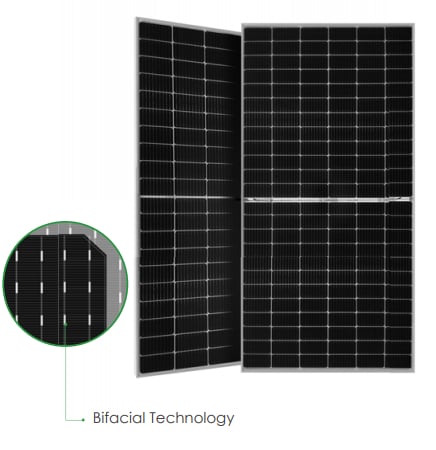
The 72HC-TV version is a bifacial module with a transparent rear side, allowing it to capture reflected light from the ground surface. This is a significant advantage on flat roofs, light membrane roofs, and ground-based structures with the right substrate. Another key feature is its durable construction, which appeals to investors seeking predictable returns and lower service risks.
This is an excellent choice for companies, agricultural operations, and larger commercial installations where the focus is on achieving a favorable cost-to-energy ratio, not just module datasheet parameters.
Ranking
Signals from the data
Commercial and shaded-installations.
Tight roof space and roofs where every square metre has to count.
Bottom 20% of the PERC 500-550 W segment, against a median of 20.90%.
Bottom 20% of the PERC 500-550 W segment, against a median of 209.0.
The 72HC-TV variant uses a transparent backsheet instead of a rear glass layer, reducing module weight while retaining full bifacial functionality. Jinko claims a 5–25% energy yield gain over monofacial equivalents — a tangible LCOE advantage on ground-mount installations with high-albedo surfaces or flat roofs with white membranes.
Half-cut (HC) cell splitting reduces power loss in a partially shaded string by approximately 50% versus full-cell designs. Multi Busbar (MBB) shortens current paths, lowers series resistance, and improves micro-crack resistance — relevant for a module rated for 2400 Pa wind and 5400 Pa snow mechanical loads.
Jinko guarantees ≤1% degradation in Year 1 and ≤0.4%/year from Years 2–30, ensuring ≥87.4% of nameplate power at end of warranty. This outperforms the common PERC 72-cell market standard of 0.45–0.55%/year annual degradation.
Jinko Solar appears on the BloombergNEF Tier-1 list in both Q1 and Q2 2026 (42 manufacturers total), co-leading in annual production capacity at ~120 GW/year. Tier-1 status lowers project financing risk and supports favorable insurance terms for C&I and utility-scale installations.
The Tiger Pro 72HC-TV was manufactured from 2020 to 2023 and has since been removed from Jinko Solar's active product lineup. New stock is essentially unavailable, and sourcing matching modules for array expansion or warranty replacement will likely become impractical within the coming years.
P-type PERC cells exhibit a median first-year LID of approximately 1.92% (field data, SurgePV 2026), versus ~0.26% for N-type TOPCon modules. With TOPCon having become the 2026 market standard, the Tiger Pro 72HC-TV effectively starts each installation at a lower real-world power baseline from Season 1 onward.
- Efficiency of 20.6% matches the PERC 500-550W median
- At 205.5 W/m², this panel generates 3.5 W/m² less per unit area than PERC 500-550W median (209.0 W/m²)
- Temperature coefficient of -0.35%/°C matches the PERC 500-550W median
- Bifaciality factor of 70% can add 4-10% extra yield with reflective mounting surface
- In the top 80% for efficiency among all PERC panels
Specifications
Simulations
Degradation from this panel's own datasheet figures. No inverter, soiling or shading losses.
Model: bifaciality × albedo × 0.6 view factor. A first-order estimate, not a yield simulation.



Found 2337 panels of the same or similar size to this one, within ±10 mm. See them here Found 2368 panels of the same or similar size to this one, within ±25 mm. See them here Found 2382 panels of the same or similar size to this one, within ±50 mm. See them here Found 2540 panels of the same or similar size to this one, within ±100 mm. See them here