
Efficiency leader, no clear weak spot
This series was designed with every square centimeter of roof space and real ease of installation in mind. It’s a compact, double-glass module that’s easier to handle, placing, and installing on pitched roof ridges and in hard-to-reach spots - without compromising on cutting-edge cell technology. The use of N-type TOPCon cells helps limit losses and maintain high operational stability over time, which is especially important in residential installations where even small drops in yield quickly translate to higher bills.
In practice, this series addresses two common problems: limited mounting space and the risk of accelerated module aging in challenging conditions. Thanks to its glass-glass construction and TOPCon technology, the panels perform well on residential rooftops, carports, and smaller commercial structures. An additional advantage is bifacial capability, allowing for the use of reflected light when mounting conditions permit. It stands out from the competition due to its installer-friendly format and focus on practical ergonomic design.
Ranking
Signals from the data
Residential and commercial.
Top 5% of the TOPCon 250-300 W segment, against a median of 14.99%. Ranked 2,359th in the whole database.
Top 5% of the TOPCon 250-300 W segment, against a median of 149.9. Ranked 2,473rd in the whole database.
Top 5% of the TOPCon 250-300 W segment, against a median of 79.5. Ranked 10,792nd in the whole database.
A peak efficiency of 22.9% clearly outperforms direct peer comparables: Kyocera KK270P (16.4%) and KU-60 (16.41%) are approximately 39% less area-efficient, while the MY Solar M2 series reaches 21.2%. In practice, this translates to roughly 10–15% more power from the same roof area compared to the best-performing alternative.
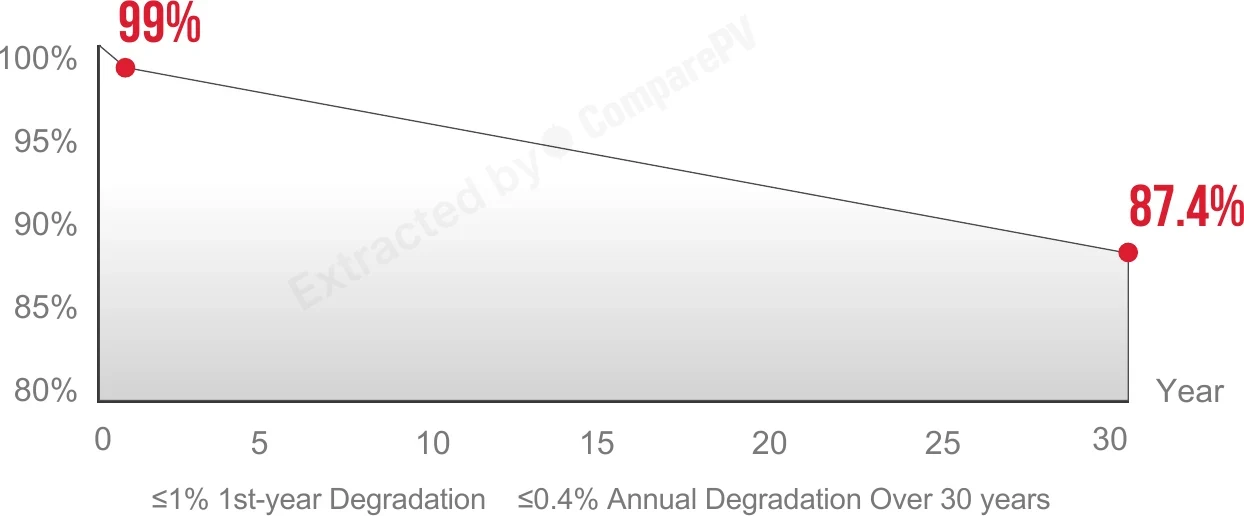
Per the manufacturer's datasheet, only 0.4% annual power degradation is guaranteed over 30 years, corresponding to ≥88% of rated power output retained at end of warranty. N-type technology eliminates the LID (Light-Induced Degradation) effect characteristic of older P-type PERC cells, delivering tangible operational benefits especially during the early years of system operation.
A linear power warranty extending to 30 years is an above-market commitment — the industry norm among Tier 2/3 manufacturers is 25 years. Combined with a 25-year product warranty and a bankability rating of 'A' (PV ModuleTech Q4 2024), the financial risk of a prosumer investment is significantly reduced.
A weight of just 15.3 kg and a form factor of 1542×766×30 mm are exceptional among glass-glass modules, which typically weigh 20–25 kg. On steep roof pitches and hard-to-access installations, this means safer handling for the installer and reduced mounting time — a meaningful competitive advantage for installation crews.
DMEGC maintains Tier 1 BloombergNEF status (confirmed Q3 2025) and an 'A' rating from S&P Global Tier 1 Cleantech. In the Wood Mackenzie 2025 ranking, the manufacturer advanced to 5th place globally with shipments of 13.4 GW in H1 2025 alone (+64% YoY), materially reducing supplier insolvency risk over the warranty horizon.
Against the 2024–2025 market standard of 400–450 Wp for full-size M10/G12 modules, achieving a 10 kWp system requires a minimum of 37 panels from this series versus approximately 23 standard modules. For systems above ~6 kWp, this proportionally increases BoS costs (rails, mounting hardware, MC4 connectors, labor), which can offset any potential module-level price advantage.
- At 22.9% efficiency, this panel is 6.9pp above typical TOPCon 0-400W modules (median: 16.0%)
- 228.6 W/m² power density - 68.8 W/m² more than TOPCon 0-400W median (159.8 W/m²), more power per roof area
- Temperature coefficient of -0.29%/°C matches the TOPCon 0-400W median
- At 15.3 kg, this panel is 8.2 kg lighter than TOPCon 0-400W median (23.5 kg) - easier handling during installation
- Bifacial design (80% factor) captures reflected light - adds 4-12% yield on ground-mount or white roof
Specifications
Datasheet charts
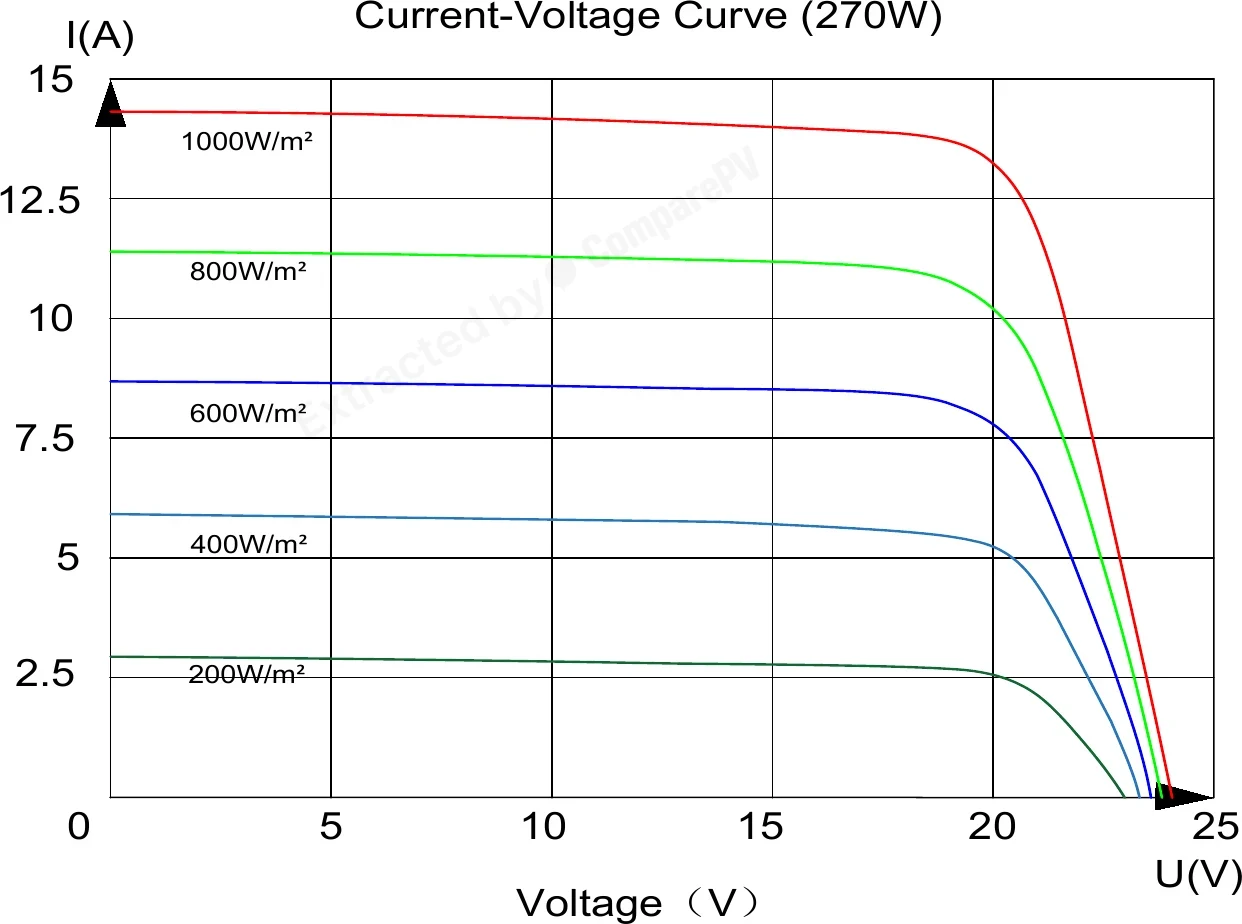
Measured curves published by DMEGC in this model's datasheet. A chart carrying a wattage was measured on that variant alone - only the ones that describe 270 Wp appear here. The rest cover the whole series.
Simulations
Degradation from this panel's own datasheet figures. No inverter, soiling or shading losses.
Model: bifaciality × albedo × 0.6 view factor. A first-order estimate, not a yield simulation.





Found 8 panels of the same or similar size to this one, within ±10 mm. See them here Found 20 panels of the same or similar size to this one, within ±25 mm. See them here Found 40 panels of the same or similar size to this one, within ±50 mm. See them here Found 149 panels of the same or similar size to this one, within ±100 mm. See them here