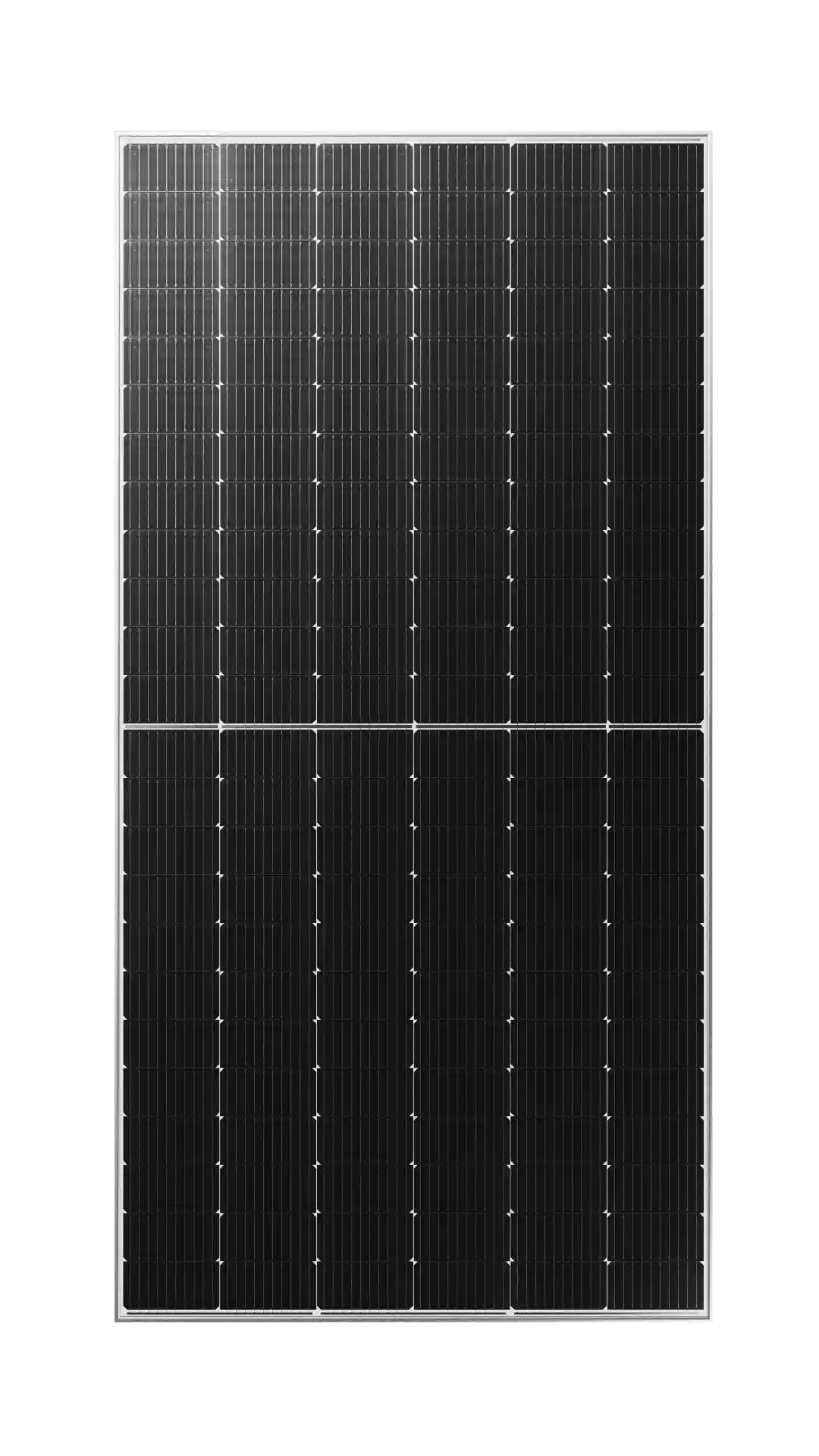
Strong in heat, heavy for its output
The BYD AURO MLBK-36 series are bifacial monocrystalline modules with a dual glass construction, designed for stable energy production under real-world conditions - not just in ideal sunlight. Thanks to bidirectional energy generation, the panel can utilize reflected light from the ground, which translates to higher efficiency, especially on light roofs, membranes, gravel, or in ground-mounted installations.
Using glass on both sides improves resistance to environmental conditions and reduces the risk of microcracks and accelerated laminate aging, which will be appreciated by investors focused on long-term, predictable performance. The modules also stand out for their good performance at high temperatures and in weaker sunlight - which is important in Polish weather, where cloud cover and fog can reduce energy output.
This series is ideal for PV farms, energy storage facilities, and larger commercial installations, as well as anywhere where low lifecycle energy costs and compatibility with modern inverters and trackers are important.
Ranking
Signals from the data
Commercial, utility-scale and cold-climate.
Weight-limited structures.
Top 6% of the PERC 500-550 W segment, against a median of -0.350. Ranked 8,526th in the whole database.
Top 18% of the PERC 500-550 W segment, against a median of 209.0.
Top 20% of the PERC 500-550 W segment, against a median of 20.90%.
Bottom 23% of the PERC 500-550 W segment, against a median of 53.0.
Glass-on-glass design eliminates the EVA degradation, delamination risk, and accelerated laminate aging associated with standard polymer backsheets. Dual-glass modules statistically exhibit lower rates of micro-cracking under cyclic mechanical loading per IEC 61215, directly translating into more durable performance well beyond the nominal 30-year service life.
The rear surface generates an additional 5–25% of energy depending on ground albedo (white TPO membrane ~25%, light gravel ~15%, concrete ~10%). The effect is most pronounced in ground-mount installations, flat roofs with light-colored membranes, and tracker-based systems — precisely the configurations for which this series is explicitly optimized according to the manufacturer.
BYD is listed as a bankable manufacturer on the BNEF Tier 1 index. With a 30-year warranty horizon, the financial strength of the BYD Group (annual revenues exceeding USD 85 billion) provides meaningful assurance of warranty and service obligation enforceability — a critical factor in risk modeling for projects underwritten by financial institutions.
The manufacturer guarantees ≥83.5% Pnom after 30 years, exceeding the standard 25-year warranties offered by peer comparables such as ET Solar Elite PLUS and Boviet VEGA SERIES. The extended warranty horizon has a direct impact on LCOE in utility-scale projects and PV farms structured with project finance.
The top-tier variant (555 Wp) achieves 21.48% efficiency, closely matching leading peer comparables — JA Solar DEEP BLUE 3.0 (21.5%) and ET Solar Elite PLUS (21.4%) — while retaining the superior environmental durability of a dual-glass construction, a rare combination in this power class.
The P-type PERC cells (AURO P MLBK-36) carry a higher temperature coefficient than N-type TOPCon: the BYD AURO N NLBK-36 achieves −0.30%/°C, while top N-type series from JA Solar and ET Solar fall within −0.30 to −0.32%/°C. At a module temperature of 70°C — typical during summer conditions in Poland — the 0.028 percentage-point/°C difference translates to approximately 1.4% lower hourly energy yield compared to N-type variants under identical conditions.
The ≥83.5% Pnom threshold at the end of the warranty period is notably below the ≥87% commonly guaranteed by N-type TOPCon manufacturers in the 530–555 Wp segment (e.g., JA Solar N-type series with a 0.4%/year degradation rate). For a 1 MWp installation, the 3.5 percentage-point gap represents approximately 35 kWp less guaranteed capacity in year 30 — a material consideration in P90 modeling for project finance lenders.
- Efficiency of 21.1% matches the PERC 500-550W median
- At 211.0 W/m² power density, roof space requirements are typical for PERC 500-550W panels
- -0.33%/°C temperature coefficient (median: -0.35%/°C) - retains ~1% more power at high temperatures
- At 32.0 kg (3.6 kg above PERC 500-550W median of 28.4 kg), requires checking roof load capacity
- 70% bifaciality enables rear-side power generation, boosting yield by 4-10% on reflective surfaces
Specifications
Simulations
Degradation from this panel's own datasheet figures. No inverter, soiling or shading losses.
Model: bifaciality × albedo × 0.6 view factor. A first-order estimate, not a yield simulation.
Alternatives



Found 2326 panels of the same or similar size to this one, within ±10 mm. See them here Found 2368 panels of the same or similar size to this one, within ±25 mm. See them here Found 2382 panels of the same or similar size to this one, within ±50 mm. See them here Found 2547 panels of the same or similar size to this one, within ±100 mm. See them here