Solid all-round for its segment
The ODA-144MHD series redefines energy efficiency standards through the use of N-type TOPCon cell technology, which provides significantly higher efficiency and better performance in low-light conditions. These innovative modules effectively solve the problem of light-induced power degradation, guaranteeing investors stable yields for over thirty years of operation. The use of a bifacial glass-glass design allows for additional energy harvesting from the rear of the panel, making this series an ideal choice for large-scale solar farms and modern carports. Thanks to the use of half-cut cells, systems based on these components are characterized by lower resistance losses and higher resistance to localized shading. The ODA-144MHD series stands out from the competition with its low temperature coefficient, which translates into real gains on the hottest summer days when standard panels lose efficiency. This solution is dedicated to professional installations where structural durability and maximization of energy self-consumption are priorities. By choosing these modules, you gain the certainty of operation in extreme weather conditions while maintaining exceptional mechanical resistance to wind pressure and snow load. This is a smart investment in the technology of the future that optimizes costs and shortens the payback period.
Ranking
Signals from the data
Utility-scale, commercial, shaded-installations and hot-climate.
The maximum efficiency of 22.83% places this series practically on par with the best comparable models: the DAH DHN-72X16/DG(BB) achieves 22.84%, while Horay Solar and Talesun reach 22.80%. The series is on par with recognized brands in terms of technology and offers the highest power output per square meter in the 550-590 Wp class.
N-type cells eliminate light-induced degradation (LID) and exhibit a lower temperature coefficient than comparable PERC cells (~0.30%/°C vs ~0.35%/°C). On hot days above 30°C, this translates into real production gains of 2-4% compared to PERC modules of the same nominal power.
Replacing the backsheet with a glass panel increases the mechanical durability and moisture-tightness for a 30-year lifespan. The bifacial design allows for the generation of an additional 10–20% of energy from the back side of the module (depending on the surface albedo), which directly improves the LCOE (Levelized Cost of Energy) of the installation – especially for large-scale solar farms with a light, gravel-covered surface.
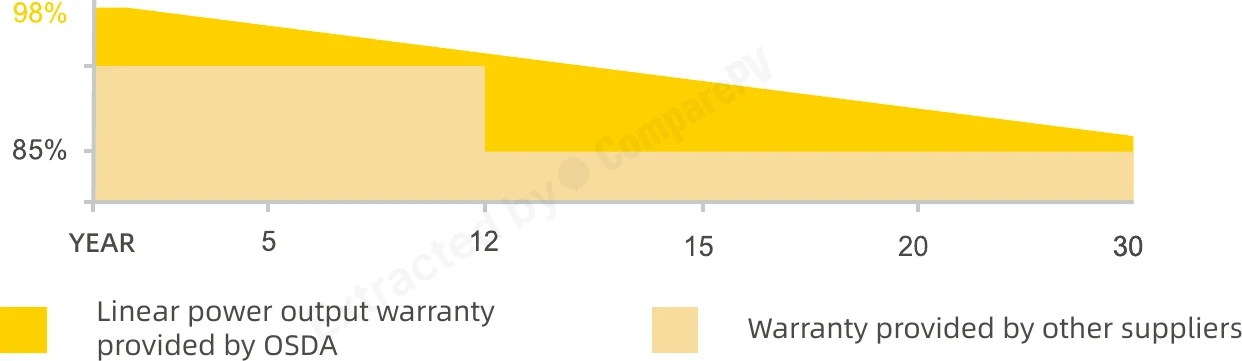
The manufacturer declares a linear degradation rate of power over 30 years – a standard characteristic of TOPCon technology, exceeding the typical 25-year warranty of PERC series with a fixed power level of approximately 84.8% at the end of the period. For institutional investors, a longer warranty period directly reduces the projected LCOE (Levelized Cost of Electricity) of the project.
Using half-cell technology reduces the current flow in the strings by half, decreasing resistive losses (I²R) and limiting the impact of localized shading (e.g., chimneys, antennas, adjacent rows of panels) on the overall module's output – a significant advantage for roof-mounted systems and farms with minimal row spacing.
The context indicates that the country of origin is India and the year of establishment is 2015. However, ENF Solar and the official website austasolar.net locate the company in China (Ningbo/Zhejiang) as being affiliated with the OSDA group, with a history dating back to 2009. This discrepancy makes financial due diligence more difficult and could complicate warranty procedures over the 30-year lifespan of the project.
With the 9 variants of the series, the lower limit of the product warranty is as low as 12 years. For comparison, Tier-1 manufacturers offering TOPCon modules (Longi Hi-MO 9, Jinko Tiger Neo) typically offer a 15-year warranty for the entire product line without any variant exceptions. The buyer should verify which variant with the shorter warranty is included before selecting a model for the contract.
The manufacturer does not appear as a Tier 1 bankable entity in the current context (despite being listed on the BNEF list in 2023, the validity of which is verified quarterly). The lack of a sustained status may make it difficult to obtain project financing or installation insurance from institutions that require a Tier 1 manufacturer's guarantee as a contractual condition.
- At 22.4% efficiency, this panel is on par with typical TOPCon 550-600W modules
- Power density of 224.4 W/m² matches the TOPCon 550-600W median
- At -0.30%/°C, hot weather performance is typical for TOPCon 550-600W panels
- At 32.2 kg, this panel is 1.0 kg heavier than the TOPCon 550-600W median (31.2 kg) - more demanding for installation crews
- #4620 for efficiency, #6093 for temperature performance out of 14005 panels
Specifications
Datasheet charts
Measured curves published by AUSTA ENERGY in this model's datasheet. A chart carrying a wattage was measured on that variant alone - only the ones that describe 580 Wp appear here. The rest cover the whole series.
Simulations
Degradation from this panel's own datasheet figures. No inverter, soiling or shading losses.




Found 2326 panels of the same or similar size to this one, within ±10 mm. See them here Found 2368 panels of the same or similar size to this one, within ±25 mm. See them here Found 2382 panels of the same or similar size to this one, within ±50 mm. See them here Found 2542 panels of the same or similar size to this one, within ±100 mm. See them here