Astronergy CHSM72N-HC-585

Astronergy CHSM72N-HC-585

585 Wp TOPCon
ComparePV verdict

Light for its output, no clear weak spot

Rank 4,092 of 14,129
Compare panels Datasheet PDF
Power (Wp)
585
Typical for its class
Efficiency (%)
22.60
Typical · median 22.44%
Density (Wp/m²)
226.5
Typical · median 224.4
Temp (%/°C)
-0.290
Typical · median -0.290
Weight (kg)
26.9
Strong · 4.3 kg below median
Warranty (yrs)
30
Typical · median 30 yrs

The ASTRO N5 CHSM72N-HC Monofacial series redefines performance standards through the use of advanced n-type TOPCon cell technology. Choosing this architecture allows for a significant reduction in light-induced degradation phenomena, which directly translates into more stable energy production over a long-term horizon. The use of the innovative Super Multi-Busbar (SMBB) solution optimizes the current flow path, effectively reducing resistive losses and increasing the module's resistance to micro-cracks. These monocrystalline panels are the ideal response to the needs of large commercial installations and solar farms, where the key is to maximize the use of available space while maintaining high investment profitability. They are distinguished by an excellent temperature coefficient, which means they work efficiently even on very hot days, minimizing energy losses resulting from cell heating. Thanks to high mechanical resistance and research-confirmed reliability, this series is a safe choice for investors seeking a balance between modern technology and component durability. ASTRO N5 effectively addresses the problem of rapid efficiency decline in older module types, offering higher power density and significantly better performance parameters under diffused light. It is a professional solution for projects where a quick return on invested capital and long-term system stability are essential.

Ranking

1,022 panels in the segment TOPCon 550-600 W
Metric This panel Median Position in segment Overall rank
Module efficiency 22.60% 22.44% Typical 3,716
Power density 226.5 224.4 Typical 3,557
Temperature coefficient -0.290 -0.290 Typical 2,220
Weight per kWp 46.0 53.8 Strong · top 9% 947
Performance warranty 30 yrs 30 yrs Typical 21
Colour key Strong - top 25% Typical - middle 50% Weak - bottom 25%

Signals from the data

6 positive · 3 caution
Best for

Commercial, utility-scale and hot-climate.

Strengths
46.0 kg per kWp

Top 9% of the TOPCon 550-600 W segment, against a median of 53.8. Ranked 947th in the whole database.

What owners get
Efficiency 22.6-23.4% above the segment median

The series achieves a significantly higher efficiency than two out of the three compared models: JS Solar JS210MHC120 (21.4%) and LEDVANCE M585~605P60UB (21.37%). This result is close to the leader, GCL SIROT NT10/72GDF (23.42%), which translates to greater power output from the same roof or ground area.

Excellent temperature coefficient of -0.29%/°C

N-type TOPCon solar cells are characterized by one of the lowest temperature coefficients in the 600 Wp class. Under typical hot weather conditions (+35°C above STC), power losses reach approximately 10.2%, compared to 12-14% for PERC modules. This directly impacts the annual energy yield in the Polish climate.

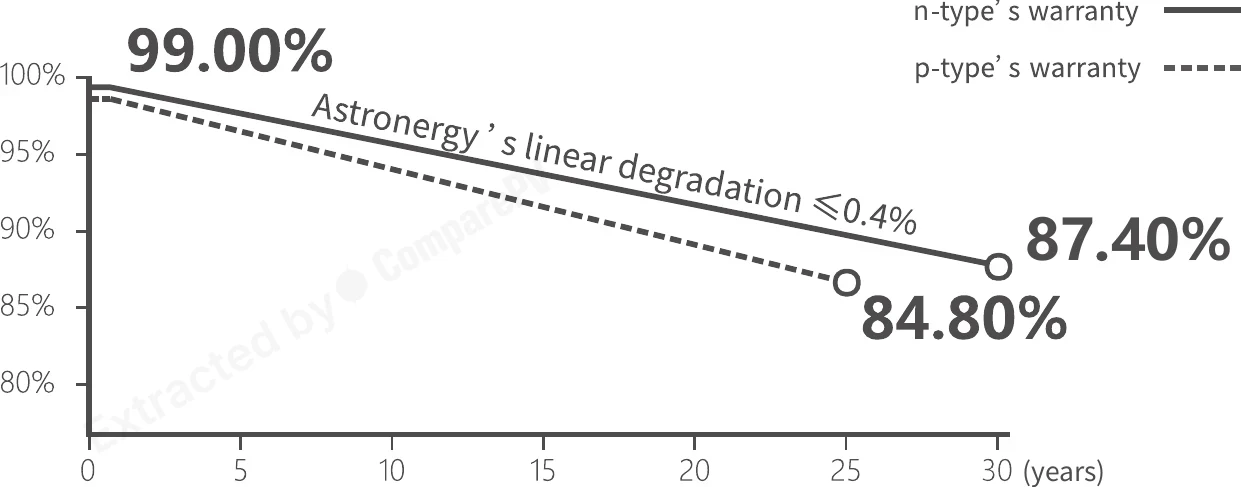
30-year power guarantee (87.4%)

The official datasheet from the manufacturer (CHSM72N-HC, update 06.2024) guarantees ≥87.4% of its rated power after 30 years of operation. A 30-year lifespan with such a high retention rate is a premium standard that is rare among this price range and strengthens the financial model for a PV farm.

The SMBB technology reduces losses and micro-cracks.

The Super Multi-Busbar solution reduces the current flow path within the module, lowering resistive losses and mechanical stresses at the connections. This results in a higher fill factor (FF) and improved resistance to wind and snow loads, which are typical for rooftop installations.

Tier 1 manufacturer - BNEF’s top 6 global producers

Astronergy (Chint) has maintained a Tier 1 rating according to BloombergNEF for years, ranking 6th among global PV module manufacturers (production capacity of 56 GW/year) in the 2023 bankability ranking. This status signifies that projects are fully financeable by banks and infrastructure funds without requiring additional risk assessments from the manufacturer.

Trade-offs
This model will be discontinued from production (starting in 2025).

The CHSM72N-HC series was discontinued in 2025 (release in 2022, end in 2025). This means that it will have limited and decreasing availability on the secondary market, there is a risk of not being able to find compatible replacement modules in case of damage, and it will be difficult to expand existing installations with identical specifications.

12-year product warranty - below the industry standard of 15 years

The product specifications indicate a 12-year warranty on the product, while the current Astronergy datasheet for newer ASTRO N5 models from 2024 offers a 15-year warranty instead. Leading Tier 1 manufacturers (Jinko Solar, Trina Solar) typically offer 15-year warranties on 600 Wp modules, which makes this series less robust in terms of warranty coverage.

Lack of bifaciality - lost potential for increased energy yield

This series is monofacial only, unlike the bifacial ASTRO N5 CHSM72N(DG)/F-BH model from the same manufacturer, which is bifacial. Ground-mounted systems with clear backsheets (gravel, concrete, snow) lose 5-15% of additional annual yield, which is achieved by bifacial counterparts at a similar price.

Notes from the database
  • Efficiency of 22.6% matches the TOPCon 550-600W median
  • At 226.5 W/m² power density, roof space requirements are typical for TOPCon 550-600W panels
  • Temperature coefficient of -0.29%/°C matches the TOPCon 550-600W median
  • At 26.9 kg, this panel is 4.3 kg lighter than TOPCon 550-600W median (31.2 kg) - easier handling during installation
  • Ranked #3716 out of 14129 panels for efficiency in the database

Specifications

Open datasheet PDF
Nominal power (Pmax) 585 Wp Nameplate at 1000 W/m², 25 °C
Module efficiency 22.60 % Typical Segment median 22.44%
Vmpp · Impp 42.75 V · 13.68 A Operating point at max power
Voc · Isc 51.30 V · 14.40 A Sizes the string length
Max system voltage 1500 V Longer strings than 1000 V modules
Dimensions 2278×1134×35 mm · 2.58 m² of roof
Weight 26.9 kg Strong Strong · 4.3 kg below median
Cells 144 · TOPCon Monocrystalline
Coefficient Pmax -0.290 %/°C Typical median -0.290 of its segment
Coefficient Voc · Isc -0.250 · 0.043 %/°C
NOCT 41 °C At 800 W/m², 20 °C ambient
Product warranty 12 years Hardware defects only
Performance warranty 30 years Typical median 30 yrs · median 30 yrs
End-of-warranty output 87.4 % Equals 511 W guaranteed
Degradation 1.00 → 0.40 % First year, then annual

Datasheet charts

Open datasheet PDF

Measured curves published by Astronergy in this model's datasheet. A chart carrying a wattage was measured on that variant alone - only the ones that describe 585 Wp appear here. The rest cover the whole series.
Simulations

Live - change any input
Lifetime output & value
30 years at 1200 kWh/kWp/year and €0.50 per kWh
Power in year 30
-
Lifetime energy
-
Energy value
-

Degradation from this panel's own datasheet figures. No inverter, soiling or shading losses.

Heat losses
-0.290 %/°C against a segment median of -0.290
-
Filter these
Size
Panel Power Eff. Temp. Weight Difference
Astronergy CHSM72N-HC-585 585 W 22.60% -0.290 26.9 kg You are here
LR7-60HVH-560M 560 W 24.80% -0.260 25.0 kg -25 W, cooler, +2.2 pp
LR7-60HVH-555M 555 W 24.60% -0.260 25.0 kg -30 W, cooler, +2.0 pp
AIKO-A635-MAE72Mw 635 W 24.60% -0.260 27.0 kg +50 W, cooler, +2.0 pp
AIKO-A630-MAH72Dw 630 W 24.40% -0.260 32.5 kg +45 W, heavier, +1.8 pp
LR7-60HVHL-550M 550 W 24.40% -0.260 16.3 kg -35 W, lighter, +1.8 pp
CHSM72M-HC-545 545 W 21.10% -0.340 26.9 kg Hotter, -1.5 pp, -5 yr warranty
CHSM72M-HC-550 550 W 21.30% -0.340 26.9 kg Hotter, -1.3 pp, -5 yr warranty
CHSM72M-HC-555 555 W 21.50% -0.340 26.9 kg Hotter, -1.1 pp, -5 yr warranty
CHSM72M-HC-560 560 W 21.70% -0.340 26.9 kg Hotter, -0.9 pp, -5 yr warranty
CHSM72N-HC-565 565 W 21.90% -0.290 26.9 kg -20 W, -0.7 pp
CHSM72N-HC-570 570 W 22.10% -0.290 26.9 kg -15 W, -0.5 pp
CHSM72N-HC-575 575 W 22.30% -0.290 26.9 kg -10 W, -0.3 pp
CHSM72N-HC-580 580 W 22.50% -0.290 26.9 kg Very close match
AIKO-A650-MAE72Mw 650 W 25.20% -0.260 27.0 kg +65 W, cooler, +2.6 pp
AIKO-A645-MAE72Mw 645 W 25.00% -0.260 27.0 kg +60 W, cooler, +2.4 pp
AIKO-A640-MAE72Mw 640 W 24.80% -0.260 27.0 kg +55 W, cooler, +2.2 pp

Found 2327 panels of the same or similar size to this one, within ±10 mm. See them here Found 2369 panels of the same or similar size to this one, within ±25 mm. See them here Found 2383 panels of the same or similar size to this one, within ±50 mm. See them here Found 2548 panels of the same or similar size to this one, within ±100 mm. See them here

About the ASTRO N5 CHSM72N-HC Monofacial Series series

6 answered

These answers cover the whole series. Where a figure differs, the specification above is this module's own.

Is the Astronergy ASTRO N5 CHSM72N-HC Monofacial series still available for purchase?
The ASTRO N5 CHSM72N-HC Monofacial series has been discontinued and is no longer actively offered by Astronergy. Availability may be limited to remaining distributor stock. Before purchasing, it is advisable to confirm that the supplier has current inventory on hand and is able to fulfill the manufacturer warranty through an authorized channel.
What is TOPCon technology and why does it matter in the ASTRO N5 CHSM72N-HC series?
TOPCon (Tunnel Oxide Passivated Contact) is an n-type cell technology in which a thin silicon oxide layer suppresses charge carrier recombination. In practice, this results in a lower temperature coefficient (approx. -0.29%/°C), reduced power loss on hot days, and slower degradation throughout the module's service life compared to older p-type PERC cells. The ASTRO N5 series combines TOPCon with SMBB technology, which further reduces resistive losses.
What warranty does Astronergy provide for the ASTRO N5 CHSM72N-HC panels and what does it cover?
The manufacturer provides a 12-year product warranty covering material and workmanship defects, along with a 30-year linear power output warranty. The latter guarantees that after 30 years the panel will retain at least the specified minimum percentage of its nominal power output. Thanks to n-type TOPCon technology, the annual degradation rate is lower than that of PERC modules, meaning the power warranty is genuinely backed by the module's performance characteristics.
What is the peak wattage of the highest-output panel in the ASTRO N5 CHSM72N-HC series, and is it sufficient for a large commercial installation?
The peak power in this series reaches 605 Wp. This variant is designed for large commercial installations and utility-scale solar farms, where high per-module power output reduces the total number of modules required, thereby lowering BoS costs including cabling, racking, and labor. When designing solar farms, higher power density per square meter directly improves return on investment for a given land area.
Do the ASTRO N5 CHSM72N-HC Monofacial panels perform efficiently under overcast conditions or diffuse light?
Yes. N-type TOPCon cells exhibit a better response to diffuse irradiance than conventional p-type cells. Due to lower dark current and a higher open-circuit voltage, modules in this series generate more energy during cloudy mornings and afternoons. This is a significant advantage in the Polish climate, where a substantial share of annual solar irradiation consists of diffuse light.
How does the ASTRO N5 CHSM72N-HC Monofacial series differ from the bifacial version, and which one should you choose?
The monofacial version generates energy exclusively from the front side of the module, while the bifacial version also captures light reflected from the ground surface. The CHSM72N-HC Monofacial is well suited for rooftop installations with dark membranes or sites with low ground albedo, where the additional bifacial energy gain would be minimal. For ground-mounted systems with high-albedo surfaces such as sand, concrete, or snow, the bifacial variant of the same series may offer a better return on investment.
Add to compare