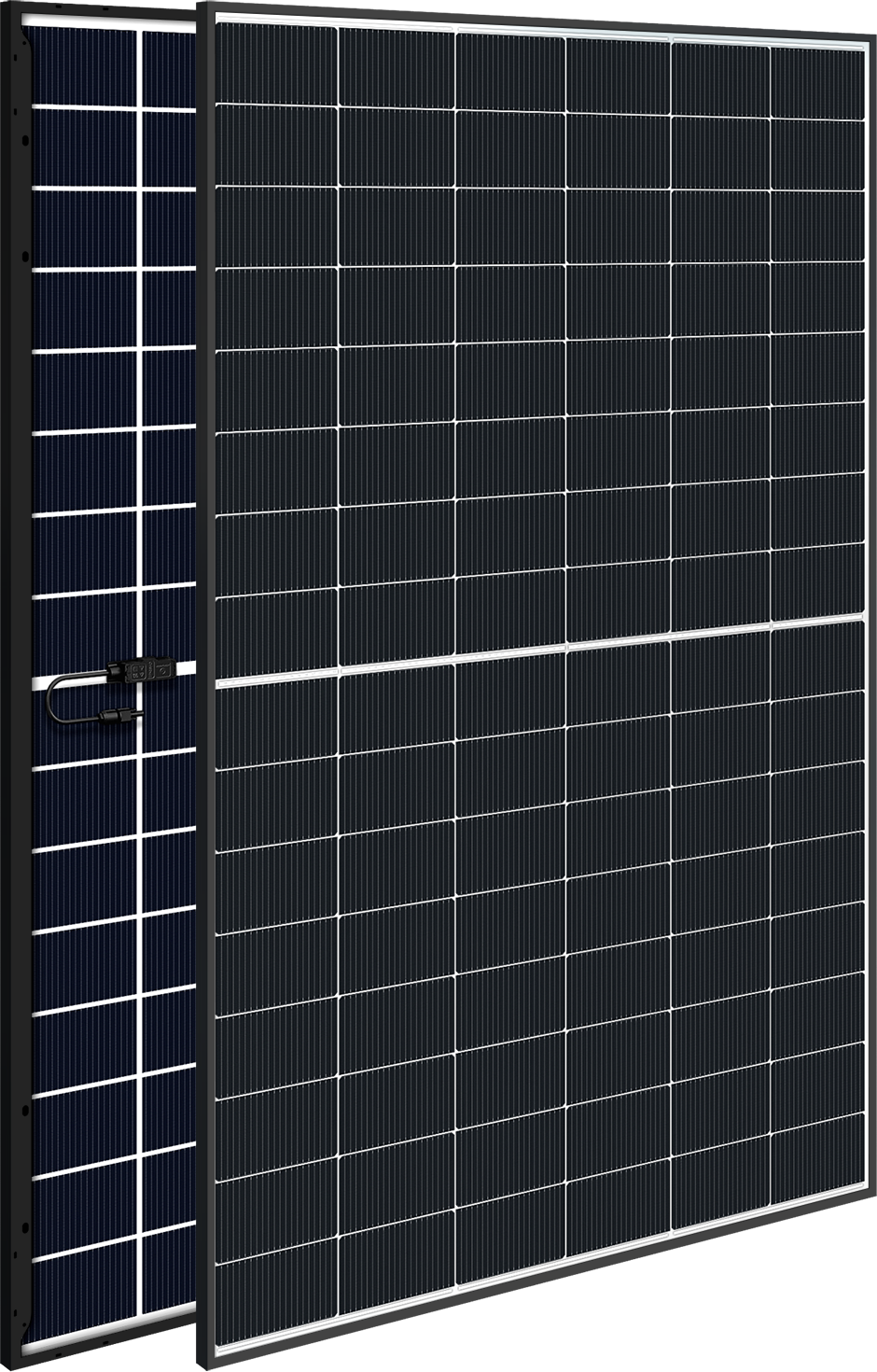
Astronergy CHSM54RN(DG)/F-BH-530

CHSM54RN(DG)/F-BH-530

530 Wp TOPCon Bifacial 80%
ComparePV verdict

Space saver, no clear weak spot

Rank 2,143 of 14,005
Compare panels Datasheet PDF
Power (Wp)
530
Strong · top 15%
Efficiency (%)
23.80
Strong · top 3%
Density (Wp/m²)
238.3
Strong · top 3%
Temp (%/°C)
-0.290
Typical · median -0.290
Weight (kg)
26.9
Typical · median 27.0 kg
Warranty (yrs)
30
Typical · median 30 yrs

The Astronergy ASTRO N7s 2.0 Bifacial (CHSM54RN(DG)/F-BH) series was designed for maximum yield from the same rooftop surface - without compromising on durability and aesthetics. These bifacial glass-glass modules feature n-type TOPCon 5.0 cells, which better withstand high operating temperatures and experience slower degradation over time, translating to more stable energy production year after year.

A key highlight is the ZBB (zero busbar) technology, which minimizes shading on the cells and resistive losses while enhancing resistance to microcracking. In practical terms, this ensures reliable performance in real-world installation conditions and under mechanical stress.

Compared to competitors, the series stands out thanks to the Light Redirecting black film, which optimizes light distribution and helps better utilize sunlight, and the format facilitating transportation and installation on roofs with limited space. This is a smart choice for residential and premium segments, where performance, appearance, and long-term reliability are key.

Ranking

432 panels in the segment TOPCon 500-550 W
Metric This panel Median Position in segment Overall rank
Module efficiency 23.80% 22.73% Strong · top 3% 433
Power density 238.3 227.4 Strong · top 3% 421
Temperature coefficient -0.290 -0.290 Typical 2,165
Weight per kWp 50.8 52.4 Typical 4,171
Performance warranty 30 yrs 30 yrs Typical 21
Colour key Strong - top 25% Typical - middle 50% Weak - bottom 25%

Signals from the data

7 positive · 1 caution
Best for

Residential, commercial, hot-climate and shaded-installations.

Strengths
238.3 watts per square metre

Top 3% of the TOPCon 500-550 W segment, against a median of 227.4. Ranked 421st in the whole database.

23.80% module efficiency

Top 3% of the TOPCon 500-550 W segment, against a median of 22.73%. Ranked 433rd in the whole database.

What owners get
Low Temperature Coefficient — TOPCon 5.0

The Pmax temperature coefficient is -0.29%/°C, which delivers measurably higher energy yield on hot days compared to PERC modules (typically -0.35%/°C). At a cell temperature of 70°C, that difference translates to approximately 2.1% more power output relative to PERC.

30-Year Linear Power Warranty with Low Degradation

The manufacturer guarantees degradation of ≤1.0% in Year 1 and ≤0.4%/year in Years 2–30, retaining ~84.95% of nominal power after 30 years. While peers such as Huasun and JA Solar offer comparable warranty terms in this segment, the warranty being backed by a third-party insurer — as confirmed in the official datasheet — adds meaningful credibility to the claim.

Zero-Busbar Technology with 20 Ribbons

The zero-busbar (ZBB) design using 20 ribbons — versus 16 in standard SMBB configurations — shortens current paths and improves micro-crack resistance by 25% according to Astronergy's data. This directly translates to higher reliability under installation stresses and mechanical loading conditions such as snow and wind.

Up to 85% Bifaciality and 23.8% Module Efficiency

TOPCon 5.0 cells increase the bifaciality factor by more than 5 percentage points over TOPCon 4.0, reaching up to 85%. Module efficiency reaches 23.8% — closely competitive with peers such as the Huasun Everest G12R and JA Solar JAT60S41 LR (both at 23.9%), placing this series firmly among the top performers in the 54-cell segment.

BNEF Tier 1 Status and KIWA TOP PERFORMER 2025 Certification

Astronergy maintains BNEF Tier 1 bankable manufacturer status (56 GW of production capacity as of Q2 2025 data) and has received the independent KIWA TOP PERFORMER 2025 designation for the N7s 2.0 series. Both factors carry significant weight in project financing processes and investor quality due diligence.

Trade-offs
Weight of 26.9 kg — Glass/Glass Construction

The glass-glass build weighs 26.9 kg (module dimensions: 1961×1134×30 mm), which is substantially heavier than comparable glass-backsheet modules (typically 21–24 kg). For rooftops with limited load-bearing capacity or installations without contractor support, an additional structural assessment may be required.

Notes from the database
  • 23.8% module efficiency - 1.1pp better than the TOPCon 500-550W median of 22.7%
  • Power density of 238.3 W/m² packs 10.9 W/m² more into the same footprint vs TOPCon 500-550W median (227.4 W/m²)
  • Temperature coefficient of -0.29%/°C matches the TOPCon 500-550W median
  • 80% bifaciality enables rear-side power generation, boosting yield by 4-12% on reflective surfaces
  • Ranked #433 out of 14005 panels for efficiency in the database

Specifications

Open datasheet PDF
Nominal power (Pmax) 530 Wp Nameplate at 1000 W/m², 25 °C
Module efficiency 23.80 % Strong Segment median 22.73%
Vmpp · Impp 34.60 V · 15.32 A Operating point at max power
Voc · Isc 41.59 V · 16.04 A Sizes the string length
Max system voltage 1500 V Longer strings than 1000 V modules
Dimensions 1961×1134×30 mm · 2.22 m² of roof
Weight 26.9 kg Typical Typical · median 27.0 kg
Cells 108 · TOPCon Monocrystalline
Bifaciality 80 % Rear output as a share of front
Coefficient Pmax -0.290 %/°C Typical median -0.290 of its segment
Coefficient Voc · Isc -0.250 · 0.043 %/°C
Product warranty 25 years Hardware defects only
Performance warranty 30 years Typical median 30 yrs · median 30 yrs
End-of-warranty output 87.4 % Equals 463 W guaranteed
Degradation 1.00 → 0.40 % First year, then annual

Datasheet charts

Open datasheet PDF

Measured curves published by Astronergy in this model's datasheet. A chart carrying a wattage was measured on that variant alone - only the ones that describe 530 Wp appear here. The rest cover the whole series.

Simulations

Live - change any input
Lifetime output & value
30 years at 1200 kWh/kWp/year and €0.50 per kWh
Power in year 30
-
Lifetime energy
-
Energy value
-
With bifacial gain
-

Degradation from this panel's own datasheet figures. No inverter, soiling or shading losses.

Heat losses
-0.290 %/°C against a segment median of -0.290
-
Bifacial gain
Rear gain over light concrete: -
-

Model: bifaciality × albedo × 0.6 view factor. A first-order estimate, not a yield simulation.

Filter these
Size
Panel Power Eff. Temp. Weight Difference
Astronergy CHSM54RN(DG)/F-BH-530 530 W 23.80% -0.290 26.9 kg You are here
LR7-54HJD-510M 510 W 25.00% -0.240 23.5 kg Cooler, lighter, +1.2 pp
AIKO-A495-MCE54Mw 495 W 24.80% -0.260 21.0 kg -35 W, lighter, +1.0 pp
LR7-60HVH-560M 560 W 24.80% -0.260 25.0 kg +30 W, cooler, +1.0 pp
LR7-54HJD-505M 505 W 24.70% -0.240 23.5 kg Cooler, lighter, +0.9 pp
LR7-60HVH-555M 555 W 24.60% -0.260 25.0 kg +25 W, cooler, +0.8 pp
AIKO-A490-MCE54Mw 490 W 24.50% -0.260 21.0 kg -40 W, lighter, +0.7 pp
LR7-54HJD-500M 500 W 24.50% -0.240 23.5 kg Cooler, lighter, +0.7 pp
CHSM54RN(DG)/F-BH-510 510 W 22.90% -0.290 26.9 kg -20 W, -0.9 pp
CHSM54RN(DG)/F-BH-515 515 W 23.20% -0.290 26.9 kg -15 W, -0.6 pp
CHSM54RN(DG)/F-BH-520 520 W 23.40% -0.290 26.9 kg -10 W, -0.4 pp
CHSM54RN(DG)/F-BH-525 525 W 23.60% -0.290 26.9 kg Very close match
LR7-60HVHL-550M 550 W 24.40% -0.260 16.3 kg Cooler, lighter, +0.6 pp
JAT60S40-540/LR 540 W 24.40% -0.260 23.5 kg Cooler, lighter, +0.6 pp
GK-5-60HG-540M 540 W 24.40% -0.260 23.3 kg Cooler, lighter, +0.6 pp
JKM545-54QL6-DV-F1-EU 545 W 24.27% -0.260 27.5 kg +15 W, cooler, +0.5 pp
LR7-60HVH-545M 545 W 24.20% -0.260 25.0 kg Cooler, lighter, +0.4 pp

Found 471 panels of the same or similar size to this one, within ±10 mm. See them here Found 508 panels of the same or similar size to this one, within ±25 mm. See them here Found 662 panels of the same or similar size to this one, within ±50 mm. See them here Found 1471 panels of the same or similar size to this one, within ±100 mm. See them here

Common questions

6 answered
What warranty does the Astronergy ASTRO N7s 2.0 Bifacial series carry and what does it cover?
The ASTRO N7s 2.0 Bifacial series comes with a 25-year product warranty and a 30-year linear power output warranty. First-year degradation does not exceed 1%, and from year two through year thirty the annual degradation cap is 0.4% — meaning the module retains at least 87.4% of its nominal power after 30 years. The product warranty is backed by an international insurance underwriter, which significantly strengthens its credibility and enforceability.
What is ZBB technology in the ASTRO N7s 2.0 panels and does it genuinely improve performance?
ZBB (zero busbar) eliminates conventional busbars from the cell surface; current is collected through an alternative interconnection scheme that reduces shading of the active cell area and lowers resistive losses. Astronergy reports a module efficiency gain of 0.4–0.55% and an increase of more than 5% in rear-side power contribution compared to conventional busbar designs. An additional benefit is a more uniform stress distribution across the cell, which reduces the risk of microcracks.
How do the ASTRO N7s 2.0 panels perform at high temperatures during summer?
The power temperature coefficient is -0.29%/°C, which ranks among the best in its class. By comparison, older p-type modules typically exhibit coefficients of -0.35 to -0.45%/°C. In practical terms, this translates to lower losses on hot days — at a module surface temperature of 70°C, the ASTRO N7s 2.0 loses approximately 13% of its rated power, versus the typical 17–20% loss seen with BSF or PERC technology.
Are the Astronergy ASTRO N7s 2.0 panels suitable for a pitched roof with limited space?
Yes. Modules in the CHSM54RN(DG)/F-BH series measure 1961×1134×30 mm and weigh approximately 26.9 kg, which falls within the standard envelope for rooftop installations. This form factor was designed with ease of transport and installation on space-constrained roofs in mind. The glass-glass bifacial construction also provides superior mechanical resistance under wind and snow loads.
Does the bifacial design of the ASTRO N7s 2.0 make sense for a typical residential rooftop installation?
Yes, although the gain depends on the surface beneath the modules. Light-colored surfaces — white roofing membrane, light-colored tiles, gravel — reflect more irradiance onto the rear side of the panel and can increase energy yield by 5–15% compared to a monofacial module. Even on darker roofs, the glass-glass rear pane extends service life and improves moisture resistance, which justifies selecting this series in the premium segment.
Is Astronergy a reliable panel manufacturer and can I count on warranty claims being honored 20 years from now?
Astronergy (Chint New Energy) is listed on the Bloomberg NEF Tier 1 ranking and holds certifications from TÜV Rheinland, CE, ISO 9001/14001/45001, as well as the KIWA TOP PERFORMER 2025 distinction. The product warranty is underwritten by an independent international insurer — meaning that even if issues arise with the manufacturer, claims can be filed directly with the insurer. This represents a significant advantage over warranties that depend solely on the financial standing of the manufacturing company.
Add to compare