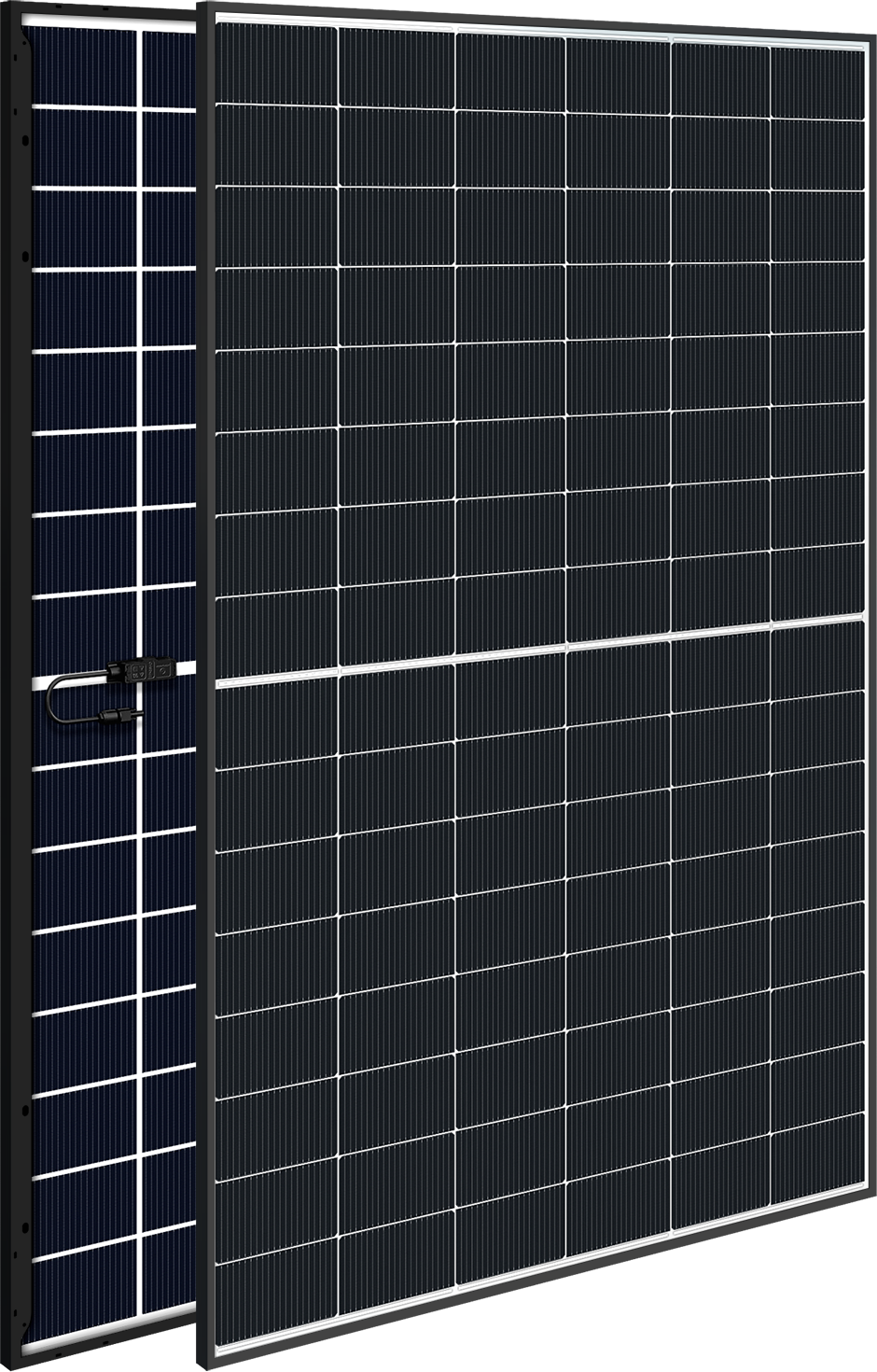
Space saver, no clear weak spot
The Astronergy ASTRO N7s 2.0 Bifacial (CHSM54RN(DG)/F-BH) series was designed for maximum yield from the same rooftop surface - without compromising on durability and aesthetics. These bifacial glass-glass modules feature n-type TOPCon 5.0 cells, which better withstand high operating temperatures and experience slower degradation over time, translating to more stable energy production year after year.
A key highlight is the ZBB (zero busbar) technology, which minimizes shading on the cells and resistive losses while enhancing resistance to microcracking. In practical terms, this ensures reliable performance in real-world installation conditions and under mechanical stress.
Compared to competitors, the series stands out thanks to the Light Redirecting black film, which optimizes light distribution and helps better utilize sunlight, and the format facilitating transportation and installation on roofs with limited space. This is a smart choice for residential and premium segments, where performance, appearance, and long-term reliability are key.
Ranking
Signals from the data
Residential, commercial, hot-climate and shaded-installations.
Top 5% of the TOPCon 500-550 W segment, against a median of 227.4. Ranked 645th in the whole database.
Top 6% of the TOPCon 500-550 W segment, against a median of 22.73%. Ranked 627th in the whole database.
The Pmax temperature coefficient is -0.29%/°C, which delivers measurably higher energy yield on hot days compared to PERC modules (typically -0.35%/°C). At a cell temperature of 70°C, that difference translates to approximately 2.1% more power output relative to PERC.
The manufacturer guarantees degradation of ≤1.0% in Year 1 and ≤0.4%/year in Years 2–30, retaining ~84.95% of nominal power after 30 years. While peers such as Huasun and JA Solar offer comparable warranty terms in this segment, the warranty being backed by a third-party insurer — as confirmed in the official datasheet — adds meaningful credibility to the claim.
The zero-busbar (ZBB) design using 20 ribbons — versus 16 in standard SMBB configurations — shortens current paths and improves micro-crack resistance by 25% according to Astronergy's data. This directly translates to higher reliability under installation stresses and mechanical loading conditions such as snow and wind.
TOPCon 5.0 cells increase the bifaciality factor by more than 5 percentage points over TOPCon 4.0, reaching up to 85%. Module efficiency reaches 23.8% — closely competitive with peers such as the Huasun Everest G12R and JA Solar JAT60S41 LR (both at 23.9%), placing this series firmly among the top performers in the 54-cell segment.
Astronergy maintains BNEF Tier 1 bankable manufacturer status (56 GW of production capacity as of Q2 2025 data) and has received the independent KIWA TOP PERFORMER 2025 designation for the N7s 2.0 series. Both factors carry significant weight in project financing processes and investor quality due diligence.
The glass-glass build weighs 26.9 kg (module dimensions: 1961×1134×30 mm), which is substantially heavier than comparable glass-backsheet modules (typically 21–24 kg). For rooftops with limited load-bearing capacity or installations without contractor support, an additional structural assessment may be required.
- Efficiency of 23.6% is 0.9pp above the TOPCon 500-550W median (22.7%)
- At 236.1 W/m² power density, this panel generates 8.7 W/m² more per unit area than TOPCon 500-550W median (227.4 W/m²)
- At -0.29%/°C, hot weather performance is typical for TOPCon 500-550W panels
- Bifacial design (80% factor) captures reflected light - adds 4-12% yield on ground-mount or white roof
- Ranked #627 out of 14005 panels for efficiency in the database
Specifications
Datasheet charts
Measured curves published by Astronergy in this model's datasheet. A chart carrying a wattage was measured on that variant alone - only the ones that describe 525 Wp appear here. The rest cover the whole series.

Simulations
Degradation from this panel's own datasheet figures. No inverter, soiling or shading losses.
Model: bifaciality × albedo × 0.6 view factor. A first-order estimate, not a yield simulation.






Found 471 panels of the same or similar size to this one, within ±10 mm. See them here Found 508 panels of the same or similar size to this one, within ±25 mm. See them here Found 662 panels of the same or similar size to this one, within ±50 mm. See them here Found 1471 panels of the same or similar size to this one, within ±100 mm. See them here