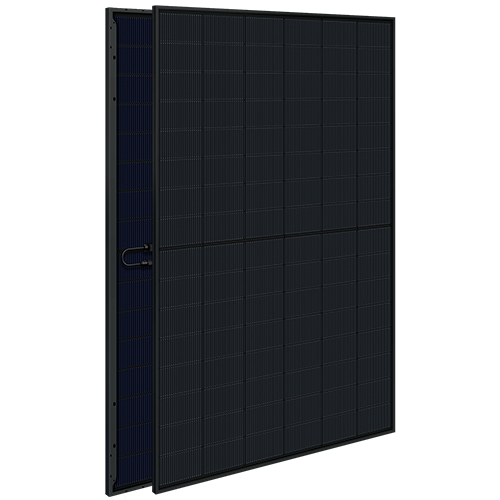
Astronergy CHSM48RN(DG)/F-BH-445

CHSM48RN(DG)/F-BH-445

445 Wp TOPCon Bifacial 80%
ComparePV verdict

Efficiency leader, no clear weak spot

Rank 6,677 of 14,005
Compare panels Datasheet PDF
Power (Wp)
445
Strong · top 8%
Efficiency (%)
22.30
Strong · top 17%
Density (Wp/m²)
222.7
Typical · median 220.2
Temp (%/°C)
-0.290
Typical · median -0.290
Weight (kg)
24.5
Typical · median 22.0 kg
Warranty (yrs)
30
Typical · median 30 yrs

Astronergy ASTRO N7s (Bifacial Series) are dual-sided modules designed to maximize energy yield in real-world operating conditions - not just in the lab. Cells of type n in the TOPCon technology help reduce power degradation over time and improve energy production stability, which is crucial for long-term installations. A key feature is the ZBB (zero busbar) construction - fewer panel shading and better performance under partial shading. Versions with double glazing enhance mechanical strength and durability, valued by investors seeking reliability in challenging environments. The dual-sided nature of the module supports additional gain from reflected light, especially on light-colored roofs, with light crushed stone or on ground-mounted structures. This is a great choice for homes, small businesses, and C&I projects where high power density, aesthetics, and predictable return on investment matter.

Ranking

1,218 panels in the segment TOPCon 400-450 W
Metric This panel Median Position in segment Overall rank
Module efficiency 22.30% 22.00% Strong · top 17% 5,100
Power density 222.7 220.2 Typical 5,302
Temperature coefficient -0.290 -0.290 Typical 2,165
Weight per kWp 55.1 51.4 Typical 9,435
Performance warranty 30 yrs 30 yrs Typical 21
Colour key Strong - top 25% Typical - middle 50% Weak - bottom 25%

Signals from the data

6 positive · 2 caution
Best for

Residential, commercial and shaded-installations.

Strengths
22.30% module efficiency

Top 17% of the TOPCon 400-450 W segment, against a median of 22.00%.

What owners get
N-type TOPCon with Zero Busbar (ZBB) Technology

The N-type TOPCon 4.0 cells feature a Zero Busbar (ZBB) architecture that eliminates conventional busbars, reducing shading of the active cell area and improving carrier collection efficiency. Astronergy became the first manufacturer to obtain TÜV Rheinland certification for a ZBB-TF module, confirming enhanced reliability — the elimination of the soldering process reduces the risk of degradation under damp-heat conditions.

30-Year Linear Power Warranty ≥87%

The manufacturer guarantees degradation of ≤1.0% in year one and ≤0.4%/year in years 2–30, ensuring ≥87% of rated power output after 30 years. The peer-comparable Q-Cells Q.TRON BLACK, at a similar efficiency of 22.3%, offers a standard 25-year warranty — the ASTRO N7s extends the coverage horizon by 5 years, a material consideration when calculating IRR for C&I installations.

High Power Density: 22.0–22.3% Efficiency

Module efficiency of 22.0–22.3% at 440–445 Wp places this series at the forefront of the DG/residential segment: the peer SunEvo SE6-46SC (shingled) achieves only 21.4%, which translates to approximately 4% more annual energy yield for the same roof area.

Bankable Tier 1 per BNEF (Top 6 in 2023)

Astronergy ranked in the Top 6 module manufacturers in the BloombergNEF 2023 bankability ranking and has maintained Tier-1 status in subsequent quarters (Q4 2025, Q1 2026). For externally financed projects or those subject to insurer review, this status is a prerequisite for product acceptance.

Dual-Glass Construction and Mechanical Durability

Dual-glass (DG) variants deliver enhanced resistance to mechanical loads and reduce the risk of damage caused by PID (Potential Induced Degradation). For installations in regions with wide temperature swings or significant wind and snow exposure, this translates to a physically longer service life extending beyond the warranty period.

Trade-offs
Limited Bifacial Gain on Typical Rooftop Installations

The module's bifacial design delivers maximum benefit at albedo ≥0.3 (light-colored gravel, white membranes, ground-mount systems). On typical rooftops with dark tiles or bituminous felt, albedo ranges from 0.1 to 0.15, reducing the real bifacial gain to 2–4% rather than the stated 5–15%. In such installations, the price premium for a bifacial module may not be justified compared to monofacial modules of equivalent efficiency.

Non-EU Manufacturing Origin

Modules are manufactured in China, whereas the peer-comparable Solitek SOLRIF D Satin (Lithuania) offers similar output of 445 Wp and efficiency of 22.06% with certified EU production. For projects subject to CBAM requirements, local tender criteria, or ESG preferences regarding supply chain carbon footprint, this may be a disqualifying factor.

Notes from the database
  • Efficiency of 22.3% matches the TOPCon 400-450W median
  • At 222.7 W/m² power density, roof space requirements are typical for TOPCon 400-450W panels
  • At -0.29%/°C, hot weather performance is typical for TOPCon 400-450W panels
  • At 24.5 kg, this panel is 2.5 kg heavier than the TOPCon 400-450W median (22.0 kg) - more demanding for installation crews
  • 80% bifaciality enables rear-side power generation, boosting yield by 4-12% on reflective surfaces

Specifications

Open datasheet PDF
Nominal power (Pmax) 445 Wp Nameplate at 1000 W/m², 25 °C
Module efficiency 22.30 % Strong Segment median 22.00%
Vmpp · Impp 30.20 V · 14.74 A Operating point at max power
Voc · Isc 36.25 V · 15.57 A Sizes the string length
Max system voltage 1500 V Longer strings than 1000 V modules
Dimensions 1762×1134×30 mm · 2.00 m² of roof
Weight 24.5 kg Typical Typical · median 22.0 kg
Cells 96 · TOPCon Monocrystalline
Bifaciality 80 % Rear output as a share of front
Coefficient Pmax -0.290 %/°C Typical median -0.290 of its segment
Coefficient Voc · Isc -0.250 · 0.043 %/°C
Product warranty 25 years Hardware defects only
Performance warranty 30 years Typical median 30 yrs · median 30 yrs
End-of-warranty output 87.4 % Equals 389 W guaranteed
Degradation 1.00 → 0.40 % First year, then annual

Datasheet charts

Open datasheet PDF

Measured curves published by Astronergy in this model's datasheet. A chart carrying a wattage was measured on that variant alone - only the ones that describe 445 Wp appear here. The rest cover the whole series.

Simulations

Live - change any input
Lifetime output & value
30 years at 1200 kWh/kWp/year and €0.50 per kWh
Power in year 30
-
Lifetime energy
-
Energy value
-
With bifacial gain
-

Degradation from this panel's own datasheet figures. No inverter, soiling or shading losses.

Heat losses
-0.290 %/°C against a segment median of -0.290
-
Bifacial gain
Rear gain over light concrete: -
-

Model: bifaciality × albedo × 0.6 view factor. A first-order estimate, not a yield simulation.

Filter these
Size
Panel Power Eff. Temp. Weight Difference
Astronergy CHSM48RN(DG)/F-BH-445 445 W 22.30% -0.290 24.5 kg You are here
AIKO-A495-MCE54Mw 495 W 24.80% -0.260 21.0 kg +50 W, lighter, +2.5 pp
AIKO-A490-MCE54Mw 490 W 24.50% -0.260 21.0 kg +45 W, lighter, +2.2 pp
STP-NT11/48QGSF-490 490 W 24.50% -0.260 21.5 kg +45 W, lighter, +2.2 pp
JAT54S40-485/LR 485 W 24.30% -0.260 19.3 kg +40 W, lighter, +2.0 pp
AIKO-A485-MCE54Mw 485 W 24.30% -0.260 21.0 kg +40 W, lighter, +2.0 pp
LR7-54HJD-495M 495 W 24.30% -0.240 23.5 kg +50 W, cooler, +2.0 pp
AIKO-A485-MAH54Mw 485 W 24.30% -0.260 21.5 kg +40 W, lighter, +2.0 pp
CHSM48RN(DG)/F-BH-440 440 W 22.00% -0.290 24.5 kg -0.3 pp
CHSM48RN(DG)(BLH)/F-BH-450 450 W 22.50% -0.290 24.5 kg Very close match
LR7-54HJD-510M 510 W 25.00% -0.240 23.5 kg +65 W, cooler, +2.7 pp
LR7-54HJD-505M 505 W 24.70% -0.240 23.5 kg +60 W, cooler, +2.4 pp
LR7-54HJD-500M 500 W 24.50% -0.240 23.5 kg +55 W, cooler, +2.2 pp
CIPRO-TN9C54M-500W 500 W 24.50% -0.260 21.4 kg +55 W, lighter, +2.2 pp

Found 1395 panels of the same or similar size to this one, within ±10 mm. See them here Found 1425 panels of the same or similar size to this one, within ±25 mm. See them here Found 3614 panels of the same or similar size to this one, within ±50 mm. See them here Found 3962 panels of the same or similar size to this one, within ±100 mm. See them here

Common questions

6 answered
What warranty does the Astronergy ASTRO N7s Bifacial series carry?
Astronergy provides a 25-year product warranty on the ASTRO N7s series along with an industry-leading 30-year linear power output warranty. First-year power degradation is capped at 1%, with subsequent annual degradation from year 2 through year 30 not exceeding 0.4%. This represents one of the longest warranty packages available for TOPCon modules on the market, resulting in a more predictable return on investment over the system's lifetime.
What is ZBB technology in the ASTRO N7s panels, and does it make a practical difference?
ZBB (Zero Busbar) refers to a cell architecture that eliminates conventional busbars from the front cell surface, replacing them with a greater number of fine current-collecting fingers. This shorter current path reduces resistive losses and minimizes shading of the active cell area. The practical result is improved performance under partial shading conditions — such as from a chimney or antenna — as well as higher overall module efficiency compared to standard busbar designs.
Are the Astronergy ASTRO N7s Bifacial panels suitable for a typical pitched roof in Poland?
Yes. ASTRO N7s modules have a footprint below 2 m² and a relatively low module weight, making on-roof handling and installation straightforward even in hard-to-access locations. The n-type TOPCon cell technology performs well under diffuse irradiance and low-temperature winter conditions characteristic of the Polish climate. The series is well-suited for gabled, hipped, and flat roof installations alike.
Does the bifacial design of the ASTRO N7s panels deliver a real energy gain on a residential roof?
The module's bifaciality (bifaciality factor up to 85%) generates additional yield from reflected irradiance striking the rear cell surface. On a light-colored or reflective roofing material, the bifacial gain typically ranges from 5–15% relative to an equivalent monofacial module. Ground-mounted systems with high-albedo ground cover benefit the most, but the gain is measurable even on rooftops, particularly during summer months.
How does the Astronergy ASTRO N7s differ from lower-cost PERC panels available on the market?
The ASTRO N7s uses n-type TOPCon cells, which exhibit a lower long-term degradation rate and significantly reduced susceptibility to LID (Light-Induced Degradation) compared to mainstream p-type PERC cells. This translates into smaller power losses during the early years of operation and higher cumulative energy yield over the full 30-year warranty period, even though the upfront purchase price is typically higher than that of equivalent PERC modules.
Is Astronergy a proven manufacturer, and do the ASTRO N7s panels hold the necessary certifications?
Astronergy is recognized as a Tier 1 manufacturer under the BNEF (Bloomberg NEF) classification, confirming its financial stability and manufacturing reliability. ASTRO N7s modules carry IEC and MCS certifications required for European markets. The company has received TOP PERFORMER distinctions in independent reliability tests for dual-glass modules. Both the product and power output warranties are backed by an independent insurance policy, providing additional security for the investor.
Add to compare