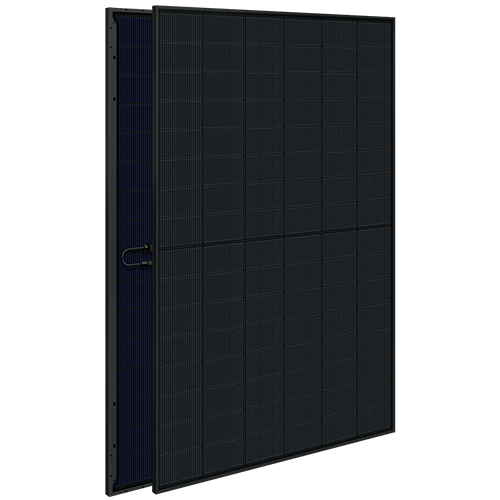
Astronergy CHSM48RN(DG)(BLH)/F-BH-450

CHSM48RN(DG)(BLH)/F-BH-450

450 Wp TOPCon Bifacial 80%
ComparePV verdict

Middle of its segment, heavy for its output

Rank 6,225 of 14,005
Compare panels Datasheet PDF
Power (Wp)
450
Weak · bottom 9%
Efficiency (%)
22.50
Typical · median 22.52%
Density (Wp/m²)
225.2
Typical · median 225.2
Temp (%/°C)
-0.290
Typical · median -0.290
Weight (kg)
24.5
Weak · bottom 23%
Warranty (yrs)
30
Typical · median 30 yrs

Astronergy ASTRO N7s 2.0 Bifacial series are modules designed for maximum yield from the same surface area - combining n-type TOPCon cells with a bifacial structure that genuinely harnesses reflected light. What sets them apart is the TOPCon 5.0 technology, focused on high efficiency and stable performance over the long term, and ZBB (zero busbar), a solution minimizing shading from conductor traces and resistive losses - translating to better performance in partial shade and high temperatures.

In practice, this series addresses typical roof installation challenges: limited space, the need for aesthetic integration, and the requirement for reliable performance over the years. Full black variants with black light-directing film help maintain a seamless roof appearance without sacrificing performance. Furthermore, the bifacial structure enhances durability and supports longevity in demanding conditions.

ASTRO N7s 2.0 Bifacial is an excellent choice for homes, small businesses, and C&I projects, where yield, aesthetics, and reliability matter just as much as table specifications.

Ranking

1,089 panels in the segment TOPCon 450-500 W
Metric This panel Median Position in segment Overall rank
Module efficiency 22.50% 22.52% Typical 4,222
Power density 225.2 225.2 Typical 4,225
Temperature coefficient -0.290 -0.290 Typical 2,165
Weight per kWp 54.4 52.2 Weak · bottom 23% 8,755
Performance warranty 30 yrs 30 yrs Typical 21
Colour key Strong - top 25% Typical - middle 50% Weak - bottom 25%

Signals from the data

5 positive · 1 caution
Best for

Residential and commercial.

Not ideal for

Weight-limited structures.

Watch-outs
54.4 kg per kWp

Bottom 23% of the TOPCon 450-500 W segment, against a median of 52.2.

What owners get
TOPCon 5.0 + Zero Busbar – Higher Yield vs. Previous Generation

TOPCon 5.0 technology raises cell efficiency by 0.4–0.55 percentage points over TOPCon 4.0, while the Zero Busbar (ZBB) layout eliminates shading from conductive ribbons, pushing bifaciality to ≥85% — more than 5 pp above a conventional multi-busbar (MBB) design. The result is a measurably higher annual energy yield with no increase in module footprint.

Temperature Coefficient of –0.29%/°C

A Pmax temperature coefficient of –0.29%/°C outperforms typical PERC modules (–0.34%/°C) and ranks among the best available TOPCon products in this power class. In climates where module temperatures reach 60–70°C in summer, the 0.05 pp TC advantage translates to approximately 1.5–2.5% higher seasonal yield compared to an average PERC module.

30-Year Linear Power Warranty, 87.4% Retention

Guaranteed degradation of ≤0.4%/year from year two onward and power retention of ≥87.4% after 30 years exceeds the standard 25-year warranties offered by most competitors in this power segment. The warranty is backed by an independent insurer (Tier 1 Warranty), reducing counterparty risk in the event of manufacturer-side issues.

BNEF Tier 1 Manufacturer, Top 7 Globally

Astronergy (Chint) appears on the BNEF Tier 1 list with an annual manufacturing capacity of 56 GW (Q2 2025 data), ranking in the global top seven just behind Canadian Solar. Direct peers for this series — Recom and Sunlike Solar — operate at significantly smaller scale, making Astronergy the stronger bankability choice for projects requiring third-party financing.

Full-Black Variants with No Efficiency Compromise

The series includes modules with a black light-redirecting backsheet (BLH) that maintain full efficiency of 22.5–23.5% while delivering all-black aesthetics — a key advantage in the residential and C&I segments where homeowners' associations or heritage preservation requirements increasingly mandate low-visibility panel designs.

Notes from the database
  • At 22.5% efficiency, this panel is on par with typical TOPCon 450-500W modules
  • At 225.2 W/m² power density, roof space requirements are typical for TOPCon 450-500W panels
  • At -0.29%/°C, hot weather performance is typical for TOPCon 450-500W panels
  • Bifaciality factor of 80% can add 4-12% extra yield with reflective mounting surface
  • Ranked #4222 out of 14005 panels for efficiency in the database

Specifications

Open datasheet PDF
Nominal power (Pmax) 450 Wp Nameplate at 1000 W/m², 25 °C
Module efficiency 22.50 % Typical Segment median 22.52%
Vmpp · Impp 30.51 V · 14.75 A Operating point at max power
Voc · Isc 36.59 V · 15.61 A Sizes the string length
Max system voltage 1500 V Longer strings than 1000 V modules
Dimensions 1762×1134×30 mm · 2.00 m² of roof
Weight 24.5 kg Weak Weak · bottom 23%
Cells 96 · TOPCon Monocrystalline
Bifaciality 80 % Rear output as a share of front
Coefficient Pmax -0.290 %/°C Typical median -0.290 of its segment
Coefficient Voc · Isc -0.250 · 0.043 %/°C
Product warranty 25 years Hardware defects only
Performance warranty 30 years Typical median 30 yrs · median 30 yrs
End-of-warranty output 87.4 % Equals 393 W guaranteed
Degradation 1.00 → 0.40 % First year, then annual

Datasheet charts

Open datasheet PDF

Measured curves published by Astronergy in this model's datasheet. A chart carrying a wattage was measured on that variant alone - only the ones that describe 450 Wp appear here. The rest cover the whole series.

Simulations

Live - change any input
Lifetime output & value
30 years at 1200 kWh/kWp/year and €0.50 per kWh
Power in year 30
-
Lifetime energy
-
Energy value
-
With bifacial gain
-

Degradation from this panel's own datasheet figures. No inverter, soiling or shading losses.

Heat losses
-0.290 %/°C against a segment median of -0.290
-
Bifacial gain
Rear gain over light concrete: -
-

Model: bifaciality × albedo × 0.6 view factor. A first-order estimate, not a yield simulation.

Filter these
Size
Panel Power Eff. Temp. Weight Difference
Astronergy CHSM48RN(DG)(BLH)/F-BH-450 450 W 22.50% -0.290 24.5 kg You are here
AIKO-A495-MCE54Mw 495 W 24.80% -0.260 21.0 kg +45 W, lighter, +2.3 pp
AIKO-A490-MCE54Mw 490 W 24.50% -0.260 21.0 kg +40 W, lighter, +2.0 pp
LR7-54HJD-500M 500 W 24.50% -0.240 23.5 kg +50 W, cooler, +2.0 pp
CIPRO-TN9C54M-500W 500 W 24.50% -0.260 21.4 kg +50 W, lighter, +2.0 pp
GK-3-54HGb-500M 500 W 24.50% -0.260 21.4 kg +50 W, lighter, +2.0 pp
GCL-NR10R/54BGDF 500 W 24.50% -0.260 24.6 kg +50 W, cooler, +2.0 pp
CHSM48RN(DG)/F-BH-440 440 W 22.00% -0.290 24.5 kg -10 W, -0.5 pp
CHSM48RN(DG)/F-BH-445 445 W 22.30% -0.290 24.5 kg Very close match
LR7-54HJD-510M 510 W 25.00% -0.240 23.5 kg +60 W, cooler, +2.5 pp
LR7-54HJD-505M 505 W 24.70% -0.240 23.5 kg +55 W, cooler, +2.2 pp

Found 1395 panels of the same or similar size to this one, within ±10 mm. See them here Found 1425 panels of the same or similar size to this one, within ±25 mm. See them here Found 3614 panels of the same or similar size to this one, within ±50 mm. See them here Found 3962 panels of the same or similar size to this one, within ±100 mm. See them here

Common questions

6 answered
What warranty applies to the Astronergy ASTRO N7s 2.0 Bifacial panels?
The ASTRO N7s 2.0 Bifacial series comes with a 25-year product warranty and a 30-year power output warranty. The manufacturer guarantees degradation of no more than 1% in the first year and a maximum of 0.4% per year thereafter, meaning the module will retain over 87% of its nominal power after 30 years. This is one of the strongest warranty performance figures in the TOPCon panel class.
What is ZBB technology in the ASTRO N7s 2.0 panels, and does it genuinely improve energy yield?
ZBB (Zero Busbar) eliminates conventional metal busbars on the cell and replaces them with a dense network of fine interconnecting wires. This reduces cell shading and lowers series resistance. In practice, it translates into better performance under partial shading conditions and at elevated temperatures, which is particularly relevant for rooftop installations in Poland.
Are the ASTRO N7s 2.0 Bifacial panels suitable for a pitched roof with limited available area?
Yes. The 48-cell variant (e.g., the 470 W full black) has a footprint of under 2 m², allowing installation by a single person and simplifying transport across the roof. With a module efficiency of up to 23.8%, fewer panels are needed to achieve the same energy output as older, lower-efficiency modules — a critical advantage when roof space is constrained.
How much additional energy does the bifacial design of the ASTRO N7s 2.0 panels generate?
The bifaciality factor reaches up to 85%, meaning the rear side of the panel can harvest up to 85% of the energy captured by the front side under equivalent irradiance conditions. Real-world gain depends on the albedo of the surface beneath the array: a light-colored gravel bed, white roofing membrane, or snow cover can add between 5% and 15% to annual energy production. On a typical dark pitched roof, this effect is minimal, which is why bifacial technology delivers its best results in ground-mount or flat-roof installations with a high-albedo finish.
Is Astronergy a reliable manufacturer, and is it on the Tier 1 list?
Yes, Astronergy (the solar brand of Chint Group) is listed on the BloombergNEF Tier 1 module manufacturers list, confirming the company's financial capability to honor warranty claims throughout the full warranty period. The company has been manufacturing solar panels since 2006 and supplies modules to both the residential prosumer market and large-scale utility projects worldwide.
What is the difference between the ASTRO N7s 2.0 full black variant and the standard bifacial variant?
The full black variant uses a black light-redirecting backsheet instead of a white one, giving the module a uniform dark appearance that blends seamlessly with roof tiles. The manufacturer notes that this backsheet distributes mechanical stress more evenly, reducing the risk of microcracks. Module efficiency remains comparable; however, the rear-side albedo gain is lower than in the glass-glass bifacial version with a light background, which is why the full black variant is primarily chosen for installations where aesthetics take priority over maximum bifacial yield.
Add to compare