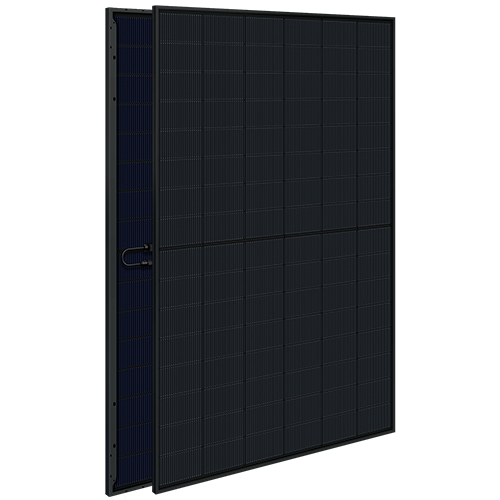
Solid all-round for its segment
Astronergy ASTRO N7s (Bifacial Series) are dual-sided modules designed to maximize energy yield in real-world operating conditions - not just in the lab. Cells of type n in the TOPCon technology help reduce power degradation over time and improve energy production stability, which is crucial for long-term installations. A key feature is the ZBB (zero busbar) construction - fewer panel shading and better performance under partial shading. Versions with double glazing enhance mechanical strength and durability, valued by investors seeking reliability in challenging environments. The dual-sided nature of the module supports additional gain from reflected light, especially on light-colored roofs, with light crushed stone or on ground-mounted structures. This is a great choice for homes, small businesses, and C&I projects where high power density, aesthetics, and predictable return on investment matter.
Ranking
Signals from the data
Residential, commercial and shaded-installations.
The N-type TOPCon 4.0 cells feature a Zero Busbar (ZBB) architecture that eliminates conventional busbars, reducing shading of the active cell area and improving carrier collection efficiency. Astronergy became the first manufacturer to obtain TÜV Rheinland certification for a ZBB-TF module, confirming enhanced reliability — the elimination of the soldering process reduces the risk of degradation under damp-heat conditions.
The manufacturer guarantees degradation of ≤1.0% in year one and ≤0.4%/year in years 2–30, ensuring ≥87% of rated power output after 30 years. The peer-comparable Q-Cells Q.TRON BLACK, at a similar efficiency of 22.3%, offers a standard 25-year warranty — the ASTRO N7s extends the coverage horizon by 5 years, a material consideration when calculating IRR for C&I installations.
Module efficiency of 22.0–22.3% at 440–445 Wp places this series at the forefront of the DG/residential segment: the peer SunEvo SE6-46SC (shingled) achieves only 21.4%, which translates to approximately 4% more annual energy yield for the same roof area.
Astronergy ranked in the Top 6 module manufacturers in the BloombergNEF 2023 bankability ranking and has maintained Tier-1 status in subsequent quarters (Q4 2025, Q1 2026). For externally financed projects or those subject to insurer review, this status is a prerequisite for product acceptance.
Dual-glass (DG) variants deliver enhanced resistance to mechanical loads and reduce the risk of damage caused by PID (Potential Induced Degradation). For installations in regions with wide temperature swings or significant wind and snow exposure, this translates to a physically longer service life extending beyond the warranty period.
The module's bifacial design delivers maximum benefit at albedo ≥0.3 (light-colored gravel, white membranes, ground-mount systems). On typical rooftops with dark tiles or bituminous felt, albedo ranges from 0.1 to 0.15, reducing the real bifacial gain to 2–4% rather than the stated 5–15%. In such installations, the price premium for a bifacial module may not be justified compared to monofacial modules of equivalent efficiency.
Modules are manufactured in China, whereas the peer-comparable Solitek SOLRIF D Satin (Lithuania) offers similar output of 445 Wp and efficiency of 22.06% with certified EU production. For projects subject to CBAM requirements, local tender criteria, or ESG preferences regarding supply chain carbon footprint, this may be a disqualifying factor.
- At 22.0% efficiency, this panel is on par with typical TOPCon 400-450W modules
- At 220.2 W/m² power density, roof space requirements are typical for TOPCon 400-450W panels
- Temperature coefficient of -0.29%/°C matches the TOPCon 400-450W median
- At 24.5 kg, this panel is 2.5 kg heavier than the TOPCon 400-450W median (22.0 kg) - more demanding for installation crews
- Bifaciality factor of 80% can add 4-12% extra yield with reflective mounting surface
Specifications
Datasheet charts
Measured curves published by Astronergy in this model's datasheet. A chart carrying a wattage was measured on that variant alone - only the ones that describe 440 Wp appear here. The rest cover the whole series.

Simulations
Degradation from this panel's own datasheet figures. No inverter, soiling or shading losses.
Model: bifaciality × albedo × 0.6 view factor. A first-order estimate, not a yield simulation.







Found 1395 panels of the same or similar size to this one, within ±10 mm. See them here Found 1425 panels of the same or similar size to this one, within ±25 mm. See them here Found 3614 panels of the same or similar size to this one, within ±50 mm. See them here Found 3962 panels of the same or similar size to this one, within ±100 mm. See them here