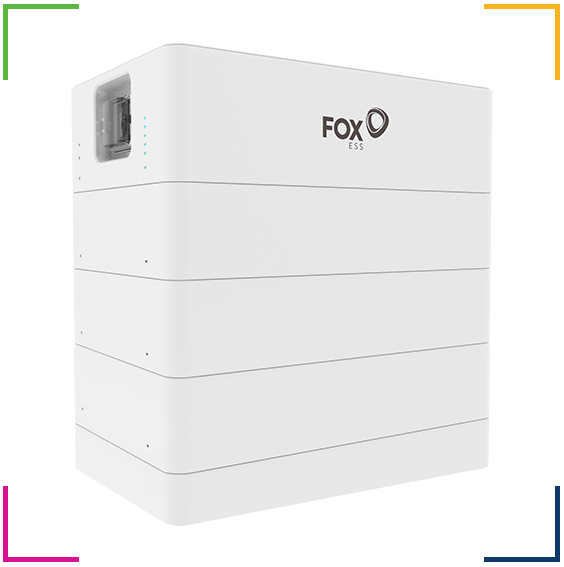

FoxESS ECS2900-H5

FoxESS ECS2900-H5

12.96 kWh usable LFP High voltage Outdoor-rated
Compare with closest alternative Datasheet PDF
Usable (kWh)
12.96
Weak · bottom 7%
Round-trip (%)
95.0
Typical · median 95.0%
Power (kW)
-
Not published
Cycles
6000
Typical · median 6000
Weight (kg)
164.3
Typical · median 189.8 kg
Warranty (yrs)
-
Not published

The FoxESS ECS series (ECS2900-H2/H3/H4/H5/H6/H7) is a high-voltage, modular energy storage system where capacity increases by adding subsequent segments in a single tower. This architecture simplifies the design of installations - from a single-family home to a larger facility - and allows for system expansion when energy consumption genuinely increases or you plan to add PV.

The applied chemistry, LFP (LiFePO4), prioritizes safety and operational stability, along with excellent resistance to intensive cyclic charging and discharging. In practice, this translates to a long service life. The declared number of cycles and 10-year warranty ensure predictable costs and a lower risk of the storage unit's utility declining over time.

The system is scalable up to 7 modules in series. The plug-and-play installation type speeds up both installation and service. The ECS works with hybrid FoxESS inverters and is a good option for prosumers, companies, and systems with backup power and semi-off-grid operation.

Ranking

36 batteries from 12 to 20 kWh
Metric This battery Median Position in class Rank in class
Round-trip efficiency 95.0% 95.0% Typical 5
Power per kWh - 0.68 Not published -
Cycle life 6000 6000 Typical 5
Weight per kWh 12.7 12.4 Typical 18
Warranty - 10 yrs Not published -
Colour key Strong - top 25% Typical - middle 50% Weak - bottom 25%

See 21 FoxESS offers

Specifications

Open datasheet PDF
Usable energy 12.96 kWh What the battery delivers, full to empty
Nominal energy 14.40 kWh What the cells hold
Depth of discharge 90 %
Module energy 2.88 kWh
Modules per stack 2 to 7
Max system capacity 20.2 kWh
Max discharge current 50 A
Max charge current 50 A
Peak discharge current 65 A
Round-trip efficiency 95.0 %
Cycle life 6000 cycles At 90 % depth of discharge
Voltage class High voltage
Nominal voltage 288.0 V
Operating voltage 243 to 328 V
Cell technology LFP LiFePO4 (LFP)
Cell management Cobalt-free
Dimensions 710 × 570 × 380 mm Height × width × depth
Weight 164.3 kg 12.7 kg per kWh
Enclosure IP65
Mounting floor
Outdoor installation Yes
Cooling passive
Operating temperature -20 to 55 °C
Protocols CANRS485
Certifications IEC 62619EN IEC 61000-6-1/2/3/4UN38.3IP65

Pros and cons

5 positive · 2 caution
What owners get
LFP: ≥6,000 cycles at 90% DoD

LiFePO4 cells are reported to have a lifespan of ≥6,000 full cycles under 90% DoD and 0.5C conditions at 25°C (V3.7 datasheet, 2024). In comparison, NMC/NCA batteries used by some competitors typically achieve 3,000-4,500 cycles under similar conditions, which translates to a significantly longer and more reliable lifespan for the battery.

Modular scalability from 5.76-20.16 kWh

The 1-module master (CM2900) system, combined with up to 6 slave modules (CS2900), allows for the creation of a system with a capacity ranging from 5.76 kWh (H2) to 20.16 kWh (H7) without the need to replace the BMS controller. This enables cost-effective expansion over time, and the six pre-configured H2-H7 options cover both typical prosumer installations (~10 kWh) and larger facilities.

10-year warranty with ≥70% capacity retention

FoxESS guarantees a minimum of 70% of its nominal capacity is maintained for 10 years from installation (or 12 years in certain regions, according to warranty policy v2.6, December 2025). The clearly defined retention threshold and the long warranty period reduce investment risk and simplify the calculation of TCO (Total Cost of Ownership).

Plug-and-play, high-voltage architecture

The modules are mechanically and electrically connected in a plug-and-play manner, which reduces installation and maintenance time. The high-voltage system (~52 V per module in series) allows for lower operating currents (up to 50 A continuous, peak of 65 A for 30 seconds) while maintaining the same power, thereby reducing resistive losses in the wiring.

Tier 1 manufacturer recognized by BNEF (BloombergNEF)

FoxESS is listed as a bankable manufacturer by Bloomberg NEF, which makes it easier for banks and funds to finance projects and confirms the stability and continuity of service support provided by the company. Despite its relatively short period of operation (founded in 2019), the company has quickly obtained certifications and achieved a production scale comparable to established suppliers.

Trade-offs
Vendor lock-in: Only FoxESS inverters are compatible.

The ECS2900-H is designed to work exclusively with FoxESS hybrid inverters (e.g., H3, AIO series). The lack of a standard communication protocol prevents integration with popular inverters from SMA, Fronius, Huawei SUN2000, SolarEdge, or Victron. In the event of inverter failure or a desire to switch inverter brands, the entire system becomes unusable without replacing it with FoxESS equipment.

Lack of compatibility between V1/V2 generations

Modules in versions V1 and V2 cannot be mixed in a single system, and modules with different capacities (e.g., ECS2900 and ECS4100) also cannot function simultaneously. This means that expanding the system with newer-generation modules requires replacing the entire tower, rather than simply purchasing individual modules.

Alternatives

All FoxESS batteries
Battery Usable Round-trip Power Voltage Difference
FoxESS ECS2900-H5 12.96 kWh 95.0% - High voltage You are here
Battery-Box Premium HVS 12.8 12.8 kWh 96.0% 12.8 kW HV -0.2 kWh, +1.0 pp round-trip
SMA Home Storage 13.1 13.12 kWh 94.5% 13.8 kW HV +0.2 kWh, -0.5 pp round-trip
Force H2 (FH9637M) 12.79 kWh - - HV -0.2 kWh
Battery-Box Premium HVM 13.8 13.8 kWh 96.0% - HV +0.8 kWh, +1.0 pp round-trip
LUNA2000-14-S1 13.8 kWh - 7.0 kW HV +0.8 kWh
Ai-HB 150A 13.82 kWh 95.0% 9.2 kW HV +0.9 kWh
BOS-G15 13.82 kWh - - HV +0.9 kWh
HS12.5 11.91 kWh - - HV -1.1 kWh

About the ECS Series (ECS2900-H2/H3/H4/H5/H6/H7) series

6 answered

These answers cover the whole series. Where a figure differs, the specification above is this model's own.

What is the storage capacity of the FoxESS ECS2900, and how do the H2, H3, H4, H5, H6, and H7 versions differ?
Each ECS2900 module has a capacity of 2.88 kWh. The different versions vary in the number of modules in the tower: H2 has a capacity of 5.76 kWh, H3 has a capacity of 8.64 kWh, H4 has a capacity of 11.52 kWh, H5 has a capacity of 14.40 kWh, H6 has a capacity of 17.28 kWh, and H7 has a maximum capacity of 20.16 kWh. For a typical single-family home with a 10 kWp PV system, the H2 or H3 variants are most commonly chosen, while H5-H7 are suitable for higher energy consumption or operation in emergency mode.
What is the warranty on the FoxESS ECS2900 and how many charge cycles can the battery withstand?
FoxESS offers a 10-year warranty on the ECS2900 series. The LFP (LiFePO4) chemistry used ensures a lifespan of at least 6000 full charge and discharge cycles at a depth of discharge (DoD) of up to 90%. This means that with a single cycle per day, the battery maintains its functionality for over 16 years, making it one of the most durable options in the prosumer storage market.
Can the FoxESS ECS2900 storage system be expanded after purchase if energy consumption increases?
Yes, this is one of the key advantages of this series. The modular architecture allows for the addition of further CS2900 modules (each with 2.88 kWh) and their integration into an existing tower, up to a maximum of 7 modules in total (20.16 kWh). The installation is plug-and-play, so expansion does not require replacing the inverter or other major investments, as long as the new capacity falls within the range supported by the FoxESS hybrid inverter.
Which inverters are compatible with the FoxESS ECS2900 series?
The ECS2900 is officially certified for use with FoxESS hybrid inverters, such as the H3 series, AIO H3, and H3 Pro. Communication is achieved via CAN or RS485. The product is designed as a closed FoxESS ecosystem, so before purchasing, it is essential to verify that the inverter you have or plan to purchase is listed as compatible by the manufacturer. Connection with inverters from other brands is not officially supported.
Does the FoxESS ECS2900 battery function in winter, and at what temperatures can it be used?
The ECS2900 series is designed to operate in temperatures ranging from -10°C to +50°C, meaning it will perform well in Polish climatic conditions throughout the year. However, it's important to note that at very low temperatures (below 0°C), the usable capacity of the LFP battery may decrease slightly. The storage unit should be mounted in a location protected from frost - such as a garage or boiler room - to maintain optimal performance during winter.
Does the FoxESS ECS2900 storage system support backup power in the event of a network outage?
Yes, the ECS2900 series supports emergency mode (EPS/backup) operation in conjunction with a compatible FoxESS hybrid inverter. In the event of a power outage in the grid, the system automatically switches to battery power, allowing selected loads to continue operating. The duration of backup power depends on the capacity of the installed version - for the H7 (20.16 kWh) model, with typical household consumption, it lasts for several hours. This is a good solution for installations that require partial independence from the grid.
Compare with alternative