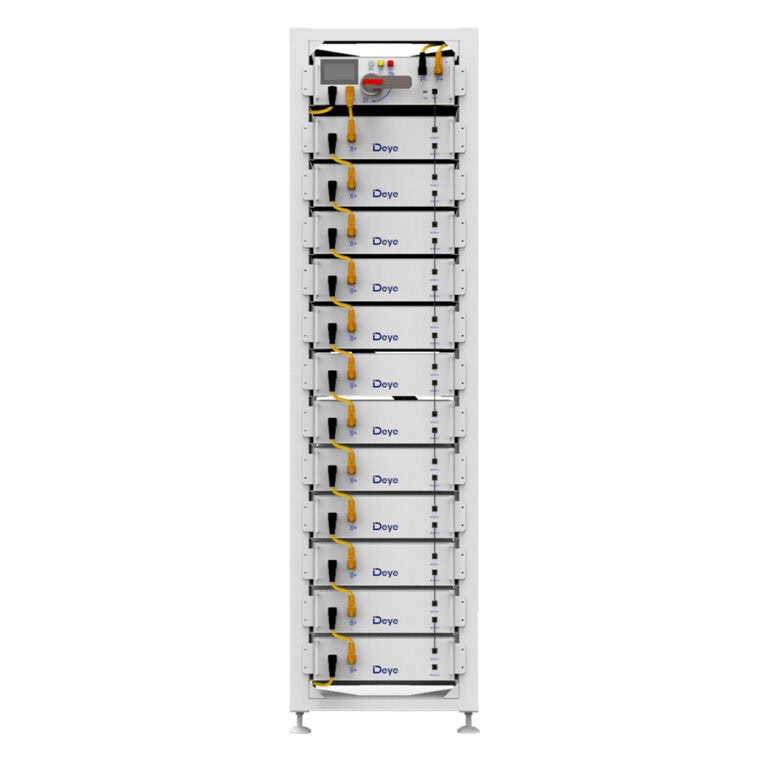

Deye BOS-G15
The BOS-G series are high-voltage rack-format energy storage units designed for rapid installation and seamless expansion without necessitating a complete system overhaul. Their most distinguishing feature is modular scalability - capacity increases by adding further modules, and the system performs effectively both as a UPS backup and for PV self-consumption in businesses or larger homes.
BOS-G utilizes the LiFePO4 (LFP) chemistry, which, compared to NMC, is typically more thermally stable, better withstands intensive operation, and promotes a long service life. This translates to a high cycle count and long warranty period - meaning predictable costs and reduced risk of performance decline after several seasons for the user.
In practice, an intelligent Battery Management System (BMS) with cell balancing and a comprehensive safety suite, along with communication (e.g., CAN/RS485), facilitating integration with inverters and hybrid systems, is also crucial. BOS-G is a suitable choice for grid-connected, hybrid, and specific off-grid scenarios where safety, serviceability, and flexible expansion are key.
Ranking
Specifications
Pros and cons
The system is built from BOS-GM5.1 modules rated at 5.12 kWh (51.2 V, 100 Ah), allowing capacity to scale from ~25.6 kWh (5 modules) to over 80 kWh (16 modules) without rebuilding the system - a typical strength of rack-mount architecture in C&I applications.
The manufacturer specifies ≥6000 cycles to EOL 70% (25±2°C, 0.5C/0.5C test), placing it at the upper end for LiFePO4 rack storage and well above many older NMC designs (typically 3000-4000 cycles).
LFP has a higher thermal runaway onset temperature and lower propensity for uncontrolled runaway than NMC, which matters for installation in technical rooms of businesses and homes.
The warranty covers 10 years or the cycle-life limit, whichever comes first - standard among tier-1 LFP manufacturers and gives predictable operating costs over a typical PV amortization horizon.
Market listings show prices around €124-156/kWh for multi-module configurations (e.g., 60 kWh for ~$14,799, roughly $247/kWh in the US), which is attractive compared to many HV rack storage systems available in Europe and Africa.
Independent distributors list differing module counts for the series (e.g., 5/8/12/16 for Pro variants vs. 6/12 for BOS-G-L/H), and one configurator cites 153.6 V with only 3 modules, suggesting inconsistency in publicly available technical documentation outside Deye's official datasheet.
Each BOS-GM5.1 module weighs about 44 kg, and full 12-16 module rack configurations require solid flooring and typically two installers or lift equipment - a common but real logistical barrier for installation and servicing.
Alternatives






About the BOS-G series
These answers cover the whole series. Where a figure differs, the specification above is this model's own.