
Buying
Is a bifacial solar panel worth it?
When the back of a bifacial module pays off, ground mount or roof, how bifaciality factors are spread in our catalogue and what bifacial modules cost per watt.
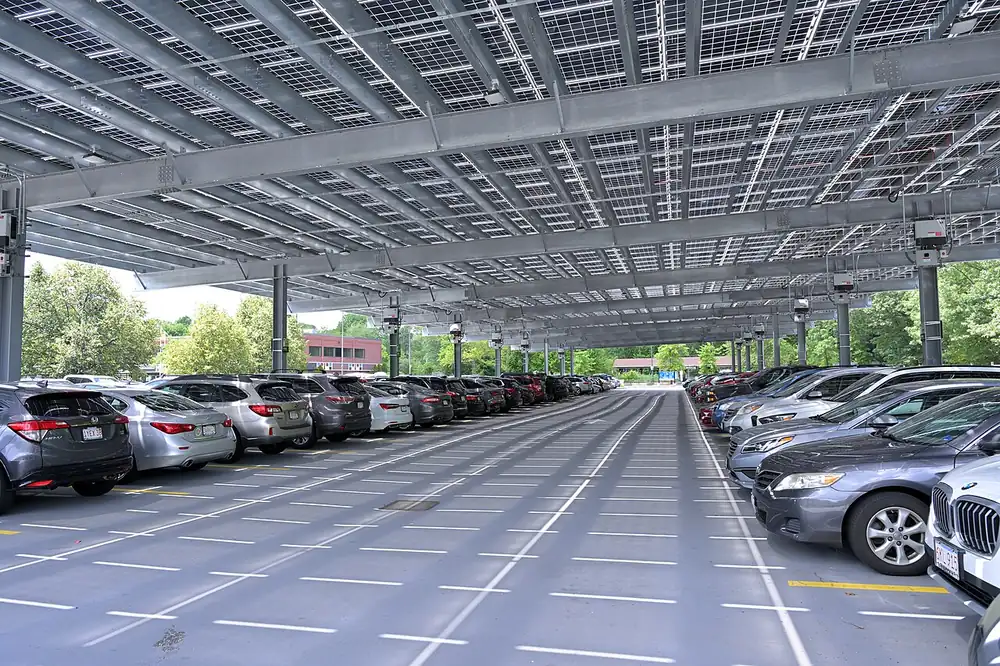
In short: the back of a bifacial module pays off when light can reach it, on a ground mount, a carport or a high frame over a bright surface. On a pitched roof, close to the tiles, it adds little, so judge the module by its front rating, weight and warranty. In Poland, PERC aside, bifacial modules sell at a median 0.140 EUR/W against 0.153 EUR/W for monofacial ones, before tax.
A bifacial module collects light on both faces. The front works like any other module. The back turns light reflected from the ground, or from whatever sits behind the module, into extra power, and the datasheet rates it with one number: the bifaciality factor, rear output as a share of front output.
Whether that's worth having depends on how good the back is, how much light reaches it and what you pay. The catalogue answers the first, the shops the last. The middle one depends on where you mount the module, and it decides the most.
Where the numbers come from
7,743 of the 14,005 modules in our catalogue are listed as bifacial, 55 %. Of those, 5,780 state a bifaciality factor in the sane range, 0.50 to just under 1.00. The factor figures further down use a wider base, every module that prints a factor in range whether or not it's flagged bifacial, so their counts differ. The exact counting rules are in Figures and denominators below the article.
Prices come from Polish shops. Our crawler holds 1,171 offers there for single rooftop modules, and the matcher tied 351 of them to a catalogue module by part number. Only matched offers can be sorted into bifacial and monofacial, because a shop's product title doesn't say so reliably.
One bifacial module as the example
The worked examples below use one bifacial module, a 460 W TOPCon module whose datasheet states a bifaciality factor of 0.80 in our records. I took it from the modules with shop offers in our live offers list when this article was written. Nobody paid for a place.
To have something to compare it with, the arithmetic pairs it with a monofacial module of the same size rated 470 W. That partner is a round number I chose for the sums, not a product we list.
Scorecard for this module: open its page on ComparePV.
How often each cell technology is bifacial
Share bifacial says how often a technology has an active back; the median factor says how good that back is when the datasheet states it. The median runs over every module of that technology printing a factor, flagged bifacial or not. N-type is the group whose datasheets name no cell beyond "N-type", and back contact means cells with all their contacts on the rear face.
| Technology | Modules | Share bifacial | Bifacial, factor stated | Median factor |
|---|---|---|---|---|
| TOPCon | 5,733 | 73 % | 3,106 | 0.80 |
| PERC | 4,306 | 37 % | 1,124 | 0.70 |
| N-type | 1,656 | 58 % | 762 | 0.80 |
| HJT | 697 | 94 % | 545 | 0.90 |
| Back contact | 440 | 43 % | 138 | 0.70 |
Cell design gives a reason to expect the rows to differ. UNSW's teaching material on PV manufacturing calls the heterojunction cell bifacial by nature. A PERC cell finishes its rear with an insulating layer that also works as a mirror, plus local metal contacts, so a rear that lets light in is an adaptation of that design. Hold the HJT and PERC rows against that expectation.
Bifaciality factors cluster on round numbers
Across all technologies, the median bifaciality factor is 0.80, with the 10th percentile at 0.70 and the 90th at 0.85.
The numbers behind the chart
| Bifaciality factor | Modules |
|---|---|
| <0.60 | 10 |
| 0.60-0.65 | 18 |
| 0.65-0.70 | 18 |
| 0.70-0.75 | 1,371 |
| 0.75-0.80 | 173 |
| 0.80-0.85 | 3,527 |
| 0.85-0.90 | 394 |
| 0.90-0.95 | 224 |
| 0.95+ | 70 |
Where the chart spikes instead of sloping, blame the way datasheets print the figure. 83 % of stated factors are exactly 0.70 or 0.80, often with a tolerance such as ±5 % or ±10 % beside them. Read such a figure as a nominal class, not a measurement of the module you'll get. Of all stated factors, 12 % are 0.85 or more.
How the factor is measured
The test is IEC TS 60904-1-2, described by Rauer and colleagues at Fraunhofer ISE. The module is measured with only the front lit, then with only the rear lit. The specification takes two ratios of rear to front, one of short-circuit currents and one of maximum powers, and keeps the smaller. A datasheet usually prints one figure without saying which.
What else changes on a bifacial module
Check whether the bifacial row is bigger, heavier and longer warranted. The columns are median rated power, median weight per square metre, the share with a performance warranty of 30 years or more, and the median annual degradation that warranty allows.
| Group | Power | Weight | 30-year warranty | Degradation |
|---|---|---|---|---|
| Bifacial | 555 W | 12.2 kg/m² | 93 % | 0.40 %/yr |
| Monofacial | 450 W | 10.8 kg/m² | 40 % | 0.50 %/yr |
Those rows mix technologies, and the mix needn't match between the groups. Where a gap shows up again within TOPCon and within PERC below, the mix doesn't explain it.
| Group | Power | Weight | 30-year warranty | Degradation |
|---|---|---|---|---|
| TOPCon, bifacial | 570 W | 12.2 kg/m² | 98 % | 0.40 %/yr |
| TOPCon, monofacial | 475 W | 10.6 kg/m² | 71 % | 0.40 %/yr |
| PERC, bifacial | 535 W | 12.2 kg/m² | 78 % | 0.45 %/yr |
| PERC, monofacial | 430 W | 10.9 kg/m² | 20 % | 0.55 %/yr |
Many bifacial datasheets name a second sheet of glass at the back, which adds weight. The catalogue records what datasheets print; it can't say why.

Weight matters twice: for the load your roof can carry and for the mechanical load the frame is rated for.
What bifacial modules cost in Poland
PERC is left out of both groups, so the gap can't be PERC's own price level in disguise. Compare the two medians first, then whether the middle halves overlap. Prices are in euro per watt, before tax.
| Group | Median, EUR/W | Middle half, EUR/W | Offers | Shops |
|---|---|---|---|---|
| Bifacial | 0.140 | 0.131 to 0.154 | 202 | 26 |
| Monofacial | 0.153 | 0.136 to 0.171 | 97 | 22 |
The offers cover 95 bifacial and 47 monofacial catalogue modules. If the bifacial median sits at or below the monofacial one, the back came without a premium per watt in these shops. Where the middle halves overlap, the shop you pick can move the price as much as the back does.
Size, shop and brand all move the price too, and the groups needn't hold the same mix of them. So the gap describes what a buyer met in the shops; it doesn't price the back side. Market-wide figures are in the price per watt article.
The bifacial example in the shops today:
Cheapest current offers for JA Solar JAM54D40-460/LB, prices read 9 Oct 2026.
| Shop | Market | Price | Availability |
|---|---|---|---|
| Megawat Elektrohurt | Poland | 321.03 zł incl. VAT | In stock |
| PV Zenit | Poland | 333.00 zł incl. VAT | In stock |
| Eco System Projekt | Poland | 350.00 zł incl. VAT | In stock |
Each price is the figure the shop printed, on its own side of VAT.
How much power the back adds
The extra power is the factor times the share of front light that reaches the back. That product is the bifacial gain. The datasheet gives you the factor. Your site gives you the rear light, mostly through the albedo of the surface below (how much light it reflects) and the gap behind the module.
Try it on a rough model of one module over open ground: change the surface, the height and the tilt.
Light on the back of a bifacial module
Pick the ground under the module, lift it and tilt it, and watch how much reflected light reaches its back and what that adds to the output.
How this is computed
The scene is a cross-section: one module of the given length, tilted, its lower edge at the given height over flat, open ground that runs on in both directions, so it stands for a single long row. The sun is at the module's normal, the hour a module tilted for its site is designed for. Its shadow on the ground is then the module length over the cosine of the tilt, starting height × tan(tilt) behind the lower edge.
Of the light on open ground, 30 % is taken as diffuse, from an even sky, and the rest as direct sunlight. A ground point gets the direct part only outside the shadow, and the diffuse part times the share of sky it still sees past the module. The back's view of the ground is split into 1 cm strips, each weighted by its view factor from crossed strings (Hottel's method, exact for a cross-section), and the ground's light is multiplied by the albedo. The back also sees a little sky, which counts too.
Rear-to-front light is that sum over the light on the front; the bifacial gain is the bifaciality factor times it, and the extra energy is the gain times the yield per kWp you enter. The ceiling in the readout is the same module so high that its shadow no longer counts.
This is a rough planning estimate for one moment, used as if it held all year. It leaves out what real arrays have: neighbouring rows, which shade the ground behind each other and often halve the rear light; the frame, rails and posts behind the module; a diffuse share that changes with weather and season; light that is uneven across the back, which costs more than its average suggests; and a sun that moves. Snow on the ground also tends to mean snow on the front. The albedo presets are typical textbook values, example inputs, not measurements of your ground.
Illustrative model, not a measurement.
The break-even against the 470 W partner
At the front, the bifacial module is 10 W behind the 470 W monofacial partner. To catch up it needs 470 / 460 - 1 = 2.17 % of bifacial gain. At a factor of 0.80, the class this datasheet states, that takes rear light of 2.17 / 0.80 = 2.72 % of the front light.
Ground mounts over grass or sand
Tonita and colleagues modelled a fixed-tilt array at latitude tilt in Boulder, Colorado, over a year. Their rear-to-front light ratio was 0.107 over green grass and 0.255 over white sand. For the 460 W example the gain is that ratio times 0.80; compare the last column with the 470 W monofacial partner.
| Case | Rear/front light | Bifacial gain | 460 W module gives |
|---|---|---|---|
| Break-even | 0.027 | 2.17 % | 470.0 W |
| Green grass | 0.107 | 8.56 % | 499.4 W |
| White sand | 0.255 | 20.4 % | 553.8 W |
Over grass that puts the bifacial module 29.4 W ahead, over white sand 83.8 W.
Roofs, where the back has little room
On a low rooftop mount the result is less certain. González-Moreno and colleagues measured bifacial and monofacial modules under identical conditions on an industrial-style rooftop mount, held low because the structure allowed no more height. They found a bifacial gain between 2 and 15 %, and saw that small misalignments between a module and the structural beams could virtually eliminate the rear contribution. At 2 % the example gives 460 W × 1.02 = 469.2 W, just under the 470 W partner; at 15 % it would give 460 W × 1.15 = 529 W. The mounting decides which end you meet.
A pitched roof keeps the module close over tiles it shades itself. Set the figure above low and flat to see what that leaves the back, and plan on the front rating doing the work.
Layouts that need both faces
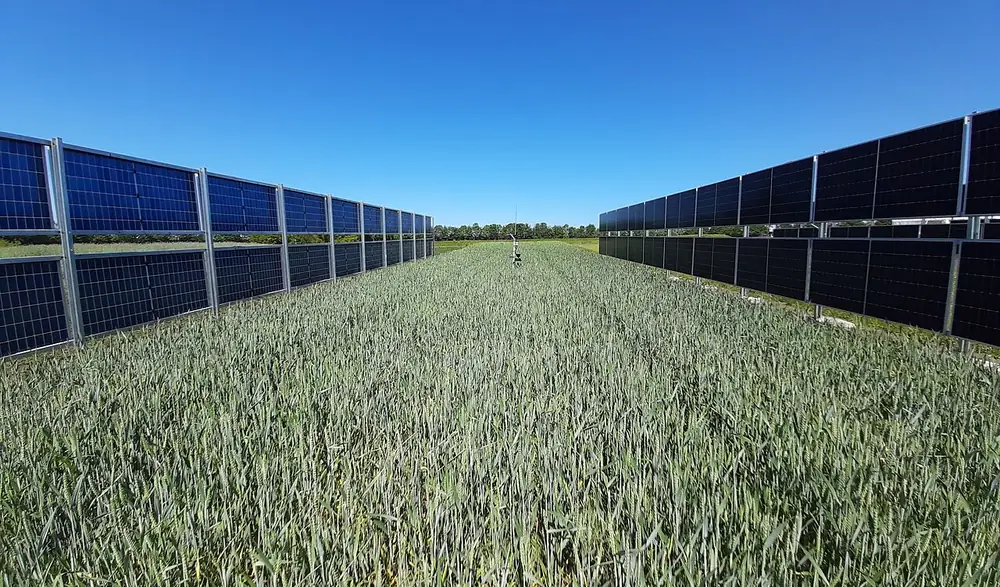
Some installations only make sense with two active faces. In vertical rows one face catches the morning sun and the other the evening sun, and the ground between the rows stays free. A monofacial module standing there would face away from the sun for half the day.

What this means when you buy
The mounting decides more than the cell does. I'd check things in this order:
- On a ground mount, a carport or a high frame over a light surface, a bifacial module with a lower front rating can still come out ahead.
- On a pitched roof, judge the module by its front rating, weight and product warranty. If the bifacial version costs no more per front watt, choosing it costs you little, but read the product warranty on both sheets instead of assuming they match.
- Read the bifaciality factor as a class. A 0.80 with ±10 % beside it tells you the module's group, not what the back of your module will do.
Put the bifacial module and a monofacial alternative side by side in the panel comparison calculator, and check weight and size against your roof in the roof-fit selector.
Caveats
The bifacial flag and the factor are our reading of datasheets, and warranties are what those datasheets promise. Counts are modules, not datasheets. One datasheet usually covers a ladder of power ratings, several modules that differ only in rated power, so a manufacturer with long ladders weighs more in every share.
The gain arithmetic assumes output scales linearly with light and ignores the small extra heating from the back. Tonita and colleagues modelled one site and one mounting, and the rooftop study measured one installation, quoted here from its abstract. Neither is a forecast for your roof.
The price comparison covers one market and only the offers the matcher could tie to the catalogue.
Figures and denominators
How the figures above were computed. Every figure is recomputed from the catalogue and the live shop offers when the page is served, and each one counts only the modules or offers that publish the value.
Catalogue figures are computed from the modules listed in our catalogue (the rankings view, which keeps only modules with a power rating and a page): 14,005 modules. Each is a row read from its manufacturer's datasheet, and one datasheet usually covers a ladder of power ratings, so a datasheet with eight ratings is eight modules here. A module counts as bifacial when its datasheet says so; every other module counts as monofacial.
A bifaciality factor counts when it lies from 0.50 up to, but not including, 1.00. Below 0.50 the field holds a rear power gain printed where the factor goes, and exactly 1.00 is a placeholder no silicon module measures. Weight per square metre is the datasheet weight over length times width, kept between 5 and 25 kg/m²; outside that a unit is wrong. Cell technology is the label on the datasheet; modules labelled only "N-type" are a group of their own.
Prices come from the shop offers our crawler holds now, one row per product page, kept for a week after the crawler last saw them. An offer counts when it is a single module of 400 to 800 W with a price before tax between 0.05 and 2 EUR per watt, converted to euro at the day's ECB rate. The bifacial and monofacial price comparison uses only Polish offers that our matcher tied to one catalogue module by its part number, and leaves PERC out.
All 54 figures on this page and what each counts
| Figure | Value | Computed over |
|---|---|---|
| Modules listed as bifacial | 7,743 | 14,005 modules |
| Modules in the catalogue | 14,005 | 14,005 modules |
| Share of modules listed as bifacial | 55 % | 14,005 modules |
| Bifacial modules stating a bifaciality factor | 5,780 | 14,005 modules |
| Poland: offers matched to a catalogue module | 351 | 1,171 offers |
| TOPCon: modules in the catalogue | 5,733 | 14,005 modules |
| TOPCon: share listed as bifacial | 73 % | 5,733 modules |
| TOPCon: bifacial modules stating a bifaciality factor | 3,106 | 14,005 modules |
| TOPCon: bifaciality factor, median | 0.80 | 3,119 modules |
| PERC: modules in the catalogue | 4,306 | 14,005 modules |
| PERC: share listed as bifacial | 37 % | 4,306 modules |
| PERC: bifacial modules stating a bifaciality factor | 1,124 | 14,005 modules |
| PERC: bifaciality factor, median | 0.70 | 1,126 modules |
| N-type: modules in the catalogue | 1,656 | 14,005 modules |
| N-type: share listed as bifacial | 58 % | 1,656 modules |
| N-type: bifacial modules stating a bifaciality factor | 762 | 14,005 modules |
| N-type: bifaciality factor, median | 0.80 | 767 modules |
| HJT: modules in the catalogue | 697 | 14,005 modules |
| HJT: share listed as bifacial | 94 % | 697 modules |
| HJT: bifacial modules stating a bifaciality factor | 545 | 14,005 modules |
| HJT: bifaciality factor, median | 0.90 | 545 modules |
| Back Contact: modules in the catalogue | 440 | 14,005 modules |
| Back Contact: share listed as bifacial | 43 % | 440 modules |
| Back Contact: bifacial modules stating a bifaciality factor | 138 | 14,005 modules |
| Back Contact: bifaciality factor, median | 0.70 | 138 modules |
| Bifaciality factor, median | 0.80 | 5,805 modules |
| Bifaciality factor, 10th percentile | 0.70 | 5,805 modules |
| Bifaciality factor, 90th percentile | 0.85 | 5,805 modules |
| Share of stated bifaciality factors that are exactly 0.70 or 0.80 | 83 % | 5,805 modules |
| Share of stated bifaciality factors of 0.85 or more | 12 % | 5,805 modules |
| Bifacial modules: rated power, median | 555 W | 7,743 modules |
| Bifacial modules: weight per square metre, median | 12.2 kg/m² | 7,735 modules |
| Bifacial modules: share with a performance warranty of 30 years or more | 93 % | 7,737 modules |
| Bifacial modules: annual degradation, median | 0.40 %/yr | 6,709 modules |
| Monofacial modules: rated power, median | 450 W | 6,262 modules |
| Monofacial modules: weight per square metre, median | 10.8 kg/m² | 6,145 modules |
| Monofacial modules: share with a performance warranty of 30 years or more | 40 % | 6,140 modules |
| Monofacial modules: annual degradation, median | 0.50 %/yr | 4,837 modules |
| TOPCon bifacial modules: rated power, median | 570 W | 4,165 modules |
| TOPCon bifacial modules: weight per square metre, median | 12.2 kg/m² | 4,163 modules |
| TOPCon bifacial modules: share with a performance warranty of 30 years or more | 98 % | 4,165 modules |
| TOPCon bifacial modules: annual degradation, median | 0.40 %/yr | 3,565 modules |
| TOPCon monofacial modules: rated power, median | 475 W | 1,568 modules |
| TOPCon monofacial modules: weight per square metre, median | 10.6 kg/m² | 1,563 modules |
| TOPCon monofacial modules: share with a performance warranty of 30 years or more | 71 % | 1,562 modules |
| TOPCon monofacial modules: annual degradation, median | 0.40 %/yr | 1,372 modules |
| PERC bifacial modules: rated power, median | 535 W | 1,607 modules |
| PERC bifacial modules: weight per square metre, median | 12.2 kg/m² | 1,604 modules |
| PERC bifacial modules: share with a performance warranty of 30 years or more | 78 % | 1,607 modules |
| PERC bifacial modules: annual degradation, median | 0.45 %/yr | 1,365 modules |
| PERC monofacial modules: rated power, median | 430 W | 2,699 modules |
| PERC monofacial modules: weight per square metre, median | 10.9 kg/m² | 2,645 modules |
| PERC monofacial modules: share with a performance warranty of 30 years or more | 20 % | 2,656 modules |
| PERC monofacial modules: annual degradation, median | 0.55 %/yr | 1,991 modules |
Related tools
Reference list
- Tonita et al., A general illumination method to predict bifacial photovoltaic system performance, Joule 7(1), 2023 (arXiv 2302.13829)
- González-Moreno et al., Outdoor Performance Comparison of Bifacial and Monofacial Photovoltaic Modules in Temperate Climate and Industrial-like Rooftops, Applied Sciences 14(13), 5714, 2024
- UNSW, PV-Manufacturing.org, Heterojunction and passivating contacts on solar cells (teaching resource)
- Rauer et al., Comprehensive evaluation of IEC measurement procedures for bifacial solar cells and modules, Fraunhofer ISE, 37th EU PVSEC, 2020