
Technology
108, 120 or 144 cells: what cell count and cell size mean on a solar panel
What 108, 120 or 144 cells and M10, G12 or 210R mean on a datasheet. Cell count sets the voltage, cell size the current, and both meet your inverter.
In short: a module that lists 108, 120 or 144 cells is almost always a 54, 60 or 72 cell layout with every cell cut in half, and 84 % of modules in our catalogue are built that way. The count tells you the voltage, the cell size (M10, G12, 210R) tells you the current: the median module on M10 cells states 13.9 A, on G12 cells 18.3 A. The current is the figure to hold against your inverter's input limits.
Datasheets print the cell count near the top, and shop titles repeat it: "108 cells", "144 half-cut", "G12", "210R". These read like quality badges, but they're wiring facts. They tell you how a module is built and what voltage and current it puts out, which is what decides how it fits a string and an inverter. They say very little about how well it turns light into power.
This is the electrical side of the question. How big the frames are and how much they weigh is in how big are modern solar panels; here it's volts and amps.
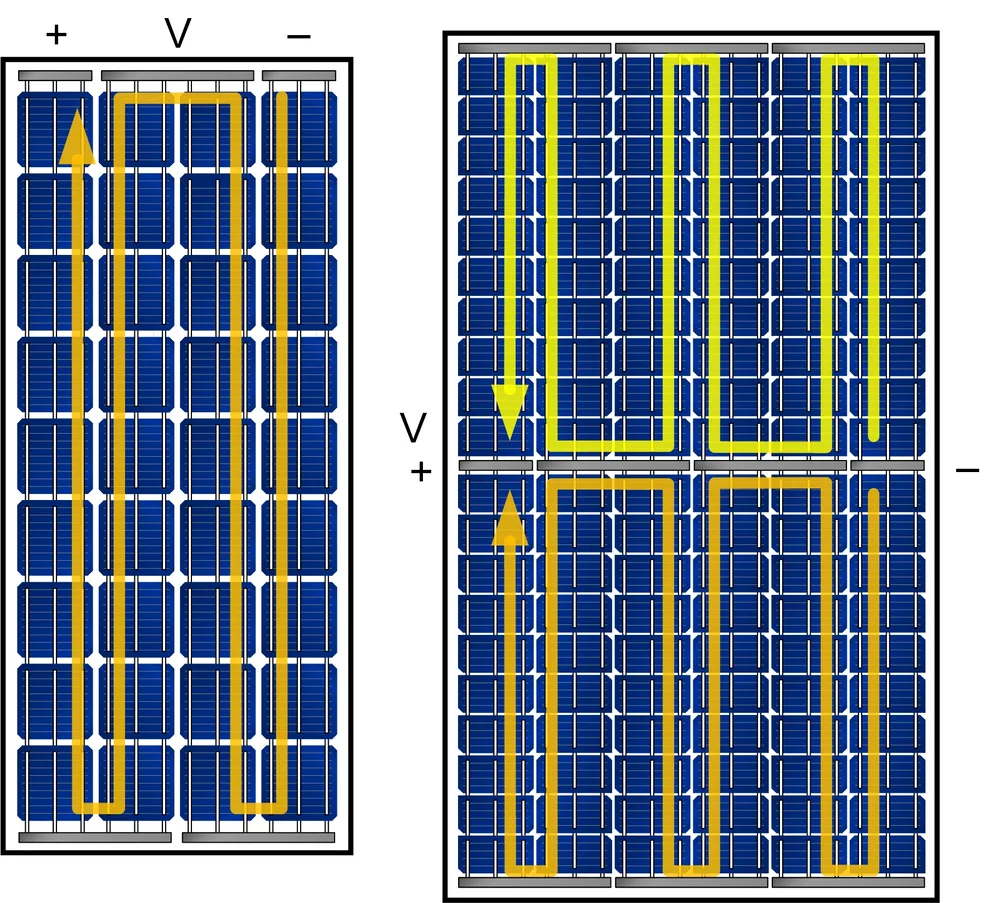
The drawing below shows the two ways a module is wired. On the left, one string of full cells. On the right, cells cut in half and built as two half-modules, top and bottom, joined in parallel.

How I read the figures
Every number here is what a manufacturer printed on a datasheet. None of it is our own measurement. Of 14,005 modules, 13,453 state a usable cell count, but only 5,926 print cell dimensions we can read, so the cell-size figures rest on a smaller part of the catalogue than everything else here. Many sheets simply don't say.
Voc is the open-circuit voltage and Isc the short-circuit current, both at standard test conditions. Each value in the tables is the median of the group, and the share column tells you how big the group is before you trust its median. The exact rules are under the article.
Why cells are cut in half
PV-Manufacturing.org, the UNSW course, puts the idea in one line: the two halves of a cut cell "will produce the same voltage output but half the current". Power lost in the copper that joins the cells grows with the square of the current, P = I² × R. Halve the current and that loss falls to a quarter, which the course writes as "reduced by 75%".
There's a catch the drawing shows. A module of half cells has twice as many pieces, and if they all went in one string the voltage would double. So manufacturers split the module into a top half and a bottom half and join the two in parallel, or as the course puts it, "the resulting module looks like 2 smaller, square modules connected in parallel". The result keeps the voltage and current of the full-cell module it replaces. A 120-cell module is a 60-cell module electrically; it just loses less in its own wiring.
How much is that worth? Max Mittag and colleagues at Fraunhofer ISE modelled it in 2019. They found the cell-to-module power ratio, how much of the cells' power survives into the finished module, "increases by 2-4% for half-cell modules", with lower electrical losses and more light reflected back from the gaps between cells as the main reasons. In their cost model the module costs 0.6 to 1.2 % more to make but 0.8 to 1.0 % less per watt.
The cut has a cost too. The same paper notes that "cut solar cells may not feature half the power of the initial full cell" because of losses at the fresh edge, so a manufacturer has to cut cleanly or treat the edge to keep the gain.
How common it is now
In 2019 the industry's own roadmap, the ITRPV that VDMA publishes each year, put half cells at about 5 % of the market and expected around 40 % by 2029, as PV-Manufacturing.org reports it. Compare that with our catalogue today, a share of models listed rather than of modules sold: 84 % of modules state a half-cut count and 6 % a full-cell one. The rest use other layouts.
Cell count sets the voltage
PVEducation says it plainly: "The voltage from the PV module is determined by the number of solar cells and the current from the module depends primarily on the size of the solar cells." Cells in series add their voltages, so more cells in the chain means more volts.
For a half-cut module, halve the printed count to get the number of cells in series. A 144-cell module has 72 in series in each half, a 108-cell module 54. Here's every common layout in the catalogue:
| Cells stated | Wired as | Share of modules | Voc, V | Isc, A | Rated power, W |
|---|---|---|---|---|---|
| 60 | 60 full cells | 2 % | 39.3 | 9.7 | 305 |
| 72 | 72 full cells | 3 % | 46.9 | 9.9 | 350 |
| 108 | 2 × 54 half cells | 23 % | 38.9 | 14.1 | 435 |
| 120 | 2 × 60 half cells | 14 % | 42.0 | 14.1 | 480 |
| 132 | 2 × 66 half cells | 20 % | 48.3 | 17.0 | 645 |
| 144 | 2 × 72 half cells | 23 % | 50.7 | 13.9 | 560 |
| 156 | 2 × 78 half cells | 4 % | 55.7 | 14.0 | 625 |
Two checks on the voltage column. First, 108 against 144: those are 54 and 72 cells in series, so if voltage followed the count exactly, the 144 row would sit a third above the 108 row. Divide one by the other and see how close it comes. Second, 60 against 120: same number in series, so they should be near each other. Any gap there comes from the cells themselves, their type and age, not from the cut.
Then read the current column. If current followed the count, it would climb from 108 to 144 the way voltage does; check whether it does. Why it doesn't have to is the next section.
What the voltage does to a string
Voltage per module decides how many modules fit in one string before the inverter's maximum input is reached on a cold morning. The catalogue median module states 45.4 V. A 108-cell module carries less voltage than a 144-cell one, so more of them fit in the same string; neither is better, they're just different bricks.
The figure below puts a string against an inverter's input. Change the number of modules and the coldest temperature and watch the voltage move against the limits. The Voc and Isc article explains each limit.
Will the string fit the inverter?
Change the number of modules in series and the coldest and hottest cell temperatures, and watch the string's voltage move against the inverter's tracking window and its maximum input.
How this is computed
Each module's voltage moves in a straight line with cell temperature: Voc(T) = Voc at STC × (1 + Voc coefficient / 100 × (T - 25)), and the same for Vmp with its own coefficient. The string is the number of modules times one module. Cold Voc is checked against the maximum DC input, hot Vmp against the MPPT minimum and cold Vmp against the MPPT maximum.
The margin rule is the plain one: a voltage equal to a limit fits, and there is no hidden safety factor. Local electrical codes and the inverter's datasheet decide which temperature to design for and what margin to keep, and some codes use their own correction tables instead of the coefficient. Follow those, not this figure.
Datasheets rarely print a Vmp coefficient. The starting value is the catalogue median Pmax coefficient less the median Isc coefficient, the usual stand-in, and a loaded module gets the same from its own datasheet. A temperature coefficient read as positive is taken for a dropped minus sign, because silicon's voltage always falls as it warms.
The model is one string on one input, at first light on the cold morning for Voc and in full sun for Vmp. It ignores cable losses, shading, mismatch between modules and the inverter's current limits, which the article covers separately. It is an illustration, not a string design.
Illustrative model, not a measurement.
Cell size sets the current
Each cell makes current in proportion to its area, so cell size is what moves the current. Silicon cells are cut from square wafers, and the industry names them by edge length:
- M6: 166 mm, the older format.
- M10: 182 mm.
- G12: 210 mm, the format behind many of the largest modules.
- 210R: a rectangle of about 182 by 210 mm, sometimes sold as G12R. It's the newer middle option, more current than M10 in a frame that still fits a rooftop width.
Cutting a cell in half doesn't change this. Each half carries half the current, but the two halves of the module run in parallel, so the module's current is that of the full wafer it was cut from.
| Cell format | Modules | Share of those stating a size | Isc, A | Voc, V | Rated power, W |
|---|---|---|---|---|---|
| M6 (166 mm) | 455 | 8 % | 11.4 | 46.7 | 425 |
| M10 (182 mm) | 2,975 | 50 % | 13.9 | 45.5 | 495 |
| 210R (182 × 210 mm) | 807 | 14 % | 15.9 | 40.4 | 505 |
| G12 (210 mm) | 1,102 | 19 % | 18.3 | 46.0 | 660 |
The area arithmetic gives a check you can run on the Isc column. A G12 cell is 210 × 210 = 44,100 mm², an M10 cell 182 × 182 = 33,124 mm², so a G12 cell has 1.33 times the area. A 210R cell, 182 × 210 = 38,220 mm², has 1.15 times the area of M10. Divide the G12 and 210R medians by the M10 median and compare them with those two ratios; the closer they come, the more of the current gap is simply wafer area. Then look down the Voc column: it has no reason to follow size, because voltage belongs to the count.
The same arithmetic covers the 132-cell row in the first table. If its current stands out from its neighbours, that's cell size, not count: 66 cells in series is a layout many G12 modules use.
Cell size also sets the frame. Six 182 mm edges across make 1,092 mm before gaps and frame, which is where the 1134 mm width comes from; 66 % of modules are that wide. Six 210 mm edges make 1,260 mm, behind the 1303 mm width of 14 % of modules.
The chart shows how Isc spreads across the whole catalogue. The tall bars are the currents many datasheets share; hold them against the Isc medians in the cell-size table.
The numbers behind the chart
| Short-circuit current at STC (A) | Modules |
|---|---|
| <10 | 993 |
| 10-11 | 661 |
| 11-12 | 763 |
| 12-13 | 208 |
| 13-14 | 3,402 |
| 14-15 | 3,518 |
| 15-16 | 1,574 |
| 16-17 | 821 |
| 17-18 | 413 |
| 18-19 | 1,609 |
| 19+ | 40 |
Current against inverter limits
Bigger cells raise power without raising the voltage, so the extra watts arrive as amps. That's the part an existing inverter may not have room for.
An inverter states a maximum input current and a maximum array short-circuit current for each input. The example in the Voc and Isc article, Fronius's Primo GEN24 6.0, takes the array's short-circuit current as at least Isc × 1.25, citing IEC 60364-7-712, NEC 2020 and AS/NZS 5033:2021. Across the catalogue the median module's Isc × 1.25 is 17.7 A, and 13 % of modules exceed 22 A on that measure, the array short-circuit limit on that inverter's second input. By power class:
| Power class | Modules | Isc, A | Isc × 1.25, A |
|---|---|---|---|
| under 400 W | 1,997 | 10.2 | 12.8 |
| 400-499 W | 5,013 | 14.0 | 17.5 |
| 500-599 W | 3,423 | 14.1 | 17.6 |
| 600-699 W | 2,726 | 16.1 | 20.1 |
| 700 W and up | 765 | 18.4 | 23.0 |
Read the last column against the short-circuit limit of the input you plan to use, and the Isc column against its maximum input current. A string inverter, a microinverter and a power optimizer all print their input limits, and a module above them needs a different device. Whether a small excess is allowed is in that device's datasheet and is your installer's call.
Mixing sizes in one string
Modules in a string are in series, so they all carry the same current. PVEducation describes the rule inside a module: "the output of the entire PV module under worst case conditions is determined by the solar cell with the lowest output." A string behaves the same way, so an M10 module in a string of G12 modules pulls the whole string down to its current. Mixing cell sizes in one string is the expensive kind of mismatch; can you mix different solar panels covers the rest.
What it means when you buy
Treat "half-cut" as a building method, not as a feature. With 84 % of the catalogue built that way, compare a half-cut module with other half-cut modules on efficiency and price per watt, not on the cut. A full-cell module is worth a look at its datasheet date before its price.
Read the cell count as a voltage figure. 108 cells means a module of around 54 cells' voltage, 144 cells around 72. It decides how many modules go in a string, not how good the module is. The module's own Voc on the sheet is the figure your installer works from.
Read the cell size as a current figure. If you're adding to or replacing modules on an existing inverter, match the current first. Moving from M10 to 210R or G12 modules raises Isc, and the inverter has to accept it on every input.
Don't mix cell sizes in one string. Put different modules on separate inputs, or keep to one size.
Look for the number, not the badge. Shop titles say "G12" or "210R" loosely, and only 5,926 of 14,005 modules in our catalogue print cell dimensions we can read. Isc on the datasheet is the figure that matters; the format just explains it.
What these figures can't tell you
Every value is a manufacturer's claim at standard test conditions, and the cell-size figures cover only the modules whose sheets print dimensions we could read.
A median per layout mixes manufacturers, cell technologies and years, so a gap between rows can come from the cell type as much as from the count or the size.
Neither table says whether a given module suits a given inverter. That depends on the full inverter datasheet, the lowest temperature at your site and your country's electrical rules, and it's your installer's calculation.
Figures and denominators
How the figures above were computed. Every figure is recomputed from the catalogue and the live shop offers when the page is served, and each one counts only the modules or offers that publish the value.
The pool is every listable module in our catalogue, 14,005 of them, as each manufacturer's datasheet states it. One datasheet usually covers a ladder of power ratings, so the figures count modules, not datasheets.
Cell count is the number of cells the datasheet states, kept between 30 and 300; 13,453 modules state one in that range. A module counts as half-cut when it states 108, 120, 132, 144 or 156 cells, the full-cell layouts of 54, 60, 66, 72 and 78 doubled, and as full-cell when it states 54, 60, 66, 72 or 78. Other counts, such as 96 cells, are in neither group. A half-cut count is the datasheet's own figure and can't be checked against a photo, so a module that states 120 cells is counted as half-cut even if its sheet doesn't use the word.
Cell size is read from the cell dimensions the datasheet prints, a text field: 5,926 modules state one we can read. M6 is 166 mm or the name M6; M10 is 182 or 183 mm or the name M10; G12 is 210 mm or the name G12; 210R is "210R", "G12R", the word rectangular, or a 182 or 183 mm side paired with 105 or 210 mm. Older formats from 156 to 163 mm count only in the total, so the four shares don't add up to 100 %.
Voc, Isc and rated power are medians over the modules in each group that state them, at standard test conditions. Isc × 1.25 is each module's Isc times 1.25, the factor Fronius's Primo GEN24 6.0 datasheet applies to the array's short-circuit current, citing IEC 60364-7-712, NEC 2020 and AS/NZS 5033:2021; the 22 A limit is that inverter's second input.
All 58 figures on this page and what each counts
| Figure | Value | Computed over |
|---|---|---|
| Share of stated cell counts that are a half-cut count (108 to 156) | 84 % | 13,453 modules |
| Cells M10 (182 mm): Isc at STC, median | 13.9 A | 2,975 modules |
| Cells G12 (210 mm): Isc at STC, median | 18.3 A | 1,102 modules |
| Modules in the catalogue | 14,005 | 14,005 modules |
| Modules stating a cell count | 13,453 | 14,005 modules |
| Modules whose cell dimensions name a wafer format | 5,926 | 14,005 modules |
| Share of stated cell counts that are a full-cell count (54 to 78) | 6 % | 13,453 modules |
| Modules with 60 cells: share of stated cell counts | 2 % | 13,453 modules |
| Modules with 60 cells: Voc at STC, median | 39.3 V | 298 modules |
| Modules with 60 cells: Isc at STC, median | 9.7 A | 298 modules |
| Modules with 60 cells: rated power, median | 305 W | 299 modules |
| Modules with 72 cells: share of stated cell counts | 3 % | 13,453 modules |
| Modules with 72 cells: Voc at STC, median | 46.9 V | 378 modules |
| Modules with 72 cells: Isc at STC, median | 9.9 A | 378 modules |
| Modules with 72 cells: rated power, median | 350 W | 378 modules |
| Modules with 108 cells: share of stated cell counts | 23 % | 13,453 modules |
| Modules with 108 cells: Voc at STC, median | 38.9 V | 3,044 modules |
| Modules with 108 cells: Isc at STC, median | 14.1 A | 3,044 modules |
| Modules with 108 cells: rated power, median | 435 W | 3,044 modules |
| Modules with 120 cells: share of stated cell counts | 14 % | 13,453 modules |
| Modules with 120 cells: Voc at STC, median | 42.0 V | 1,873 modules |
| Modules with 120 cells: Isc at STC, median | 14.1 A | 1,873 modules |
| Modules with 120 cells: rated power, median | 480 W | 1,874 modules |
| Modules with 132 cells: share of stated cell counts | 20 % | 13,453 modules |
| Modules with 132 cells: Voc at STC, median | 48.3 V | 2,732 modules |
| Modules with 132 cells: Isc at STC, median | 17.0 A | 2,732 modules |
| Modules with 132 cells: rated power, median | 645 W | 2,732 modules |
| Modules with 144 cells: share of stated cell counts | 23 % | 13,453 modules |
| Modules with 144 cells: Voc at STC, median | 50.7 V | 3,094 modules |
| Modules with 144 cells: Isc at STC, median | 13.9 A | 3,094 modules |
| Modules with 144 cells: rated power, median | 560 W | 3,094 modules |
| Modules with 156 cells: share of stated cell counts | 4 % | 13,453 modules |
| Modules with 156 cells: Voc at STC, median | 55.7 V | 597 modules |
| Modules with 156 cells: Isc at STC, median | 14.0 A | 597 modules |
| Modules with 156 cells: rated power, median | 625 W | 597 modules |
| Open-circuit voltage at STC, median | 45.4 V | 13,925 modules |
| Cells M6 (166 mm): modules | 455 | 14,005 modules |
| Cells M6 (166 mm): share of modules naming a wafer format | 8 % | 5,926 modules |
| Cells M6 (166 mm): Isc at STC, median | 11.4 A | 455 modules |
| Cells M6 (166 mm): Voc at STC, median | 46.7 V | 455 modules |
| Cells M6 (166 mm): rated power, median | 425 W | 455 modules |
| Cells M10 (182 mm): modules | 2,975 | 14,005 modules |
| Cells M10 (182 mm): share of modules naming a wafer format | 50 % | 5,926 modules |
| Cells M10 (182 mm): Voc at STC, median | 45.5 V | 2,974 modules |
| Cells M10 (182 mm): rated power, median | 495 W | 2,975 modules |
| Cells 210R (182 x 210 mm): modules | 807 | 14,005 modules |
| Cells 210R (182 x 210 mm): share of modules naming a wafer format | 14 % | 5,926 modules |
| Cells 210R (182 x 210 mm): Isc at STC, median | 15.9 A | 807 modules |
| Cells 210R (182 x 210 mm): Voc at STC, median | 40.4 V | 795 modules |
| Cells 210R (182 x 210 mm): rated power, median | 505 W | 807 modules |
| Cells G12 (210 mm): modules | 1,102 | 14,005 modules |
| Cells G12 (210 mm): share of modules naming a wafer format | 19 % | 5,926 modules |
| Cells G12 (210 mm): Voc at STC, median | 46.0 V | 1,102 modules |
| Cells G12 (210 mm): rated power, median | 660 W | 1,102 modules |
| Share of modules 1134 mm wide (within 1 mm) | 66 % | 13,990 modules |
| Share of modules 1303 mm wide (within 1 mm) | 14 % | 13,990 modules |
| Isc at STC times 1.25, median | 17.7 A | 14,002 modules |
| Share of modules whose Isc times 1.25 exceeds 22 A | 13 % | 14,002 modules |
Related tools
Reference list
- PVEducation (Honsberg and Bowden), Module Circuit Design
- PVEducation (Honsberg and Bowden), Mismatch Effects
- PV-Manufacturing.org (UNSW), Half-cells PV modules
- Mittag et al., Techno-economic analysis of half cell modules, the impact of half cells on module power and costs, Fraunhofer ISE, 36th EU PVSEC, 2019
- VDMA, International Technology Roadmap for Photovoltaic (ITRPV)
- Fronius, Primo GEN24 6.0 technical data (input data and footnote on array short-circuit current)