
Buying
Are all-black solar panels worth it?
Do all-black solar panels make less power, run hotter or cost more? Datasheet medians for matched formats and live shop prices per watt answer it.
In short: an all-black module can give up a little power for its looks, because its black backsheet swallows light a white one would bounce back onto the cells. In a matched format, monofacial TOPCon all-black modules state 22.0 % against 22.4 % for silver frames, with a NOCT of 44 °C against 44 °C. On price, the median shop sets its all-black 400-499 W modules -2 % per watt apart from its plain ones, a minus meaning cheaper, so buy black for the roof you want to look at, and compare it per watt like anything else.
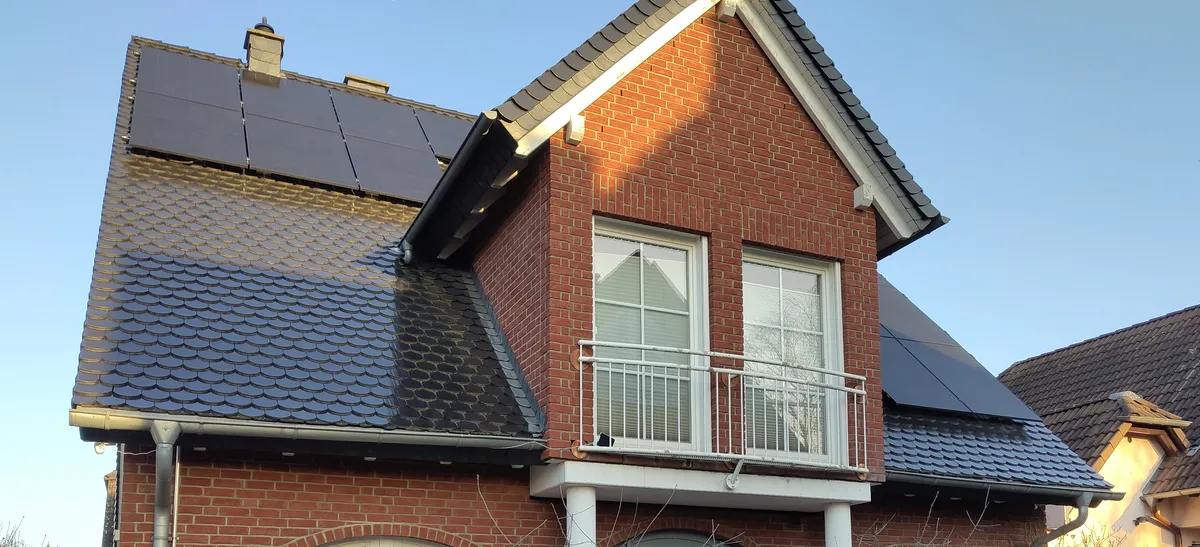
"All-black" or "full black" is a look: a module with no silver frame and no white lines between its cells, so from the street it reads as one dark surface. Buyers ask three things about it. Does it make less power, does it run hotter on the roof, and does it cost more? The datasheets in our catalogue and the shop offers our crawler reads answer all three, with one catch about how many datasheets state a colour at all.

What makes a module all-black
A crystalline module has three visible parts: the cells, the frame and the backsheet showing through the gaps between cells. The cells are dark on every modern module, so colour is a matter of the other two.
- Frame. Usually anodised aluminium, left silver or coated black. A black frame alone makes a module darker from a distance and changes nothing electrically.
- Backsheet. The rear layer, visible in the gaps between cells and around the edge. Standard modules use white; an all-black module uses black.
- Cells. Dark blue to black monocrystalline cells. Some all-black designs also hide the busbars or space the cells tighter, so less backsheet shows.
A black frame over a white backsheet is a different product: it keeps the white grid between the cells. Shops sometimes sell both as "black", so read the datasheet line for the backsheet, not only the photo. A glass-glass module has no backsheet; its gaps show whatever the rear glass is printed or coated with, and its datasheet says that in its own words.
How the figures were read
Every catalogue figure here is a manufacturer's datasheet claim, not our own measurement. The catch is coverage. 8,692 of our 14,005 modules state a frame colour and only 2,867 state a backsheet colour, so I can name a module all-black only when its datasheet prints both. That gives 659 all-black modules, a floor rather than a census: 2,414 modules state a black frame, and many of the rest are likely all-black sheets that never mention the backsheet.
Among modules that state both colours, 28 % are all-black. That share is of a self-selected group, since a manufacturer selling a full black version has a reason to print the colour, so don't read it as the share of all-black modules on the market.
The comparison group is 5,720 modules with a silver, anodised or grey frame. They count whatever their backsheet, because the backsheet colour is missing on most silver-frame sheets too. The exact rules are in the method note under the article.
Efficiency and power: compare the same format
Across the whole catalogue, all-black modules state a median efficiency of 21.4 % against 21.8 % for silver frames, and a median rating of 430 W against 545 W. Distrust the rating columns first. All-black is a residential product, so it skews to small rooftop formats, while silver frames cover the large utility modules too. Whole-catalogue medians compare formats, not colours.
So I narrowed both sides the same way three times: monofacial TOPCon, monofacial PERC, and the common monofacial rooftop format 1,134 mm wide and 1,700 to 1,780 mm long. Bifacial modules are out of every group, because their rear side is glass or a clear backsheet, with no colour to compare.
| Group | Modules, all-black | Modules, silver frame | Efficiency, all-black | Efficiency, silver frame | Rating, all-black | Rating, silver frame |
|---|---|---|---|---|---|---|
| Monofacial TOPCon | 119 | 524 | 22.0 % | 22.4 % | 445 W | 545 W |
| Monofacial PERC | 208 | 1,143 | 20.5 % | 20.7 % | 405 W | 445 W |
| Monofacial, 1,134 mm wide | 247 | 322 | 21.2 % | 21.5 % | 415 W | 420 W |
Check the counts first: the smaller a column's count, the more one manufacturer's long power ladder can move its median. Then read the efficiency columns in the last row, the one where both sides share a size. There the rating gap is a gap in power on the same area, which is what costs you on a full roof. In the TOPCon and PERC rows the rating columns still mix sizes, so read efficiency there and leave the watts alone.
Where the all-black median sits below the silver one, there is a physical reason for it. PVEducation notes that in a sparsely packed module "some of the light striking regions of the module between cells and cell contacts is scattered and channelled to active regions of the module". A white backsheet does that scattering. A black one absorbs the light instead, and the gaps stop contributing.
What one datasheet pair shows
Medians mix manufacturers. A cleaner view is one manufacturer selling the same module in two colours. Jinko's Tiger Neo 54HL4R comes as the -B, labelled "ALL-BLACK MODULE" on its sheet, and as the plain 54HL4R and -V, whose shared sheet is labelled "MONO-FACIAL MODULE" and pictures them with white lines between the cells. Both Australian sheets, from 2022, list a ladder from 415 to 435 W on the same 1,762 × 1,134 mm module.
| Line on the datasheet | 54HL4R-B, all-black | 54HL4R and -V, white lines |
|---|---|---|
| Rating, middle of the ladder | 430 W | 430 W |
| Module efficiency at that rating | 21.52 % | 21.52 % |
| Power at NOCT | 323 W | 323 W |
| NOCT | 45 ± 2 °C | 45 ± 2 °C |
| Pmax temperature coefficient | -0.30 %/°C | -0.29 %/°C |
The efficiency is identical because it can't be anything else: it is the rating divided by the area, and the two modules share both. A manufacturer sells modules by measured power, so a 430 W all-black module and a 430 W white one deliver the same 430 W under test light. The colour shows up in how many cells end up in each power class, which can push an all-black ladder a step lower than its white twin. Here the two ladders match.
That's the practical lesson for the efficiency table above. A lower all-black median means fewer modules in the top classes, not that an all-black module of a given rating is weaker. Compare the rating and the size, not the colour.
Heat: NOCT and the temperature coefficient
A darker surface absorbs more of the light that isn't turned into electricity, and that light becomes heat. PVEducation puts it plainly: "How much light is absorbed and how much is reflected is determined by the color and material of the rear backing layer of the module." Heat costs power, because a hotter cell gives a lower voltage; for silicon, PVEducation gives a loss of maximum power of "0.4% to 0.5% per °C" at the cell level, and module datasheets print their own figure as the Pmax temperature coefficient.
Two datasheet figures tell you how much heat costs a given module. NOCT is the cell temperature under 800 W/m² of sunlight, 20 °C air and 1 m/s of wind; lower runs cooler. The temperature coefficient is the share of power lost per degree above 25 °C; closer to zero loses less.
| Figure | All-black | Silver frame |
|---|---|---|
| NOCT, all modules | 45 °C | 45 °C |
| NOCT, monofacial TOPCon | 44 °C | 44 °C |
| NOCT, monofacial PERC | 45 °C | 45 °C |
| NOCT, monofacial, 1,134 mm wide | 45 °C | 45 °C |
| Pmax coefficient, all modules | -0.30 %/°C | -0.30 %/°C |
| Pmax coefficient, monofacial TOPCon | -0.30 %/°C | -0.30 %/°C |
| Pmax coefficient, monofacial PERC | -0.35 %/°C | -0.35 %/°C |
| Pmax coefficient, monofacial, 1,134 mm wide | -0.33 %/°C | -0.30 %/°C |
For reference, the whole catalogue's medians are 45 °C and -0.30 %/°C. Datasheets mostly print NOCT in whole degrees, so a median that moves by one degree is a real shift, and two columns showing the same number may still hide a degree or so between them.
Treat a printed NOCT with care in this question. The Jinko pair above prints the same 45 ± 2 °C for both colours, and PVEducation notes that "Measuring NOCT usually has a higher uncertainty than the variation in NOCT between modules." The qualification standard no longer has an operating temperature test at all: the 2021 edition of IEC 61215-2 lists the "removal of the nominal module operating test (NMOT), and associated test of performance at NMOT" among its changes. So a datasheet NOCT is the manufacturer's figure, often printed once for a whole family of colours.
What two degrees would cost
Take the tolerance at its edge and say the all-black module runs 2 °C hotter than its white twin. The NOCT method sets the cell temperature at air temperature plus (NOCT - 20) / 800 × sunlight. At 30 °C air and 1,000 W/m²:
- NOCT 45 °C: 30 + 25 / 800 × 1000 = 61.25 °C, which is 36.25 degrees above 25 °C. At -0.30 %/°C the module loses 36.25 × 0.30 = 10.9 %, so a 430 W module gives 430 × 0.891 = 383.2 W.
- NOCT 47 °C: 30 + 27 / 800 × 1000 = 63.75 °C, 38.75 degrees above. The loss is 38.75 × 0.30 = 11.6 %, so 430 × 0.884 = 380.0 W.
That's about 3 W in the hottest hour, under 1 % of the rating, and less at any other time of day. The figure below runs the same sum. It starts with a TOPCon and a PERC median module; type in an all-black datasheet as A and its silver twin as B to see your own pair.
What a hot roof does to two modules
Set the air temperature and the sunlight, give two modules their datasheet figures, and watch the cells heat up and the output bars move apart.
How this is computed
Cell temperature follows the NOCT method: Tcell = Tair + (NOCT - 20) / 800 × G, with G the sunlight on the module in W/m². NOCT is measured at 800 W/m², 20 °C air, 1 m/s wind and an open back, so the rise above the air is scaled from that test.
Output is the rating scaled by sunlight and by temperature: P = rating × G / 1000 × (1 + coefficient / 100 × (Tcell - 25)). It is the same calculation as the heat yield comparison tool, run once for each module.
The sentence under the readout splits the gap in two: B's output with A's coefficient at B's own cell temperature separates what the coefficient did from what the cooler or hotter cells did.
The model is a steady state with NOCT wind. A roof-mounted module with little air behind it runs hotter than its NOCT suggests, and wind cools it. It ignores weak-light losses, the spectrum, dirt and the inverter, and treats the coefficient as a straight line, which datasheets only state around 25 °C. It compares two modules under the same conditions; it is not a yield forecast.
Illustrative model, not a measurement.
The hot climate article explains why the coefficient usually matters more than the colour, and the heat yield comparison runs the sum for any air temperature.
Price in shops
A shop title is the only place most offers say what colour a module is, so here I read colour from the title: "full black", "all black" and the same words in Polish, Italian or German. I kept to 400-499 W single modules, the class where all-black is common, because across every class the comparison measured the power class rather than the colour: shops price large modules lower per watt, and few large modules are black.
In Poland, the market with the most offers when I wrote this:
| Group, 400-499 W | Median (EUR/W before tax) | Offers | Shops |
|---|---|---|---|
| Titled all-black | 0.157 | 118 | 22 |
| No black in the title | 0.151 | 442 | 31 |
Two market medians also compare shops: if all-black is sold mainly by shops with higher prices across the board, the medians show a premium the colour didn't cause. So I also compared each shop with itself. 41 shops outside the United States list both kinds in that class. In 17 of them the all-black median per watt is the higher one, and the median shop's difference is -2 %. A positive figure is a premium for black, a negative one means the typical shop prices its all-black modules lower per watt.
For scale, the median for every Polish single rooftop module of 400 to 800 W is 0.146 EUR/W. The price per watt by power class article shows how much the class alone moves that figure, which is why a 430 W all-black offer should be held against other 400-499 W offers, not against the cheapest 600 W module in the shop.
What to do with this when buying
- Read the backsheet line. "Black" in a shop title can mean a black frame on a white backsheet. If you want the uniform look, the datasheet should say black for both.
- Compare by rating and size, not by colour. A 430 W all-black module and a 430 W white one of the same size give the same power at test conditions. If the all-black ladder stops lower, you get fewer watts per module, and the roof-fit selector shows whether that costs you a module's worth on your roof.
- Check the coefficient on the sheet in front of you. The heat gap from a darker backsheet is small next to the spread in coefficients between technologies; a TOPCon all-black module will usually beat a PERC silver one on a hot roof. The TOPCon or PERC article has that comparison.
- Price it per watt in the same class. Divide the price by the rated power and hold it against modules of the same class in the same shop, on the same side of VAT. Then decide whether the look is worth whatever difference is left.
If the roof faces the street and you'll look at it for twenty-five years, the look is a fair thing to weigh, as long as you price it per watt. If the roof is tight on space, the watts per square metre matter more than the colour, and the best module may well be silver.
What this comparison cannot tell you
The all-black group is the modules whose datasheets print both colours, which is a minority of the catalogue and may lean towards the manufacturers that market their black versions hardest. The counts are modules, not datasheets, so a long power ladder weighs more in every median. Some sheets call a black frame just "anodised aluminium", as Jinko's all-black -B does, so a few black modules sit in the silver-frame group.
NOCT is a datasheet figure under a fixed test condition with a tolerance of a couple of degrees, not a measurement on your roof. A module mounted close to the tiles runs hotter than its NOCT for any colour.
The prices are the offers live when the page is served, colour read from shop titles, in one power class, so a shop that writes "black" differently or not at all is in neither group.
Figures and denominators
How the figures above were computed. Every figure is recomputed from the catalogue and the live shop offers when the page is served, and each one counts only the modules or offers that publish the value.
Catalogue figures come from the modules listed in our catalogue (the rankings view, which keeps only modules with a power rating and a page): 14,005 modules. Each is a row read from its manufacturer's datasheet, and one datasheet usually covers a ladder of power ratings, so a datasheet with eight ratings is eight modules here.
A module counts as all-black when its datasheet states both colours and both are black. The frame colour has to start with "black" and name no silver, so a sheet listing "black/silver" or "black or silver" as two options under one model is left out. The backsheet colour has to start with "black" and must not say white, transparent, clear, grid or mesh, or list two colours. 8,692 modules state a frame colour and 2,867 a backsheet colour, so the all-black count is a lower bound: a module whose sheet prints a black frame and says nothing about the backsheet is not counted. The comparison group is modules whose frame colour names silver, anodised, natural or grey and never black, whatever the backsheet.
The like-for-like groups narrow both sides the same way: monofacial modules whose datasheet names TOPCon, monofacial modules whose datasheet names PERC, and monofacial modules 1,134 mm wide and 1,700 to 1,780 mm long. Each figure keeps only values in a sanity range: efficiency from 5 to 30 %, a Pmax temperature coefficient between -1 and 0 %/°C, and a plausible NOCT.
Prices come from the shop offers our crawler holds now, one row per product page, kept for a week after the crawler last saw them. An offer counts when it is a single module of 400 to 499 W with a price before tax between 0.05 and 2 EUR per watt, converted to euro at the day's ECB rate. Colour is read from the shop's title, because few matched offers sit on a catalogue module whose datasheet states both colours: a title saying full black, all black, total black or the same words in Polish, Italian or German counts as all-black, and a title with no word for black in any of the crawled languages counts as the comparison group. Titles that say only "black frame" fall in neither. The same-shop comparison takes every shop outside the United States that lists both kinds, its median price per watt on each side, and the median of the shops' differences.
All 56 figures on this page and what each counts
| Figure | Value | Computed over |
|---|---|---|
| Modules, monofacial TOPCon, black frame and backsheet: module efficiency, median | 22.0 % | 119 modules |
| Modules, monofacial TOPCon, silver frame: module efficiency, median | 22.4 % | 524 modules |
| Modules, monofacial TOPCon, black frame and backsheet: NOCT, median | 44 °C | 103 modules |
| Modules, monofacial TOPCon, silver frame: NOCT, median | 44 °C | 499 modules |
| Same shop, 400 to 499 W, all-black against no black in the title, price per watt difference, median | -2 % | 41 shops |
| Modules stating a frame colour | 8,692 | 14,005 modules |
| Modules in the catalogue | 14,005 | 14,005 modules |
| Modules stating a backsheet colour | 2,867 | 14,005 modules |
| Modules, black frame and backsheet: count | 659 | 14,005 modules |
| Modules with a black frame (any backsheet) | 2,414 | 14,005 modules |
| Share of modules stating both colours that have a black frame and a black backsheet | 28 % | 2,340 modules |
| Modules, silver frame: count | 5,720 | 14,005 modules |
| Modules, black frame and backsheet: module efficiency, median | 21.4 % | 659 modules |
| Modules, silver frame: module efficiency, median | 21.8 % | 5,719 modules |
| Modules, black frame and backsheet: rated power, median | 430 W | 659 modules |
| Modules, silver frame: rated power, median | 545 W | 5,720 modules |
| Modules, monofacial TOPCon, black frame and backsheet: count | 119 | 14,005 modules |
| Modules, monofacial TOPCon, silver frame: count | 524 | 14,005 modules |
| Modules, monofacial TOPCon, black frame and backsheet: rated power, median | 445 W | 119 modules |
| Modules, monofacial TOPCon, silver frame: rated power, median | 545 W | 524 modules |
| Modules, monofacial PERC, black frame and backsheet: count | 208 | 14,005 modules |
| Modules, monofacial PERC, silver frame: count | 1,143 | 14,005 modules |
| Modules, monofacial PERC, black frame and backsheet: module efficiency, median | 20.5 % | 208 modules |
| Modules, monofacial PERC, silver frame: module efficiency, median | 20.7 % | 1,143 modules |
| Modules, monofacial PERC, black frame and backsheet: rated power, median | 405 W | 208 modules |
| Modules, monofacial PERC, silver frame: rated power, median | 445 W | 1,143 modules |
| Modules, monofacial 1134 mm wide, 1700 to 1780 mm long, black frame and backsheet: count | 247 | 14,005 modules |
| Modules, monofacial 1134 mm wide, 1700 to 1780 mm long, silver frame: count | 322 | 14,005 modules |
| Modules, monofacial 1134 mm wide, 1700 to 1780 mm long, black frame and backsheet: module efficiency, median | 21.2 % | 247 modules |
| Modules, monofacial 1134 mm wide, 1700 to 1780 mm long, silver frame: module efficiency, median | 21.5 % | 322 modules |
| Modules, monofacial 1134 mm wide, 1700 to 1780 mm long, black frame and backsheet: rated power, median | 415 W | 247 modules |
| Modules, monofacial 1134 mm wide, 1700 to 1780 mm long, silver frame: rated power, median | 420 W | 322 modules |
| Modules, black frame and backsheet: NOCT, median | 45 °C | 628 modules |
| Modules, silver frame: NOCT, median | 45 °C | 5,460 modules |
| Modules, monofacial PERC, black frame and backsheet: NOCT, median | 45 °C | 208 modules |
| Modules, monofacial PERC, silver frame: NOCT, median | 45 °C | 1,128 modules |
| Modules, monofacial 1134 mm wide, 1700 to 1780 mm long, black frame and backsheet: NOCT, median | 45 °C | 228 modules |
| Modules, monofacial 1134 mm wide, 1700 to 1780 mm long, silver frame: NOCT, median | 45 °C | 316 modules |
| Modules, black frame and backsheet: Pmax temperature coefficient, median | -0.30 %/°C | 655 modules |
| Modules, silver frame: Pmax temperature coefficient, median | -0.30 %/°C | 5,681 modules |
| Modules, monofacial TOPCon, black frame and backsheet: Pmax temperature coefficient, median | -0.30 %/°C | 119 modules |
| Modules, monofacial TOPCon, silver frame: Pmax temperature coefficient, median | -0.30 %/°C | 524 modules |
| Modules, monofacial PERC, black frame and backsheet: Pmax temperature coefficient, median | -0.35 %/°C | 208 modules |
| Modules, monofacial PERC, silver frame: Pmax temperature coefficient, median | -0.35 %/°C | 1,142 modules |
| Modules, monofacial 1134 mm wide, 1700 to 1780 mm long, black frame and backsheet: Pmax temperature coefficient, median | -0.33 %/°C | 247 modules |
| Modules, monofacial 1134 mm wide, 1700 to 1780 mm long, silver frame: Pmax temperature coefficient, median | -0.30 %/°C | 322 modules |
| Nominal operating cell temperature, median | 45 °C | 12,877 modules |
| Temperature coefficient of Pmax, median | -0.30 %/°C | 13,923 modules |
| Poland, 400 to 499 W, titled all-black: price per watt before tax, median | 0.157 EUR/W | 118 offers |
| Poland, 400 to 499 W, titled all-black: offers | 118 | 118 offers |
| Poland, 400 to 499 W, titled all-black: shops | 22 | 118 offers |
| Poland, 400 to 499 W, no black in the title: price per watt before tax, median | 0.151 EUR/W | 442 offers |
| Poland, 400 to 499 W, no black in the title: offers | 442 | 442 offers |
| Poland, 400 to 499 W, no black in the title: shops | 31 | 442 offers |
| Shops outside the United States listing 400 to 499 W modules both titled all-black and with no black in the title | 41 | 41 shops |
| Of those, shops whose all-black median price per watt is higher | 17 | 41 shops |
Related tools
Reference list
- PVEducation, Heat generation in PV modules
- PVEducation, Packing density
- PVEducation, Nominal operating cell temperature
- PVEducation, Effect of temperature
- IEC 61215-2:2021, Terrestrial photovoltaic (PV) modules, Design qualification and type approval, Part 2, Test procedures (abstract, changes from the 2016 edition)
- Jinko Solar, Tiger Neo N-type 54HL4R-B, 415-435 W all-black module datasheet (AU CEC edition, 2022)
- Jinko Solar, Tiger Neo N-type 54HL4R-(V), 415-435 W datasheet (AU CEC edition, 2022)