Yingli YL535DF72 e/2

Yingli YL535DF72 e/2

535 Wp PERC Bifacial 70%
ComparePV verdict

Middle of its segment, heavy for its output

Rank 8,431 of 14,129
Compare panels Datasheet PDF
Power (Wp)
535
Typical for its class
Efficiency (%)
20.70
Typical · median 20.90%
Density (Wp/m²)
207.1
Typical · median 209.0
Temp (%/°C)
-0.350
Typical · median -0.350
Weight (kg)
32.0
Weak · 3.7 kg above median
Warranty (yrs)
30
Typical · median 30 yrs

Yingli YLM 3.0 Pro 1 modules are monocrystalline, based on P-type PERC cell technology, designed for stable performance in real-world operating conditions, not just in the lab. The use of large cell formats and a half-cut configuration translates to lower internal losses and better tolerance to partial shading - crucial on rooftops with chimneys, window wells, or edge-mounted installations.

These modules also boast high weather resistance, thanks to refined lamination materials and a robust construction, facilitating safe mounting on rooftop and ground structures. The series offers positive power tolerance, ensuring that installers and investors achieve predictable yield without the risk of an underperforming module in a string.

The YLM 3.0 Pro 1 is suitable for projects targeting commercial and agricultural applications, as well as larger consumer-scale systems, where reliable energy output, longevity, and easy integration with standard inverters matter. What sets it apart is its practical approach - a focus on reliability and steady investment returns, rather than chasing mere claims.

Ranking

709 panels in the segment PERC 500-550 W
Metric This panel Median Position in segment Overall rank
Module efficiency 20.70% 20.90% Typical 10,842
Power density 207.1 209.0 Typical 10,842
Temperature coefficient -0.350 -0.350 Typical 10,489
Weight per kWp 59.8 53.0 Weak · bottom 12% 12,370
Performance warranty 30 yrs 30 yrs Typical 21
Colour key Strong - top 25% Typical - middle 50% Weak - bottom 25%

Signals from the data

0 positive · 1 caution
Best for

Residential, commercial and shaded-installations.

Not ideal for

Weight-limited structures.

Watch-outs
59.8 kg per kWp

Bottom 12% of the PERC 500-550 W segment, against a median of 53.0.

Notes from the database
  • At 20.7% efficiency, this panel is on par with typical PERC 500-550W modules
  • At 207.1 W/m² power density, roof space requirements are typical for PERC 500-550W panels
  • At -0.35%/°C, hot weather performance is typical for PERC 500-550W panels
  • At 32.0 kg (3.7 kg above PERC 500-550W median of 28.3 kg), requires checking roof load capacity
  • Bifacial design (70% factor) captures reflected light - adds 4-10% yield on ground-mount or white roof

Specifications

Open datasheet PDF
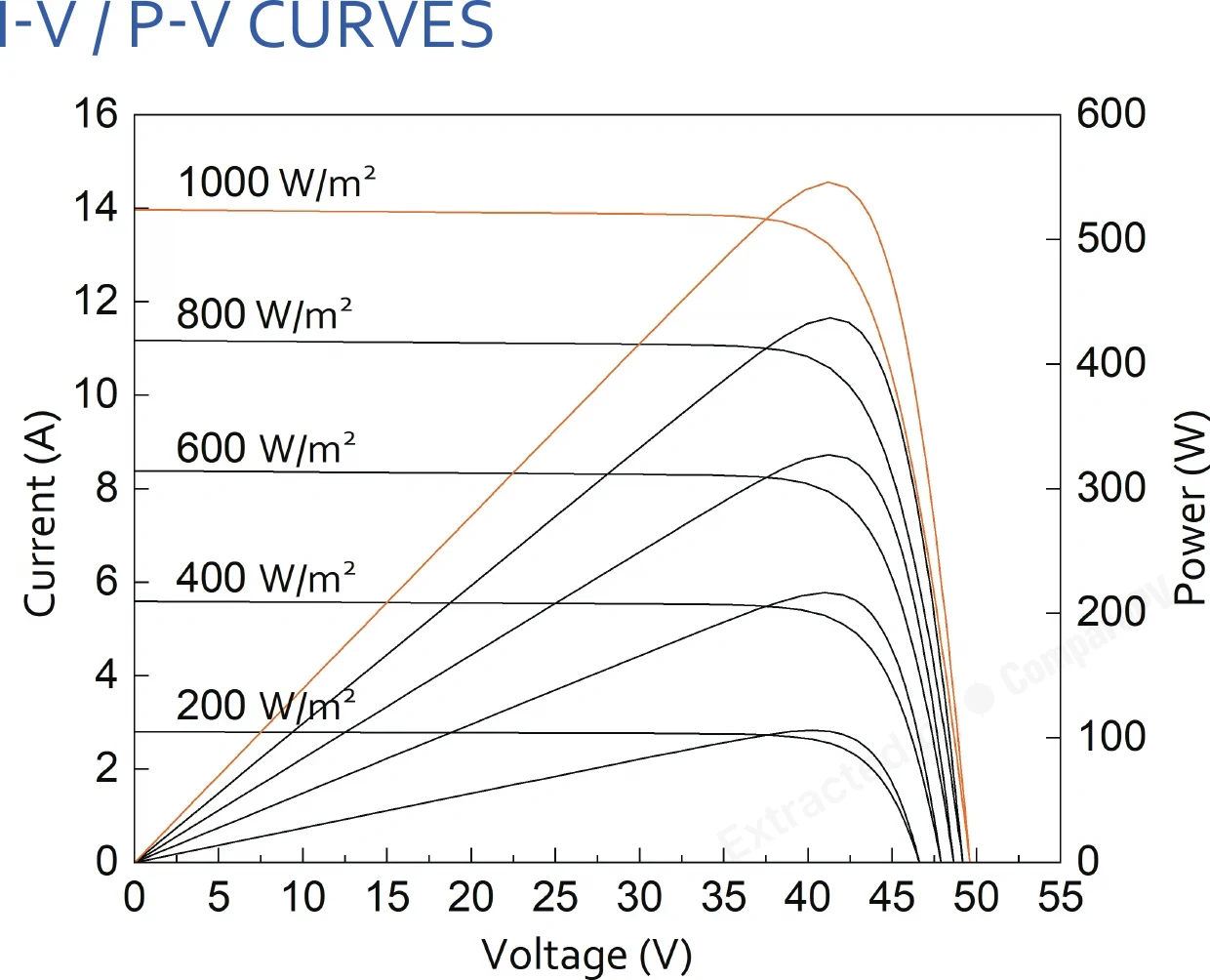
Nominal power (Pmax) 535 Wp Nameplate at 1000 W/m², 25 °C
Module efficiency 20.70 % Typical Segment median 20.90%
Vmpp · Impp 41.45 V · 12.91 A Operating point at max power
Voc · Isc 49.30 V · 13.83 A Sizes the string length
Max system voltage 1500 V Longer strings than 1000 V modules
Dimensions 2278×1134×30 mm · 2.58 m² of roof
Weight 32.0 kg Weak Weak · 3.7 kg above median
Cells 144 · PERC Monocrystalline
Bifaciality 70 % Rear output as a share of front
Coefficient Pmax -0.350 %/°C Typical median -0.350 of its segment
Coefficient Voc · Isc -0.280 · 0.050 %/°C
NOCT 39 °C At 800 W/m², 20 °C ambient
Product warranty 12 years Hardware defects only
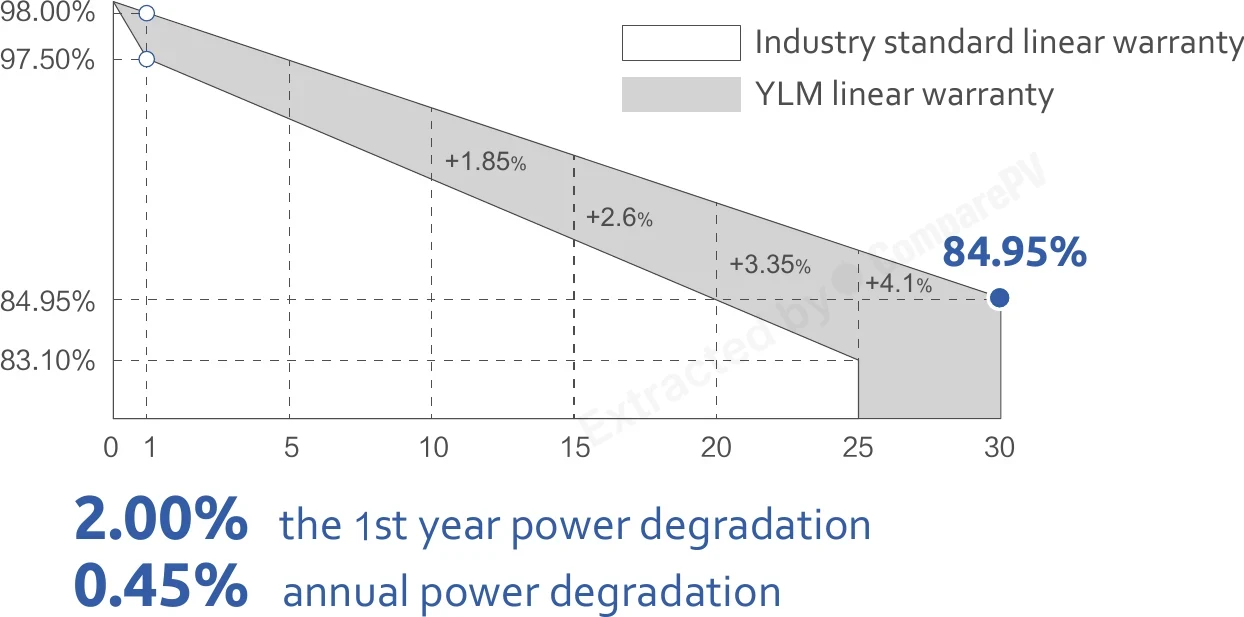
Performance warranty 30 years Typical median 30 yrs · median 30 yrs
End-of-warranty output 85.0 % Equals 454 W guaranteed
Degradation 2.00 → 0.45 % First year, then annual

Datasheet charts

Open datasheet PDF

Measured curves published by Yingli in this model's datasheet. A chart carrying a wattage was measured on that variant alone - only the ones that describe 535 Wp appear here. The rest cover the whole series.
Simulations

Live - change any input
Lifetime output & value
30 years at 1200 kWh/kWp/year and €0.50 per kWh
Power in year 30
-
Lifetime energy
-
Energy value
-
With bifacial gain
-

Degradation from this panel's own datasheet figures. No inverter, soiling or shading losses.

Heat losses
-0.350 %/°C against a segment median of -0.350
-
Bifacial gain
Rear gain over light concrete: -
-

Model: bifaciality × albedo × 0.6 view factor. A first-order estimate, not a yield simulation.

Filter these
Size
Panel Power Eff. Temp. Weight Difference
Yingli YL535DF72 e/2 535 W 20.70% -0.350 32.0 kg You are here
LR7-54HJD-510M 510 W 25.00% -0.240 23.5 kg Cooler, lighter, +4.3 pp
AIKO-A495-MCE54Mw 495 W 24.80% -0.260 21.0 kg Cooler, lighter, +4.1 pp
LR7-60HVH-560M 560 W 24.80% -0.260 25.0 kg Cooler, lighter, +4.1 pp
LR7-54HJD-505M 505 W 24.70% -0.240 23.5 kg Cooler, lighter, +4.0 pp
WST-505BKX54-A2 505 W 24.70% -0.260 25.0 kg Cooler, lighter, +4.0 pp
LR7-60HVH-555M 555 W 24.60% -0.260 25.0 kg Cooler, lighter, +3.9 pp
AIKO-A490-MCE54Mw 490 W 24.50% -0.260 21.0 kg Cooler, lighter, +3.8 pp
YL530DF72 e/2 530 W 20.50% -0.350 32.0 kg Very close match
LF535M10-72H 535 W 20.70% -0.354 28.5 kg Lighter, -5 yr warranty
YL540DF72 e/2 540 W 20.90% -0.350 32.0 kg Very close match
LF540M10-72H 540 W 20.90% -0.354 28.5 kg Lighter, -5 yr warranty
AIKO-A650-MAE72Mw 650 W 25.20% -0.260 27.0 kg +115 W, cooler, +4.5 pp
AIKO-A645-MAE72Mw 645 W 25.00% -0.260 27.0 kg +110 W, cooler, +4.3 pp
AIKO-A640-MAE72Mw 640 W 24.80% -0.260 27.0 kg +105 W, cooler, +4.1 pp
AIKO-A635-MAE72Mw 635 W 24.60% -0.260 27.0 kg +100 W, cooler, +3.9 pp
AIKO-A630-MAH72Dw 630 W 24.40% -0.260 32.5 kg +95 W, cooler, +3.7 pp

Found 2327 panels of the same or similar size to this one, within ±10 mm. See them here Found 2369 panels of the same or similar size to this one, within ±25 mm. See them here Found 2383 panels of the same or similar size to this one, within ±50 mm. See them here Found 2548 panels of the same or similar size to this one, within ±100 mm. See them here

About the YLM 3.0 Pro 1 series

6 answered

These answers cover the whole series. Where a figure differs, the specification above is this module's own.

What is the maximum power output of the Yingli YLM 3.0 Pro 1 panel?
The top variant of the YLM 3.0 Pro 1 series reaches up to 555 Wp. The panel is built with 144 monocrystalline PERC cells in a half-cut layout, delivering high efficiency within a standard module format. This means each panel produces more energy per roof area than older full-cell designs.
Are Yingli YLM 3.0 Pro 1 panels suitable for a sloped residential roof?
Yes, the series works well both in larger commercial installations and in residential prosumer systems on sloped roofs. The half-cut cell layout improves shading tolerance, which matters on roofs with chimneys, dormers, or nearby trees. The durable laminate construction also supports safe mounting on standard roof racking systems.
What warranty comes with Yingli YLM 3.0 Pro 1 panels?
Yingli provides a 12-year product warranty and a 30-year linear power warranty. This means the manufacturer guarantees a defined performance level throughout three decades of operation, giving homeowners and commercial buyers a predictable return on investment.
How does PERC cell technology in the YLM 3.0 Pro 1 differ from standard monocrystalline cells?
PERC (Passivated Emitter and Rear Cell) cells feature an extra rear-side passivation layer that reflects unused light back into the cell, boosting efficiency. Combined with half-cut technology and large-format cells, this results in lower internal losses and better module performance under partial shading or elevated operating temperatures.
Is Yingli a tier 1 manufacturer worth trusting for a large investment?
Yes, Yingli is listed as a tier 1 manufacturer, reflecting solid financial standing and a long-established presence in the PV market. Headquartered in China, it is one of the more recognized solar panel suppliers worldwide, which simplifies warranty service and spare parts availability for larger commercial or agricultural projects.
Do YLM 3.0 Pro 1 panels have a positive power tolerance?
Yes, the series offers positive power tolerance, meaning the actual output never falls below the rated nameplate value. For installers and investors, this ensures predictable energy yield without the risk of receiving an underperforming unit from a given production batch.
Add to compare