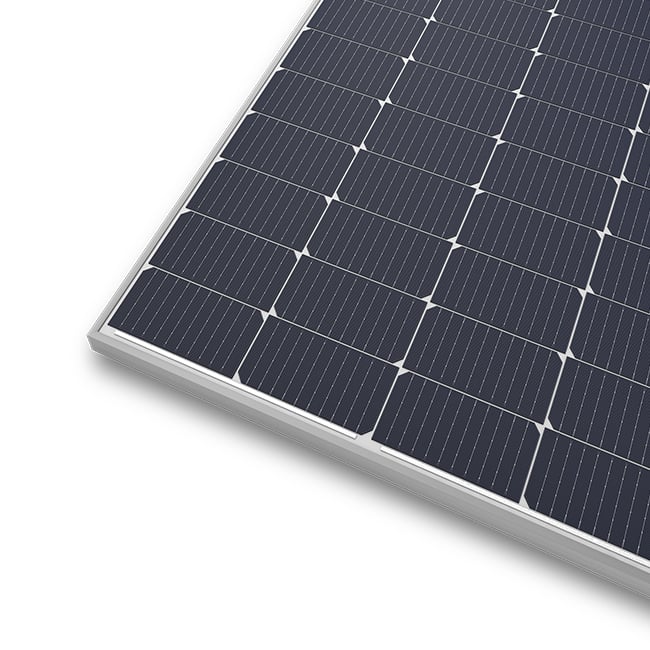
Yingli YL390DF54 e/2

Yingli YL390DF54 e/2

390 Wp PERC Bifacial 70%
ComparePV verdict

Warranty pick, heavy for its output

Rank 12,215 of 14,129
Compare panels Datasheet PDF
Power (Wp)
390
Typical for its class
Efficiency (%)
20.00
Typical · median 19.90%
Density (Wp/m²)
199.7
Typical · median 199.0
Temp (%/°C)
-0.350
Typical · median -0.350
Weight (kg)
24.8
Weak · 3.4 kg above median
Warranty (yrs)
30
Strong · top 13%

The Yingli YLM 3.0 Mini 1 series is designed for installations where high power density is key, while maintaining a convenient and compact module format. This is an ideal solution for individuals and companies seeking to extract maximum performance from rooftops with limited surface area or more challenging roof geometries - without compromising on manufacturing quality. The series stands out due to its half-cell architecture, which helps reduce resistive losses and stabilizes module performance under partial shading. The applied multi-busbar technology improves current collection and increases resistance to microcracks, which is particularly important in Polish conditions (snow, wind, freeze-thaw cycles). The series also emphasizes high reliability in harsh environments, thanks to refined lamination and layer structure design. The YLM 3.0 Mini 1 will perform excellently in single-family homes, small and medium-sized businesses, and renovation projects where long-term, reliable performance and predictable energy yield are crucial.

Ranking

579 panels in the segment PERC 350-400 W
Metric This panel Median Position in segment Overall rank
Module efficiency 20.00% 19.90% Typical 12,298
Power density 199.7 199.0 Typical 12,339
Temperature coefficient -0.350 -0.350 Typical 10,489
Weight per kWp 63.6 55.8 Weak · bottom 14% 13,016
Performance warranty 30 yrs 25 yrs Strong · top 13% 21
Colour key Strong - top 25% Typical - middle 50% Weak - bottom 25%

Signals from the data

1 positive · 1 caution
Best for

Residential, commercial, shaded-installations and cold-climate.

Not ideal for

Weight-limited structures.

Strengths
30 year performance warranty

Top 13% of the PERC 350-400 W segment, against a median of 25 yrs.

Watch-outs
63.6 kg per kWp

Bottom 14% of the PERC 350-400 W segment, against a median of 55.8.

Notes from the database
  • At 20.0% efficiency, this panel is 0.6pp above typical PERC 0-400W modules (median: 19.4%)
  • Power density of 199.7 W/m² packs 5.5 W/m² more into the same footprint vs PERC 0-400W median (194.2 W/m²)
  • At -0.35%/°C, hot weather performance is typical for PERC 0-400W panels
  • At 24.8 kg, this panel is 4.3 kg heavier than the PERC 0-400W median (20.5 kg) - more demanding for installation crews
  • Bifaciality factor of 70% can add 4-10% extra yield with reflective mounting surface

Specifications

Open datasheet PDF
Nominal power (Pmax) 390 Wp Nameplate at 1000 W/m², 25 °C
Module efficiency 20.00 % Typical Segment median 19.90%
Vmpp · Impp 30.27 V · 12.89 A Operating point at max power
Voc · Isc 36.80 V · 13.68 A Sizes the string length
Max system voltage 1500 V Longer strings than 1000 V modules
Dimensions 1722×1134×30 mm · 1.95 m² of roof
Weight 24.8 kg Weak Weak · 3.4 kg above median
Cells 108 · PERC Monocrystalline
Bifaciality 70 % Rear output as a share of front
Coefficient Pmax -0.350 %/°C Typical median -0.350 of its segment
Coefficient Voc · Isc -0.280 · 0.050 %/°C
NOCT 39 °C At 800 W/m², 20 °C ambient
Product warranty 12 years Hardware defects only
Performance warranty 30 years Strong top 13% · median 25 yrs
End-of-warranty output 85.0 % Equals 331 W guaranteed
Degradation 2.00 → 0.45 % First year, then annual

Datasheet charts

Open datasheet PDF

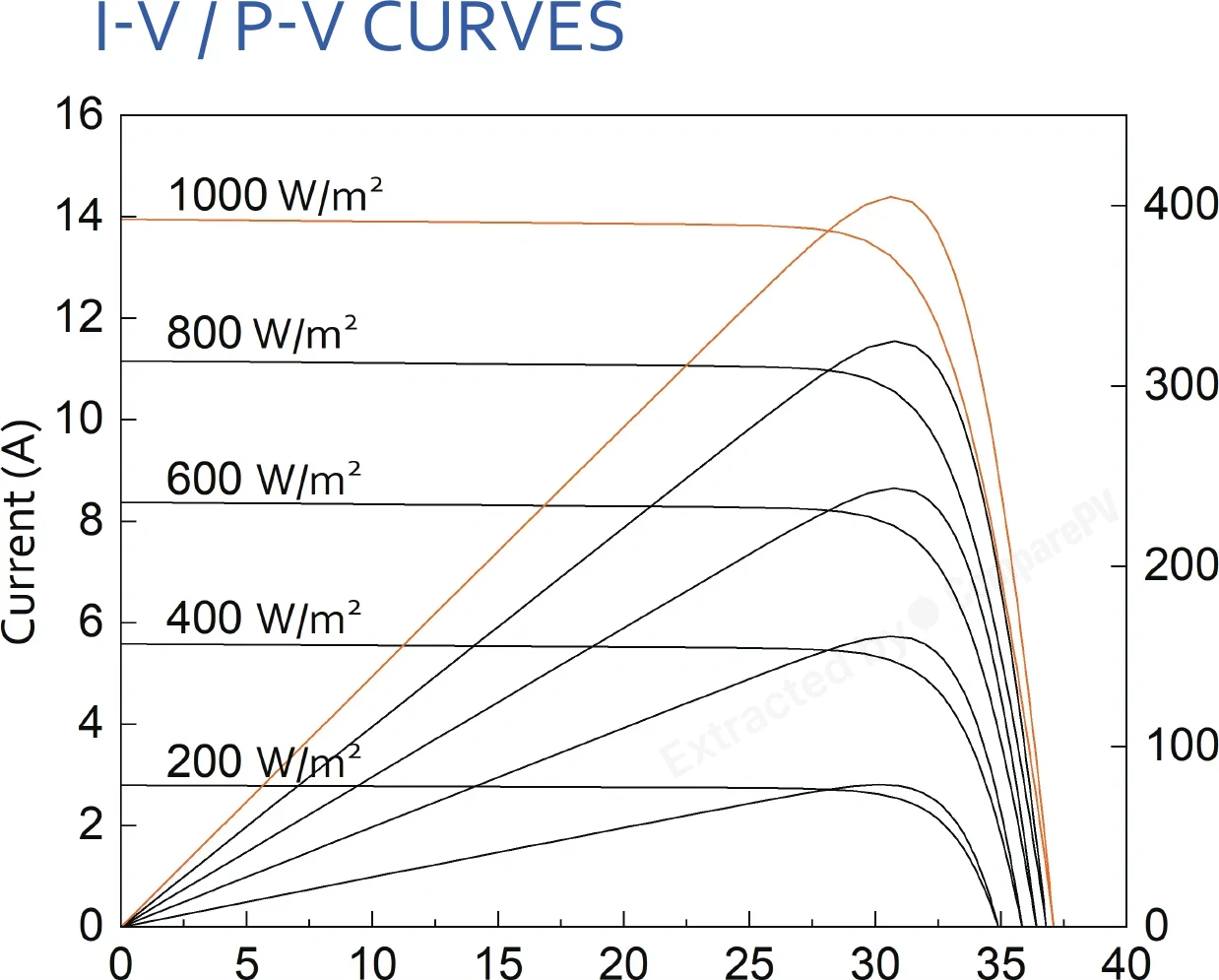
Measured curves published by Yingli in this model's datasheet. A chart carrying a wattage was measured on that variant alone - only the ones that describe 390 Wp appear here. The rest cover the whole series.
Simulations

Live - change any input
Lifetime output & value
30 years at 1200 kWh/kWp/year and €0.50 per kWh
Power in year 30
-
Lifetime energy
-
Energy value
-
With bifacial gain
-

Degradation from this panel's own datasheet figures. No inverter, soiling or shading losses.

Heat losses
-0.350 %/°C against a segment median of -0.350
-
Bifacial gain
Rear gain over light concrete: -
-

Model: bifaciality × albedo × 0.6 view factor. A first-order estimate, not a yield simulation.

Filter these
Size
Panel Power Eff. Temp. Weight Difference
Yingli YL390DF54 e/2 390 W 20.00% -0.350 24.8 kg You are here
LX-440M/182-108+GG 440 W 23.07% -0.240 23.6 kg +50 W, cooler, +3.1 pp
GKA210M340W 340 W 23.00% - 16.2 kg -50 W, lighter, +3.0 pp
GKA210M360W 360 W 23.00% - 16.2 kg -30 W, lighter, +3.0 pp
GKA210M380W (1/4*4*38) 380 W 23.00% - 17.1 kg -10 W, lighter, +3.0 pp
GKA210M400W (1/2*4*20) 400 W 23.00% - 18.0 kg +10 W, lighter, +3.0 pp
GKA210M400W (1/4*4*40) 400 W 23.00% - 18.0 kg +10 W, lighter, +3.0 pp
GKA210M380W (1/2*4*19) 380 W 23.00% - 17.1 kg -10 W, lighter, +3.0 pp
JT440SYK(B) 440 W 22.90% -0.240 23.0 kg +50 W, cooler, +2.9 pp
YL395D-37e 1/2 / YL395D-37e 1500V 1/2 395 W 20.20% -0.350 21.5 kg Lighter, -5 yr warranty
YL400D-37e 1/2 / YL400D-37e 1500V 1/2 400 W 20.50% -0.350 21.5 kg Lighter, +0.5 pp, -5 yr warranty
YL405D-37e 1/2 / YL405D-37e 1500V 1/2 405 W 20.70% -0.350 21.5 kg Lighter, +0.7 pp, -5 yr warranty
LR7-54HJD-510M 510 W 25.00% -0.240 23.5 kg +120 W, cooler, +5.0 pp
AIKO-A495-MCE54Mw 495 W 24.80% -0.260 21.0 kg +105 W, cooler, +4.8 pp
LR7-54HJD-505M 505 W 24.70% -0.240 23.5 kg +115 W, cooler, +4.7 pp
WST-505BKX54-A2 505 W 24.70% -0.260 25.0 kg +115 W, cooler, +4.7 pp
AIKO-A490-MCE54Mw 490 W 24.50% -0.260 21.0 kg +100 W, cooler, +4.5 pp

Found 1797 panels of the same or similar size to this one, within ±10 mm. See them here Found 1928 panels of the same or similar size to this one, within ±25 mm. See them here Found 3413 panels of the same or similar size to this one, within ±50 mm. See them here Found 4007 panels of the same or similar size to this one, within ±100 mm. See them here

About the YLM 3.0 Mini 1 series

6 answered

These answers cover the whole series. Where a figure differs, the specification above is this module's own.

What is the maximum power output of the Yingli YLM 3.0 Mini 1 panel?
Panels from the YLM 3.0 Mini 1 series reach a maximum power output of up to 415 Wp. Given the module's compact mini format, this represents a very good power density, allowing more energy to be generated from a limited roof area compared to older, less efficient module designs.
Is the Yingli YLM 3.0 Mini 1 suitable for roofs with limited space or unusual geometry?
Yes, this is one of the series' main use cases. The compact module format makes it easier to fit smaller roof sections, dormers, or complex roof shapes. The half-cut cell architecture also improves performance under partial shading, which is common on such roofs.
What warranty comes with the Yingli YLM 3.0 Mini 1 panels?
The manufacturer offers a 12-year product warranty and a 30-year power performance warranty. Yingli is a tier 1 manufacturer, which further increases confidence that the warranty will actually be honored over such a long time horizon, not just exist on paper.
How does the PERC technology in the YLM 3.0 Mini 1 differ from standard cells?
PERC cells feature an additional passivation layer on the rear side that reflects unused light back into the cell, increasing conversion efficiency. Combined with multi-busbar technology, this improves current collection and reduces losses, resulting in higher energy yield from the same panel surface area.
Does the YLM 3.0 Mini 1 perform well in Polish climate conditions?
Yes, the series is designed for demanding operating conditions such as snow, strong wind, and freeze-thaw cycles. Multi-busbar technology increases resistance to microcracks, while careful lamination and layer construction reduce the risk of module degradation in variable climates.
Is the YLM 3.0 Mini 1 a bifacial panel?
No, the YLM 3.0 Mini 1 series uses monofacial PERC cells, generating power only from the front side of the module. This makes it well suited for standard rooftop installations, where the module is mounted directly on the roof surface with no light access from the rear.
Add to compare