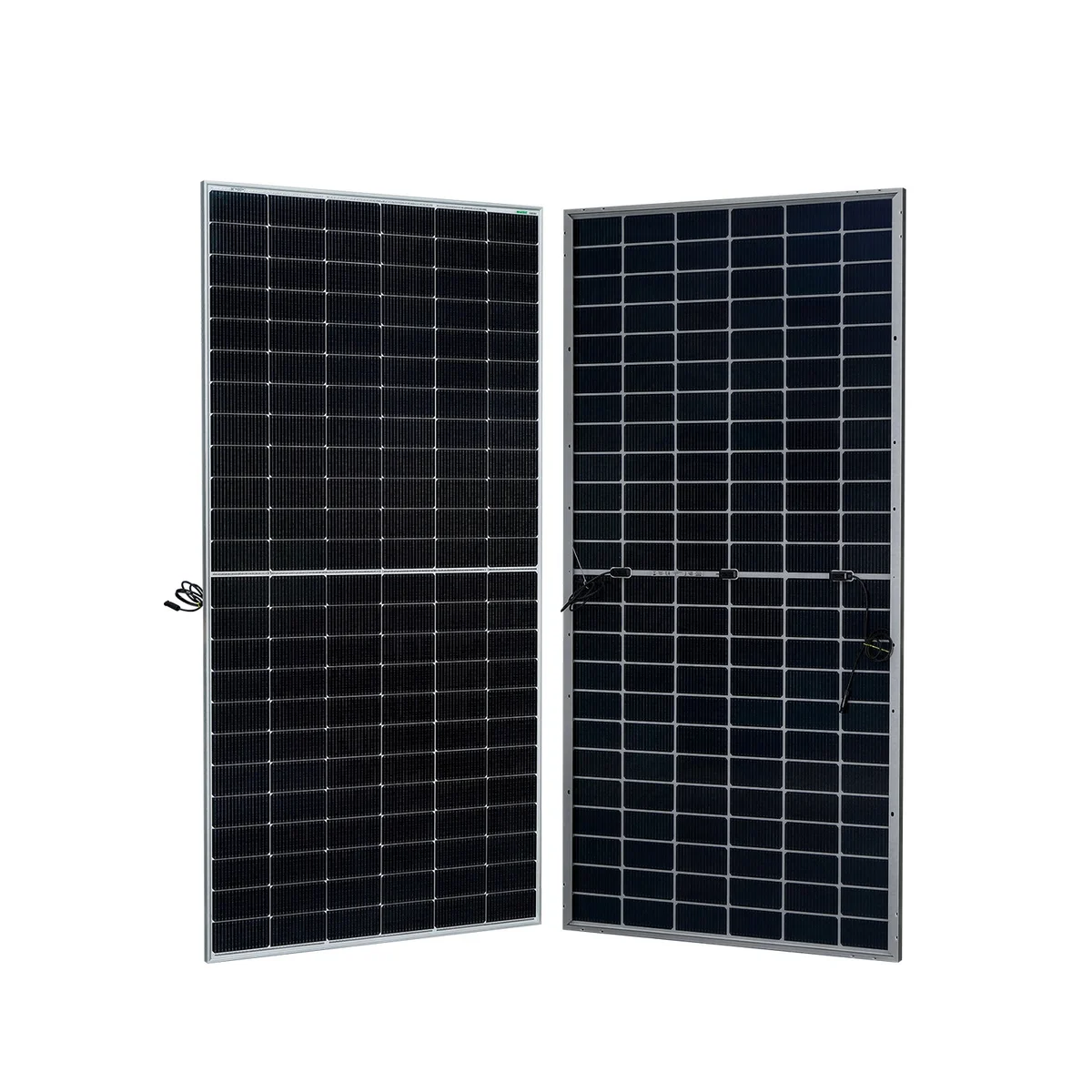
Waaree Bi-55-540

Bi-55-540

540 Wp PERC Bifacial 3000%
ComparePV verdict

Middle of its segment, heavy for its output

Rank 7,782 of 14,005
Compare panels Datasheet PDF
Power (Wp)
540
Typical for its class
Efficiency (%)
20.98
Typical · median 20.90%
Density (Wp/m²)
209.8
Typical · median 209.0
Temp (%/°C)
-0.350
Typical · median -0.350
Weight (kg)
32.5
Weak · 4.1 kg above median
Warranty (yrs)
30
Typical · median 30 yrs

The Waaree AHNAY series are bifacial glass-glass modules designed to genuinely increase energy yield from the same installation surface - especially on sites where the rear side of the module also generates electricity. The use of dual-glass construction enhances weather resistance and reduces the risk of micro-cracks, which is crucial for long-term operation. The AHNAY variants are available in both Mono PERC and N-type TOPCon technologies, making it easier to select the right module for project requirements and performance profiles (e.g., higher parameter stability over time). An additional advantage is resistance to PID and optimized heat dissipation thanks to split junction box solutions, which help limit the risk of hotspots and performance degradation. This is the series for investors building installations on flat roofs, PV farms, and commercial sites, where low energy costs and predictable power generation even under diffuse light and partial shading matter.

Ranking

706 panels in the segment PERC 500-550 W
Metric This panel Median Position in segment Overall rank
Module efficiency 20.98% 20.90% Typical 9,963
Power density 209.8 209.0 Typical 9,905
Temperature coefficient -0.350 -0.350 Typical 10,419
Weight per kWp 60.2 53.0 Weak · bottom 9% 12,384
Performance warranty 30 yrs 30 yrs Typical 21
Colour key Strong - top 25% Typical - middle 50% Weak - bottom 25%

Signals from the data

0 positive · 1 caution
Best for

Commercial, utility-scale and shaded-installations.

Not ideal for

Weight-limited structures.

Watch-outs
60.2 kg per kWp

Bottom 9% of the PERC 500-550 W segment, against a median of 53.0. Ranked 12,384th in the whole database.

Notes from the database
  • At 21.0% efficiency, this panel is on par with typical PERC 500-550W modules
  • At 209.8 W/m² power density, roof space requirements are typical for PERC 500-550W panels
  • At -0.35%/°C, hot weather performance is typical for PERC 500-550W panels
  • At 32.5 kg (4.1 kg above PERC 500-550W median of 28.4 kg), requires checking roof load capacity
  • Ranked #9963 out of 14005 panels for efficiency in the database

Specifications

Open datasheet PDF
Nominal power (Pmax) 540 Wp Nameplate at 1000 W/m², 25 °C
Module efficiency 20.98 % Typical Segment median 20.90%
Vmpp · Impp 41.75 V · 12.95 A Operating point at max power
Voc · Isc 49.61 V · 13.83 A Sizes the string length
Max system voltage 1500 V Longer strings than 1000 V modules
Dimensions 2272×1133×35 mm · 2.57 m² of roof
Weight 32.5 kg Weak Weak · 4.1 kg above median
Cells 144 · PERC Monocrystalline
Bifaciality 3000 % Rear output as a share of front
Coefficient Pmax -0.350 %/°C Typical median -0.350 of its segment
Coefficient Voc · Isc -0.270 · 0.050 %/°C
NOCT 43 °C At 800 W/m², 20 °C ambient
Product warranty 12 years Hardware defects only
Performance warranty 30 years Typical median 30 yrs · median 30 yrs
End-of-warranty output 82.0 % Equals 443 W guaranteed
Degradation 2.00 → 0.55 % First year, then annual

Simulations

Live - change any input
Lifetime output & value
30 years at 1200 kWh/kWp/year and €0.50 per kWh
Power in year 30
-
Lifetime energy
-
Energy value
-
With bifacial gain
-

Degradation from this panel's own datasheet figures. No inverter, soiling or shading losses.

Heat losses
-0.350 %/°C against a segment median of -0.350
-
Bifacial gain
Rear gain over light concrete: -
-

Model: bifaciality × albedo × 0.6 view factor. A first-order estimate, not a yield simulation.

Filter these
Size
Panel Power Eff. Temp. Weight Difference
Waaree Bi-55-540 540 W 20.98% -0.350 32.5 kg You are here
LR7-54HJD-510M 510 W 25.00% -0.240 23.5 kg Cooler, lighter, +4.0 pp
AIKO-A495-MCE54Mw 495 W 24.80% -0.260 21.0 kg Cooler, lighter, +3.8 pp
LR7-60HVH-560M 560 W 24.80% -0.260 25.0 kg Cooler, lighter, +3.8 pp
LR7-54HJD-505M 505 W 24.70% -0.240 23.5 kg Cooler, lighter, +3.7 pp
LR7-60HVH-555M 555 W 24.60% -0.260 25.0 kg Cooler, lighter, +3.6 pp
AIKO-A490-MCE54Mw 490 W 24.50% -0.260 21.0 kg Cooler, lighter, +3.5 pp
LR7-54HJD-500M 500 W 24.50% -0.240 23.5 kg Cooler, lighter, +3.5 pp
Bi-55-515 515 W 20.01% -0.350 32.5 kg -25 W, -1.0 pp
Bi-55-520 520 W 20.20% -0.350 32.5 kg -20 W, -0.8 pp
WSMD-525 525 W 20.39% -0.350 27.5 kg Lighter, -0.6 pp, -3 yr warranty
Bi-55-530 530 W 20.59% -0.350 32.5 kg -10 W, -0.4 pp
AIKO-A650-MAE72Mw 650 W 25.20% -0.260 27.0 kg +110 W, cooler, +4.2 pp
AIKO-A645-MAE72Mw 645 W 25.00% -0.260 27.0 kg +105 W, cooler, +4.0 pp
AIKO-A640-MAE72Mw 640 W 24.80% -0.260 27.0 kg +100 W, cooler, +3.8 pp
AIKO-A635-MAE72Mw 635 W 24.60% -0.260 27.0 kg +95 W, cooler, +3.6 pp
AIKO-A630-MAH72Dw 630 W 24.40% -0.260 32.5 kg +90 W, cooler, +3.4 pp

Found 2337 panels of the same or similar size to this one, within ±10 mm. See them here Found 2368 panels of the same or similar size to this one, within ±25 mm. See them here Found 2373 panels of the same or similar size to this one, within ±50 mm. See them here Found 2558 panels of the same or similar size to this one, within ±100 mm. See them here

Common questions

6 answered
What is the difference between Waaree AHNAY Mono PERC and N-type TOPCon panel variants?
Both technologies in the AHNAY series share the same dual-glass bifacial construction, but differ mainly in long-term stability and degradation rate. TOPCon modules have a lower annual degradation rate and higher output efficiency than standard PERC, resulting in higher energy yield over the system's lifetime. PERC remains a more budget-friendly option, well suited for cost-sensitive projects.
What is the maximum power output and efficiency of the Waaree AHNAY panel?
Top variants in the AHNAY series reach up to 665 Wp with 132 half-cut cells, and module efficiency reaches around 21.3 percent. This is a high value for dual-glass bifacial modules, allowing more energy to be generated from the same roof or ground-mount area compared to older, less efficient series.
What warranty does Waaree offer on the AHNAY series, and what does it cover?
The manufacturer provides a 12-year product warranty and a 30-year linear power output warranty. This means protection against factory defects for over a decade, plus a predictable, guaranteed power degradation curve over three decades of operation, which simplifies ROI planning for commercial installations and PV farms.
Do Waaree AHNAY bifacial panels actually increase energy production compared to standard modules?
Yes, the dual-glass construction lets the rear side of the module capture light reflected from the ground, roof, or surroundings, boosting total energy yield, especially over bright, reflective surfaces like gravel or white roofing. The actual gain depends on mounting height and ground albedo, but in practice AHNAY installations outperform comparable monofacial panels of the same surface area.
Are Waaree AHNAY modules PID-resistant and suitable for large-scale PV farms?
Yes, the AHNAY series has certified resistance to potential-induced degradation (PID), which matters in large installations with long strings and high system voltage. A split junction box design also improves heat dissipation and reduces hotspot risk, making this series well suited for PV farms and large commercial rooftop installations.
Does Waaree offer the quality assurance typical of Tier 1 solar manufacturers?
Yes, Waaree is an India-based Tier 1 manufacturer, meaning it has financial stability, its own production capacity, and a documented track record of supplying modules to large commercial and industrial projects worldwide. Tier 1 status increases confidence in the long-term warranty, since the manufacturer has the real capacity to honor it throughout the full 30-year power warranty period.
Add to compare