VSUN420N-108BMH-DG

420 Wp TOPCon Bifacial 80%
ComparePV verdict

Middle of its segment, heavy for its output

Rank 10,626 of 14,005
Compare panels Datasheet PDF
Power (Wp)
420
Weak · bottom 16%
Efficiency (%)
21.55
Typical · median 22.00%
Density (Wp/m²)
215.1
Weak · bottom 19%
Temp (%/°C)
-0.300
Typical · median -0.290
Weight (kg)
24.7
Weak · 2.7 kg above median
Warranty (yrs)
30
Typical · median 30 yrs

The VSUN 108BMH-DG series are modules designed for high energy production in real-world conditions, both on rooftops and in larger installations. A key advantage is the bifacial technology, which allows the panel to generate energy not only from the front, but also from reflected light from the ground. Combined with N-type TOPCon cells, this results in more stable performance in hot weather, lower losses over time, and better efficiency in low-light conditions.

The use of a 108-cell half-cut configuration improves resistance to partial shading and reduces the risk of losses due to uneven lighting - which is particularly important in Poland due to chimneys, skylights, or trees. The dual-glass (glass-glass) construction increases durability and resistance to environmental factors, while the robust design makes it easy to integrate into projects where long-term reliability is a priority.

This is a good choice for investors who want to maximize the energy output from a given area and are looking for a technology that is clearly more advanced than standard PERC modules.

Ranking

1,218 panels in the segment TOPCon 400-450 W
Metric This panel Median Position in segment Overall rank
Module efficiency 21.55% 22.00% Typical 7,784
Power density 215.1 220.2 Weak · bottom 19% 7,882
Temperature coefficient -0.300 -0.290 Typical 6,093
Weight per kWp 58.8 51.4 Weak · bottom 7% 11,908
Performance warranty 30 yrs 30 yrs Typical 21
Colour key Strong - top 25% Typical - middle 50% Weak - bottom 25%

Signals from the data

0 positive · 2 caution
Best for

Residential, commercial and shaded-installations.

Not ideal for

Weight-limited structures and roofs where every square metre has to count.

Watch-outs
58.8 kg per kWp

Bottom 7% of the TOPCon 400-450 W segment, against a median of 51.4. Ranked 11,908th in the whole database.

215.1 watts per square metre

Bottom 19% of the TOPCon 400-450 W segment, against a median of 220.2.

Notes from the database
  • At 21.6% efficiency, this panel is on par with typical TOPCon 400-450W modules
  • At 215.1 W/m², this panel generates 5.1 W/m² less per unit area than TOPCon 400-450W median (220.2 W/m²)
  • Temperature coefficient of -0.30%/°C matches the TOPCon 400-450W median
  • At 24.7 kg (2.7 kg above TOPCon 400-450W median of 22.0 kg), requires checking roof load capacity
  • 80% bifaciality enables rear-side power generation, boosting yield by 4-12% on reflective surfaces

Specifications

Open datasheet PDF
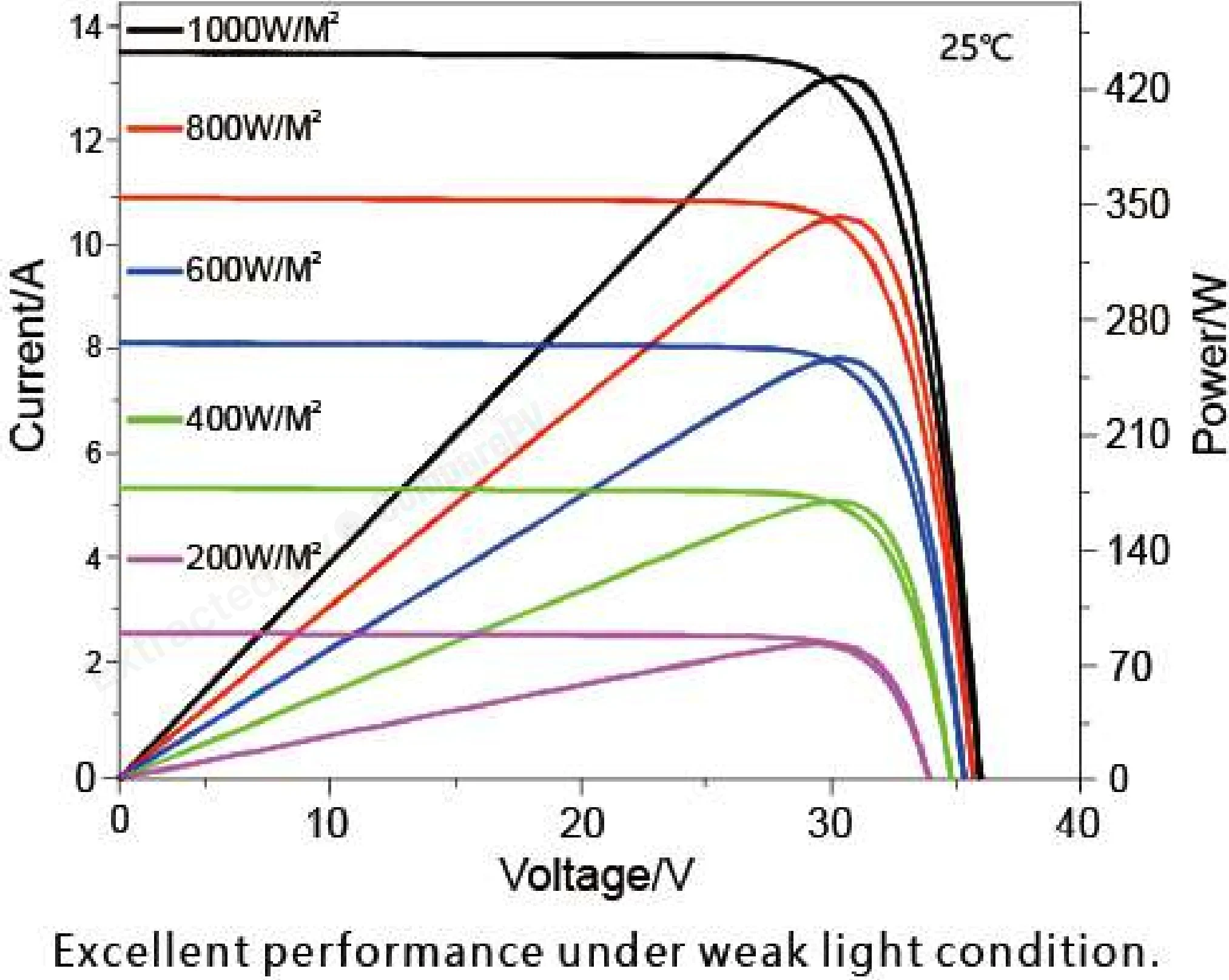
Nominal power (Pmax) 420 Wp Nameplate at 1000 W/m², 25 °C
Module efficiency 21.55 % Typical Segment median 22.00%
Vmpp · Impp 30.38 V · 13.82 A Operating point at max power
Voc · Isc 38.31 V · 14.07 A Sizes the string length
Max system voltage 1500 V Longer strings than 1000 V modules
Dimensions 1722×1134×30 mm · 1.95 m² of roof
Weight 24.7 kg Weak Weak · 2.7 kg above median
Cells 108 · TOPCon Monocrystalline
Bifaciality 80 % Rear output as a share of front
Coefficient Pmax -0.300 %/°C Typical median -0.290 of its segment
Coefficient Voc · Isc -0.280 · 0.040 %/°C
NOCT 45 °C At 800 W/m², 20 °C ambient
Product warranty 12 years Hardware defects only
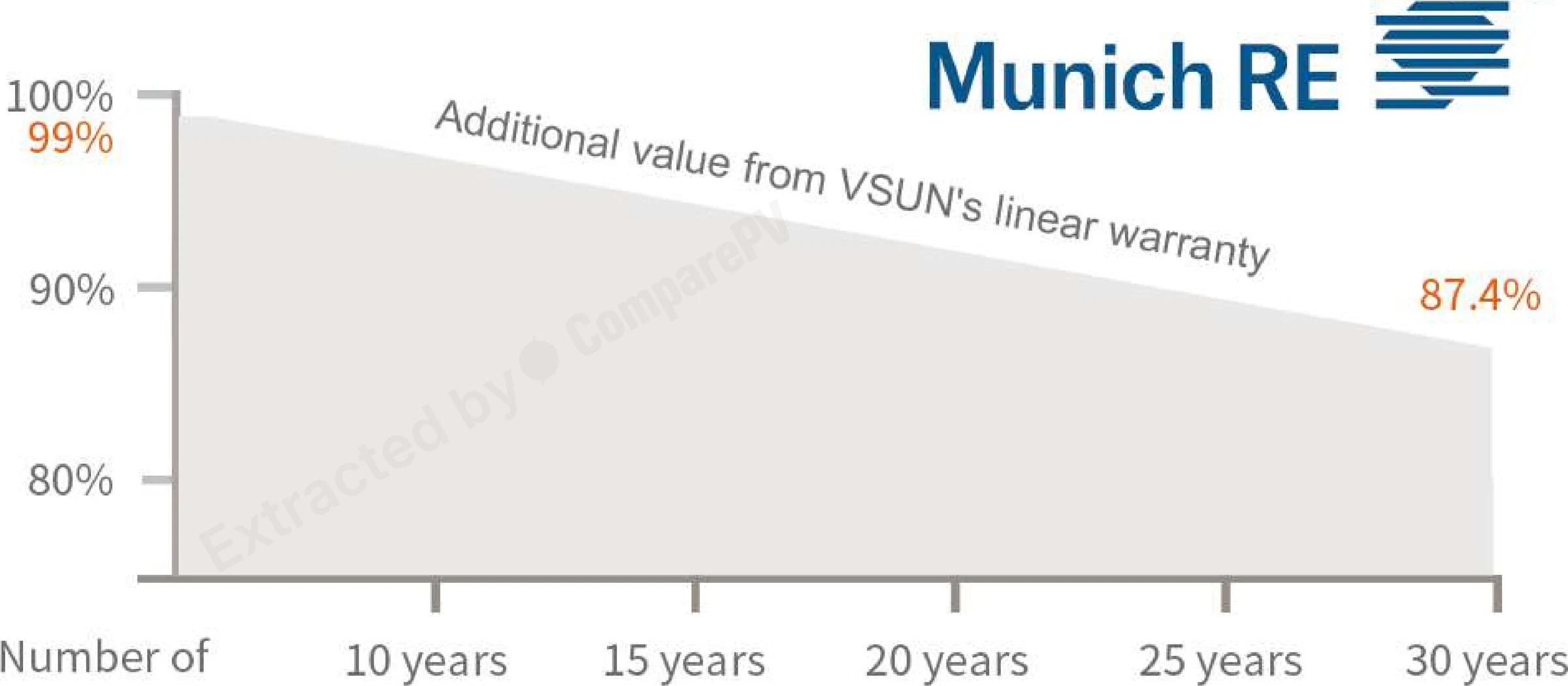
Performance warranty 30 years Typical median 30 yrs · median 30 yrs
End-of-warranty output 87.4 % Equals 367 W guaranteed
Degradation 1.00 → 0.40 % First year, then annual

Datasheet charts

Open datasheet PDF

Measured curves published by VSUN in this model's datasheet. A chart carrying a wattage was measured on that variant alone - only the ones that describe 420 Wp appear here. The rest cover the whole series.
Simulations

Live - change any input
Lifetime output & value
30 years at 1200 kWh/kWp/year and €0.50 per kWh
Power in year 30
-
Lifetime energy
-
Energy value
-
With bifacial gain
-

Degradation from this panel's own datasheet figures. No inverter, soiling or shading losses.

Heat losses
-0.300 %/°C against a segment median of -0.290
-
Bifacial gain
Rear gain over light concrete: -
-

Model: bifaciality × albedo × 0.6 view factor. A first-order estimate, not a yield simulation.

Filter these
Size
Panel Power Eff. Temp. Weight Difference
VSUN VSUN420N-108BMH-DG 420 W 21.55% -0.300 24.7 kg You are here
JST-EDMH-(445-465)W-TD (465W class) 465 W 23.81% -0.300 20.5 kg +45 W, lighter, +2.3 pp
LX-465M/182R-96+ GG 465 W 23.80% -0.260 23.5 kg +45 W, cooler, +2.2 pp
SPR-MAX7-470 470 W 23.70% -0.270 21.1 kg +50 W, +2.1 pp, +10 yr warranty
AIKO-A470-MAH54Mb 470 W 23.60% -0.260 21.5 kg +50 W, cooler, +2.1 pp
AIKO-A460-MAH54Mb 460 W 23.60% -0.290 20.5 kg +40 W, lighter, +2.1 pp
HSM-BD54-LA470 470 W 23.60% -0.260 21.5 kg +50 W, cooler, +2.1 pp
VSUN390-108BMH-DG 390 W 19.97% -0.320 24.7 kg -30 W, hotter, -1.6 pp
VSUN395-108BMH-DG 395 W 20.23% -0.320 24.7 kg -25 W, hotter, -1.3 pp
VSUN400-108BMH-DG 400 W 20.48% -0.320 24.7 kg -20 W, hotter, -1.1 pp
VSUN405-108BMH-DG 405 W 20.74% -0.320 24.7 kg -15 W, hotter, -0.8 pp
VSUN410-108BMH 410 W 21.00% -0.320 21.4 kg Hotter, lighter, -0.6 pp
VSUN415N-108MH 415 W 21.25% -0.300 21.4 kg Lighter, -0.3 pp
LR7-54HJD-510M 510 W 25.00% -0.240 23.5 kg +90 W, cooler, +3.4 pp
AIKO-A495-MCE54Mw 495 W 24.80% -0.260 21.0 kg +75 W, cooler, +3.2 pp
LR7-54HJD-505M 505 W 24.70% -0.240 23.5 kg +85 W, cooler, +3.1 pp
AIKO-A490-MCE54Mw 490 W 24.50% -0.260 21.0 kg +70 W, cooler, +2.9 pp

Found 1783 panels of the same or similar size to this one, within ±10 mm. See them here Found 1914 panels of the same or similar size to this one, within ±25 mm. See them here Found 3392 panels of the same or similar size to this one, within ±50 mm. See them here Found 3970 panels of the same or similar size to this one, within ±100 mm. See them here

Common questions

6 answered
Is the VSUN 108BMH-DG series still available to buy?
No, production of the VSUN 108BMH-DG series has ended and the model is being phased out of the manufacturer's lineup. Availability is now limited to remaining distributor stock, so it's worth confirming current inventory before placing larger orders. Buyers should also consider newer VSUN TOPCon models that have replaced the 108BMH-DG in the current catalog.
What does bifacial technology actually add on the VSUN 108BMH-DG panel?
Bifacial cells let the panel generate extra energy from its rear side using light reflected off the roof, ground, or a light-colored surface underneath. Depending on the ground albedo and mounting height, this can add several percent of extra annual yield compared to a monofacial module of the same power rating. The benefit is most noticeable on ground-mount and carport installations where the rear side has good access to reflected light.
How do the N-type TOPCon cells in the VSUN 108BMH-DG differ from standard PERC cells?
TOPCon cells add a tunnel oxide passivation layer that reduces electron recombination and boosts efficiency compared to conventional P-type PERC cells. In practice this means higher output from the same panel area, lower annual degradation, and better performance in high heat and low-light conditions. It's a newer-generation cell technology that manufacturers now treat as the natural successor to PERC.
What warranty comes with the VSUN 108BMH-DG series and what does it cover?
The manufacturer provides a 12-year product warranty covering material and workmanship defects, plus a 30-year linear power warranty guaranteeing at least 87.4 percent of rated output at the end of that period. This is a typical standard for newer-generation TOPCon modules, longer than older PERC series offered. Since the series is discontinued, it's worth confirming warranty servicing terms directly with the seller.
Does the 108-cell half-cut layout on the VSUN 108BMH-DG handle partial shading well?
Yes, splitting cells into half-cut halves limits how much shading on one section affects the whole string, since a shaded portion of the panel doesn't disable the entire module. This matters for typical rooftop obstacles like chimneys, antennas, or dormers where uneven light exposure through the day is common. The result is lower production losses compared to full-cell panels.
Does the glass-glass construction on the VSUN 108BMH-DG hold up better against weather than a standard laminate?
Yes, the dual-glass build replaces the rear polymer backsheet with tempered glass, improving resistance to moisture, PID, and microcracks, which typically extends the panel's real-world service life. This construction also tends to age more slowly under long-term UV exposure. The tradeoff is added weight, which should be factored into mounting structure choice, especially on older roofs.
Add to compare