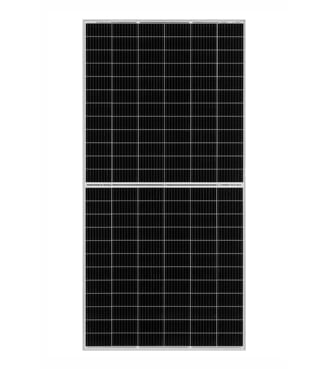
Warranty pick, heavy for its output
The JA Solar JAM72D10 400-420/MB/1500V series is designed for stable energy production under real-world operating conditions-including when the installation faces high temperatures, intermittent shading, or grid-side DC requirements. This series employs bifacial PERC technology and a double glass construction, which helps better utilize reflected light (e.g., from light-colored roofs, gravel, or concrete) and simultaneously enhances resistance to environmental factors. The half-cell cell configuration minimizes losses and supports higher operational reliability under partial shading, translating to more predictable yields in practice.
A key advantage of this series is its low temperature coefficient, making power drops less noticeable on hot days compared to many standard modules. These modules operate in 1500 V systems, facilitating longer string designs and optimizing cabling costs. This makes them an excellent choice for large commercial rooftops, PV farms, and projects where durability, stability, and cost-effectiveness are key priorities.
Ranking
Signals from the data
Commercial and shaded-installations.
Weight-limited structures and hot climates.
Top 17% of the PERC 400-450 W segment, against a median of 25 yrs.
Bottom 14% of the PERC 400-450 W segment, against a median of 53.0.
Bottom 20% of the PERC 400-450 W segment, against a median of -0.350.
The module generates power from both front and rear sides, while the glass-glass (double glass) construction eliminates the rear EVA backsheet, reducing PID degradation and improving moisture resistance. On reflective surfaces (gravel, concrete, white membranes), bifaciality can increase energy yield by 5-15% compared to monofacial equivalents.
The half-cut format (144 cells vs. 72) splits the module into two electrically independent halves, reducing resistive losses and limiting the impact of partial shading on the entire string. This results in more stable output in installations with obstacles such as chimneys or antennas casting partial shadows.
The Pmax temperature coefficient of -0.354%/°C is below the typical -0.36 to -0.40%/°C range for standard PERC modules. At Tcell = 65°C (ΔT = 40°C above STC), power loss is ~14.2% vs. ~14.4-16.0% for lower-grade modules - a measurable difference in annual energy yield.
Support for a 1500 V DC system voltage allows longer strings (up to ~30 modules in series at a typical Voc of ~49.5 V), reducing the number of cables, MC4 connectors, and MPPT inputs. In commercial and utility-scale PV projects, this realistically cuts BoS costs by 5-8% compared to 1000 V systems.
JA Solar guarantees a linear power degradation of no more than 0.5%/year over 30 years (>83% of Pnom after 30 years), consistent with Tier-1 standards. This is favorable for LCOE calculations compared to older models that applied a first-year degradation step (-3%) followed by 0.7%/year linear decline over 25 years.
The JAM72D10 400-420/MB/1500V series was manufactured between 2019 and 2022 and is officially discontinued. This means no new supply from JA Solar directly, limited availability of replacement modules in case of damage, and potentially reduced technical support and service coverage over a 15-20 year installation lifetime.
Peer comparables in the same 420 Wp power class achieve higher efficiencies: 20.98% (Phono Solar TWINPLUS), 21.5% (GCL-M10/54H), and 21.51% (Solarspace SS8-54HSB). The ~1-1.2 percentage point gap translates to measurable differences in energy yield per m² of roof area - critical where mounting space is limited.
Modules from 2019 based on PERC technology carry higher LID degradation (~1-2% in year one) and lower bifacial gain potential compared to newer N-type TOPCon or HJT cells available since 2023. For new projects commissioned in 2025-2026, N-type modules deliver a better LCOE at comparable purchase prices.
- Efficiency of 20.5% matches the PERC 400-450W median
- Power density of 205.2 W/m² matches the PERC 400-450W median
- At -0.35%/°C, hot weather performance is typical for PERC 400-450W panels
- At 25.0 kg (3.0 kg above PERC 400-450W median of 22.0 kg), requires checking roof load capacity
- 70% bifaciality enables rear-side power generation, boosting yield by 4-10% on reflective surfaces
Specifications
Simulations
Degradation from this panel's own datasheet figures. No inverter, soiling or shading losses.
Model: bifaciality × albedo × 0.6 view factor. A first-order estimate, not a yield simulation.





Found 30 panels of the same or similar size to this one, within ±10 mm. See them here Found 56 panels of the same or similar size to this one, within ±25 mm. See them here Found 222 panels of the same or similar size to this one, within ±50 mm. See them here Found 824 panels of the same or similar size to this one, within ±100 mm. See them here
About the JAM72D10 400-420/MB/1500V Series series
These answers cover the whole series. Where a figure differs, the specification above is this module's own.