Runergy HY-DH108N11-510

HY-DH108N11-510

510 Wp N-type Bifacial 80%
ComparePV verdict

Middle of its segment, heavy for its output

Rank 6,407 of 14,005
Compare panels Datasheet PDF
Power (Wp)
510
Typical for its class
Efficiency (%)
22.90
Typical · median 22.54%
Density (Wp/m²)
229.3
Typical · median 225.3
Temp (%/°C)
-0.290
Typical · median -0.290
Weight (kg)
27.5
Weak · 1.3 kg above median
Warranty (yrs)
30
Typical · median 30 yrs

Turbo is the variant of the HY-DH108N11 series built for installations where squeezing the maximum energy yield out of every available square meter of roof or ground really matters. The panel uses N-Type half-cut cells on the 210R platform, delivering higher conversion efficiency and steadier performance under partial shading. Thanks to its bifacial dual glass construction, the module captures additional energy reflected from the ground, meaningfully lowering system LCOE and shortening the payback period. A low power temperature coefficient combined with strong low-light performance means the series performs well both in temperate climates and in regions with high ambient temperatures. The manufacturer highlights resistance to LID, LeTID and PID degradation, while the reinforced frame and tempered glass withstand snow loads up to 5400 Pa, wind loads up to 2400 Pa, and hail up to 35 mm in diameter. It's a fit for installers and investors working on PV farms and large rooftop projects who need high power density, long-term reliability, and predictable annual degradation. Strict quality control and extended manufacturer warranties further protect project profitability over decades of operation.

Ranking

140 panels in the segment N-type 500-550 W
Metric This panel Median Position in segment Overall rank
Module efficiency 22.90% 22.54% Typical 2,359
Power density 229.3 225.3 Typical 2,343
Temperature coefficient -0.290 -0.290 Typical 2,165
Weight per kWp 53.9 50.0 Weak · bottom 25% 8,073
Performance warranty 30 yrs 30 yrs Typical 21
Colour key Strong - top 25% Typical - middle 50% Weak - bottom 25%

Signals from the data

0 positive · 1 caution
Best for

Commercial, utility-scale, shaded-installations and hot-climate.

Not ideal for

Weight-limited structures.

Watch-outs
53.9 kg per kWp

Bottom 25% of the N-type 500-550 W segment, against a median of 50.0.

Notes from the database
  • At 22.9% efficiency, this panel is on par with typical N-type 500-550W modules
  • 229.3 W/m² power density - 4.0 W/m² more than N-type 500-550W median (225.3 W/m²), more power per roof area
  • Temperature coefficient of -0.29%/°C matches the N-type 500-550W median
  • At 27.5 kg (1.3 kg above N-type 500-550W median of 26.2 kg), requires checking roof load capacity
  • Bifacial design (80% factor) captures reflected light - adds 4-12% yield on ground-mount or white roof

Specifications

Open datasheet PDF
Nominal power (Pmax) 510 Wp Nameplate at 1000 W/m², 25 °C
Module efficiency 22.90 % Typical Segment median 22.54%
Vmpp · Impp 33.69 V · 15.14 A Operating point at max power
Voc · Isc 40.59 V · 15.93 A Sizes the string length
Max system voltage 1500 V Longer strings than 1000 V modules
Dimensions 1961×1134×30 mm · 2.22 m² of roof
Weight 27.5 kg Weak Weak · 1.3 kg above median
Cells 108 · N-type Monocrystalline
Bifaciality 80 % Rear output as a share of front
Coefficient Pmax -0.290 %/°C Typical median -0.290 of its segment
Coefficient Voc · Isc -0.250 · 0.045 %/°C
NOCT 45 °C At 800 W/m², 20 °C ambient
Product warranty 12 years Hardware defects only
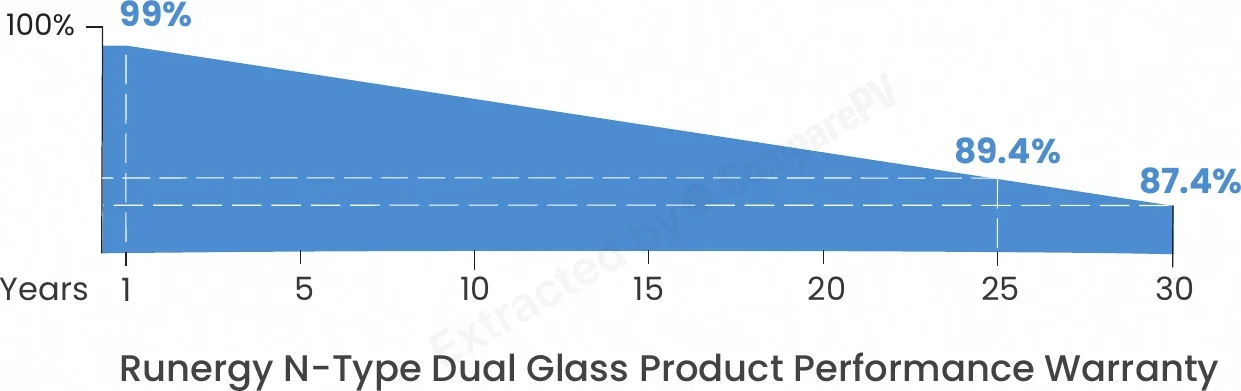
Performance warranty 30 years Typical median 30 yrs · median 30 yrs
End-of-warranty output 87.4 % Equals 446 W guaranteed
Degradation 1.00 → 0.40 % First year, then annual

Datasheet charts

Open datasheet PDF

Measured curves published by Runergy in this model's datasheet. A chart carrying a wattage was measured on that variant alone - only the ones that describe 510 Wp appear here. The rest cover the whole series.
Simulations

Live - change any input
Lifetime output & value
30 years at 1200 kWh/kWp/year and €0.50 per kWh
Power in year 30
-
Lifetime energy
-
Energy value
-
With bifacial gain
-

Degradation from this panel's own datasheet figures. No inverter, soiling or shading losses.

Heat losses
-0.290 %/°C against a segment median of -0.290
-
Bifacial gain
Rear gain over light concrete: -
-

Model: bifaciality × albedo × 0.6 view factor. A first-order estimate, not a yield simulation.

Filter these
Size
Panel Power Eff. Temp. Weight Difference
Runergy HY-DH108N11-510 510 W 22.90% -0.290 27.5 kg You are here
LR7-54HJD-510M 510 W 25.00% -0.240 23.5 kg Cooler, lighter, +2.1 pp
AIKO-A495-MCE54Mw 495 W 24.80% -0.260 21.0 kg Cooler, lighter, +1.9 pp
LR7-60HVH-560M 560 W 24.80% -0.260 25.0 kg +50 W, cooler, +1.9 pp
LR7-54HJD-505M 505 W 24.70% -0.240 23.5 kg Cooler, lighter, +1.8 pp
LR7-60HVH-555M 555 W 24.60% -0.260 25.0 kg +45 W, cooler, +1.7 pp
AIKO-A490-MCE54Mw 490 W 24.50% -0.260 21.0 kg Cooler, lighter, +1.6 pp
LR7-54HJD-500M 500 W 24.50% -0.240 23.5 kg Cooler, lighter, +1.6 pp
HY-DH108N11-490 490 W 22.00% -0.290 27.5 kg -20 W, -0.9 pp
HY-DH108N11-495 495 W 22.20% -0.290 27.5 kg -15 W, -0.7 pp
HY-DH108N11-500 500 W 22.50% -0.290 27.5 kg -10 W, -0.4 pp
HY-DH108N11-505 505 W 22.70% -0.290 27.5 kg Very close match
HY-DH108N11-515 515 W 23.20% -0.290 27.5 kg +0.3 pp
HY-DH108N11-520 520 W 23.40% -0.290 27.5 kg +10 W, +0.5 pp
HY-DH108N11-525 525 W 23.60% -0.290 27.5 kg +15 W, +0.7 pp
HY-DH108N11-530 530 W 23.80% -0.290 27.5 kg +20 W, +0.9 pp
LR7-60HVHL-550M 550 W 24.40% -0.260 16.3 kg +40 W, lighter, +1.5 pp

Found 471 panels of the same or similar size to this one, within ±10 mm. See them here Found 508 panels of the same or similar size to this one, within ±25 mm. See them here Found 662 panels of the same or similar size to this one, within ±50 mm. See them here Found 1471 panels of the same or similar size to this one, within ±100 mm. See them here

Common questions

6 answered
How much power does the Runergy HY-DH108N11 Turbo panel produce and who is it for?
The module delivers up to 530 Wp of maximum power, with 108 half-cut N-type cells providing high power density per square meter. This makes it well suited for installers and investors of PV farms and large rooftop installations, where maximizing energy yield from limited installation area is the priority.
What does bifacial dual glass technology offer in the Runergy Turbo panels?
The bifacial dual glass construction allows the module to capture light from both sides, recovering extra energy reflected off the ground, roof, or a light-colored surface. In practice this means higher annual yield without increasing installation area, which lowers LCOE and shortens payback time, especially with reflective ground or elevated mounting.
What warranty comes with the Runergy HY-DH108N11 Turbo panels?
The manufacturer offers a 12-year product warranty and a 30-year power output warranty, which is standard for premium N-type modules. Runergy, as a Tier 1 manufacturer, also applies strict quality control, safeguarding the investment's profitability over decades of operation.
Can the Runergy Turbo panels withstand heavy wind, snow, and hail?
Yes, the robust frame and tempered glass support snow loads up to 5400 Pa and wind loads up to 2400 Pa, with hail resistance up to 35 mm diameter. This makes the series suitable for regions with heavy snowfall as well as areas prone to strong winds or hailstorms.
How do N-type half-cut cells differ from older P-type technology?
The N-type cells on the 210R platform with half-cut technology offer higher conversion efficiency, a lower power temperature coefficient, and better stability under partial shading compared to older P-type cells. The manufacturer also highlights resistance to LID, LeTID, and PID degradation, resulting in more predictable and slower power loss over time.
Do the Runergy Turbo panels perform well in high ambient temperatures?
Yes, the low power temperature coefficient typical of N-type cells means the module loses relatively less output as operating temperature rises compared to P-type designs. Combined with better low-light performance, the series performs well in both moderate climates and regions with high ambient temperatures.
Add to compare
