
HY-DH108N11-495

495 Wp N-type Bifacial 80%
ComparePV verdict

Middle of its segment, heavy for its output

Rank 7,882 of 14,005
Compare panels Datasheet PDF
Power (Wp)
495
Strong · top 4%
Efficiency (%)
22.20
Weak · bottom 24%
Density (Wp/m²)
222.6
Typical · median 225.2
Temp (%/°C)
-0.290
Typical · median -0.290
Weight (kg)
27.5
Weak · 3.8 kg above median
Warranty (yrs)
30
Typical · median 30 yrs

The HY-DH108N11 series consists of photovoltaic modules built around next-generation N-Type cells on the 210R technology platform, designed for installations where maximizing energy yield from every square meter of roof or ground counts. The use of half-cut cell technology reduces resistive losses and improves panel behavior under partial shading, translating into higher real-world energy production rather than just lab-condition performance. The bifacial dual glass construction also captures light reflected from the ground, increasing output power without the need for a larger installation footprint, a feature especially valued by investors focused on the lowest possible cost of energy per watt (LCOE). The panels also stand out for their high resistance to degradation - low susceptibility to LID, LeTID, and PID - allowing them to maintain stable performance over many years of operation. Robust mechanical construction, confirmed by high snow and wind load resistance and hail impact durability, makes this series a solid choice for both rooftop installations and ground-mounted PV farms, where long-term reliability and predictable return on investment matter most.

Ranking

301 panels in the segment N-type 450-500 W
Metric This panel Median Position in segment Overall rank
Module efficiency 22.20% 22.52% Weak · bottom 24% 5,817
Power density 222.6 225.2 Typical 5,521
Temperature coefficient -0.290 -0.290 Typical 2,165
Weight per kWp 55.6 49.5 Weak · bottom 13% 9,909
Performance warranty 30 yrs 30 yrs Typical 21
Colour key Strong - top 25% Typical - middle 50% Weak - bottom 25%

Signals from the data

0 positive · 2 caution
Best for

Commercial, utility-scale and shaded-installations.

Not ideal for

Weight-limited structures and tight roof space.

Watch-outs
55.6 kg per kWp

Bottom 13% of the N-type 450-500 W segment, against a median of 49.5.

22.20% module efficiency

Bottom 24% of the N-type 450-500 W segment, against a median of 22.52%.

Notes from the database
  • Efficiency of 22.2% matches the N-type 450-500W median
  • Power density of 222.6 W/m² matches the N-type 450-500W median
  • Temperature coefficient of -0.29%/°C matches the N-type 450-500W median
  • At 27.5 kg, this panel is 3.8 kg heavier than the N-type 450-500W median (23.7 kg) - more demanding for installation crews
  • Bifacial design (80% factor) captures reflected light - adds 4-12% yield on ground-mount or white roof

Specifications

Open datasheet PDF
Nominal power (Pmax) 495 Wp Nameplate at 1000 W/m², 25 °C
Module efficiency 22.20 % Weak Segment median 22.52%
Vmpp · Impp 33.09 V · 14.96 A Operating point at max power
Voc · Isc 39.79 V · 15.82 A Sizes the string length
Max system voltage 1500 V Longer strings than 1000 V modules
Dimensions 1961×1134×30 mm · 2.22 m² of roof
Weight 27.5 kg Weak Weak · 3.8 kg above median
Cells 108 · N-type Monocrystalline
Bifaciality 80 % Rear output as a share of front
Coefficient Pmax -0.290 %/°C Typical median -0.290 of its segment
Coefficient Voc · Isc -0.250 · 0.045 %/°C
NOCT 45 °C At 800 W/m², 20 °C ambient
Product warranty 12 years Hardware defects only
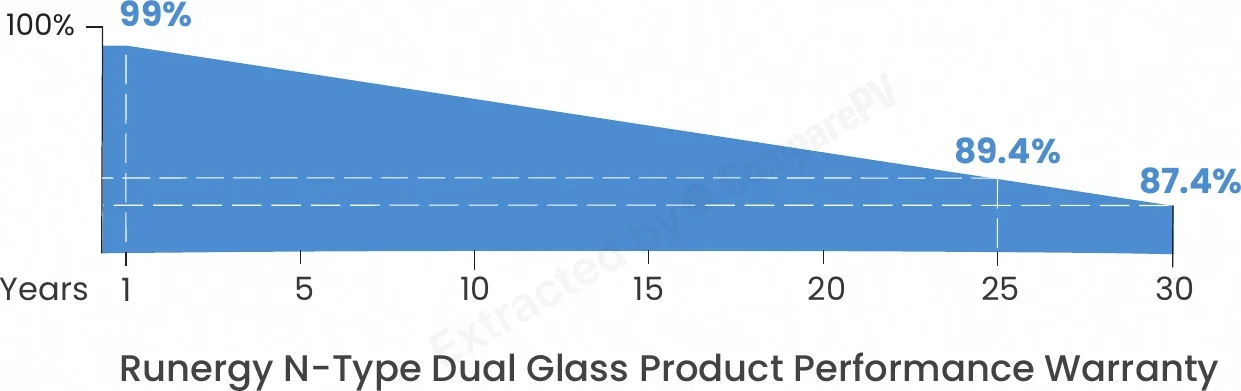
Performance warranty 30 years Typical median 30 yrs · median 30 yrs
End-of-warranty output 87.4 % Equals 433 W guaranteed
Degradation 1.00 → 0.40 % First year, then annual

Datasheet charts

Open datasheet PDF

Measured curves published by Runergy in this model's datasheet. A chart carrying a wattage was measured on that variant alone - only the ones that describe 495 Wp appear here. The rest cover the whole series.
Simulations

Live - change any input
Lifetime output & value
30 years at 1200 kWh/kWp/year and €0.50 per kWh
Power in year 30
-
Lifetime energy
-
Energy value
-
With bifacial gain
-

Degradation from this panel's own datasheet figures. No inverter, soiling or shading losses.

Heat losses
-0.290 %/°C against a segment median of -0.290
-
Bifacial gain
Rear gain over light concrete: -
-

Model: bifaciality × albedo × 0.6 view factor. A first-order estimate, not a yield simulation.

Filter these
Size
Panel Power Eff. Temp. Weight Difference
Runergy HY-DH108N11-495 495 W 22.20% -0.290 27.5 kg You are here
LR7-54HJD-510M 510 W 25.00% -0.240 23.5 kg Cooler, lighter, +2.8 pp
AIKO-A495-MCE54Mw 495 W 24.80% -0.260 21.0 kg Cooler, lighter, +2.6 pp
LR7-54HJD-505M 505 W 24.70% -0.240 23.5 kg Cooler, lighter, +2.5 pp
AIKO-A490-MCE54Mw 490 W 24.50% -0.260 21.0 kg Cooler, lighter, +2.3 pp
LR7-54HJD-500M 500 W 24.50% -0.240 23.5 kg Cooler, lighter, +2.3 pp
CIPRO-TN9C54M-500W 500 W 24.50% -0.260 21.4 kg Cooler, lighter, +2.3 pp
HY-DH108N11-490 490 W 22.00% -0.290 27.5 kg Very close match
HY-DH108N11-500 500 W 22.50% -0.290 27.5 kg +0.3 pp
HY-DH108N11-505 505 W 22.70% -0.290 27.5 kg +10 W, +0.5 pp
HY-DH108N11-510 510 W 22.90% -0.290 27.5 kg +15 W, +0.7 pp
HY-DH108N11-515 515 W 23.20% -0.290 27.5 kg +20 W, +1.0 pp
HY-DH108N11-520 520 W 23.40% -0.290 27.5 kg +25 W, +1.2 pp
HY-DH108N11-525 525 W 23.60% -0.290 27.5 kg +30 W, +1.4 pp
HY-DH108N11-530 530 W 23.80% -0.290 27.5 kg +35 W, +1.6 pp
LR7-60HVH-560M 560 W 24.80% -0.260 25.0 kg +65 W, cooler, +2.6 pp
LR7-60HVH-555M 555 W 24.60% -0.260 25.0 kg +60 W, cooler, +2.4 pp

Found 471 panels of the same or similar size to this one, within ±10 mm. See them here Found 508 panels of the same or similar size to this one, within ±25 mm. See them here Found 662 panels of the same or similar size to this one, within ±50 mm. See them here Found 1471 panels of the same or similar size to this one, within ±100 mm. See them here

Common questions

6 answered
How does the Runergy HY-DH108N11 differ from standard PERC-cell modules?
The HY-DH108N11 panels use N-type cells built on the 210R platform, which unlike classic PERC cells offer higher efficiency (up to 23.2%) and significantly lower degradation over time. In addition, half-cut cell technology reduces resistive losses and improves module performance under partial shading, resulting in higher real-world energy yield compared to older PERC designs.
Does the bifacial dual-glass construction of the HY-DH108N11 actually increase energy output?
Yes, the dual-glass design allows the panel to capture light reflected from the ground on its rear side. In practice, with a bright surface (e.g., gravel or a white roof membrane), the additional power gain can range from a few to over ten percent compared to a monofacial module of the same front-side rated power, lowering the levelized cost of energy (LCOE).
What warranty comes with the Runergy HY-DH108N11 panels, and what does it cover?
The manufacturer provides a 12-year product warranty covering material and workmanship defects, plus a 30-year linear power output warranty. This means that after 30 years of operation, the module should still deliver the manufacturer-guaranteed percentage of its initial power, which is standard for modern high-end N-type panels.
Are HY-DH108N11 panels better suited for ground-mount solar farms or rooftop installations?
This series is versatile and performs well in both applications. Its reinforced mechanical construction, rated for high snow and wind loads plus hail impact resistance, makes it suitable for rooftops in demanding climates, while its bifacial design and high power output (up to 495 Wp) make it especially cost-effective for ground-mount PV farms, where the panel can capture reflected ground light along the entire row.
Is Runergy a reliable, trustworthy solar panel manufacturer?
Runergy is a Tier 1 manufacturer headquartered in China, meaning it appears on the list of the most financially stable and creditworthy module producers, regularly audited by independent banks and insurers. Tier 1 status increases investment security by reducing the risk of warranty servicing issues down the line.
How does the low LID, LeTID, and PID degradation of the HY-DH108N11 affect real-world operation?
Low susceptibility to these three degradation types means the panel maintains stable power output throughout its service life instead of losing several percent of performance within the first months or years, as can happen with cheaper modules. In practice, this gives investors predictable energy production and a real return on investment close to the values projected during system design.
Add to compare
