Q-SUN Solar QN-570HT-6

QN-570HT-6

570 Wp N-type Bifacial 75%
ComparePV verdict

Solid all-round for its segment

Rank 4,421 of 14,005
Compare panels Datasheet PDF
Power (Wp)
570
Typical for its class
Efficiency (%)
22.30
Typical · median 22.45%
Density (Wp/m²)
220.7
Typical · median 224.5
Temp (%/°C)
-0.290
Typical · median -0.290
Weight (kg)
31.2
Typical · median 29.5 kg
Warranty (yrs)
30
Typical · median 30 yrs

The Q-SUN Solar Qrystal N8 (N-type, 565-585W) series is designed to maximize energy yield in installations where every square meter counts. The use of N-type solar cells in TOPCon technology supports high efficiency and stable performance over time, while double-glass construction enhances resistance to moisture, microcracks, and harsh environmental conditions. This makes it a good choice in areas where competing modules degrade faster - particularly in open areas, near industrial sites, or in environments with high dust levels.

Thanks to the bifacial module, Qrystal N8 can utilize reflected light from the ground, which significantly increases energy production in PV farms, carport structures, and flat-roof installations with reflective coverings. In practice, this means lower BOS (Balance of System) costs and easier budget closure without compromising quality.

The series also features enhanced resistance to PID (Potential Induced Degradation) and reduced hot-spot losses, which facilitates predictable energy yields over the long term.

Ranking

259 panels in the segment N-type 550-600 W
Metric This panel Median Position in segment Overall rank
Module efficiency 22.30% 22.45% Typical 5,100
Power density 220.7 224.5 Typical 6,058
Temperature coefficient -0.290 -0.290 Typical 2,165
Weight per kWp 54.7 52.3 Typical 9,146
Performance warranty 30 yrs 30 yrs Typical 21
Colour key Strong - top 25% Typical - middle 50% Weak - bottom 25%

Signals from the data

5 positive · 3 caution
Best for

Utility-scale, commercial, shaded-installations and hot-climate.

What owners get
N-type TOPCon cells

N-type TOPCon cells deliver lower LID/LeTID degradation and better high-temperature performance than legacy PERC cells, reaching up to 22.65% efficiency - on par with top-tier comparables (Hanersun Hitouch 5N, Risen RSM144-9).

Double-glass bifacial design

The double-glass construction improves resistance to moisture and micro-cracks, while the bifacial module captures light reflected off the ground, boosting energy yield in ground-mount farms and flat roofs with light-colored surfaces, lowering BoS cost per Wp.

30-year linear power warranty

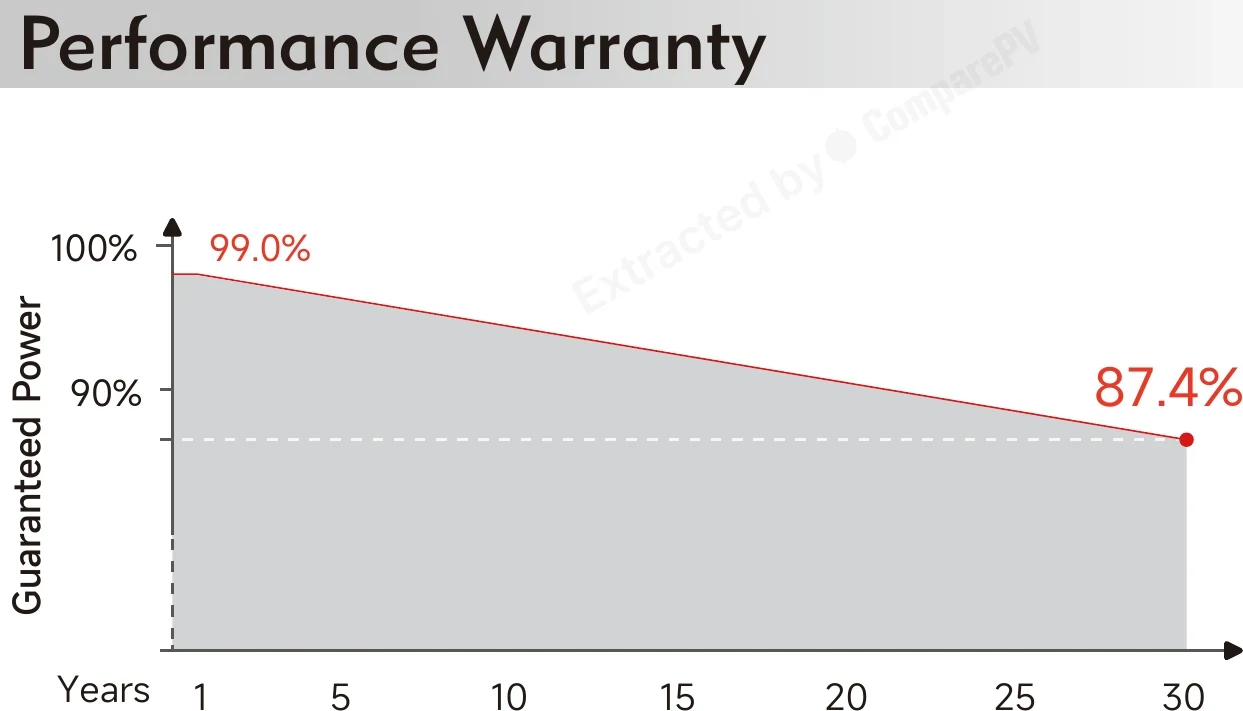
The manufacturer guarantees at least 87.4% of nameplate power after 30 years, backed by a 15-year product warranty - terms consistent with the official datasheet and on par with reputable Tier-1 offerings.

Enhanced environmental durability

The series features improved PID resistance and reduced hot-spot losses, and per manufacturer materials also higher resistance to ammonia, salt mist, sand, and dust exposure - relevant for agricultural, coastal, and industrial installations.

Power range matches segment leaders

The 565-585 Wp power range aligns exactly with top competitors (Hanersun Hitouch 5N HN18-72H, Risen RSM144-9-560-585BNDG), simplifying module substitution in projects with standardized layouts.

Trade-offs
No BNEF Tier 1 status

Q-SUN Solar does not appear on BloombergNEF's Tier 1 bankable manufacturer list, which may limit bank financing availability for large-scale ground-mount projects compared to peer comparables like Risen.

Limited manufacturer track record

The company was founded in 2014 and has a shorter operating history than established Tier-1 players, raising questions about long-term service continuity and warranty honoring given the 30-year power warranty.

Lower efficiency bound trails peers

The series' minimum efficiency is 22.1%, while comparable Hanersun and Risen modules start at 22.6%, so lower-power variants (565 Wp) may lag competitors on per-m² yield.

Notes from the database
  • At 22.3% efficiency, this panel is on par with typical N-type 550-600W modules
  • Power density of 220.7 W/m² is 3.8 W/m² below N-type 550-600W median (224.5 W/m²) - needs more roof space
  • At -0.29%/°C, hot weather performance is typical for N-type 550-600W panels
  • Weight of 31.2 kg is 1.7 kg above N-type 550-600W median (29.5 kg) - verify structural support
  • 75% bifaciality enables rear-side power generation, boosting yield by 4-11% on reflective surfaces

Specifications

Open datasheet PDF
Nominal power (Pmax) 570 Wp Nameplate at 1000 W/m², 25 °C
Module efficiency 22.30 % Typical Segment median 22.45%
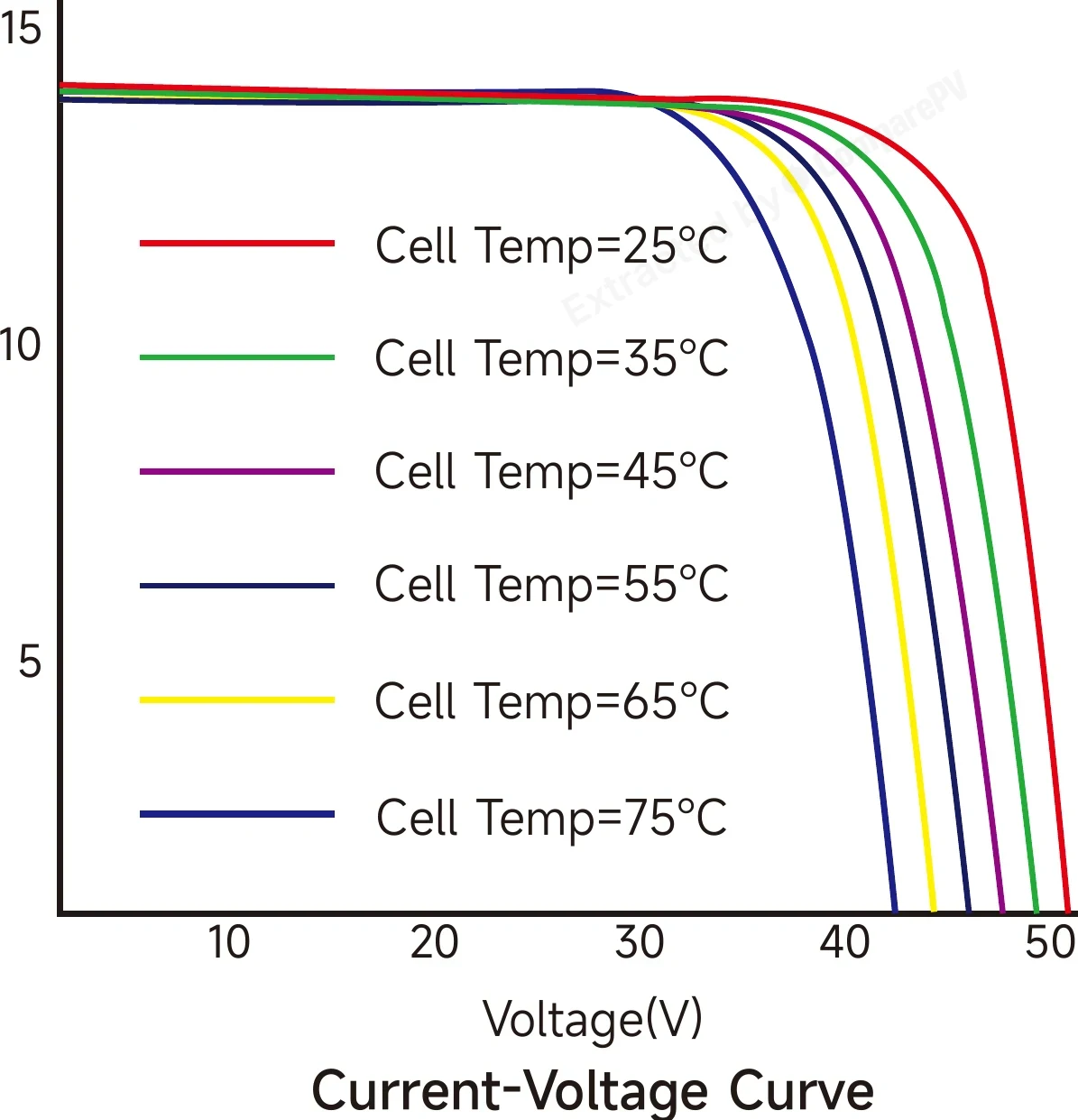
Vmpp · Impp 43.21 V · 13.19 A Operating point at max power
Voc · Isc 51.22 V · 14.08 A Sizes the string length
Max system voltage 1500 V Longer strings than 1000 V modules
Dimensions 2278×1134×30 mm · 2.58 m² of roof
Weight 31.2 kg Typical Typical · median 29.5 kg
Cells 144 · N-type Monocrystalline
Bifaciality 75 % Rear output as a share of front
Coefficient Pmax -0.290 %/°C Typical median -0.290 of its segment
Coefficient Voc · Isc -0.240 · 0.040 %/°C
NOCT 42 °C At 800 W/m², 20 °C ambient
Product warranty 15 years Hardware defects only
Performance warranty 30 years Typical median 30 yrs · median 30 yrs
End-of-warranty output 87.4 % Equals 498 W guaranteed
Degradation 1.00 → 0.40 % First year, then annual

Datasheet charts

Open datasheet PDF

Measured curves published by Q-SUN Solar in this model's datasheet. A chart carrying a wattage was measured on that variant alone - only the ones that describe 570 Wp appear here. The rest cover the whole series.
Simulations

Live - change any input
Lifetime output & value
30 years at 1200 kWh/kWp/year and €0.50 per kWh
Power in year 30
-
Lifetime energy
-
Energy value
-
With bifacial gain
-

Degradation from this panel's own datasheet figures. No inverter, soiling or shading losses.

Heat losses
-0.290 %/°C against a segment median of -0.290
-
Bifacial gain
Rear gain over light concrete: -
-

Model: bifaciality × albedo × 0.6 view factor. A first-order estimate, not a yield simulation.

Alternatives

All Q-SUN Solar panels
Filter these
Size
Panel Power Eff. Temp. Weight Difference
Q-SUN Solar QN-570HT-6 570 W 22.30% -0.290 31.2 kg You are here
LR7-60HVH-560M 560 W 24.80% -0.260 25.0 kg Cooler, lighter, +2.5 pp
LR7-60HVH-555M 555 W 24.60% -0.260 25.0 kg Cooler, lighter, +2.3 pp
LR7-60HVHL-550M 550 W 24.40% -0.260 16.3 kg Cooler, lighter, +2.1 pp
JAT60S40-540/LR 540 W 24.40% -0.260 23.5 kg -30 W, lighter, +2.1 pp
GK-5-60HG-540M 540 W 24.40% -0.260 23.3 kg -30 W, lighter, +2.1 pp
JKM545-54QL6-DV-F1-EU 545 W 24.27% -0.260 27.5 kg Cooler, lighter, +2.0 pp
LR7-60HVH-545M 545 W 24.20% -0.260 25.0 kg Cooler, lighter, +1.9 pp
QNM182-HG530-72 530 W 20.50% -0.310 31.4 kg -40 W, hotter, -1.8 pp
QNM182-HS535-72 535 W 20.70% -0.320 28.3 kg -35 W, -1.6 pp, -5 yr warranty
QNM182-HS540-72 540 W 20.90% -0.320 28.3 kg Hotter, -1.4 pp, -5 yr warranty
QN-540HT 540 W 20.80% -0.340 26.0 kg Hotter, lighter, -1.5 pp
QNM182-HS545-72 545 W 21.10% -0.320 28.3 kg Hotter, -1.2 pp, -5 yr warranty
QN-545HT 545 W 21.10% -0.340 26.0 kg Hotter, lighter, -1.2 pp
QNM182-HS550-72 550 W 21.30% -0.320 28.3 kg Hotter, -1.0 pp, -5 yr warranty
AIKO-A650-MAE72Mw 650 W 25.20% -0.260 27.0 kg +80 W, lighter, +2.9 pp
AIKO-A645-MAE72Mw 645 W 25.00% -0.260 27.0 kg +75 W, lighter, +2.7 pp

Found 2326 panels of the same or similar size to this one, within ±10 mm. See them here Found 2368 panels of the same or similar size to this one, within ±25 mm. See them here Found 2382 panels of the same or similar size to this one, within ±50 mm. See them here Found 2547 panels of the same or similar size to this one, within ±100 mm. See them here

Common questions

5 answered
What warranty does the Q-SUN Solar Qrystal N8 come with, and what does a 30-year power warranty actually mean?
The manufacturer provides a 15-year product warranty covering material and workmanship defects, plus a 30-year linear power warranty guaranteeing at least 87.4% of rated power output after 30 years. The N-type TOPCon cell technology exhibits lower annual degradation than conventional P-type PERC modules, making this warranty a realistic commitment rather than a marketing statement.
What does it mean that the Qrystal N8 is bifacial, and how much extra energy can it produce?
A bifacial module captures light from both the front and rear surfaces, harvesting energy from ground or rooftop albedo reflection. On utility-scale PV farms with a light-colored ground surface or in carport installations, the bifacial gain typically ranges from a few percent up to 25% additional annual yield. On a dark pitched roof the rear-side contribution is minimal, so the Qrystal N8 delivers its full potential primarily in ground-mount and flat-roof applications with a reflective surface.
What is the efficiency of the Q-SUN Solar Qrystal N8, and how does it compare to competing modules?
Depending on the power variant (565–585 W), module efficiency ranges from 21.9% to 22.6%. This is significantly above the market average for mass-produced panels — standard PERC modules typically achieve 20–21%. Higher efficiency translates directly into fewer modules and less roof or ground area required to reach the same system output, lowering BoS costs on constrained sites.
How much does the Q-SUN Solar Qrystal N8 weigh, and does it require a reinforced mounting structure?
The Qrystal N8 (565–585 W) weighs approximately 31.2 kg and measures 2278 × 1134 × 30 mm. The double-glass construction is heavier than conventional backsheet modules, so a structural assessment is recommended for older rooftops before installation. For ground-mount arrays and carports the additional load is generally not an issue, and the dual-glass design significantly extends the module's service life.
Are the Q-SUN Solar Qrystal N8 panels suitable for harsh environments — heavy dust, humidity, or extreme temperatures?
Yes. The double-glass construction eliminates the backsheet, which is susceptible to delamination and moisture ingress — a key advantage in dusty environments or near industrial sites. N-type TOPCon technology provides enhanced PID (Potential Induced Degradation) resistance. The low temperature coefficient of -0.29%/°C means smaller power losses during peak summer heat compared to typical PERC modules rated at -0.34 to -0.37%/°C.
Add to compare