Philadelphia Solar PS-MNG144(HCBF)-575W

PS-MNG144(HCBF)-575W

575 Wp N-type Bifacial 80%
ComparePV verdict

Middle of its segment, heavy for its output

Rank 4,965 of 14,005
Compare panels Datasheet PDF
Power (Wp)
575
Typical for its class
Efficiency (%)
22.26
Typical · median 22.45%
Density (Wp/m²)
222.6
Typical · median 224.5
Temp (%/°C)
-0.290
Typical · median -0.290
Weight (kg)
32.5
Weak · 3.0 kg above median
Warranty (yrs)
30
Typical · median 30 yrs

The Philadelphia Solar Nexus series introduces a new quality to large-scale and commercial installations through the effective use of bifacial technology and half-cut cells. This combination allows for the intensive use of light reflected from the ground, which translates directly into higher annual energy yields, even with less favorable sunlight. These modules effectively solve the problem of performance drops in difficult environments, offering certified resistance to salt corrosion and extreme dust. It is an optimal choice for projects implemented in demanding industrial locations or coastal belts. The solid frame construction and tempered glass ensure the highest mechanical stability, minimizing the risk of damage during installation and operation. Nexus distinguishes itself from competing solutions with an excellent temperature coefficient, which guarantees stable system operation during summer heat. Investing in this series is primarily about maximizing profitability while reducing operating costs. Thanks to an advanced production process, the panels eliminate potential-induced degradation, making them a reliable foundation for modern solar farms and large rooftop systems where reliability and a fast return on investment matter.

Ranking

259 panels in the segment N-type 550-600 W
Metric This panel Median Position in segment Overall rank
Module efficiency 22.26% 22.45% Typical 5,593
Power density 222.6 224.5 Typical 5,549
Temperature coefficient -0.290 -0.290 Typical 2,165
Weight per kWp 56.5 52.3 Weak · bottom 8% 10,695
Performance warranty 30 yrs 30 yrs Typical 21
Colour key Strong - top 25% Typical - middle 50% Weak - bottom 25%

Signals from the data

5 positive · 3 caution
Best for

Commercial, utility-scale, shaded-installations and hot-climate.

Not ideal for

Weight-limited structures.

Watch-outs
56.5 kg per kWp

Bottom 8% of the N-type 550-600 W segment, against a median of 52.3. Ranked 10,695th in the whole database.

What owners get
N-type + half-cut + bifacial design

The combination of N-type cells, half-cut technology, and a bifacial design delivers up to 23.26% efficiency plus a rear-side energy gain of roughly 5-25%, depending on ground albedo. This translates into real annual yield gains versus conventional PERC panels.

Very low temperature coefficient

The Pmax temperature coefficient is -0.29%/°C, clearly better than the -0.34% to -0.40%/°C typical of PERC panels. This results in lower power losses during summer heat and higher yield in high-irradiance climates.

Certified corrosion and PID resistance

The series holds IEC 61701 (salt mist), IEC 62716 (ammonia resistance), and IEC TS 62804 (potential-induced degradation resistance) certifications. This provides real protection for investments in coastal, industrial, and agricultural sites.

Tier-1, bankable manufacturer

Philadelphia Solar has operated since 2007 and holds Tier-1 (bankable) status, reducing counterparty risk for bank financing of large-scale PV plants and commercial installations.

30-year linear power warranty

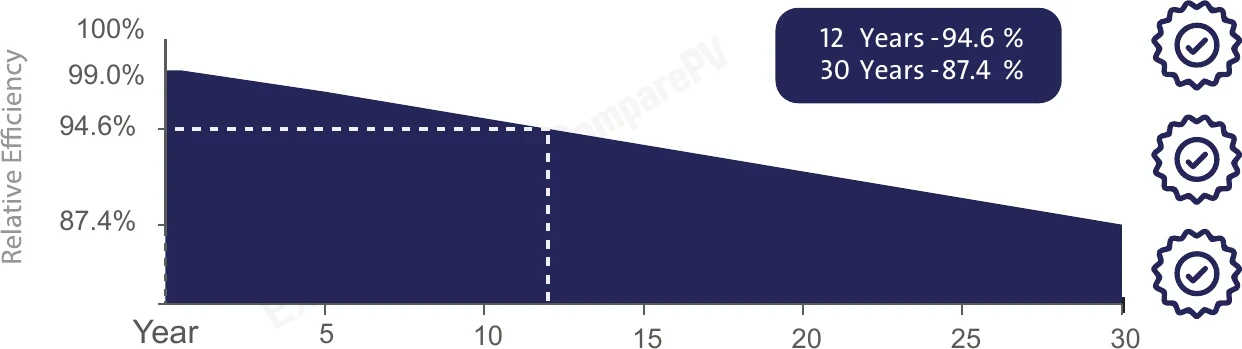
The 30-year power warranty with -0.4% annual degradation guarantees at least 87.4% of rated power after 30 years — competitive against many Tier-1 offerings based on a standard 25-year term.

Trade-offs
Shorter product warranty

The product warranty is 12 years, while several competing Tier-1 series (e.g., Trina Vertex N, Astronergy ASTRO N5) standardly offer 15-25 years of product warranty alongside the same 30-year power warranty. This could increase the investor's cost exposure if component failures occur in later years.

Efficiency below segment leader

Peak efficiency of 23.26% is close to Astronergy ASTRO N5 (23.3%) but clearly below Trina Vertex N TSM-NEG19RC.20 (24.1% at the same 650 Wp power). The ~0.8 pp gap means lower power density per m² for projects with limited roof or land area.

Notes from the database
  • At 22.3% efficiency, this panel is on par with typical N-type 550-600W modules
  • Power density of 222.6 W/m² matches the N-type 550-600W median
  • Temperature coefficient of -0.29%/°C matches the N-type 550-600W median
  • Weight of 32.5 kg is 3.0 kg above N-type 550-600W median (29.5 kg) - verify structural support
  • Bifacial design (80% factor) captures reflected light - adds 4-12% yield on ground-mount or white roof

Specifications

Open datasheet PDF
Nominal power (Pmax) 575 Wp Nameplate at 1000 W/m², 25 °C
Module efficiency 22.26 % Typical Segment median 22.45%
Vmpp · Impp 42.44 V · 13.55 A Operating point at max power
Voc · Isc 51.27 V · 14.31 A Sizes the string length
Max system voltage 1500 V Longer strings than 1000 V modules
Dimensions 2278×1134×30 mm · 2.58 m² of roof
Weight 32.5 kg Weak Weak · 3.0 kg above median
Cells 144 · N-type Monocrystalline
Bifaciality 80 % Rear output as a share of front
Coefficient Pmax -0.290 %/°C Typical median -0.290 of its segment
Coefficient Voc · Isc -0.250 · 0.045 %/°C
NOCT 45 °C At 800 W/m², 20 °C ambient
Product warranty 12 years Hardware defects only
Performance warranty 30 years Typical median 30 yrs · median 30 yrs
End-of-warranty output 87.4 % Equals 503 W guaranteed
Degradation 0.40 % Per year after the first

Datasheet charts

Open datasheet PDF

Measured curves published by Philadelphia Solar in this model's datasheet. A chart carrying a wattage was measured on that variant alone - only the ones that describe 575 Wp appear here. The rest cover the whole series.
Simulations

Live - change any input
Lifetime output & value
30 years at 1200 kWh/kWp/year and €0.50 per kWh
Power in year 30
-
Lifetime energy
-
Energy value
-
With bifacial gain
-

Degradation from this panel's own datasheet figures. No inverter, soiling or shading losses.

Heat losses
-0.290 %/°C against a segment median of -0.290
-
Bifacial gain
Rear gain over light concrete: -
-

Model: bifaciality × albedo × 0.6 view factor. A first-order estimate, not a yield simulation.

Filter these
Size
Panel Power Eff. Temp. Weight Difference
Philadelphia Solar PS-MNG144(HCBF)-575W 575 W 22.26% -0.290 32.5 kg You are here
LR7-60HVH-560M 560 W 24.80% -0.260 25.0 kg Cooler, lighter, +2.5 pp
LR7-60HVH-555M 555 W 24.60% -0.260 25.0 kg Cooler, lighter, +2.3 pp
LR7-60HVHL-550M 550 W 24.40% -0.260 16.3 kg Cooler, 16 kg lighter, +2.1 pp
JAT60S40-540/LR 540 W 24.40% -0.260 23.5 kg -35 W, lighter, +2.1 pp
GK-5-60HG-540M 540 W 24.40% -0.260 23.3 kg -35 W, lighter, +2.1 pp
JKM545-54QL6-DV-F1-EU 545 W 24.27% -0.260 27.5 kg -30 W, lighter, +2.0 pp
AIKO-A625-MAH72Dw 625 W 24.20% -0.260 32.5 kg +50 W, cooler, +1.9 pp
PS-M144(HCBF)-GG-535W 535 W 20.71% -0.349 32.5 kg -40 W, hotter, -1.6 pp
PS-M144(HCBF)-GG-540W 540 W 20.90% -0.349 32.5 kg -35 W, hotter, -1.4 pp
PS-M144(HCBF)-540W 540 W 20.90% -0.350 29.0 kg Hotter, -1.4 pp, -5 yr warranty
PS-M144(HCBF)-GG-545W 545 W 21.10% -0.349 32.5 kg -30 W, hotter, -1.2 pp
PS-M144(HCBF)-545W 545 W 21.10% -0.350 29.0 kg Hotter, -1.2 pp, -5 yr warranty
PS-M144(HCBF)-550W 550 W 21.30% -0.350 29.0 kg Hotter, -1.0 pp, -5 yr warranty
AIKO-A650-MAE72Mw 650 W 25.20% -0.260 27.0 kg +75 W, lighter, +2.9 pp
AIKO-A645-MAE72Mw 645 W 25.00% -0.260 27.0 kg +70 W, lighter, +2.7 pp
AIKO-A640-MAE72Mw 640 W 24.80% -0.260 27.0 kg +65 W, lighter, +2.5 pp

Found 2326 panels of the same or similar size to this one, within ±10 mm. See them here Found 2368 panels of the same or similar size to this one, within ±25 mm. See them here Found 2382 panels of the same or similar size to this one, within ±50 mm. See them here Found 2547 panels of the same or similar size to this one, within ±100 mm. See them here

Common questions

6 answered
How much extra energy does the bifacial technology in the Philadelphia Solar Nexus series actually produce?
Nexus panels can generate 5–25% additional energy by harvesting reflected irradiance from the module's rear side. The bifaciality ratio is approximately 80%. The actual gain depends on ground albedo — bright surfaces such as light-gray concrete, white gravel, or snow deliver the best results. For a typical ground-mounted utility-scale farm, this translates to a measurably lower LCOE and faster return on investment.
How does the Nexus panel perform in summer heat — what does the -0.29%/°C temperature coefficient mean in practice?
The power temperature coefficient is -0.29%/°C, meaning the panel loses only 0.29% of rated power for every degree Celsius above 25°C. This is notably better than conventional P-type PERC modules, which typically reach -0.35%/°C or worse. In real-world conditions the Nexus series delivers meaningfully more energy on hot summer days, a critical advantage for commercial rooftop systems and utility-scale farms where every fraction of a percent in yield affects project economics.
What warranty does Philadelphia Solar provide on the Nexus series and what exactly does it cover?
Philadelphia Solar offers a 12-year product warranty covering material and workmanship defects, plus a 30-year linear power warranty. The power warranty caps annual degradation at 0.4%, guaranteeing at least 88% of rated power after 30 years. As a Tier 1 manufacturer, Philadelphia Solar provides the financial stability and bankability that lenders and EPCs require for project financing.
Are Philadelphia Solar Nexus panels suitable for coastal installations or environments with heavy dust exposure?
Yes, the Nexus series holds certified resistance to salt-mist corrosion and extreme dust ingress, making it a reliable choice for farms near coastlines, industrial ports, or desert regions. The anodized aluminum frame and 3.2 mm AR-coated tempered glass ensure long-term structural integrity in chemically aggressive environments. This dual certification is one of the key differentiators for projects in demanding locations where standard modules degrade prematurely.
How do the N-type cells in the Nexus series compare to conventional P-type PERC panels — is the premium justified?
N-type cells are inherently immune to PID (Potential Induced Degradation), a failure mode that can permanently reduce P-type PERC output by several percent over the system lifetime. Nexus modules degrade at only 0.4% per year versus a typical 0.55–0.7% for PERC. N-type technology also delivers up to 23.23% module efficiency with a superior temperature coefficient. Over a 30-year power warranty horizon, the difference in annual energy yield fully justifies the higher upfront cost.
What mechanical loads can the Nexus panels withstand — are they suitable for regions with heavy snowfall?
The Nexus series is rated for a 5,400 Pa front static load and 2,400 Pa rear static load, equivalent to approximately 55 cm of wet snow. Dynamic load resistance is 1,000 Pa. The 3.2 mm AR-coated tempered glass and rigid anodized aluminum frame provide long-term mechanical stability both during installation and throughout years of operation in climates with heavy snowfall or high wind pressure.
Add to compare