Philadelphia Solar PS-M144(HC)-550W

550 Wp PERC
ComparePV verdict

Strong in heat, short guarantee

Rank 8,140 of 14,129
Compare panels Datasheet PDF
Power (Wp)
550
Weak · bottom 15%
Efficiency (%)
21.30
Typical · median 21.29%
Density (Wp/m²)
213.2
Typical · median 212.9
Temp (%/°C)
-0.300
Strong · top 1%
Weight (kg)
29.0
Typical · median 30.8 kg
Warranty (yrs)
25
Weak · bottom 24%

The Iris series from Philadelphia Solar consists of monocrystalline monofacial modules engineered for installations where both performance and long-term reliability matter. The panels use half-cut cells in a 132 (66x2) configuration, which meaningfully reduces power loss caused by partial shading and lowers the module's internal resistance - the result is more stable energy output even in challenging mounting conditions, such as rooftops with nearby chimneys or antennas. Thanks to PERC technology and a carefully engineered cell design, the series delivers low annual power degradation, translating into higher energy yield over the entire lifetime of the installation. A multi-busbar layout, offering more busbars than conventional 5-busbar modules, improves resistance to microcracks, which matters during transport and installation on difficult terrain. The manufacturer backs the series with a 25-year linear warranty, making it an attractive choice for both residential system investors and larger commercial projects or solar power plants, where predictable performance over time directly translates into investment profitability.

Ranking

589 panels in the segment PERC 550-600 W
Metric This panel Median Position in segment Overall rank
Module efficiency 21.30% 21.29% Typical 8,585
Power density 213.2 212.9 Typical 8,512
Temperature coefficient -0.300 -0.350 Strong · top 1% 6,152
Weight per kWp 52.7 52.7 Typical 6,427
Performance warranty 25 yrs 27 yrs Weak · bottom 24% 9,912
Colour key Strong - top 25% Typical - middle 50% Weak - bottom 25%

Signals from the data

6 positive · 4 caution
Best for

Residential, commercial, shaded-installations and utility-scale.

Not ideal for

Owners who want a long output guarantee.

Strengths
-0.300 %/°C temperature coefficient

Top 1% of the PERC 550-600 W segment, against a median of -0.350. Ranked 6,152nd in the whole database.

Watch-outs
25 year performance warranty

Bottom 24% of the PERC 550-600 W segment, against a median of 27 yrs.

What owners get
Up to 21.5% efficiency - leads the peer group

The Iris series' peak efficiency of 21.5% outperforms comparable 555W peers - Jinko JS-PERC (21.48%) and Shinson S-Max (21.48%), as well as Boviet VEGA (21.3%). This is the highest figure among the listed peer comparables at the same peak power.

Half-cut cells, 132 (66x2) config, extra busbars

Splitting cells in half reduces power loss under partial shading and lowers module internal resistance, while a higher busbar count than classic 5BB designs improves resistance to microcracks during transport and installation.

25-year linear warranty with low degradation

The manufacturer specifies annual power degradation of around 0.5%, which combined with the 25-year linear power warranty translates into predictable, high energy yield over the system's lifetime.

Tier-1, bankable manufacturer since 2007

Philadelphia Solar has operated since 2007 (Jordan) and is listed as a BNEF Tier-1 bankable manufacturer, which simplifies financing for commercial projects and utility-scale PV farms.

Wide 500-555 Wp range across 7 variants

The series offers 7 power variants from 500 to 555 Wp, giving flexibility to match a module to a specific roof area or project scale without switching suppliers.

Trade-offs
PERC technology nearing its efficiency ceiling

At 20.9-21.5% efficiency, the Iris series is close to the technological ceiling of PERC, while newer N-type TOPCon modules in the 555W segment (2025-2026) increasingly exceed 22-23% efficiency, with better temperature coefficients and lower LID degradation.

12-year product warranty below market trend

The 12-year product warranty is shorter than many newer TOPCon series available in 2026, which offer 15, or even 25-30 years of product warranty at comparable power output.

No bifacial variant within the series

Iris is a monofacial module only (is_bifacial: false) - unlike some competing offerings (including this manufacturer's own bifacial PHENEX line), it cannot capture extra rear-side energy gain in ground-mount or high-albedo installations.

Notes from the database
  • At 21.3% efficiency, this panel is on par with typical PERC 550-600W modules
  • At 213.2 W/m² power density, roof space requirements are typical for PERC 550-600W panels
  • Temperature coefficient of -0.30%/°C vs median -0.35%/°C means ~2% less power loss at 65°C
  • 29.0 kg weight - 1.8 kg lighter than PERC 550-600W median (30.8 kg), reducing installation effort
  • Ranked #8585 out of 14129 panels for efficiency in the database

Specifications

Open datasheet PDF
Nominal power (Pmax) 550 Wp Nameplate at 1000 W/m², 25 °C
Module efficiency 21.30 % Typical Segment median 21.29%
Vmpp · Impp 42.10 V · 13.08 A Operating point at max power
Voc · Isc 50.20 V · 13.80 A Sizes the string length
Max system voltage 1500 V Longer strings than 1000 V modules
Dimensions 2277×1133×35 mm · 2.58 m² of roof
Weight 29.0 kg Typical Typical · median 30.8 kg
Cells 144 · PERC Monocrystalline
Coefficient Pmax -0.300 %/°C Strong top 1% of its segment
Coefficient Voc · Isc -0.260 · 0.040 %/°C
NOCT 45 °C At 800 W/m², 20 °C ambient
Product warranty 12 years Hardware defects only
Performance warranty 25 years Weak bottom 24% · median 27 yrs
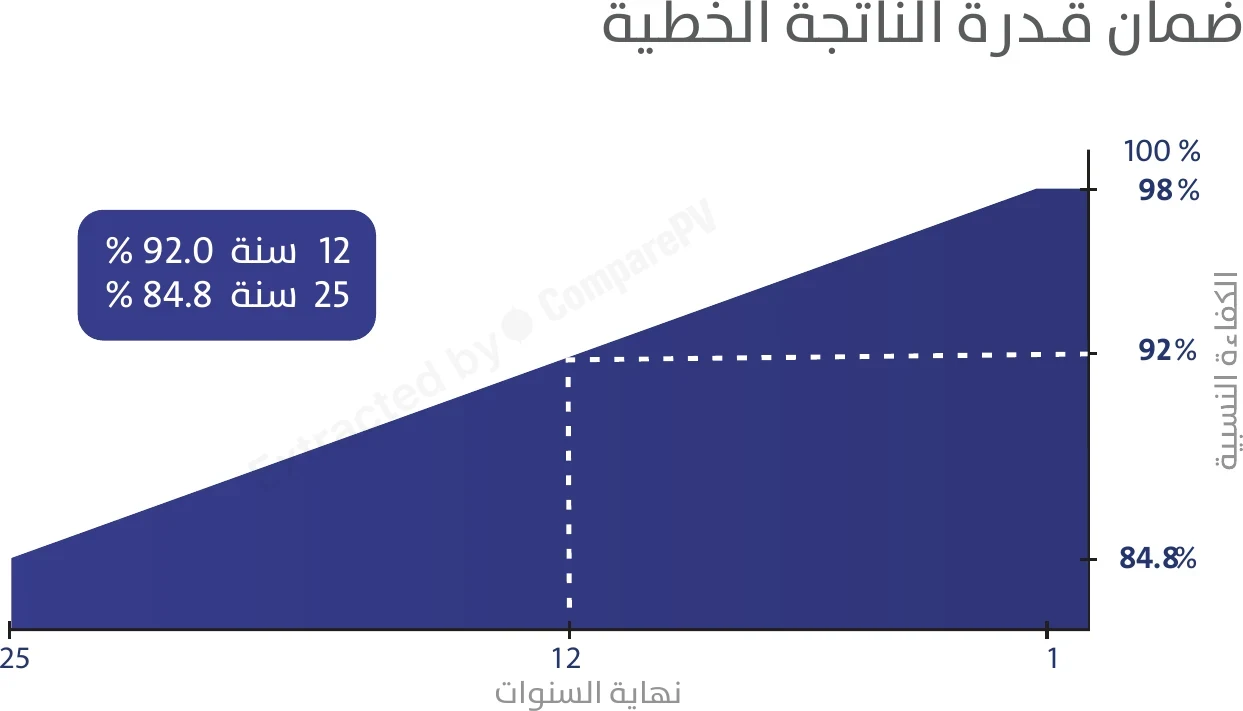
End-of-warranty output 84.8 % Equals 451 W guaranteed
Degradation 2.00 → 0.55 % First year, then annual

Datasheet charts

Open datasheet PDF

Measured curves published by Philadelphia Solar in this model's datasheet. A chart carrying a wattage was measured on that variant alone - only the ones that describe 550 Wp appear here. The rest cover the whole series.
Simulations

Live - change any input
Lifetime output & value
30 years at 1200 kWh/kWp/year and €0.50 per kWh
Power in year 30
-
Lifetime energy
-
Energy value
-

Degradation from this panel's own datasheet figures. No inverter, soiling or shading losses.

Heat losses
-0.300 %/°C against a segment median of -0.350
-
Filter these
Size
Panel Power Eff. Temp. Weight Difference
Philadelphia Solar PS-M144(HC)-550W 550 W 21.30% -0.300 29.0 kg You are here
LR7-54HJD-510M 510 W 25.00% -0.240 23.5 kg Cooler, lighter, +3.7 pp
LR7-60HVH-560M 560 W 24.80% -0.260 25.0 kg Lighter, +3.5 pp, +5 yr warranty
LR7-54HJD-505M 505 W 24.70% -0.240 23.5 kg Cooler, lighter, +3.4 pp
WST-505BKX54-A2 505 W 24.70% -0.260 25.0 kg -45 W, +3.4 pp, +5 yr warranty
LR7-60HVH-555M 555 W 24.60% -0.260 25.0 kg Lighter, +3.3 pp, +5 yr warranty
LR7-54HJD-500M 500 W 24.50% -0.240 23.5 kg Cooler, lighter, +3.2 pp
PS-M144(HCBF)-GG-535W 535 W 20.71% -0.349 32.5 kg Hotter, heavier, +5 yr warranty
PS-M144(HCBF)-GG-540W 540 W 20.90% -0.349 32.5 kg Hotter, heavier, +5 yr warranty
PS-M144(HCBF)-540W 540 W 20.90% -0.350 29.0 kg -10 W, hotter, -0.4 pp
PS-M144(HCBF)-GG-545W 545 W 21.10% -0.349 32.5 kg Hotter, heavier, +5 yr warranty
PS-M144(HCBF)-545W 545 W 21.10% -0.350 29.0 kg Hotter
AIKO-A650-MAE72Mw 650 W 25.20% -0.260 27.0 kg +100 W, +3.9 pp, +5 yr warranty
AIKO-A645-MAE72Mw 645 W 25.00% -0.260 27.0 kg +95 W, +3.7 pp, +5 yr warranty
AIKO-A640-MAE72Mw 640 W 24.80% -0.260 27.0 kg +90 W, +3.5 pp, +5 yr warranty
AIKO-A635-MAE72Mw 635 W 24.60% -0.260 27.0 kg +85 W, +3.3 pp, +5 yr warranty
AIKO-A630-MAH72Dw 630 W 24.40% -0.260 32.5 kg +80 W, +3.1 pp, +5 yr warranty

Found 2322 panels of the same or similar size to this one, within ±10 mm. See them here Found 2369 panels of the same or similar size to this one, within ±25 mm. See them here Found 2383 panels of the same or similar size to this one, within ±50 mm. See them here Found 2551 panels of the same or similar size to this one, within ±100 mm. See them here

About the Iris series

6 answered

These answers cover the whole series. Where a figure differs, the specification above is this module's own.

What is the maximum power output of the Philadelphia Solar Iris series panels?
The Iris series panels reach a maximum power output of up to 555 Wp. This is achieved through half-cut cell technology in a 132-cell (66x2) configuration combined with PERC technology, which increases energy conversion efficiency. Higher single-module power reduces the number of panels needed to reach a target system size, lowering mounting structure and cabling costs.
What warranty does the Iris series come with and what does it cover?
Philadelphia Solar provides a 12-year product warranty and a 25-year linear power warranty on the Iris series. The product warranty covers material and workmanship defects, while the power warranty guarantees a minimum energy output level over the years of operation. This warranty scope is standard among tier 1 manufacturers and increases the long-term security of the investment.
How do the half-cut cells in Iris panels differ from full-size cells?
Half-cut cells are standard silicon cells physically cut in half, connected in the module as 132 pieces (66x2). The smaller cell surface area reduces internal resistance and thermal losses, and under partial shading the panel loses less power compared to a module with full-size cells. In practice this means more stable energy production, for example under shading from a chimney or antenna.
Are Iris panels suitable for roofs with a risk of partial shading?
Yes, the half-cut design used in the Iris series was engineered specifically for such conditions. Splitting cells into smaller segments limits the impact of shade cast by chimneys, antennas, or neighboring buildings on the panel's overall output. This works well both on sloped roofs in residential installations and in larger commercial projects with irregular roof layouts.
Does the PERC technology in Iris panels result in higher energy yield?
Yes, the PERC (Passivated Emitter and Rear Cell) technology used in the Iris series increases the cell's ability to capture light reflected from the rear side of the panel, boosting solar-to-electricity conversion efficiency. Combined with a carefully optimized cell design, this results in low annual power degradation and higher cumulative energy yield over the panel's 25-year service life.
Are Iris panels resistant to microcracks during transport and installation?
The Iris series uses a busbar configuration with more busbars than classic 5-busbar modules, improving current distribution and mechanical resistance to microcracks. This matters especially during transport over rough terrain and installation in conditions where panels are exposed to vibration and stress, such as mounting on roofs with uneven structures.
Add to compare