Philadelphia Solar PS-M108(HC)-410W

410 Wp PERC
ComparePV verdict

Strong in heat, no clear weak spot

Rank 10,336 of 14,354
Compare panels Datasheet PDF
Power (Wp)
410
Typical for its class
Efficiency (%)
21.00
Strong · top 23%
Density (Wp/m²)
210.3
Strong · top 18%
Temp (%/°C)
-0.300
Strong · top 3%
Weight (kg)
20.5
Strong · 1.5 kg below median
Warranty (yrs)
25
Typical · median 25 yrs

Black Iris Mono is a series that pairs an all-black aesthetic with construction engineered for residential rooftops. The use of half-cut cells in Mono PERC technology with 10 busbars reduces the risk of microcracks and power loss that occur more frequently in conventional 5BB modules during transport or installation. Splitting the cells in half also gives the panel more favorable temperature coefficients, translating into steadier energy output on hot days when standard modules lose efficiency. The black anodized aluminum frame combined with a uniform black front lets the array blend visually with the roof, an important advantage for homeowners who care about the look of their facade. The series also stands out for its high resistance to potential-induced degradation (PID), ensuring predictable energy yield throughout its service life. The module's low weight simplifies installation on structures with limited load capacity, while its mechanical strength allows reliable operation under demanding snow and wind loads. The manufacturer backs the series with a 25-year linear power warranty and an annual degradation rate of just -0.55%, making Black Iris Mono a dependable choice for both residential and commercial installations.

Ranking

957 panels in the segment PERC 400-450 W
Metric This panel Median Position in segment Overall rank
Module efficiency 21.00% 20.60% Strong · top 23% 9,982
Power density 210.3 206.2 Strong · top 18% 9,872
Temperature coefficient -0.300 -0.350 Strong · top 3% 6,298
Weight per kWp 50.0 53.0 Strong · top 17% 3,363
Performance warranty 25 yrs 25 yrs Typical 10,073
Colour key Strong - top 25% Typical - middle 50% Weak - bottom 25%

Signals from the data

8 positive · 2 caution
Best for

Residential and commercial.

Strengths
-0.300 %/°C temperature coefficient

Top 3% of the PERC 400-450 W segment, against a median of -0.350. Ranked 6,298th in the whole database.

50.0 kg per kWp

Top 17% of the PERC 400-450 W segment, against a median of 53.0.

210.3 watts per square metre

Top 18% of the PERC 400-450 W segment, against a median of 206.2.

What owners get
25-year product and power warranty

Philadelphia Solar backs the series with a full 25-year product warranty alongside the 25-year power warranty, while the typical market standard is only 10-12 years of product coverage against a 25-year power warranty. The low annual degradation rate of just -0.55% ensures predictable energy yield over the panel's lifetime.

Half-cut cells with 10 busbars

Splitting PERC cells into halves and using 10 busbars (versus the conventional 5BB) reduces microcrack risk during transport and installation and improves low-light behavior, resulting in more stable energy production under partial shading conditions.

Tier-1 manufacturer with 19-year track record

Philadelphia Solar, founded in 2007 in Jordan, is listed on BloombergNEF's Tier-1 bankable manufacturer list (Q2 2026), which facilitates commercial bank financing and boosts confidence among institutional investors.

High PID resistance

Enhanced resistance to potential-induced degradation (PID) minimizes long-term power loss risk, which matters for large rooftop and ground-mount installations operating under continuous system voltage.

Full-black aesthetic for residential roofs

The anodized aluminum black frame and uniform black front blend visually with roof coverings, a significant selling point for private investors concerned with facade aesthetics.

Trade-offs
Efficiency trails N-type leaders

The 20.5-21% efficiency based on Mono PERC technology falls short of the best comparable N-type TOPCon models in this power class, e.g., Luxor Solar Eco Line (410W, 21.33%), reflecting PERC's inherent efficiency ceiling versus newer N-type cells.

No bifacial variant in this series

Black Iris Mono is a monofacial module (is_bifacial: false), while comparable peer Luxor Solar offers a glass-glass bifacial version in the same 410W power class, delivering additional albedo-driven energy yield unavailable in this series.

Notes from the database
  • At 21.0% efficiency, this panel is on par with typical PERC 400-450W modules
  • Power density of 210.3 W/m² packs 4.1 W/m² more into the same footprint vs PERC 400-450W median (206.2 W/m²)
  • -0.30%/°C temperature coefficient (median: -0.35%/°C) - retains ~2% more power at high temperatures
  • 20.5 kg weight - 1.5 kg lighter than PERC 400-450W median (22.0 kg), reducing installation effort
  • #9982 for efficiency, #6298 for temperature performance out of 14354 panels

Specifications

Open datasheet PDF
Nominal power (Pmax) 410 Wp Nameplate at 1000 W/m², 25 °C
Module efficiency 21.00 % Strong Segment median 20.60%
Vmpp · Impp 31.40 V · 13.06 A Operating point at max power
Voc · Isc 37.60 V · 13.76 A Sizes the string length
Max system voltage 1500 V Longer strings than 1000 V modules
Dimensions 1721×1133×30 mm · 1.95 m² of roof
Weight 20.5 kg Strong Strong · 1.5 kg below median
Cells 108 · PERC Monocrystalline
Coefficient Pmax -0.300 %/°C Strong top 3% of its segment
Coefficient Voc · Isc -0.260 · 0.040 %/°C
NOCT 45 °C At 800 W/m², 20 °C ambient
Product warranty 25 years Hardware defects only
Performance warranty 25 years Typical median 25 yrs · median 25 yrs
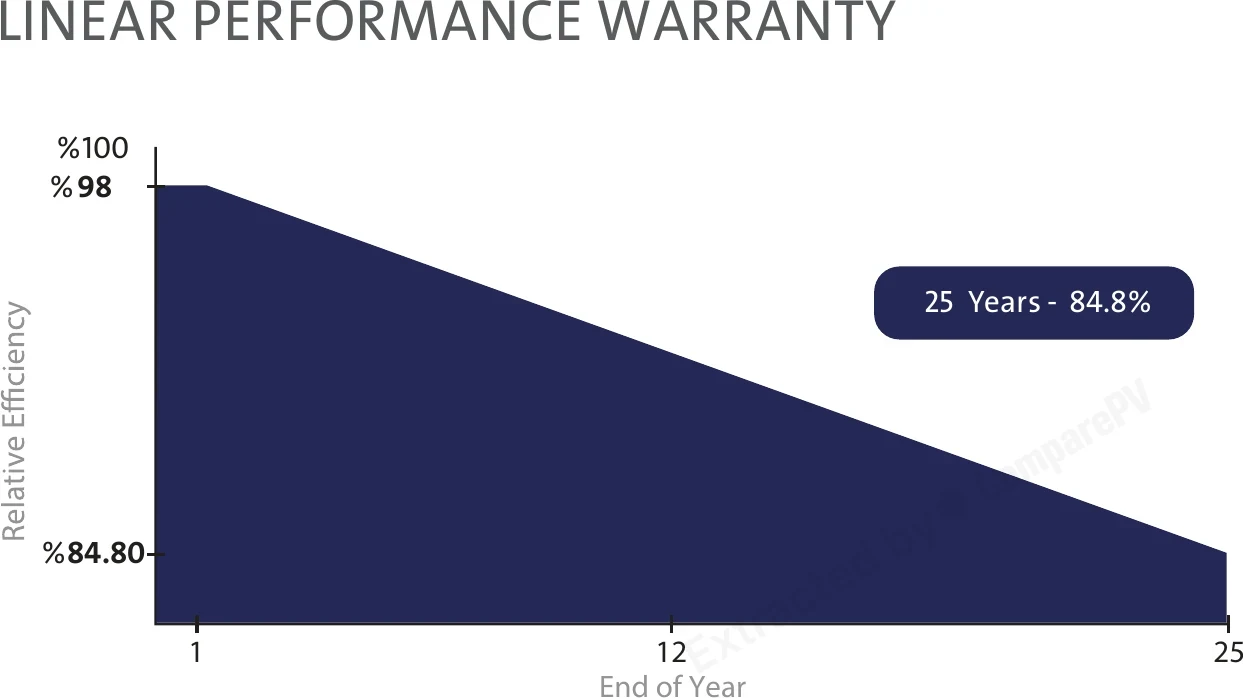
End-of-warranty output 84.8 % Equals 336 W guaranteed
Degradation 2.00 → 0.55 % First year, then annual

Datasheet charts

Open datasheet PDF

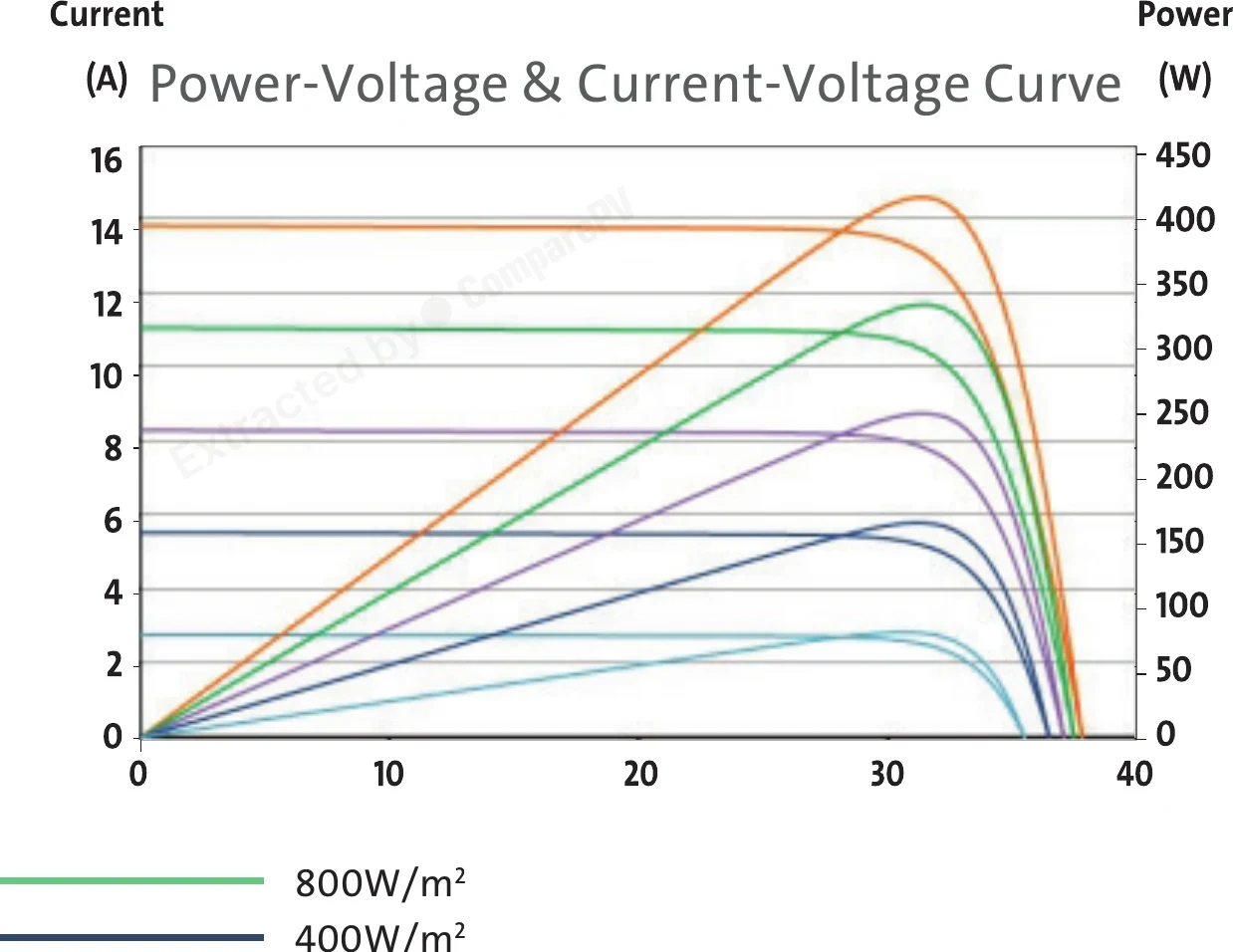
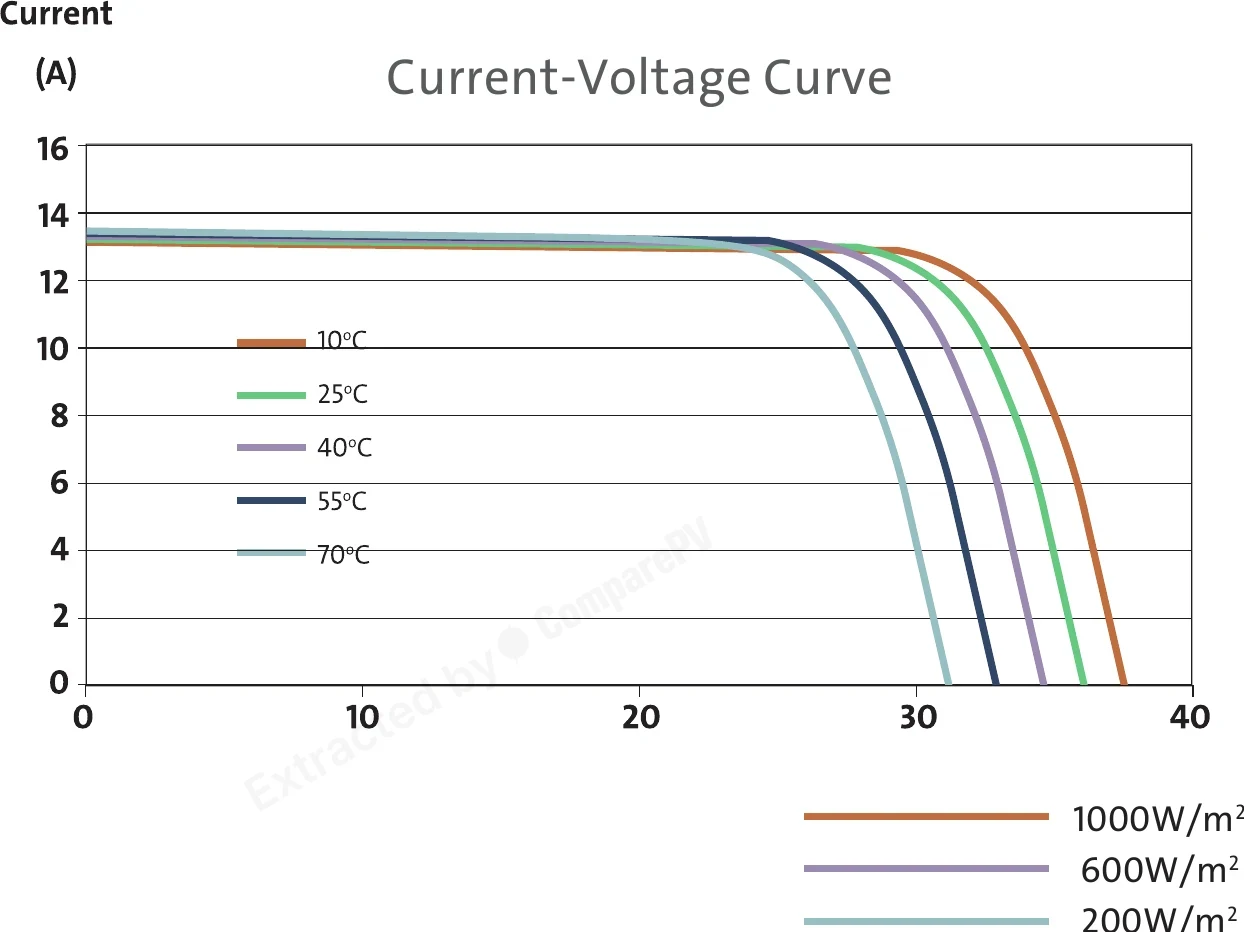
Measured curves published by Philadelphia Solar in this model's datasheet. A chart carrying a wattage was measured on that variant alone - only the ones that describe 410 Wp appear here. The rest cover the whole series.
Simulations

Live - change any input
Lifetime output & value
30 years at 1200 kWh/kWp/year and €0.50 per kWh
Power in year 30
-
Lifetime energy
-
Energy value
-

Degradation from this panel's own datasheet figures. No inverter, soiling or shading losses.

Heat losses
-0.300 %/°C against a segment median of -0.350
-
Filter these
Size
Panel Power Eff. Temp. Weight Difference
Philadelphia Solar PS-M108(HC)-410W 410 W 21.00% -0.300 20.5 kg You are here
AIKO-A460-MAH54Mb 460 W 23.60% -0.290 20.5 kg +50 W, +2.6 pp, +5 yr warranty
JST-EDMH-(445-465)W-TD (460W class) 460 W 23.56% -0.300 20.5 kg +50 W, +2.6 pp, +5 yr warranty
LX-460M/182R-96+ GG 460 W 23.55% -0.260 23.5 kg +50 W, +2.6 pp, +5 yr warranty
PS-MNB108(HCBF)-460W 460 W 23.53% -0.290 20.5 kg +50 W, +2.5 pp, +5 yr warranty
JAT54S40-460/LR 460 W 23.50% -0.260 19.3 kg +50 W, +2.5 pp, +5 yr warranty
LX-460M/182R188-108+ GG 460 W 23.35% -0.290 24.5 kg +50 W, +2.4 pp, +5 yr warranty
AIKO-455-MAH54Db 455 W 23.30% -0.260 24.0 kg +45 W, +2.3 pp, +5 yr warranty
LR5-54HTH-455M 455 W 23.30% -0.290 20.8 kg +45 W, cooler, +2.3 pp
PS-M108(HC)-400W 400 W 20.50% -0.300 20.5 kg -10 W, -0.5 pp
PS-M108(HC)-405W 405 W 20.80% -0.300 20.5 kg Very close match
PS-MNB108(HCBF)-425W 425 W 21.80% -0.290 20.5 kg +15 W, +0.8 pp, +5 yr warranty
PS-MNB108(HCBF)-430W 430 W 22.05% -0.290 20.5 kg +20 W, +1.1 pp, +5 yr warranty
PS-MNB108(HCBF)-435W 435 W 22.31% -0.290 20.5 kg +25 W, +1.3 pp, +5 yr warranty
PS-MNB108(HCBF)-440W 440 W 22.57% -0.290 20.5 kg +30 W, +1.6 pp, +5 yr warranty
JKM510T-48HL6M-DB 510 W 25.52% -0.240 22.0 kg +100 W, cooler, +4.5 pp
JKM505T-48HL6M-DB 505 W 25.27% -0.240 22.0 kg +95 W, cooler, +4.3 pp

Found 1839 panels of the same or similar size to this one, within ±10 mm. See them here Found 1970 panels of the same or similar size to this one, within ±25 mm. See them here Found 3497 panels of the same or similar size to this one, within ±50 mm. See them here Found 4133 panels of the same or similar size to this one, within ±100 mm. See them here

About the Black Iris Mono series

6 answered

These answers cover the whole series. Where a figure differs, the specification above is this module's own.

What is the maximum power output of the Black Iris Mono panel and is it enough to power a single-family home?
Black Iris Mono series panels reach a maximum power output of 410 Wp. An installation of about 15-20 modules (roughly 6-8 kWp) covers the typical energy demand of a 100-150 m2 single-family home, depending on electricity usage and location.
Are Black Iris Mono panels suitable for a pitched residential roof?
Yes, the series is specifically designed for residential roofs. The module's low weight makes installation easier on rafters with limited load capacity, and the uniform black front with an anodized black frame blends visually with the roof covering, which matters to investors focused on facade aesthetics.
How do half-cut cells with 10 busbars differ from classic 5BB panels?
Splitting cells in half (half-cut) using Mono PERC technology with 10 busbars significantly reduces the risk of microcracks during transport and installation compared to classic 5BB modules. This design also improves temperature coefficients, so the panel loses less power on hot days than older-generation modules.
What warranty comes with Black Iris Mono panels and what is the annual power degradation rate?
Philadelphia Solar backs the Black Iris Mono series with a 25-year linear power warranty and a 25-year product warranty. Annual output degradation is only -0.55%, ensuring predictable and high energy yield throughout the entire lifespan of the installation.
Are Black Iris Mono panels resistant to PID degradation and harsh weather conditions?
Yes, the series features high resistance to potential induced degradation (PID), preventing unexpected power loss over time. The reinforced mechanical construction allows the modules to operate safely under heavy snow load and strong wind conditions.
Who manufactures the Black Iris Mono panels and is it a Tier 1 producer?
The Black Iris Mono series is manufactured by Philadelphia Solar, headquartered in Jordan and classified as a Tier 1 manufacturer, indicating strong financial stability and bankability. The panels are non-bifacial, generating power only from the front side of the module.
Add to compare