Middle of its segment, short guarantee
Photovoltaic panels from the Panasonic HIT N340 and N335 series utilize advanced heterojunction technology (HIT), which combines the advantages of monocrystalline silicon with amorphous layers. This solution effectively eliminates energy losses typical of traditional modules, ensuring the highest efficiency even with very limited installation space. A key distinguishing feature of this series is the low temperature coefficient, thanks to which the panels maintain high power generation on hot days, when competing products drastically lose efficiency. The innovative, pyramidal cell structure allows for more effective capture of diffused light, which translates into stable operation in the morning, evening, and during heavy cloud cover. An additional design advantage is the unique water drainage system in the frame corners, which prevents dust accumulation and the formation of permanent streaks that limit energy yields. This solution is primarily dedicated to demanding individual investors with complex roof geometries, where maximizing the yield from every square meter of the installation is what matters most. By choosing the HIT series, you gain exceptional resistance to degradation and longevity, which places these modules at the very forefront of the premium segment. Thanks to record power density, these panels solve the problem of space deficits, offering parameters unattainable for most standard silicon cells available on the market.
Ranking
Signals from the data
Residential and hot-climate.
Owners who want a long output guarantee, tight roof space and roofs where every square metre has to count.
Bottom 17% of the HJT 240-440 W segment, against a median of 30 yrs.
Bottom 23% of the HJT 240-440 W segment, against a median of 21.14%.
Bottom 23% of the HJT 240-440 W segment, against a median of 211.4.
The power temperature coefficient is -0.258%/°C, well below the typical -0.35% to -0.40%/°C seen in mono PERC modules. On hot days (above 25°C), HIT panels lose materially less power than silicon competitors, translating into higher annual energy yield in high-irradiance climates.
Combining monocrystalline silicon with thin amorphous layers reduces carrier recombination and enables 20-20.3% efficiency at relatively low process temperatures, which historically placed HIT at the forefront of PV technology before TOPCon became mainstream.
The bifacial design captures additional energy from reflected light on the rear side of the module, particularly beneficial when mounted on light-colored roof surfaces or ground-mounted arrays with adequate clearance.
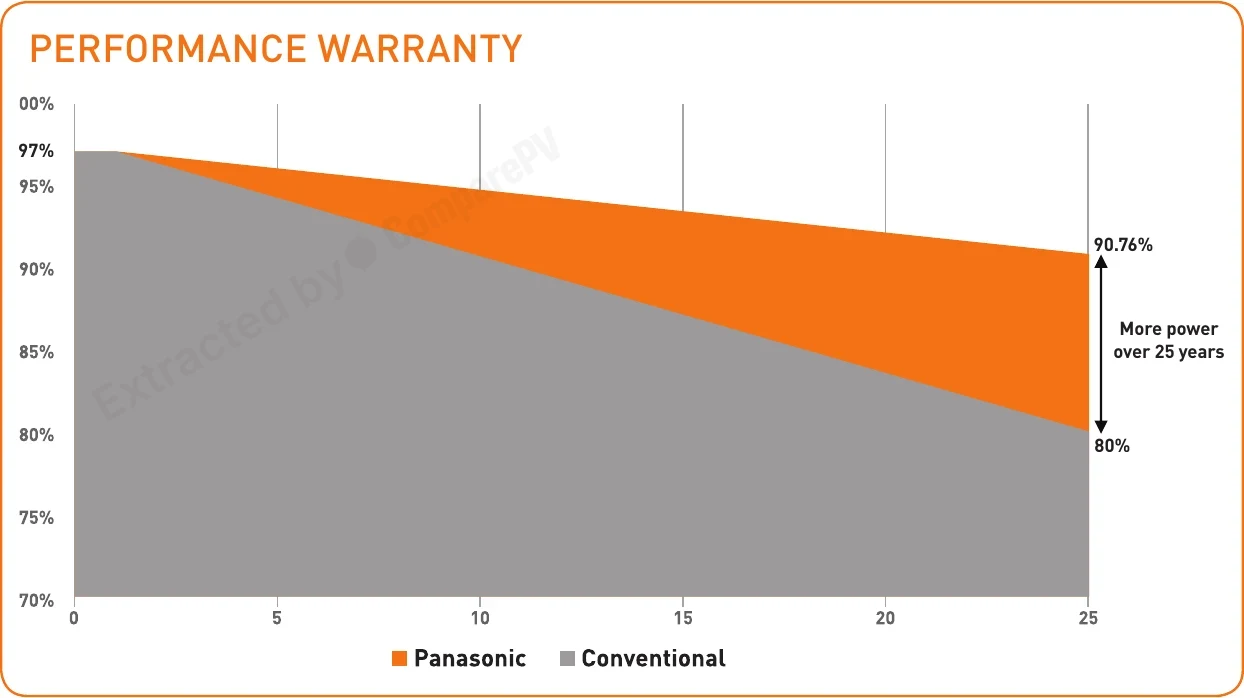
Panasonic guarantees both workmanship and power output for 25 years, with a guaranteed power level of approximately 86.2% at end of term - a full, symmetrical warranty package less common in the standard segment.
Panasonic, founded in 1918 in Japan, was long regarded as a Tier-1 manufacturer with rigorous quality control and a decades-long track record in the premium PV module segment.
Panasonic ceased in-house HIT module production by March 2022, and in April 2025 fully exited the solar and battery storage business. This means identical modules are unavailable for system expansion, and there is uncertainty around fulfilling service and warranty claims over the remaining 25-year term.
Despite a formal 25-year product and power warranty, Panasonic's complete withdrawal from the solar segment in 2025 creates risk for system owners regarding actual warranty enforceability in later years, particularly beyond 2030.
The maximum 20.3% efficiency is comparable to, and in some cases slightly lower than, current competitors in the same 340 Wp power class, e.g. Bruk-Bet NIVO EXTREME (20.32%) or Resun Solar RS6K-M (20.15%) - HIT's 2019-era technological edge has largely eroded with the rise of TOPCon.
- At 20.3% efficiency, this panel is on par with typical HJT 0-400W modules
- Power density of 203.1 W/m² is 3.3 W/m² below HJT 0-400W median (206.4 W/m²) - needs more roof space
- Temperature coefficient of -0.26%/°C matches the HJT 0-400W median
- Weight of 18.5 kg (3.0 kg below HJT 0-400W median of 21.5 kg) allows easier transport and roof mounting
- Ranked #11769 out of 14005 panels for efficiency in the database
Specifications
Datasheet charts
Measured curves published by Panasonic in this model's datasheet. A chart carrying a wattage was measured on that variant alone - only the ones that describe 340 Wp appear here. The rest cover the whole series.
Simulations
Degradation from this panel's own datasheet figures. No inverter, soiling or shading losses.






Found 8 panels of the same or similar size to this one, within ±10 mm. See them here Found 8 panels of the same or similar size to this one, within ±25 mm. See them here Found 8 panels of the same or similar size to this one, within ±50 mm. See them here Found 430 panels of the same or similar size to this one, within ±100 mm. See them here