Middle of its segment, short guarantee
Panasonic HIT N330/N325 photovoltaic panels are based on unique heterojunction technology (HIT), which effectively eliminates energy losses at the cell boundaries. By combining monocrystalline silicon layers with an ultra-thin amorphous layer, these modules offer significantly higher efficiency in real-world weather conditions than standard market solutions. Their key advantage is an exceptionally low temperature coefficient, which allows the panels to maintain high power generation even on hot summer days when traditional modules drastically lose their efficiency. This series solves the problem of limited roof space, allowing for the maximum amount of energy to be obtained from every available square meter of a prosumer installation. Additionally, the design features an innovative water drainage system at the frame corners, which prevents the accumulation of dirt and the formation of water stains, directly translating to higher self-consumption without the need for frequent surface cleaning. This is a premium-class solution dedicated to demanding investors who prioritize maximum reliability and operational stability for decades. By choosing the HIT series, the user invests in a product with a unique design that stands out from the competition with its excellent response to diffused light, guaranteeing efficient power production even under heavy cloud cover.
Ranking
Signals from the data
Residential and hot-climate.
Owners who want a long output guarantee, tight roof space and roofs where every square metre has to count.
Bottom 20% of the HJT 230-430 W segment, against a median of 30 yrs.
Bottom 22% of the HJT 230-430 W segment, against a median of 20.86%.
Bottom 22% of the HJT 230-430 W segment, against a median of 208.6.
The power temperature coefficient is -0.258%/°C, significantly better than the typical -0.35% to -0.45%/°C found in standard crystalline modules. Thanks to HJT technology, the panels lose less power on hot days, delivering higher real-world energy yield during summer.
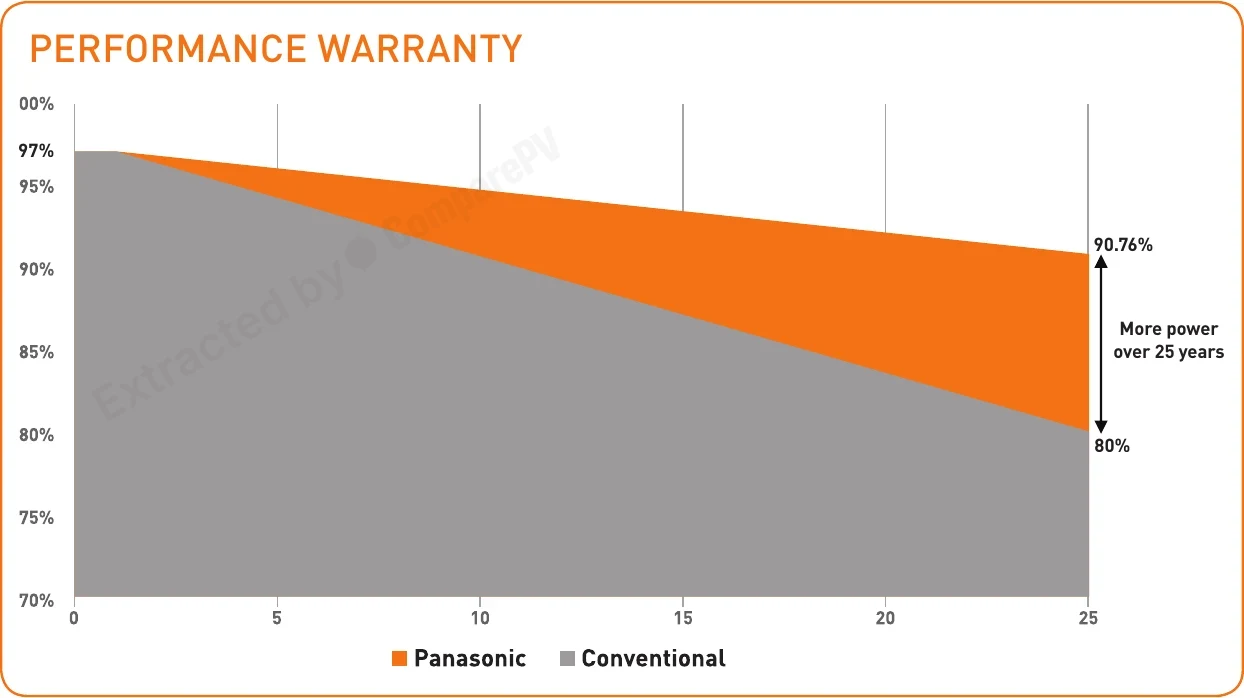
Panasonic provides 25 years of both product and power output warranty - a rarity in the market, where most manufacturers (including several peer comparables) offer only 10-15 years of product warranty alongside a 25-year power warranty.
Bifacial cells capture light reflected off the rear side of the module, generating additional energy without increasing the installation footprint - a notable advantage over monofacial modules in the same power class.
An innovative frame design channels water away from the module corners, reducing dirt buildup and streaking. This lowers the need for frequent cleaning and helps maintain higher self-consumption throughout the module's lifetime.
Panasonic (Japan, founded 1918) developed the world's first commercially available heterojunction (HJT) module in 1997. The legacy HIT line remains among the top-selling residential modules in the US market, underscoring the brand's lasting quality reputation.
Panasonic ceased HIT module production at its Japanese and Malaysian plants by March 2022, and fully exited the solar business by 2025. This means limited access to warranty service, replacement parts, and matching modules for system expansion.
Efficiency of 19.4-19.7% is clearly lower than newer TOPCon competitors - for example, JA Solar Monocrystalline80 reaches 23.15% at the same 330 Wp max power. This results in lower energy yield per roof area compared to current market offerings.
At 1590 x 1053 mm with 330 Wp max power, the module reflects an older wafer format, while modern panels reach 400-600+ Wp from a similar or smaller footprint. New installations would need more panels to reach the target system capacity.
- Efficiency of 19.7% is 0.9pp below the HJT 0-400W median (20.6%)
- 197.1 W/m² power density is 9.3 W/m² below HJT 0-400W median (206.4 W/m²) - requires larger installation area
- Temperature coefficient of -0.26%/°C matches the HJT 0-400W median
- Weight of 18.5 kg (3.0 kg below HJT 0-400W median of 21.5 kg) allows easier transport and roof mounting
- #12511 for efficiency, #466 for temperature performance out of 14005 panels
Specifications
Datasheet charts
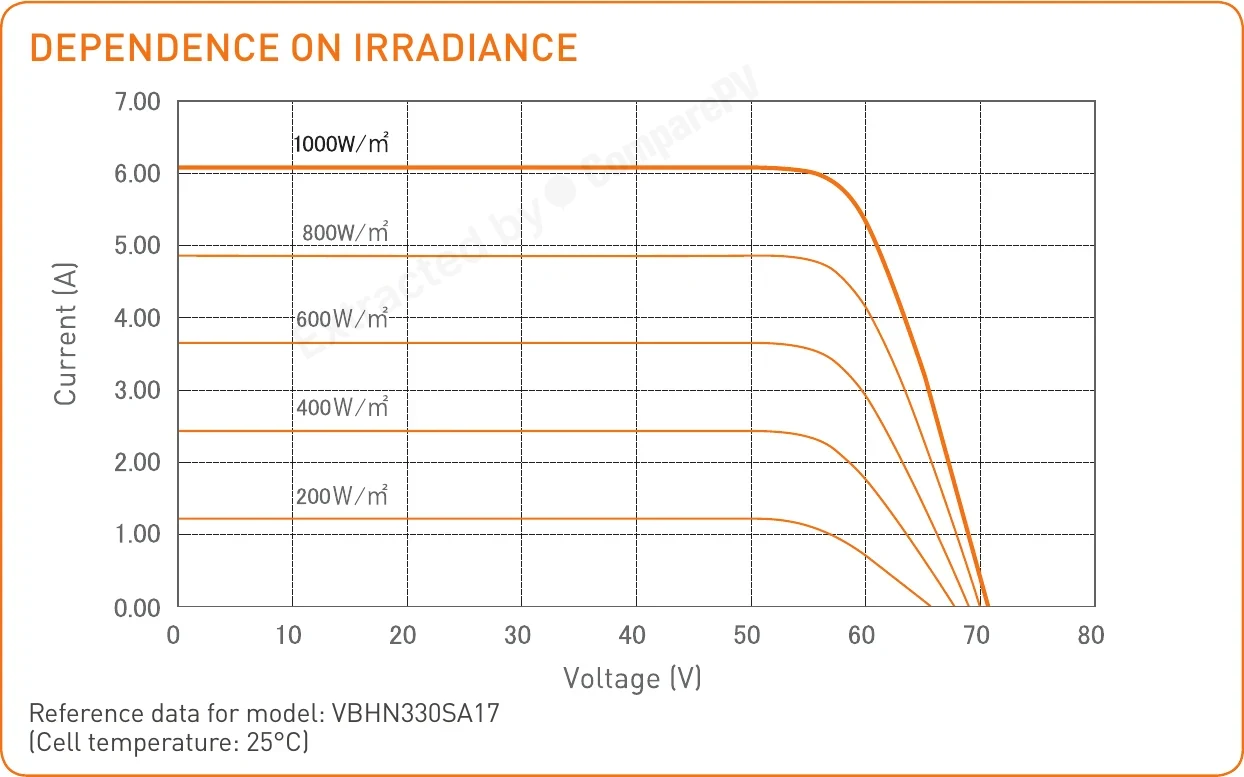
Measured curves published by Panasonic in this model's datasheet. A chart carrying a wattage was measured on that variant alone - only the ones that describe 330 Wp appear here. The rest cover the whole series.
Simulations
Degradation from this panel's own datasheet figures. No inverter, soiling or shading losses.







Found 8 panels of the same or similar size to this one, within ±10 mm. See them here Found 8 panels of the same or similar size to this one, within ±25 mm. See them here Found 8 panels of the same or similar size to this one, within ±50 mm. See them here Found 430 panels of the same or similar size to this one, within ±100 mm. See them here