EVPV370

370 Wp HJT
ComparePV verdict

Middle of its segment, weak in heat

Rank 10,799 of 14,005
Compare panels Datasheet PDF
Power (Wp)
370
Weak · bottom 24%
Efficiency (%)
21.20
Typical · median 20.90%
Density (Wp/m²)
211.6
Typical · median 209.3
Temp (%/°C)
-0.260
Weak · bottom 9%
Weight (kg)
19.5
Typical · median 22.8 kg
Warranty (yrs)
25
Weak · bottom 19%

Panasonic EverVolt series solar panels utilize advanced heterojunction cell technology (HJT), allowing for maximum efficiency even with limited roof space. This solution effectively eliminates the problem of power drop at high temperatures, as these modules feature one of the lowest temperature coefficients on the market. Thanks to the use of half-cut N-type cells, this series minimizes internal energy losses and exhibits exceptionally low degradation over time, guaranteeing stable yields for decades. EverVolt is an option for demanding homeowners looking for a balance between elegant aesthetics and the highest power output. A key differentiator is the comprehensive AllGuard warranty protection, which covers not only the product and linear performance but also labor costs, providing investors with an unprecedented sense of security. Compared to standard monocrystalline modules, this series delivers significantly more energy per square meter, making it an ideal choice for installations with difficult sun exposure. By choosing EverVolt, the user focuses on maximizing electricity self-consumption and reliability backed by years of experience in creating high-performance electronics, resulting in a faster return on investment in green energy.

Ranking

45 panels in the segment HJT 350-400 W
Metric This panel Median Position in segment Overall rank
Module efficiency 21.20% 20.90% Typical 9,076
Power density 211.6 209.3 Typical 9,189
Temperature coefficient -0.260 -0.259 Weak · bottom 9% 511
Weight per kWp 52.7 59.2 Typical 6,344
Performance warranty 25 yrs 30 yrs Weak · bottom 19% 9,798
Colour key Strong - top 25% Typical - middle 50% Weak - bottom 25%

Signals from the data

5 positive · 5 caution
Best for

Residential, hot-climate and shaded-installations.

Not ideal for

Hot climates and owners who want a long output guarantee.

Watch-outs
-0.260 %/°C temperature coefficient

Bottom 9% of the HJT 350-400 W segment, against a median of -0.259. Ranked 511th in the whole database.

25 year performance warranty

Bottom 19% of the HJT 350-400 W segment, against a median of 30 yrs.

What owners get
N-type HJT cell technology

Heterojunction (HJT) half-cut cells minimize internal power losses and show exceptionally low LID degradation compared to standard PERC cells, resulting in stable energy yields throughout the module's lifetime.

One of the industry's lowest temperature coefficients

The -0.26%/°C temperature coefficient is among the best in the industry, meaning less power loss on hot days compared to typical silicon modules with coefficients around -0.35% to -0.40%/°C.

Efficiency up to 21.7% - segment leader

Efficiency of 20.6-21.7% outperforms all comparable peer models: VDS-S120/M6H (20.8%), GKA166M120 (20.85%), and Heckert NeMo 3.0 120M (20%), delivering more energy from limited roof space.

25-year AllGuard warranty with labor coverage

The comprehensive AllGuard warranty provides 25 years of product and linear power coverage, and unlike typical manufacturer warranties, also covers service labor costs — a rare feature in the PV module market.

Decades of Tier-1 manufacturer experience

Panasonic has been an electronics manufacturer since 1918, and its Japanese manufacturing precision combined with a long-standing Tier-1 presence translates into high quality consistency across the EverVolt series.

Trade-offs
Production discontinued in 2025

Panasonic officially exited the EverVolt line on April 28, 2025, citing intense price competition from Chinese manufacturers. This means limited availability of modules for expanding existing installations and spare parts, though existing AllGuard warranties remain honored.

No bifacial technology

The EverVolt series is monofacial (is_bifacial: false), missing out on the potential 5-15% additional yield from rear-side gain available in competing bifacial modules increasingly used in ground-mount and elevated installations.

Higher cost of HJT technology

Heterojunction (HJT) cells traditionally carry a higher production cost per Wp than PERC or TOPCon technologies used in comparable peer models (Heckert NeMo 3.0, VDS-S120/M6H), and at a similar max power of 380 Wp, this price premium may not always be justified for a typical residential prosumer installation.

Notes from the database
  • At 21.2% efficiency, this panel is 0.6pp above typical HJT 0-400W modules (median: 20.6%)
  • At 211.6 W/m² power density, this panel generates 5.2 W/m² more per unit area than HJT 0-400W median (206.4 W/m²)
  • Temperature coefficient of -0.26%/°C matches the HJT 0-400W median
  • Weight of 19.5 kg (2.0 kg below HJT 0-400W median of 21.5 kg) allows easier transport and roof mounting
  • In the top 65% for efficiency among all HJT panels

Specifications

Open datasheet PDF
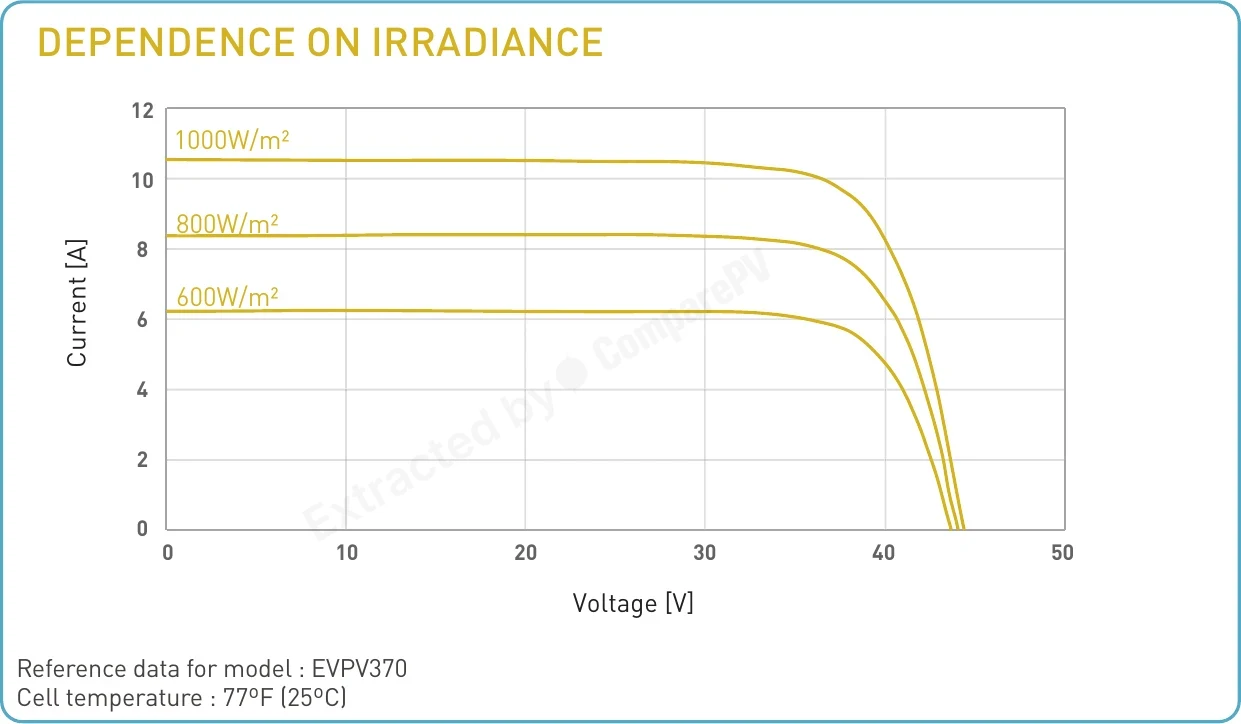
Nominal power (Pmax) 370 Wp Nameplate at 1000 W/m², 25 °C
Module efficiency 21.20 % Typical Segment median 20.90%
Vmpp · Impp 37.40 V · 9.90 A Operating point at max power
Voc · Isc 44.10 V · 10.55 A Sizes the string length
Max system voltage 1000 V Longer strings than 1000 V modules
Dimensions 1721×1016×30 mm · 1.75 m² of roof
Weight 19.5 kg Typical Typical · median 22.8 kg
Cells 120 · HJT Monocrystalline
Coefficient Pmax -0.260 %/°C Weak bottom 9% of its segment
Coefficient Voc · Isc -0.240 · 0.040 %/°C
NOCT 44 °C At 800 W/m², 20 °C ambient
Product warranty 25 years Hardware defects only
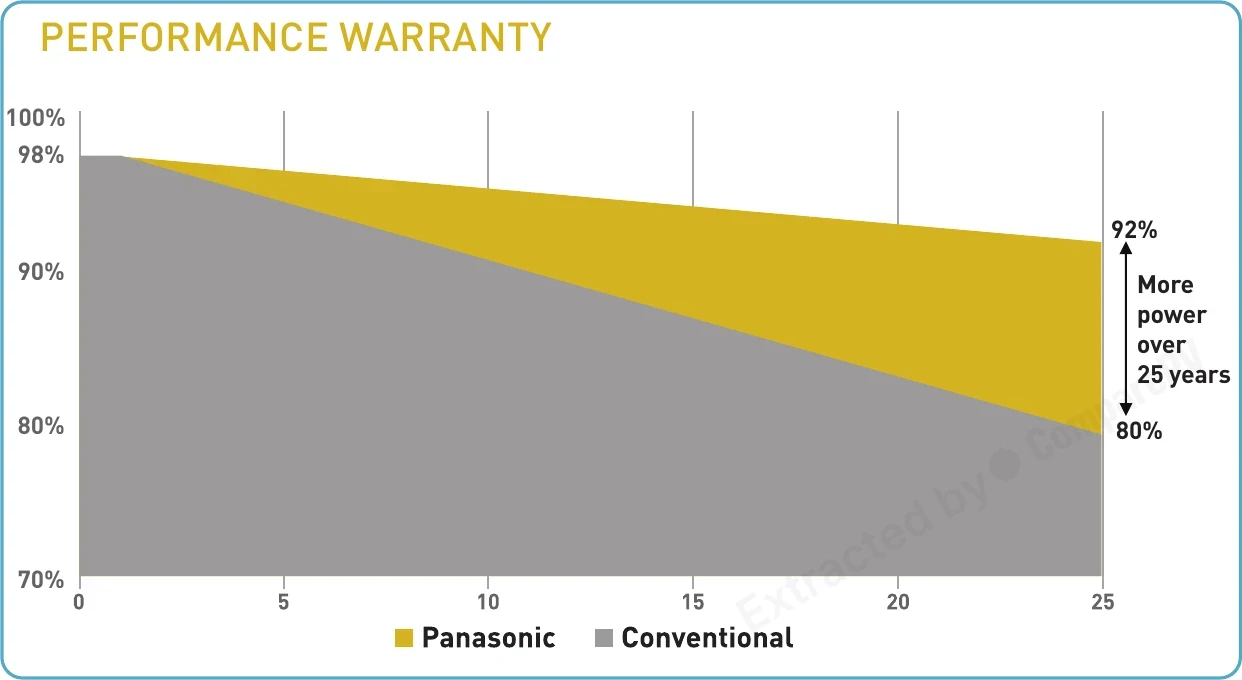
Performance warranty 25 years Weak bottom 19% · median 30 yrs
End-of-warranty output 92.0 % Equals 336 W guaranteed
Degradation 2.00 → 0.25 % First year, then annual

Datasheet charts

Open datasheet PDF

Measured curves published by Panasonic in this model's datasheet. A chart carrying a wattage was measured on that variant alone - only the ones that describe 370 Wp appear here. The rest cover the whole series.
Simulations

Live - change any input
Lifetime output & value
30 years at 1200 kWh/kWp/year and €0.50 per kWh
Power in year 30
-
Lifetime energy
-
Energy value
-

Degradation from this panel's own datasheet figures. No inverter, soiling or shading losses.

Heat losses
-0.260 %/°C against a segment median of -0.259
-
Filter these
Size
Panel Power Eff. Temp. Weight Difference
Panasonic EVPV370 370 W 21.20% -0.260 19.5 kg You are here
NS-330MH-80 330 W 23.15% -0.290 15.0 kg -40 W, lighter, +1.9 pp
GKA210M320W 320 W 23.00% - 16.2 kg -50 W, +1.8 pp, +5 yr warranty
GKA210M340W 340 W 23.00% - 16.2 kg Lighter, +1.8 pp, +5 yr warranty
GKA210M360W 360 W 23.00% - 16.2 kg Lighter, +1.8 pp, +5 yr warranty
GKA210M380W (1/4*4*38) 380 W 23.00% - 17.1 kg Lighter, +1.8 pp, +5 yr warranty
GKA210M400W (1/2*4*20) 400 W 23.00% - 18.0 kg +30 W, +1.8 pp, +5 yr warranty
GKA210M400W (1/4*4*40) 400 W 23.00% - 18.0 kg +30 W, +1.8 pp, +5 yr warranty
GKA210M380W (1/2*4*19) 380 W 23.00% - 17.1 kg Lighter, +1.8 pp, +5 yr warranty
SPR-MAX3-400-COM 400 W 22.60% -0.270 19.0 kg +30 W, +1.4 pp, +15 yr warranty
EVPV350K 350 W 20.00% -0.260 19.5 kg -20 W, -1.2 pp
EVPV360 360 W 20.60% -0.260 19.5 kg -10 W, -0.6 pp
EVPV380 380 W 21.70% -0.260 19.5 kg +10 W, +0.5 pp
JT440SYK(B) 440 W 22.90% -0.240 23.0 kg +70 W, +1.7 pp, +5 yr warranty
MS440N-DHBA 440 W 22.73% -0.290 22.0 kg +70 W, +1.5 pp, +5 yr warranty
JT435SYk(B) 435 W 22.70% -0.240 23.0 kg +65 W, +1.5 pp, +5 yr warranty

Found 6 panels of the same or similar size to this one, within ±10 mm. See them here Found 65 panels of the same or similar size to this one, within ±25 mm. See them here Found 443 panels of the same or similar size to this one, within ±50 mm. See them here Found 865 panels of the same or similar size to this one, within ±100 mm. See them here

Common questions

6 answered
Is the Panasonic EverVolt 370W series still available for purchase?
The Panasonic EverVolt EVPV370 series has been discontinued and replaced by newer HJT generations such as the HK2 lineup. Units may still be available from distributor stock, but availability is limited. Before ordering, confirm that the seller holds an active Panasonic Authorized Installer certification, as this is required to activate the full AllGuard warranty coverage.
What is HJT technology in the Panasonic EverVolt panels and why does it matter?
HJT (Heterojunction Technology) sandwiches thin amorphous silicon layers around an N-type monocrystalline wafer. The result is an industry-leading temperature coefficient of approximately -0.26%/°C, meaning the panel loses significantly less power on hot days compared to standard PERC modules. N-type cells are also virtually immune to LID and PID degradation, which ensures stable energy output throughout the full lifetime of the system.
What does the Panasonic EverVolt AllGuard warranty cover?
AllGuard is a 25-year warranty covering three areas: product defects (workmanship), linear power output (minimum 92% of rated power after 25 years), and labor costs for service calls. This means Panasonic covers not just module replacement but also the cost of the service crew. To activate full coverage, the system must be installed by a Panasonic Authorized Installer and registered within 90 days of installation.
How much energy will a 10-panel Panasonic EverVolt 370W system produce?
Ten EverVolt 370W modules deliver a combined peak power of 3,700 Wp. At average Central European irradiation of roughly 1,000–1,100 kWh/kWp per year, the system will generate 3,700–4,100 kWh annually, enough to cover 70–90% of a typical household's electricity consumption. The 21.2% module efficiency means this output is achieved from approximately 17.5 m² of roof area.
How do Panasonic EverVolt 370W panels perform in high summer temperatures?
Thanks to HJT technology and a temperature coefficient of -0.26%/°C, EverVolt modules lose considerably less power when heated than typical PERC panels rated at -0.35 to -0.40%/°C. At a cell temperature of 65°C, a common value on a hot summer noon, EverVolt loses roughly 10% of its rated power versus 15–16% for a standard PERC module. This translates into measurably higher energy yields during peak summer months.
Are Panasonic EverVolt 370W panels suitable for a pitched roof with partial shading?
Yes. The EverVolt 370W uses 120 half-cut N-type cells, splitting the module into two electrically independent halves. If a chimney, antenna, or dormer shades part of the panel, only that half is affected, not the entire module. Combined with an MPPT-equipped inverter, this makes the series a solid choice for pitched roofs with architectural obstructions where conventional full-cell panels would suffer more significant power losses.
Add to compare