
MS420N-HJTPB

420 Wp HJT Bifacial 95%
ComparePV verdict

Middle of its segment, modest efficiency

Rank 12,881 of 14,005
Compare panels Datasheet PDF
Power (Wp)
420
Weak · bottom 23%
Efficiency (%)
13.52
Weak · bottom 4%
Density (Wp/m²)
135.2
Weak · bottom 4%
Temp (%/°C)
-0.260
Weak · bottom 23%
Weight (kg)
33.8
Weak · 10.8 kg above median
Warranty (yrs)
30
Typical · median 30 yrs

The MY Solar HJT BIFACIAL BIPV solar panel series is a technological breakthrough that combines the highest efficiency of heterojunction cells with the aesthetics of building-integrated photovoltaics. Thanks to the use of N-type HJT cells, these modules completely eliminate negative light- and voltage-induced degradation phenomena, guaranteeing stable energy yields for decades. A key distinguishing feature is extremely high bifaciality exceeding 90%, which allows for generating additional power from the rear of the module, making it unrivaled in installations on light surfaces. The glass-glass construction provides not only increased mechanical resistance and fire safety, but also an elegant, modern appearance, ideal for applications such as building facades, terrace roofs, or carports. This series offers excellent low-light performance and the lowest temperature coefficient on the market, allowing the system to produce more energy on hot days compared to standard technologies. This is a product dedicated to investors whose priority is maximizing profitability from limited surface area while maintaining the highest architectural standards. By choosing this solution, you gain a unique combination of industrial durability and uncompromising efficiency that sets your installation apart from typical market solutions. It is an investment in future technology that redefines reliability standards in the Polish climate.

Ranking

113 panels in the segment HJT 400-450 W
Metric This panel Median Position in segment Overall rank
Module efficiency 13.52% 22.20% Weak · bottom 4% 13,948
Power density 135.2 221.6 Weak · bottom 4% 13,936
Temperature coefficient -0.260 -0.240 Weak · bottom 23% 511
Weight per kWp 80.5 52.4 Weak · bottom 8% 13,747
Performance warranty 30 yrs 30 yrs Typical 21
Colour key Strong - top 25% Typical - middle 50% Weak - bottom 25%

Signals from the data

4 positive · 5 caution
Not ideal for

Tight roof space, roofs where every square metre has to count and weight-limited structures.

Watch-outs
13.52% module efficiency

Bottom 4% of the HJT 400-450 W segment, against a median of 22.20%. Ranked 13,948th in the whole database.

135.2 watts per square metre

Bottom 4% of the HJT 400-450 W segment, against a median of 221.6. Ranked 13,936th in the whole database.

80.5 kg per kWp

Bottom 8% of the HJT 400-450 W segment, against a median of 52.4. Ranked 13,747th in the whole database.

What owners get
N-type HJT technology, no LID degradation

N-type HJT cells lack boron-oxygen bonds, eliminating light-induced degradation (LID) and limiting annual power degradation to approximately 0.25-0.35%, versus 0.5-0.8% for standard PERC cells.

Lowest temperature coefficient on the market

A power temperature coefficient of around -0.24%/°C, typical for HJT, is markedly lower than the -0.35% to -0.40%/°C seen in PERC panels (including peer comparables GCL, RedSolar, Jinko), translating into higher yields on hot days.

Extremely high bifaciality >90%

A bifaciality factor above 90% is significantly higher than the typical 70-85% found in standard bifacial modules, meaningfully increasing rear-side energy generation over bright, reflective ground surfaces.

30-year product and power warranty

The 30-year product and power warranty exceeds the market-standard 25 years typical of Tier-1 PERC/TOPCon modules, reflecting manufacturer confidence in the durability of the glass-glass HJT construction.

Trade-offs
Module efficiency well below peers

Efficiency of 12.88-13.52% is roughly 37-40% lower than comparable PERC modules (GCL, RedSolar, Jinko Solar) achieving 21.5-21.7% at the same 420 Wp power rating. Matching that output requires up to ~60% more panel area, undermining cost-effectiveness on space-constrained roofs.

Manufacturer not on Tier-1 list

Per the manufacturer_info field, MY Solar does not appear on the Tier-1 Bankable manufacturer list, which may complicate project bank financing or insurance requirements versus comparable offerings from Jinko Solar or GCL.

Notes from the database
  • Module efficiency of 13.5% is 8.7pp below average for HJT 400-450W panels (median: 22.2%)
  • 135.2 W/m² power density is 86.4 W/m² below HJT 400-450W median (221.6 W/m²) - requires larger installation area
  • At -0.26%/°C, loses 0.02pp more power per degree than HJT 400-450W median (-0.24%/°C)
  • Weight of 33.8 kg is 10.8 kg above HJT 400-450W median (23.0 kg) - verify structural support
  • Bifacial design (95% factor) captures reflected light - adds 5-14% yield on ground-mount or white roof

Specifications

Open datasheet PDF
Nominal power (Pmax) 420 Wp Nameplate at 1000 W/m², 25 °C
Module efficiency 13.52 % Weak Segment median 22.20%
Vmpp · Impp 24.85 V · 16.82 A Operating point at max power
Voc · Isc 30.22 V · 17.53 A Sizes the string length
Max system voltage 1500 V Longer strings than 1000 V modules
Dimensions 2384×1303×35 mm · 3.11 m² of roof
Weight 33.8 kg Weak Weak · 10.8 kg above median
Cells 80 · HJT Monocrystalline
Bifaciality 95 % Rear output as a share of front
Coefficient Pmax -0.260 %/°C Weak bottom 23% of its segment
Coefficient Voc · Isc -0.240 · 0.040 %/°C
NOCT 42 °C At 800 W/m², 20 °C ambient
Product warranty 30 years Hardware defects only
Performance warranty 30 years Typical median 30 yrs · median 30 yrs
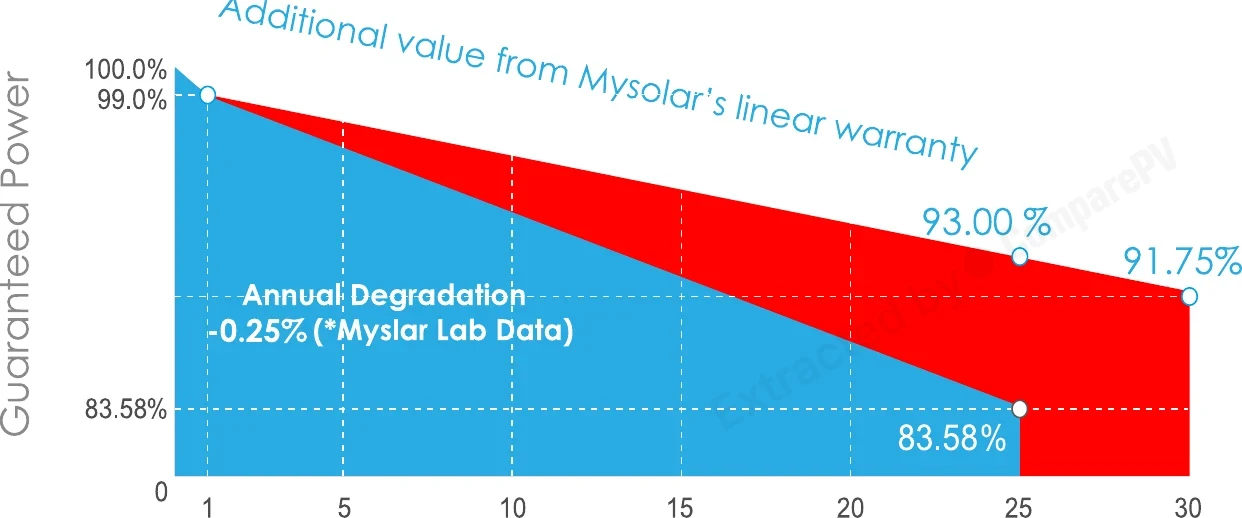
End-of-warranty output 91.8 % Equals 385 W guaranteed
Degradation 1.00 → 0.25 % First year, then annual

Datasheet charts

Open datasheet PDF

Measured curves published by MY Solar in this model's datasheet. A chart carrying a wattage was measured on that variant alone - only the ones that describe 420 Wp appear here. The rest cover the whole series.
Simulations

Live - change any input
Lifetime output & value
30 years at 1200 kWh/kWp/year and €0.50 per kWh
Power in year 30
-
Lifetime energy
-
Energy value
-
With bifacial gain
-

Degradation from this panel's own datasheet figures. No inverter, soiling or shading losses.

Heat losses
-0.260 %/°C against a segment median of -0.240
-
Bifacial gain
Rear gain over light concrete: -
-

Model: bifaciality × albedo × 0.6 view factor. A first-order estimate, not a yield simulation.

Alternatives

All MY Solar panels
Filter these
Size
Panel Power Eff. Temp. Weight Difference
MY Solar MS420N-HJTPB 420 W 13.52% -0.260 33.8 kg You are here
JST-EDMH-(445-465)W-TD (465W class) 465 W 23.81% -0.300 20.5 kg +45 W, lighter, +10.3 pp
LX-465M/182R-96+ GG 465 W 23.80% -0.260 23.5 kg +45 W, lighter, +10.3 pp
SPR-MAX7-470 470 W 23.70% -0.270 21.1 kg Lighter, +10.2 pp, +10 yr warranty
AIKO-A470-MAH54Mb 470 W 23.60% -0.260 21.5 kg +50 W, lighter, +10.1 pp
AIKO-A460-MAH54Mb 460 W 23.60% -0.290 20.5 kg +40 W, lighter, +10.1 pp
HSM-BD54-LA470 470 W 23.60% -0.260 21.5 kg +50 W, lighter, +10.1 pp
MS400N-HJTPB 400 W 12.88% -0.260 33.8 kg -20 W, -0.6 pp
MS405N-HJTPB 405 W 13.04% -0.260 33.8 kg -15 W, -0.5 pp
MS410N-HJTPB 410 W 13.20% -0.260 33.8 kg -10 W, -0.3 pp
MS415N-HJTPB 415 W 13.36% -0.260 33.8 kg Very close match
MS680N-DHBG 680 W 21.89% -0.300 38.5 kg +260 W, heavier, +8.4 pp
MS685N-DHBG 685 W 22.05% -0.300 38.5 kg +265 W, heavier, +8.5 pp
MS690N-DHBG 690 W 22.21% -0.300 38.5 kg +270 W, heavier, +8.7 pp
MS695N-DHBG 695 W 22.37% -0.300 38.5 kg +275 W, heavier, +8.9 pp
MS700N-DHBG 700 W 22.53% -0.300 38.5 kg +280 W, heavier, +9.0 pp
AIKO-A805-GRH78Dw 805 W 25.10% -0.260 39.8 kg +385 W, heavier, +11.6 pp

Found 1390 panels of the same or similar size to this one, within ±10 mm. See them here Found 1400 panels of the same or similar size to this one, within ±25 mm. See them here Found 1400 panels of the same or similar size to this one, within ±50 mm. See them here Found 1432 panels of the same or similar size to this one, within ±100 mm. See them here

Common questions

6 answered
What warranty does the MY Solar HJT BIFACIAL BIPV series come with and what does it cover?
The MY Solar HJT BIFACIAL BIPV series comes with a 30-year product warranty and a 30-year power output warranty. This means the manufacturer guarantees both the physical integrity of the module and the maintenance of its rated performance for three decades. Such an extended warranty is made possible by the durable glass-glass construction and N-type HJT cell technology, which eliminates LID and LETID degradation mechanisms common in conventional PERC modules.
Are MY Solar HJT BIFACIAL BIPV panels suitable for building facades or carport installations?
Yes, the HJT BIFACIAL BIPV series was specifically engineered for building-integrated photovoltaics (BIPV) applications. The glass-glass frameless construction gives the modules a clean, modern aesthetic that integrates well into building facades, terrace canopies, and carport structures. The absence of a plastic backsheet improves fire safety ratings, and the tempered glass layers provide the mechanical strength required for structural applications in architectural projects.
What does bifaciality above 90% mean for MY Solar HJT BIFACIAL panels and how much extra energy does it actually produce?
A bifaciality factor above 90% means the rear side of the module generates over 90% of the power produced by the front side under identical irradiance conditions. In real-world installations over light-colored surfaces — white gravel, pale concrete, or snow — this translates to a 10–25% increase in energy yield compared to a standard monofacial panel. This is among the highest bifaciality ratings available on the market for HJT technology, making it exceptionally competitive in ground-mounted and carport systems.
Do MY Solar HJT 420 Wp panels perform well during summer when temperatures exceed 35°C?
Yes. HJT technology features one of the lowest power temperature coefficients available, typically around -0.24 to -0.26%/°C. By comparison, standard PERC cells have a coefficient of approximately -0.35%/°C. This means that at 35°C an HJT module loses significantly less output than conventional panels, resulting in measurably higher energy yields on hot summer days — an important advantage in the Polish climate where summer heat waves are increasingly common.
How do MY Solar HJT BIFACIAL BIPV panels compare to popular N-type TOPCon modules and which should I choose?
Both technologies use N-type silicon and eliminate LID degradation, but HJT offers a lower temperature coefficient, higher bifaciality (above 90% vs. 70–85% for TOPCon), and better low-light performance. TOPCon modules are generally less expensive and more widely available from established Tier 1 manufacturers. The MY Solar HJT BIFACIAL BIPV series is the better choice for investors who prioritize maximum energy yield per square meter and architectural integration, and for whom LCOE over 30 years outweighs the higher initial cost per watt.
Is a 420 Wp output from MY Solar HJT BIFACIAL BIPV panels sufficient for a typical residential rooftop installation?
A 420 Wp module is a high-output unit well suited for residential pitched roofs. For a typical single-family home with an annual consumption of 4,000–5,000 kWh, approximately 10–14 panels are required depending on roof orientation and tilt angle. The high cell efficiency of HJT technology means this power is achieved in a smaller footprint than equivalent PERC modules, which is a key advantage on roofs with limited usable area or obstructions such as chimneys and roof windows.
Add to compare